Reporter's Notebook

Deep Archive
Show Newer Notes
Gerald Herbert / AP

Yesterday I wrote about the patriotic myth of “Paul Revere’s Ride,” recounted in Henry Wadsworth Longfellow’s famous 1861 poem.

Longfellow’s fellow Atlantic founder John Greenleaf Whittier put a similar, though less historically accurate, myth to paper in “Barbara Frietchie,” from our October 1863 issue. The poem—inspired, like Longfellow’s, by the abolitionist cause—tells the story of an elderly woman who refused to lower her American flag when Confederate forces marched through her Maryland town:

Forty flags with their silver stars,
Forty flags with their crimson bars,

Flapped in the morning wind: the sun
Of noon looked down, and saw not one.

Up rose old Barbara Frietchie then,
Bowed with her fourscore years and ten;

Bravest of all in Frederick town,
She took up the flag the men hauled down;

In her attic-window the staff she set,
To show that one heart was loyal yet.

Shortly after Whittier died in 1892, literary critic George Edward Woodberry celebrated him as an American myth-maker for the ages:

The length of his life carried him beyond his time. It is plainer now than it was at an earlier day that his poems are one of the living records of a past which will be of perennial interest and ever held in honor. …

In his … poems he had told the legends of the country, and winnowed its history for what was most heroic or romantic. … He had shared in the great moral passion of his people in peace and war, and had become its voice and been adopted as one of its memorable leaders.

In another eulogy, Atlantic co-founder Oliver Wendell Holmes had similarly effusive praise for Whittier’s moral impact:

Peaceful thy message, yet for struggling right, —
When Slavery’s gauntlet in our face was flung, —
While timid weaklings watched the dubious fight
No herald’s challenge more defiant rung. …

In the brave records of our earlier time
A hero’s deed thy generous soul inspired,
And many a legend, told in ringing rhyme
The youthful soul with high resolve has fired.

It’s strange reading through these old pieces now, because until I started digging into The Atlantic archives this year I had never heard of Barbara Frietchie, or of Whittier. Unlike “Paul Revere’s Ride,” this myth of American heroism never reached me, no matter how much Woodberry believed Whittier’s works would “be of perennial interest and ever held in honor.”

In 1999, parsing American verse for a sense of national identity, then poet-laureate Robert Pinsky noted the country’s lack of a common cultural foundation:

The nation developed with a relative scarcity of unifying folk culture—a single web of rhymes, songs, peasant tales, and superstitions passed down by grandparents. What we lacked in unity of that kind we made up for with richness and variety.

I’ve definitely heard a variety of stories, poems, and songs about American history—from the fable of George Washington and the cherry tree to “Paul Revere’s Ride” to, more recently, the musicalized life of Alexander Hamilton. And as I’ve moved from state to state and read deeper into the country’s history, I’ve constantly stumbled across new ones. Like “Barbara Frietchie.”

Though it’s disconcerting to see how the work Woodberry and Holmes believed to be so important and enduring could disappear into America’s web of cultural myths over time, Pinsky saw value in this variable understanding of our national past:

The greatness of our nation, then, may consist partly in its ability to thrive, to endure, and to evolve without certain marks of peoplehood. Indeed, a major, traditional American proposition has been that our greatness consists precisely in the fact that we are making it up as we go along—that we are perpetually in the process of devising ourselves as a people.

But he also asserted that “the supposed American lack of historical sense is itself in part a national myth or delusion,” because our culture is linked to a continuous thread of American memory.

“Deciding to remember, and what to remember, is how we decide who we are,” Pinsky concluded. This month I’m looking back on poetry I love in our archives. And today, for the first time, I’m taking a moment to remember Whittier and Barbara Frietchie.

* * *

Update from a reader, Marc:

Like you, I was completely unaware of this poem until today—but I've known Barbara Frietchie's name since I was quite small, because my parents were fans of Ogden Nash. Buried in one of our several collections of his verse (I won't call it “poetry” exactly), perhaps in “The Golden Trashery of Ogden Nashery,” was this bit of fun from Nash’s “The Scratch”:

I am greatly attached
To Barbara Frietchie—
I bet she scratched
When she was itchy.

Pulitzer Prize-winning author John Updike is best remembered for his insightful and richly descriptive novels and short stories about middle-class America. But he often applied his distinctive literary style to poetry as well, producing eight volumes of verse over the course of his lifetime. In his poetry, as in his prose, he had a talent for making everyday things seem beautiful and strange.

For instance, here’s a bit of Updike’s “Half Moon, Small Cloud”:

For what is the moon, that it haunts us,
this impudent companion immigrated
from the system’s less fortunate margins,
the realm of dust collected in orbs?

Read the full poem from our October 2006 issue here, and then take a look at some of Updike’s other poems in our archives.

Matthew Brady and Alexander Hesler / Library of Congress

In 1925, when The Atlantic first published “The Bear Hunt,” the editor’s preface remarked that Abraham Lincoln “neither wrote, nor attempted to write, much verse.” But what he did write ain’t half bad! There’s a reason why American poet Carl Sandburg took up Honest Abe as a muse.

To me, Lincoln’s most enchanting poems are the three-canto series he sent to his former Springfield neighbor, Andrew Johnston, in 1847. The first two—published together in Johnston’s Whig newspaper as “My Childhood Home I See Again” —were subtitled “Reflection” and “The Maniac.” These poems convey Lincoln’s early bout with melancholy, dealing with nostalgia and loss, fear and anguish—the pain of losing loved ones or one’s mind. (Lincoln even asked to remain anonymous as the author when he sent the third canto.) They moved me to contemplate the battle commemorations in my hometown of Gettysburg and to record Lincoln’s poems to original music.

But the final canto, published almost 80 years after the first two as “The Bear Hunt,” is jolly escapism—it’s most joyous when read aloud. The scene transports us to the woods, where a bear’s “short-lived fun” of preying on pigs is cut short as “man and horse, with dog and gun / For vengeance, at him fly.” We settle inside the bear’s mind for a minute as it runs through a thicket—where Lincoln even manages to drop a dog pun:

A sound of danger strikes his ear;
He gives the breeze a snuff;
Away he bounds, with little fear,
And seeks the tangled rough.

He then recruits an entire “merry corps” to fill the senses—as dogs “scent around,” horses throw riders, and “bang—bang! the rifles go!” I won’t spoil the ending, but a dispute mints this great Lincoln coinage:

But, who did this, and how to trace
What ’s true from what ’s a lie,—
Like lawyers in a murder case
They stoutly argufy.

The argument doesn’t end with a verdict, but you’ll have to read the full story to find out who wins “The Bear Hunt.”

It’s been lovely and warm in Washington, D.C., this week after some wetter, drearier days. In tribute to the beauty of springtime—even in the midst of melancholy—here’s a bit of Grace Schulman’s elegiac “Celebration,” from our May 2009 issue:

Seeing, in April, hostas unfurl like arias,
and tulips, white cups inscribed with licks of flame,
gaze feverish, grown almost to my waist,
and the oak raise new leaves for benediction,
I mourn for what does not come back

Read the full poem here.

Michael Dwyer / AP

The Civil War began on this day in 1861, when Confederate forces fired on Fort Sumter in South Carolina.

I grew up in northern California, far from the battlefields on which the conflict was fought. My local forerunners were Spanish explorers and gold seekers, not musket-wielding soldiers; the historical sites around me commemorated losses, celebrated victories, and acknowledged demons that had nothing to do with slavery or sectional conflict.

It wasn’t until I moved to Massachusetts six years ago that the Civil War began to feel close and real to me, and that I really began to grasp its complicated impact. The state abounds with mementos, from buildings and streets named after abolitionists to numberless memorials for lost soldiers and local heroes. The war, and the fierce political and moral disputes that led to it, are as physically present in and native to New England as they are absent from my California hometown.

It’s this tangible local legacy that Robert Lowell confronts in “For the Union Dead,” from our November 1960 issue. In the poem he considers one of Boston’s many tributes to the war, the Memorial to Robert Gould Shaw and the 54th Massachusetts Volunteer Infantry Regiment, which shows Shaw leading a troop of African American soldiers into battle:

Two months after marching through Boston,
half the regiment was dead;
at the dedication,
William James could almost hear the bronze Negroes breathe.

The monument sticks like a fishbone
in the city’s throat.
Its colonel is as lean
as a compass needle.

Unlike me, Lowell was born and raised among the memorials and mementos of Boston. In a 2001 column, Peter Davison described how Lowell’s own historical moment and lived experience of his native city shaped “For the Union Dead”:

In 1960 the Common was undergoing a typical twentieth-century exploitation, being plowed up by bulldozers to serve as the site for a cavernous underground garage. Few other poets would even have mentioned this enterprise, but Lowell perceived the building of the garage in a harsh and intimate light. He had, after all, been born only a stone’s throw away, across from the house of Julia Ward Howe at the top of Chestnut Street, some of the houses on which had been designed by Bulfinch himself. Was the Boston Common not the place where young Bobby had been taken to play as a child? In what light could the heroism of a Robert Gould Shaw be appreciated when after only a hundred years the cherished common ground of Boston’s, and Lowell’s, past was being transformed into a stable for machines? And how could an onlooker in 1960 assess the motto that Saint-Gaudens had inscribed upon his memorial sculpture (“Omnia Reliquit Servare Rem Publicam”), the Latin declaration that Colonel Shaw—only Colonel Shaw, not his martyred black soldiers—had given up everything to save the State?

In the poem, Lowell weaves these personal and historical influences into uncomfortable knots of interconnection. He ties the celebration of Shaw to Boston’s contentious civil-rights record; the remembrance of some tragedies to the dismissal of others; the destruction of one thing to the creation of something else from its disassembled parts.

The resulting work is at once a criticism and a commemoration, a reflection on history that’s inextricably, unabashedly bound to Lowell’s particular place, time, and personal experience. And, as our poetry editor David Barber wrote on the poem’s 50th birthday, that internal conflict has made it an enduring classic:

“For the Union Dead” is now as canonical as they come, an indisputable masterwork by an indispensable American poet. But its vast renown hardly begins to account for its staying power. Originally commissioned as the keynote to the Boston Arts Festival in June 1960, Lowell’s searching meditation on his native city’s freighted heritage stands as a paradigm for a poet rising to the occasion in every sense of the word. A serviceable piece of commemorative verse would have done the job, but what Lowell instead wrote on deadline seizes the day for the ages—an ode, a jeremiad, and a lamentation all in one, a poem that has lost none of its urgency and authority after all these years.

Shaw and his regiment are long dead now, as is Lowell, and the Boston Common of Lowell’s childhood has been broken down and reconstructed into something new. But the Robert Shaw Memorial is still there—one of the many tributes I found when I moved to Massachusetts. And Lowell’s poem persists, too, a memorial in its own right.

Dr. Anthony R. Picciolo / National Oceanic & Atmospheric Administration

The rich metaphors and descriptions in Derek Walcott’s poetry render the Caribbean world where he grew up almost tangible: the tropical ocean air; the warm beaches; the birds and sea creatures that populated the coasts—and the specter of colonialism, too, lingering on after the dissolution of centuries-long European control.

Saint Lucia, the island in the West Indies where the Nobel Prize-winning poet was born and raised, passed from French to British rule and back more than a dozen times between the 17th and 19th centuries. The island didn’t begin moving toward full independence from Britain until the late 1950s, when Walcott, then almost 30 years old, was just beginning his literary career.

That history looms large in poems like 2010’s “The Lost Empire,” in which Walcott explores the end of colonial control, and its legacy:

And then there was no more Empire all of a sudden.
Its victories were air, its dominions dirt:
Burma, Canada, Egypt, Africa, India, the Sudan.
The map that had seeped its stain on a schoolboy’s shirt
like red ink on a blotter, battles, long sieges.
Dhows and feluccas, hill stations, outposts, flags
fluttering down in the dusk, their golden aegis
went out with the sun

Read the full poem here to see more of Walcott’s world.

Edgard Garrido / Reuters

From our December 2003 issue, Kay Ryan’s “Hailstorm,” in its entirety:

Like a storm
of hornets, the
little white planets
layer and relayer
as they whip around
in their high orbits,
getting more and
more dense before
they crash against
our crust. A maelstrom
of ferocious little
fists and punches,
so hard to believe
once it’s past.

Like most of the two-term Poet Laureate’s verse, this poem is quick and strange. It offers a take on the world that’s appealing for its very spareness and ungracefulness—for the way it disregards expansive narratives and literary stylings to interrogate the peculiar essence of things.

Ryan’s poems are short but dense with this insight and, often, with sharp, dry wit and quirky rhymes as well. To get a fuller sense of her distinctive voice, you can read 1993’s “This Life” and “Emptiness” and 1998’s “Among English Verbs.”

Theodore Roethke “may have been the maddest poet of his generation,” as Peter Davison wrote in 1965’s “Madness in the New Poetry.” But, Davison adds,

Whatever Roethke’s disordered imagination did to him, it endowed his poems with nothing but intensity … Madness in Roethke’s poetry is accepted as part of reality; but it is accepted, and through the devices and desires of art, vanquished.

That intensity, and madness, is evident in “The Dance,” from our November 1952 issue:

I tried to fling my shadow at the moon,
The while my blood leaped with a wordless song.
Though dancing needs a master, I had none
To teach my toes to listen to my tongue.
But what I learned there, dancing all alone,
Was not the joyless motion of a stone.

To delve further into Roethke’s disordered imagination, read the full poem, and then see what authors Thomas Pierce and Jim Harrison had to say about Roethke poems that spoke to them.

Library of Congress

In “The Lesson,” from our October 2003 issue, Pulitzer Prize-winning poet Philip Levine imagines a conversation with a sage, cigarette-smoking doctor against an industrial backdrop. At one point, the poem’s speaker recalls his birth into this setting:

Years before, before the invention of smog,
before Fluid Drive, the eight-hour day,
the iron lung, I’d come into the world
in a shower of industrial filth raining
from the bruised sky above Detroit.

As he does here, Levine often returned in his poetry to the working-class Detroit of his childhood. Of the way he portrayed this world in verse, our former poetry editor Peter Davison wrote in 1999:

If Walt Whitman’s vision contained multitudes, and if Emerson’s vision of nature transcended what it saw with its own eyes, Levine’s poetic vision, nearly religious, transcends class, transcends natural boundaries, and transcends time. …

Philip Levine’s vision of the American city may on its surface appear grim, yet there are always flowers blooming in the empty lots and along the half-deserted avenues. Poets are enabled to notice such things.

You can see more of Levine’s vision in 1997’s “The New World” and in an interview he gave in April 1999.

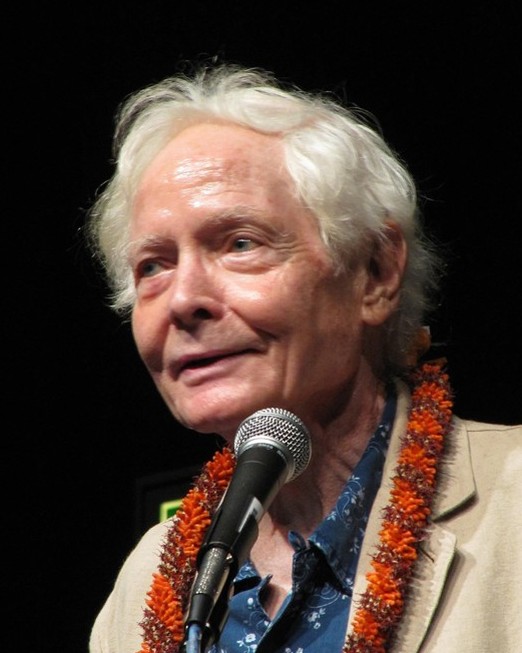
In his poetry, W. S. Merwin draws on Buddhist philosophy and its profound respect for the inherent worth of all living things. As The Atlantic’s then-poetry editor Peter Davison wrote in 1997, the two-time Pulitzer Prize–winner and former U.S. Poet Laureate

Audrey McAvoy / AP

… is not only profoundly anti-imperialist, pacifist, and environmentalist, but also possessed by an intimate feeling for landscape and language and the ways in which land and language interflow. … The intentions of Merwin’s poetry are as broad as the biosphere yet as intimate as a whisper. He conveys in the sweet simplicity of grounded language a sense of the self where it belongs, floating between heaven, earth, and underground.

From our February 1995 issue, his poem “Green Fields”:

Peter with his gaunt cheeks
     and point of white beard the face of an aged Lawrence
Peter who had lived on from another time and country
     and who had seen so many things set out and vanish
still believed in heaven and said he had never once
     doubted it since his childhood on the farm

Read the full poem here, and go here to explore the language and landscapes of some of his other work.

Ralph Waldo Emerson's study Benjamin F. Mills / Library of Congress

In “Emerson,” composed in 1868 and published posthumously in our December 1904 issue, theologian Henry James Sr. reflected on the distinct impression Ralph Waldo Emerson made upon his readers:

No writer so quickens the pulse of generous youth; so makes his brain throb and reel with the vision of the world that is yet to be. … Mr. Emerson was never the least of a pedagogue, addressing your scientific intelligence, but an every way unconscious prophet, appealing exclusively to the regenerate heart of mankind, and announcing the speedy fulfilment of the hope with which it had always been pregnant.

Library of Congress

Emerson applied his impassioned insight to a variety of topics in The Atlantic, but maybe most notably to the questions of freedom and equality at the heart of the Civil War.

In 1863’s “Boston Hymn,” Emerson connected the fight against slavery to the virtuous founding ideals of his home city, and of America as a whole. Narrated by God, the poem characterizes abolitionism as divine and honorable:

And ye shall succor men;
’T is nobleness to serve;
Help them who cannot help again;
Beware from right to swerve.

I break your bonds and masterships,
And I unchain the slave:
Free be his heart and hand henceforth,
As wind and wandering wave.

Emerson first read the poem publicly on January 1, 1863, in honor of the Emancipation Proclamation that President Lincoln had issued just hours earlier.

It wasn’t the first time he’d paid such tribute: In “The President’s Proclamation,” published in November 1862 in anticipation of Lincoln’s official order, Emerson wrote about the coming proclamation at greater length and in his own voice. The article, like “Boston Hymn,” provides a ringing endorsement for emancipation:

The force of the act is that it commits the country to this justice,—that it compels the innumerable officers, civil, military, naval, of the Republic to range themselves on the line of this equity. … This act makes that the lives of our heroes have not been sacrificed in vain. It makes a victory of our defeats. Our hurts are healed; the health of the nation is repaired. With a victory like this, we can stand many disasters. It does not promise the redemption of the black race: that lies not with us: but it relieves it of our opposition.

Earlier the same year, Emerson had similarly espoused his support for abolition, and for President Lincoln’s efforts to further it, in “American Civilization”:

Well, now here comes this conspiracy of slavery, — they call it an institution, I call it a destitution, — this stealing of men and setting them to work, — stealing their labor, and the thief sitting idle himself; and for two or three ages it has lasted, and has yielded a certain quantity of rice, cotton, and sugar.  … In this national crisis, it is not argument that we want, but that rare courage which dares commit itself to a principle. … We want men of original perception and original action, who can open their eyes wider than to a nationality, namely, to considerations of benefit to the human race, can act in the interest of civilization.

As James observed, each of these writings is fervently hopeful and full of heart. From the midst of the Civil War, Emerson offered a righteous indictment of slavery and a vision of an America that was more moral, more equal, and more true to the principles of its founders.

Emerson sees this America clearly. In these lines, you can see it too.

In a 1999 interview with The Atlantic, Richard Wilbur—the two-time Pulitzer Prize–winner and former U.S. Poet Laureate—spoke about perfection, translation, and what interviewer Peter Davison referred to as his “lifetime in poetry.” Asked how he was grateful to poetry, Wilbur responded:

I … enjoy being able to do something with the important feelings of my life. I think that to be inarticulate can be a great suffering, and I’m glad that my loves, and my other feelings, have sometimes found their way into poems that fully express them.

From our November 1958 issue, his poem “She,” in which he conjures an ethereal, shape-shifting female spirit:

Tree, temple, valley, prow, gazelle, machine,
More named and nameless than the morning star,
Lovely in every shape, in all unseen,
We dare not wish to find you as you are

Read the full poem here, and go here to discover more of Wilbur’s numerous contributions to The Atlantic—and, perhaps, some of the important feelings of his life.

More Notes From The Atlantic
  • Notes Home