Reporter's Notebook

American Futures
Show Newer Notes
A cowboy with his herd in Maine, en route to Turkey. courtesy Quoddy Tides

Last night my wife Deb put up a report called “Little Town, Big Art.” It’s about how a surprisingly ambitious effort in The Arts—painting, sculpture, photography, drama, music, festivals (like the Pirate Festival underway this weekend), etc.—had given a very small place a much larger economic and cultural presence than it would otherwise have.

Here is a follow-up note on a less artsy aspect of that same place, Eastport, Maine. As I mentioned in this item, “The World Comes to a Tiny Town,” one of the ways in which this part of Down East Maine was connected to the world was by shipping pregnant cows across the Atlantic, mainly to Turkey. That business has become yet another casualty of the horrific warfare in Syria and its spillover effects into Turkey.

Bob Godfrey of Eastport, one of whose careers has been as a photographer, sends an email about the kind of surprise the pregnant cattle brought to his town:

In my Indiana photography business my largest client was an animal pharmaceutical company. As a result, I did a lot of photography of cattle. Little did I know that in Eastport tens of thousands of head of cattle would pass through this tiny place.

One day a couple of years ago I was having coffee, facing the window at the Happy Crab, when I noticed a black Angus running past the library! I was not drinking Irish coffee.

A cowboy showed up at the shore walk next to the WaCo Diner, threw the cow, and hogtied it. Several men rolled the animal onto a pallet, a fork lift raised the pallet onto a flatbed trailer, and the critter was trucked back to the port.

Apparently, even cattle can have second thoughts about crossing the ocean.

His note was titled “the Reluctant Bovine Sailor.” No larger point, just part of the surprises of our vast country—and a reason to point again to Deb’s new piece. Good wishes to Eastporters for this weekend’s Pirate Festival.

The cow’s intended getaway route, past the Peavey Library at the left. (James Fallows)

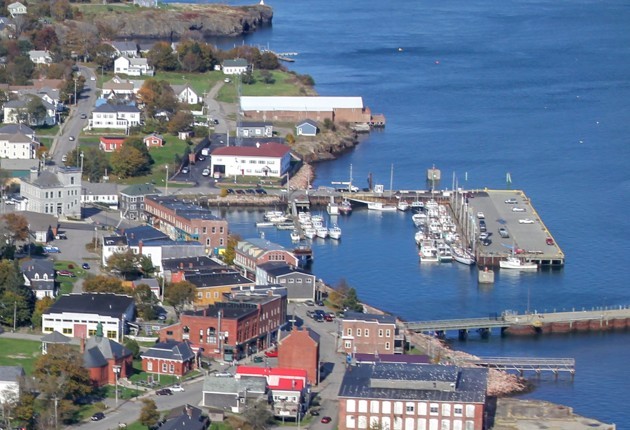
Downtown Eastport, from above, on our previous visit James Fallows

Early in 2014, I wrote a magazine article about the 1,300 residents of Eastport, Maine, with the title “The Little Town That Might.” The theme was that this tiny settlement, on the farthest extreme of Down East Maine just one mile across a strait from Canada’s famous Campobello Island, was trying in every conceivable way to invent a viable economic and cultural future for itself.

It had invested heavily in its very deep-water port (because of the Maine fjords, it is the deepest on the U.S. Atlantic coast) to handle shipments to customers around the world. It was making itself into an arts and tourism center, including whale-watching and other eco-tourism activities along its spectacular coast.

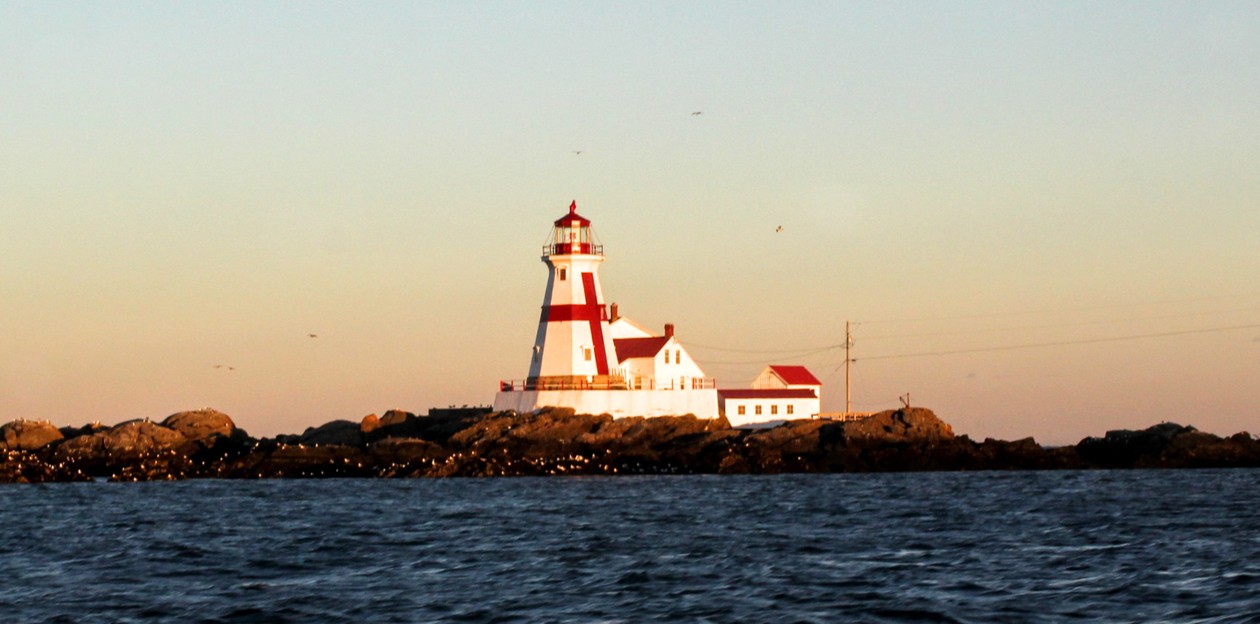
Head Harbour Light, at the far eastern tip of Campobello Island near Eastport (James Fallows)

It was becoming a major salmon-farming locale, in addition to its lobster and scallop industries. An indefatigable group of local citizens pursued plans to redevelop beautiful-but-tattered buildings downtown. And on through a list that you can read about in that article and a number of accompanying posts.

***

There was one more element in the portfolio of Eastport ambitions: a plan to generate electricity from the powerful currents of its Passamaquoddy and Cobscook Bays, which feed into the adjoining and famously tidal Bay of Fundy.

Even before he became president, Franklin Roosevelt—who knew the area from childhood visits to the family summer home on Campobello—had endorsed creating tidal-power systems in Eastport and nearby Lubec. As president he authorized WPA funding for the dams and power plants that would constitute the Passamaquoddy Bay Tidal Power Project. Congressional opponents stopped the funding before the project was complete. But the dams and dikes are still there, along with some of the houses the WPA had built, which then were used for a youth job-training center, and as military housing during World War II.

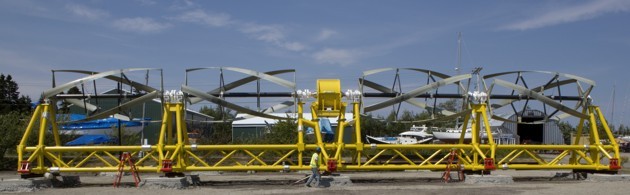
Of course the tides are still there too, and in Eastport a group called the Ocean Renewable Power Company (ORPC) has been testing huge undersea turbines, like the one shown below, to generate low-cost renewable power from the tidal flow.

Turbine Generator Unit (TGU) from Ocean Renewable Power Company. The turbines, which are made of composite materials to resist corrosion, turn like paddlewheels to generate electricity. Because water is 800 times denser than air, they can capture proportionally more energy than similar turbines in the wind. (ORPC photo)

When we first visited Eastport, these big turbines and the yellow frames with which they were anchored to the seabed were out in dry dock, to be inspected after their long trial run in the water. Since then ORPC has been testing its components in Maine, Alaska, and elsewhere. The purpose of the tests, I was told today in a phone call with Bob Lewis, ORPC’s Director of Operations and Chief Safety Officer, was to refine engineering issues rather than to resolve any fundamental conceptual or scientific questions. The company has also been running extensive tests to ensure coexistence with salmon and other wildlife in their areas.

ORPC’s floating TidGen system (ORPC)
Two days ago, just as we were leaving Eastport after our latest visit, the U.S. Department of Energy announced that ORPC had won a $5.3 million grant (as part of a larger $20 million program) to support its latest “TidGen” project for MHK (marine and hydro-kinetic) energy. This new project differs in floating at the top of fast-moving water, rather than being anchored on the seabed. (The schematic at right shows the floating model.) “This allows placement in the most advantageous water column,” Bob Lewis told me. As a joint statement from Maine’s senators, Republican Susan Collins and Independent Angus King, said:

The grant is intended to help ORPC improve the performance and commercialize its TidGen® Power System by integrating several advanced component technologies.  This project, which is based on 11 previous in-water deployments, will integrate improvements into a commercially viable and certified tidal power system.

The device’s novel floating design will move the turbine near the surface to capture higher flow velocities and will help reduce the cost of installation and on-water operations, ultimately lowering the cost of energy.

This is the way the cleaner-energy revolution is happening around the world: project by project, improvement by improvement, small engineering refinements amounting to significant steps forward in practicality.

***

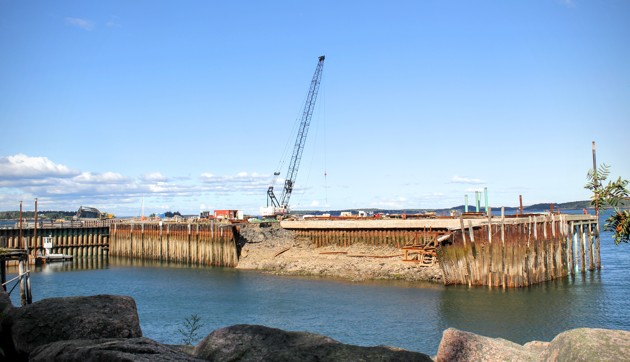
There’s more going on, for both better and worse, in Eastport, as we’ll try to explain in upcoming reports—intertwined with more from Erie, Pennsylvania, and Dodge City, Kansas. The picture at the very top of this post is a pointer to one of the things that has gone worse for Eastport. In that opening photo, you see a breakwater and pier that had been important parts of Eastport’s economy and its culture. A mooring site for visiting cruise ships; protection for local boats; even a site for day fishing—that was what the breakwater meant:

The breakwater in Eastport, as of two years ago (James Fallows)

In December 2014, just as Eastport had decided to authorize repairs for the breakwater, it suddenly collapsed, damaging many boats and closing this part of the harbor. When we visited last week, repairs were still underway:

The breakwater in Eastport undergoing repairs, a year and a half after it gave way (James Fallows)

The goal is to open again by the beginning of next summer’s season—for anglers, for pleasure craft, for cruise ships, and for the normal life of the port. More ahead, on the successes and setbacks of cities like Eastport, but for the moment we’re glad to know of this good news for ORPC.

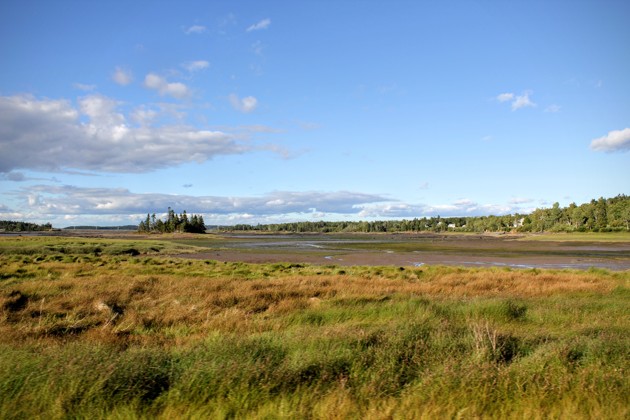
Tidal lands that would have been part of the New Deal-era Quoddy Tidal Power plan. (James Fallows)
Eastport, Maine, "the little town that might," where we're back for a return look at a city trying to remake itself. James Fallows

My wife Deb and I are on the road again this week, but as a reminder of the ongoing theme:

  • People across the country are aware of the serious economic, political, cultural, social, public-health, infrastructure, environmental, and other problems of contemporary America during this Second Gilded Age;  but
  • in most parts of the country, the possibility of dealing with those problems seems closer at hand, and more encouraging, than it does in national politics.

Updates for today:

1. Syrian Refugees in Erie. Two weeks ago, Donald Trump gave a big, angry speech in Erie, Pennsylvania, about the economic decline of the area and the threat posed in particular by Syrian refugees. Just after that, Deb spent time with a Syrian refugee family in Erie. You can read her report here.

The more we have traveled in parts of America that are actively undergoing ethnic and cultural change—whether western Kansas with its Latino immigrants, or South Dakota with its refugee arrivals, or Allentown, Pennsylvania, as it shifts from Pennsylvania Dutch to Latino, or Holland, Michigan, as it shifts from Dutch-Dutch to a more varied population—the more frequently we have witnessed the ongoing power of the American assimilative process.

Around the world and over the eons, ethnic change and newcomer-adjustment has never been automatic or problem-free. But the process moves on more irresistibly in the United States than in most other societies. And based on what we have seen, in most parts of the country it’s occurring with less tumult and trauma than at many other points in our past. (For instance: 1840s; 1880s-1910s; mid-1960s; early 1980s.)

Deb’s report on the Zkrit family—formerly of Aleppo, now of Erie—conveys part of what we have seen. But so does this response, which came in from a reader in the Midwest:

Is it possible to send the Zkrit family packages, welcoming them? Maybe a PO box?

My wife and I have two girls, 8 and 5, and are heartbroken at what is happening to the Syrian people. We’re blessed to know we’ll never know this type of suffering: for ourselves and for our kids.

Deb put the reader in touch with the refugee-resettlement group in Erie. Obviously this is just one note from just one (generous) family. My point for now is how heavily the anecdotal evidence weighs for us on this same side. Over the years we’ve seen and heard more of this kind of response than the “build a wall” “send ’em back” “we don’t want them here!” tone so familiar from political news.

***

2. Where government works, in Oklahoma. When it comes to national voting patterns, Oklahoma is arguably the very most conservative state. The current FiveThirtyEight polls-only reading gives Donald Trump a 99.4 percent chance of victory there. A reader in an Oklahoma city sends this note:

My wife and I were enjoying a libation on the front porch this Sunday evening in the heartland, when we hear someone cry out “Call 911!” We see smoke a few houses down. Within two minutes, the first fire engine. Within 10 minutes, two more, plus police and EMT. [JF: The reader sends a photo of the immediate response, which I’m not using because it would identify the neighborhood.]

After it is clear everything is under control, the fire is out, and the house was empty, we turn to leave. I mention to my neighbors, “Ya know, folks complain about gummint, but look what we just saw happen.” A neighbor replied, “Yep. Gummint works here in *[city name]*...”

And of course by extension it doesn’t work anywhere else.

***

3) Worst place in America. A year ago, Christopher Ingraham of the Washington Post wrote that by some objective measures the “worst place” to live in America was the tiny city of Red Lake Falls, Minnesota. Of course he’s aware, as everyone is, that other cities could seem “worst” by other measures. San Bernardino, where Deb and I have spent a lot of time, is arguably worse-off than any other place in California. Mississippi usually has more than its share of “worst” lists. Erie is seriously threatening to close its public high schools.

But Red Lake Falls could make its case. Earlier this year, as a journalistic and data-analysis experiment, Ingraham, his wife, and their small children actually moved there. This past week he wrote about what he has found.

By now you can probably guess what’s coming: Ingraham reports that things are actually going better in this “worst” place than you would ever guess from afar. Sample from his story “What life is really like in ‘America’s worst place to live’”:

The data do not tell you about the relentless industriousness of the people here. Everybody seems to have three or four jobs. One of our neighbors runs a beef cattle operation during the day, drives a bulk mail truck between Fargo and Grand Forks, N.D., at night, and picks up odd trucking jobs here and there on the side. He and his wife built a lovely stone patio behind their house earlier this summer, which I’ve seen them use twice.

The spirit of industry is shared by the younger generations, too. Shortly after we arrived, our friends who run a tubing business in town offered to see whether any of their high school-age summer staff would be interested in babysitting for us on the side. “A lot of the kids are looking for a second job,” they explained. Throughout the summer, kids have stopped by periodically to ask whether there’s any yardwork that needs doing, to make a few bucks for the county fair.

Even though everyone seems to be holding down multiple jobs, opportunities for additional work abound. Around here, you see “help wanted” signs everywhere—at gas stations and restaurants, even hanging on the window at the Red Lake Falls Gazette, the local newspaper serving the town, which publishes once a week.

Statisticians also have not figured out a great way to capture neighborliness, either. Since we moved here three months ago, folks have gone out of their way to help us feel at home.

Of course I realize (as Ingraham must) that the “everyone has three or four jobs” detail could also be a data point for the wage-slavery of modern America. And of course the pressure on middle-income jobs is the fundamental problem of just about every economy in the world, from America’s to China’s to Egypt’s.

But the part of the country where Ingraham now lives, like many others we have visited, was never based on the high-wage factory jobs whose loss has been so traumatic for former paper-mill workers in northern Maine or former steelworkers in Allentown. I know what Ingraham means in talking about “industriousness,” rather than immiseration, as a way some smaller communities have worked for a long time (it is familiar from my small-town upbringing) and that is not automatically associated with economic resentment or fatalism. The piece is very much worth reading.

***

4) The dynamics of news. In the same vein, a reader who I believe lives outside the U.S. writes about the split between widespread pessimism on America’s overall prospects, and much brighter feelings about the parts of America people know first-hand. During the Republican convention, Politico had the headline: “GOP Delegates Say the Economy is Terrible—Except Where They Live.” The reader writes:

If this is a generalized phenomenon, it would seem to be a result of the news and opinion media those folks were ingesting. That is, their view of themselves was sincere and positive but their view of the country as a whole was skewed by the information they were taking in.

The combined reality of each of their data points, however, would actually be that the general malaise we hear about is not supported, at least not by their anecdotal evidence.

Downtown Dodge City, Kansas James Fallows / The Atlantic

This week’s election news out of Kansas was the defeat in the GOP primaries of some of the hardest-line Tea Party Republicans, at both the Congressional and local- and state-legislative level. The most publicized single upset was that of Rep. Tim Huelskamp of Kansas’s First Congressional District, which covers a huge amount of mainly rural territory in the western half of the state. The “Big First” also includes Dodge City and Garden City, which we began writing about last month.

A theme in the local coverage of these election results, which very powerfully matches what we saw there and plan to discuss further, is the contrast between (on the one hand) the harsh, tribal-friction, polarized tone of today’s national politics plus the very conservative policies that Gov. Sam Brownback and his allies have brought to Kansas, and (on the other) the tone of civic, economic, and educational life at the local level in these same places.

When they went to the polls, residents of the First District and the state as a whole voted for Huelskamp, Brownback, and all Republican presidential candidates in the past 80 years except two. (The exceptions were FDR against their own Alf Landon in 1936, then LBJ against Barry Goldwater in 1964.) But in their community life, they passed a significant permanent sales-tax increase for public investments; a largely white electorate voted a significant bond issue for a public school district with mainly minority students; and handled the complexities of multi-ethnic life in a way different, more “we’re in this together” way from what each night’s news might suggest.

That’s for further elaboration in days to come. For now, my purpose is to point out this latest post by my wife Deb Fallows, about how children of migrant laborers are being educated, cared for, and incorporated in this small city in western Kansas. It follows her report last week on how a similar process is underway at Dodge City High School.

This is operating-level America, which is so many places is practical-minded and inclusive in a way that differs starkly from the campaign struggle that will engage the country for the next 96 days. Our main hope for the country is that this real-world practicality and humanity will prevail. Deb’s story tells you more about it, and also has an embedded video of Edward R. Murrow’s famous Harvest of Shame. As a bonus you see it below.

All this is why, even while going crazy during the election, I feel more positive about the country’s prospects than I otherwise might.

***

The title of this item is obviously an allusion to Thomas Frank’s What’s the Matter With Kansas, about the tension between economic interests there and in other non-super-elite parts of America, and their voting behavior.

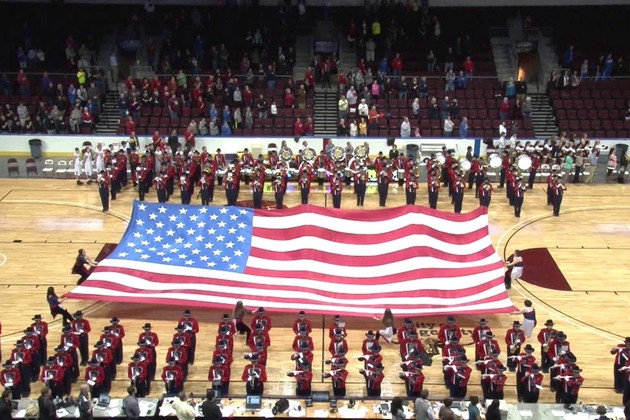
Dodge City High School Marching Band, “the Pride of Southwest Kansas.” (Red Demon Football on Youtube.)

Western Kansas, where Deb and I have spent time over the past month, is the heart of Trump Nation in one sense: Trump and the GOP will almost certainly carry this area, and the whole state, this fall.

But if you compared the daily texture of economic, educational, civic, and cultural life in cities like this, with the America-in-the-ashcan end-times tone of political discourse in general, and of the past week in Cleveland in particular, you would wonder about the contrast.

The tension between these two basic assessments of 21st century America, and the ways in which each might selectively be true, was the theme of my March issue cover story, and of our on-scene reports from around the country over the past few years collected here. It’s also been part of our previous reports from Kansas here, here, here, and here, with more to come.

Deb Fallows has a new installment up this morning. It’s about Dodge City High School: home of two successive Kansas State teachers-of-the-year; source of civic pride; locus of ethnic diversity exceeding that of many big cities; and home, among other things, to a fishing team. You can read her report here, and I hope you will.

***

Process note: the balancing act within our own household and inside my own mind, between the increasingly dire aspects of America’s national politics, and the fresh and encouraging developments in most other realms, is our own local reminder of the larger challenge of trying to make sense of the national condition.

Maybe I should just fall back on the principle that was so handy in China: Everything you could possibly say about the country is true — somewhere. Maybe I should call it schizophrenia or cognitive dissonance, rather than a balancing act. But most of all I should probably keep the balance in favor of on-the-road reporting, which usually has the virtue of being surprising in positive rather than negative ways.

This is not the controller I spoke with last week at Denver’s Centennial airport, because this man is working that same day in the control tower at LAX. But this gives you an idea of what controllers are looking at and dealing with. (Bob Riha Jr / Reuters)

Two days ago I mentioned the unflappable, multi-tasking and multi-dimensional competence with which an air-traffic controller at Denver’s Centennial airport handled a sudden shift in winds, and the resulting complete re-organization in flow of airplanes headed toward his runways. Deb Fallows did her “view from the right seat” complementary report on the episode.

A long-time controller, who runs a site about ATC, writes about what he heard in the audio archive of that interaction (emphasis added):

As a 30 year ATC veteran, I appreciated the clip you posted going into APA [the code for Centennial airport]. You’re right, the local guy did a very good job. I’ve sat in that metaphorical seat often, myself, although I’ve always been a center guy.

As a controller, I can tell you that crisp transmissions, grasp of the situation, and execution of clearances are very helpful when there are plenty of “say agains” going on. And trust me, your “nice job” was not missed nor wasted in the melee—just not time available to acknowledge. [At time 23:15 of this ATC recording, I give a rushed and spontaneous “Good job!” to the controller after I’ve landed, in appreciation of what I’d heard him do.]

Also, as a veteran of many tape talks (both given and received) I can tell you that he was about four times as busy as the tape indicates. All that talking is the result of a lot of scanning, a lot of planning, a lot of thinking, and a lot of recall.

I’d like to direct your attention to an audio recording of me at my ATC website. You may enjoy it, if you’re not sick of listening to ATC recordings already. I was working an arrival rush to ORD [O’Hare], not as dramatic as the APA guy, but it was a decent workout.

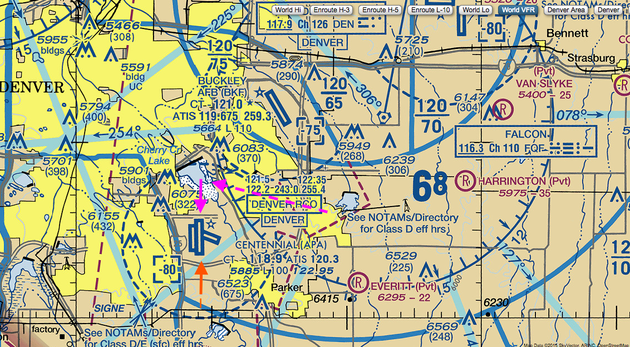
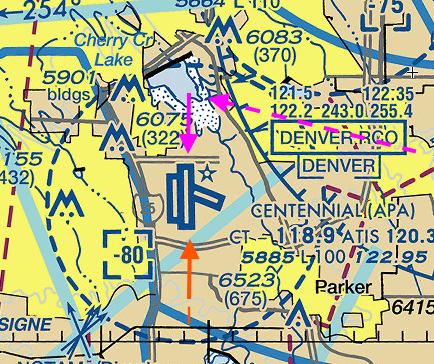
The airspace that was the subject of a coordinated aerial ballet two days ago. The magenta line shows where pilots thought they would be going. The orange line shows where they ended up. (FAA sectional charts via SkyVector.)

During our travels Deb has often mentioned our interest in, and nearly-all-times admiration for, the Air Traffic Controllers with whom we deal. One of her early posts, “Say Souls on Board,” is here; you can find a collection of others from the past three years here.

This past weekend, on our way from western Kansas into Denver, we had another illustration of the unflapped competence with which members of the ATC system can perform. What follows are a lot of details, which put in context the audio clip below. If you want to skip the details, the summary point is: this is a little sample of people doing very high-stakes work calmly, and without anyone particularly noticing except for those they’re directly dealing with.

***

Here is background on three fronts:

  • The permanent landscape. Our destination was Centennial Airport, in Denver, airport code KAPA. Centennial is a very busy, very nice, “reliever” airport on the south side of Denver, near Aurora. It has two big, parallel north-south runways, plus a smaller runway at an east-west angle.

    Centennial’s big runways, and its relatively flat-land location, make it attractive for aircraft ranging from little piston airplanes like ours to sizable jets. But the airport works within a narrow band of constraints, in this sense:
    — Not far west is the front range of the Rockies, which rises up with impressive suddenness.
    — Immediately north is the military airspace of Buckley Air Force Base.
    — Immediately up is the “Class Bravo” airspace for Denver’s main international airport, which it’s better to stay out of.
    The Buckley AFB airspace goes up to an elevation of 7500 feet; the Denver Class B starts at 8000 feet. Thus the last part of our approach to Centennial was within that 500-foot buffer, at 7700 feet.
                                                                                                                               .
  • The momentary landscape. On the way up from Kansas (where we’d been on a reporting trip, and where we’ll return after this week’s Aspen Ideas Festival) we’d followed NEXRAD weather displays of a great big thunderstorm in the mountains west of Centennial. The in-cockpit weather display is updated about every six minutes. Cycle by cycle, we could see the storm staying very large, but moving slowly south and east. That took it away from Centennial airport, which left the airport clear, but it still occupied a whole lot of the sky just a few miles to the south.

    We were within about ten miles of the airport — just a minute or two before beginning to descend, going through the checklist for landing — and were glad that the storm was far enough away to seem no problem. (If it had been closer, we would have diverted to an airport in the plains east of Denver and waited things out.) The winds at the airport were from the south, so planes were landing from the north, on Centennial’s Runways 17 (left and right). This is the route shown more or less by the magenta arrows in the map above, and in more detail here:
    Landing from the north, the magenta line; from the south, in orange. All the inbound planes were planning to follow the magenta line, until they were switched around to the orange.
  • The big change. Just as we were getting oriented to land from the north, the Centennial control tower reported a sudden and significant change in the winds. For reasons probably related to the nearby storm, winds at the airport quickly reversed direction. Instead of coming from the south, they started blasting in from the north — and were so strong that it would be risky to land with them as tailwinds. (Simple explanation: the speed with which an airplane meets a runway is its airspeed minus the headwind. If you land at 80 knots airspeed with a 20 knot headwind, you’re meeting the runway at 60 knots. But if you land with a 20 knot tailwind, you’re meeting the runway at 100 knots, and you could well run out of asphalt before you could stop.)

That’s the setup for the air-traffic recording you can hear below. It captures the transmissions from the control tower of a very busy airport, working within a constrained physical and regulatory space, when it all of a sudden has to re-direct a flow of incoming aircraft. The challenge for the controller is to send each airplane somewhere that will keep it out of the others’ way, and also away from the thunderstorm (and the mountains), and then sequencing planes one by one for a landing in the opposite direction from what they were expecting.

The orchestration of this complex event is what you hear below. Starting at time 10:50, the controller announces the change in winds. Rather than landing from the north on runways 17 Right and 17 Left, planes are swung around to land the opposite way, on runways 35 Right and 35 Left.

You’ll hear a few pilots still on the ground deciding that the sudden strong tailwinds — “11 knots gusting 23 knots” — were within limits for taking off. Then an inbound pilot decides to break off his landing, and the controller directs him for a “go around.”  Lots of action happens in the dozen minutes starting around 10:50, with the controller coordinating planes into some orderly queue for getting on the ground.

If you listen late into the recording you’ll hear an airplane called “Cirrus 435 Sierra Romeo” get into the action. That’s us, with me speaking in a clipped way to minimize air time on a crowded frequency. Near the end of this recording, after I’ve landed and am being handed off to the ground-control frequency, I wind up my transmission with a a very quick “good job!” to the controller That was spontaneous by me and not really standard practice, but it was sincere because of the calm synchronization I’d just seen, and been part of.

Here is the clip, via LiveATC.net and the SoundCloud player. (And here is a link to the recording starting at time 10:50.)

***

People may imagine that Air Traffic Control plays a minute-by-minute life-and-death role in keeping planes from falling out of the sky, more or less like in the movie Airplane!. As William Langewiesche explained in this wonderful Atlantic piece from the 1990s, usually it’s not that way at all. In most phases of flight, planes cruise along perfectly well on their own. The ATC’s most important role for airliners is sequencing them efficiently and safely in and out of the highly congested space at major airports.

Update: For tech screw-up reasons on my end, a version of this piece was initially published last night, and then mysteriously un-published (when an unsaved draft over-wrote it). Thanks to the Atlantic’s tech team for retrieving the right version, and sorry for any confusion. Also, Deb may add a post with her account of what this looked like from the right-hand seat as we were being vectored all around.

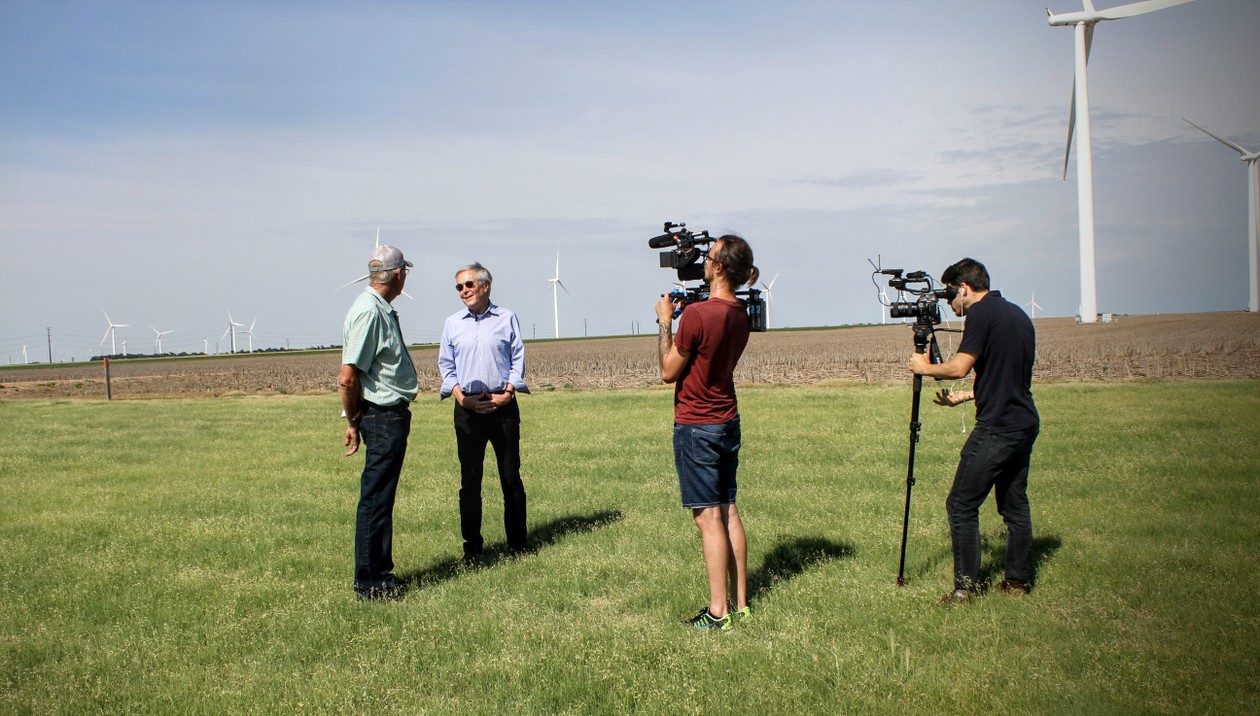
Mayor Kevin Heeke of Spearville, Kansas (far left), with Atlantic interview and video team yesterday (Deborah Fallows)

For the past week my wife Deb and I have been in western Kansas — Dodge City mainly, also Garden City, briefly Spearville. There will be a lot more to report in coming days on the economic, cultural, and political news from this part of the country. What you see above is something that touches all of those themes: me talking with Kevin Heeke, the mayor of Spearville, about the hundreds of wind turbines that have transformed the economy of the wheat- and corn-farming regions in this extremely windy part of the country.

But I can’t let this day end without noting the black-versus-white, night-versus-day contrast between the way immigration, especially from Mexico and other parts of Latin America, is discussed in this part of the country where it is actually happening, versus its role in this moment’s national political discussion.

These cities of western Kansas, Dodge City and Garden City, are both now majority-Latino. People from Mexico are the biggest single immigrant group, and they are here mainly for work in the area’s big meat-packing plants. Others are from Guatemala, El Salvador, Honduras, Cuba, and more recently Somalia and Sudan, among other countries. You might think of Kansas as stereotypical whitebread America. It’s pure America, all right — but American in the truest sense, comprising people who have come from various corners of the world to improve their fortunes.

Every single person we’ve met here — Anglo and Latino, African and Burmese and other, old and young, native-born and immigrant, male and female, well-educated and barely literate, working three jobs and retired and still in school—of all these people, we’ve asked the same questions. Namely: how has Kansas handled this shift in demography? And how does it sound, in this politically and culturally conservative part of the country, to hear the national discussion about “building a wall,” about making America “a real country again,” of the presumptive Republican nominee saying even today that Americans are “angry over borders, they're angry over people coming into the country and taking over, nobody even knows who they are.”

And every single person we have spoken with — Anglo and Latino and other, old and young, native-born and immigrant, and so on down the list — every one of them has said: We need each other! There is work in this community that we all need to do. We can choose to embrace the world, or we can fade and die. And we choose to embrace it. (The unemployment rate in this area, by the way, is under 3 percent, and every business we’ve talked with has “help wanted” notices out.)

This is in small-town western Kansas. And it is what we have heard in every discussion. I could give 50 examples, and eventually will, but here is one for now. A white man who grew up in this area, and works in construction, told us a few days ago: I wasn’t sure about the change in town. It’s different. But these people want to work. They want a better life for their children. We need them. Without them, we would shrivel up.

The details and the profiles and the specific extended quotes will follow. For today I just want to register: if you came to a part of America that had undergone some of the most profound recent ethnic change, and that was by inclination in no way trendily progressive, you would find Americans responding the way your best idea of America would suggest: inclusive, embracing, assessing newcomers on their character and behavior rather than on the categories to which they might be assigned (of course with the strains and tensions social change always brings).

This is worth noting at a time when it would be easy to assume that Americans in general were fearful, close-minded, and ready to reject those who were different in any way.

Production line at Mi Ranchito Tortilleria today, on the south side of Dodge City, Kansas. Mi Ranchito is a successful immigrant-owned startup, popular with customers of all ethnicities. (James Fallows)

I can barely express how strongly I wish that anyone writing or opining about American “nativism” or “resentment” could come to a place like this, and see real Americans of many backgrounds responding to real demographic change. We are better, still truer to ourselves, than some of our politics now suggests.

Driving into Dodge from the east side of town (James Fallows)

***

For previous items on this theme, please see this thread.

More Notes From The Atlantic
  • Notes Home