Mulling Over 'The Model Minority'

A reader quotes from a recent piece by Alia:
The highly selective UC campuses are known, sometimes bitterly, to serve especially disproportionate numbers of Asian students; Asians famously make up half of the undergraduates at UC Irvine, for example, which was No. 1 on Leonhardt’s list. By highlighting economic diversity in lieu of its race-based cousin, this year’s Upshot and Washington Monthly rankings may support arguments that the state’s ban on race-blind admissions discriminations has shortchanged blacks and Latinos in favor of whites and Asians. While that may very well be true, the rankings offer an opportunity to highlight nuances to the “model minority” stereotype and the ways in which it hinders economic equality in education.
The irony being the people most “bitter” about the Asian-American students are so-called progressives who claim to care about minority groups.
Why is Asian achievement in the UC system so quickly dismissed? As any reader of The Atlantic knows, these Asian kids live in a country founded on “white supremacy,” a country where “white privilege” rules and where they experience microaggressions. You would think people who claim to care about minorities would celebrate this accomplishment. But they actually describe the UC system—a system where whites are underrepresented relative to the white population of California—as a system with an admissions policy based on “white privilege.” They must go through a lot of mental gymnastics to come to that conclusion.
A countervailing view from another reader:
Asians don’t go through nearly as many microaggressions as other minorities. They aren’t put down and treated as if they’re thugs or criminals purely because of skin color. They also haven’t been nearly as oppressed as other groups. There are still African Americans alive from the time when they weren’t allowed to vote or go to good colleges.
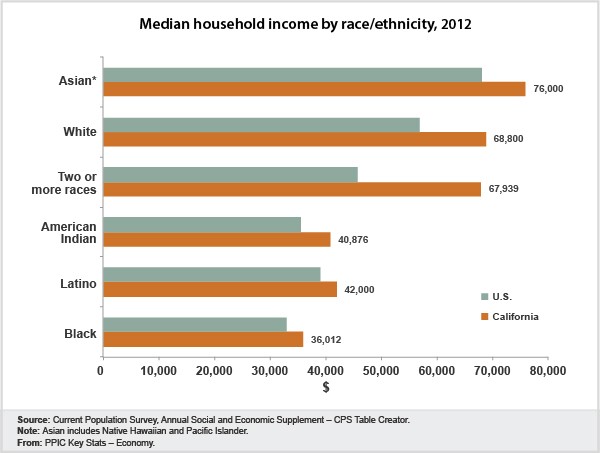
Asians in California are typically pretty wealthy, and the average Asian family might even be wealthier than the average white family.
That’s true, according to this data from the Public Policy Institute of California:
Back to our reader:
Because of this wealth disparity, Asian Americans live in better neighborhoods with better schools and can afford all the tutoring and extracurriculars they did. Most Hispanics and African Americans have much lower income, resulting in getting the shorter end of the stick by needing to go to lower quality schools because they have less money and resources to be as competitive.
For example, SAT workshops are expensive (I did a few about four years ago) and nearly everyone else except myself were wealthy Asians. They can afford to be taking those classes/workshops for four or more years, whereas the average Hispanic/African American family can’t afford the four digit cost to even do one. You don’t think that makes a difference on the end result?
Another reader doesn’t buy that argument:
Asians don’t go through as many “microaggressions” as other minorities TODAY because Asians behave differently, have different values, attitudes and behaviors, and therefore different socioeconomic outcomes. Asians went though more micro AND macro-aggressions that any other minority at the turn of the 20th century, and certainly during WWII. But they triumphed over racism and poverty because of their intelligence, honor, value systems, and their cultural priorities, combined with a work ethic as strong as the Puritans’.
It is 100 percent cause-and-effect. And when we’re finally willing to publicly admit it, THEN we can earnestly attempt to close the achievement gap. But the only possible way to do it is for the under-performing minorities to change their cultures.
Disagree? Email [email protected] and we’ll get a debate going. But here’s some quick historical context to go along with that last reader’s point about Asian Americans being macroaggressed during WWII—the most egregious example being internment, of course:
In 1988, U.S. President Ronald Reagan signed the Civil Liberties Act of 1988, [which] provided financial redress of $20,000 for each surviving detainee, totaling $1.2 billion. The question of to whom reparations should be given, how much, and even whether monetary reparations were appropriate were subjects of sometimes contentious debate within the Japanese-American community and Congress.
On September 27, 1992, the Civil Liberties Act Amendments of 1992, appropriating an additional $400 million to ensure all remaining internees received their $20,000 redress payments, was signed into law by President George H. W. Bush. He issued another formal apology from the U.S. government on December 7, 1991, on the 50th-Anniversary of the Pearl Harbor Attack, saying:
In remembering, it is important to come to grips with the past. No nation can fully understand itself or find its place in the world if it does not look with clear eyes at all the glories and disgraces of its past. We in the United States acknowledge such an injustice in our history. The internment of Americans of Japanese ancestry was a great injustice, and it will never be repeated.
