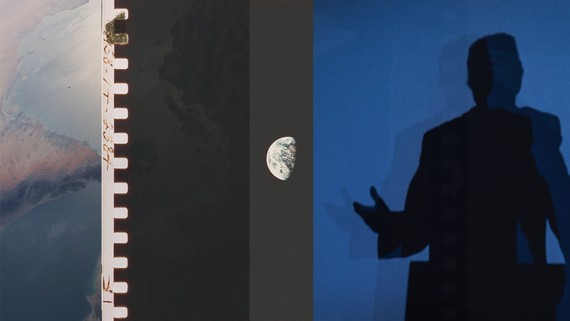
Seeing the Earth from space will change you so profoundly that there’s a term for it: the overview effect. The extreme minority who have had the privilege describe it similarly. You see something that you were never meant to see, namely the Earth just sitting there, with the entire universe surrounding it. Gazing upon the blue marble, surrounded by its oh-so-thin green layer of atmosphere, the auroras flickering on the fringes, is not merely awe-inspiring but something of a factory reset for one’s sense of self. Almost everyone tears up at the sight … I’ve never been to space, but for the past few days, I’ve oscillated between these emotions—awe and despair—as NASA has continued to post photos of the Earth and moon from Artemis II. Yesterday, the Integrity spacecraft came within 4,067 miles of the moon during its lunar flyby. For 40 minutes, it lost all contact with humanity. At one point they were 252,756 miles away from Earth—the farthest from the planet anyone has ever traveled. For seven hours, the astronauts—Koch, Reid Wiseman, Victor Glover, and Jeremy Hansen—were able to gaze upon a part of the lunar surface previously unseen by human eyes. According to NASA, the astronauts took roughly 10,000 photos, which feels perfectly proportional for such an occasion. A few of these photos—some taken before the lunar pass—have messed me up pretty good. A photo of the Earth appearing to set behind the moon. A picture, taken through a window of the Orion spacecraft, revealing the tiniest crescent Earth growing smaller as the capsule heads toward the moon. As one caption on the photo notes, “the Earth is illuminated by the blackness of space.” I’ve experienced these photos the way I experience most media: through the puny screen of my phone, with the awesome, life-affirming images sandwiched between updates about a golf tournament, oil prices, the MLB’s new automated ball-strike system, and reports of the U.S. president threatening the civilizational destruction of Iran. |