This Week in Books: Could AI Ever Write Like Stephen King and Margaret Atwood?
Two authors respond to the revelation that their work is being used to train artificial intelligence.
This is an edition of the revamped Books Briefing, our editors’ weekly guide to the best in books. Sign up for it here.
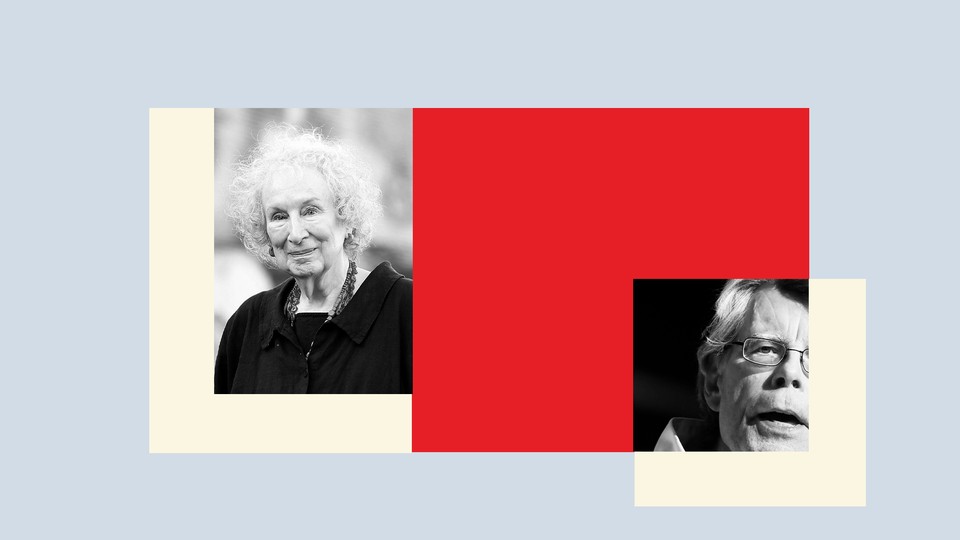
The precipitous arrival of artificial intelligence into our lives over the past year has provoked some very deep existential quandaries, such as: What is it that a human can do that a robot never could? When it comes to creativity and whether art is within the range of a machine’s capabilities, this question is not so academic. Authors in particular have found themselves blindsided and a little disturbed both by the quick advances the bots are making and by the realization that their own books have been used to train AI, essentially aiding in the education of their possible replacements. We recently turned to two giants of the literary world, Stephen King and Margaret Atwood, to see how it felt to discover that their work was being employed in ways even their fecund minds could never have dreamed up.
First, here are four new stories from The Atlantic’s Books section:
Two weeks ago, an Atlantic report revealed that Meta was training its AI, called LLaMA (which is similar to the better-known GPT-4), by feeding it tens of thousands of pirated books. Dozens of recognizable big-name authors were in the mix, including King and Atwood. But what does that mean? What is the AI actually doing with the original works? For the writers, and even for some leading the AI revolution, mystery still surrounds these questions.
“Does it make me nervous?” asks Stephen King in an essay. “Do I feel my territory encroached upon?” The confusion has to do with the matter of what exactly is being stolen. The AI isn’t copying King’s novels word for word, and it’s not trying to reproduce paragraphs or whole stories. But it is using his work in an opaque process of growing its capacity to predict language and developing “emergent” skills that the creators themselves hadn’t imagined. To illustrate what he believes can’t be taken from him, King describes a small detail in one of his forthcoming books: A character shoots another in the back of the head, and the bullet gets lodged in the victim’s forehead, creating a bulge—a bulge that goes on to haunt the shooter. “Could a machine create that bulge?” King wonders. “I would argue not, but I must—reluctantly—add this qualifier: Not yet.”
The caveat is telling. For now, the creative spark that brought that bulge into existence is fundamentally, and exclusively, human. But will that be true in the future? What happens when technology can grasp at the atomic level what makes King’s writing the unique thing it is? In her article, Atwood professes that she can relate to the impulse to deconstruct a style and copy it. “As young smarty-pants, we used to write parodies of writers older and more accomplished than ourselves,” she admits. “The sentence structure, the vocabulary—adjectives and adverbs, especially—the cadence, the subject matter. All were our fodder, as they are the fodder, too, of chatbots. But we were doing it for fun, not to impersonate, to deceive, to collect, and to render the author superfluous.”
Our old rules about copyright and intellectual property aren’t equipped to answer what’s been taken when a computer breaks down these small units of writing and uses them to build sentences, paragraphs, and eventually novels. What exactly were these authors robbed of—their souls? The violation feels real; writers, including the comedian Sarah Silverman and the authors Christopher Golden and Richard Kadrey, are already fighting back with lawsuits. Atwood sees what could happen next: “I myself can then be dispensed with—murdered by my replica, as it were—because, to quote a vulgar saying of my youth, who needs the cow when the milk’s free?”
I’m not so sure, though. When we pick up a book, the part that is magic—for me, at least—is the knowledge that we are, as humans, communing with another human mind. Sometimes the feeling is awe at the scope of another’s imagination—one that could conjure the world of Gilead or the smile of Pennywise—and other times, it’s the sensation of feeling seen by an author who understands and can articulate our shared reality better than we can. Atwood puts it this way: The most important question one can ask of art is, “Is it alive, or is it dead?” The joy, even when subconscious, comes from knowing that another person created this experience you are now having. No AI will replicate this spark of connection, because we are alive and the computer, it is dead.
Stephen King: My Books Were Used to Train AI
Margaret Atwood: Murdered by My Replica?
What to Read
This One Summer, by Mariko and Jillian Tamaki
This One Summer is one of the rare books perfect for middle schoolers, who are often caught in the gap between childhood stories and more self-reflective teen narratives. The Tamakis’ graphic novel follows adolescent Rose as she spends one important season at a lake house her family visits annually. This year, things feel different. Rose’s parents are fighting; meanwhile, she becomes privy to the activities of older teens in the area, who face complex challenges like pregnancy and mental illness. As readers look on, Rose struggles to understand the rapidly changing universe around her, and eventually finds a way to accept her place in it. The plot is so much like real life, it’s almost painful—but it’s a deeply honest depiction of adolescence, and it might provide families with a basis for difficult-to-navigate conversations. Kids absorb and puzzle over so much about the adult world, and This One Summer acknowledges that brilliantly. — Laurel Snyder
From our list: seven books to read as a family
Out Next Week
📚 Beyond the Wall: A History of East Germany, by Katja Hoyer
📚 Wednesday’s Child, by Yiyun Li
📚 Evil Eye, by Etaf Rum
Your Weekend Read
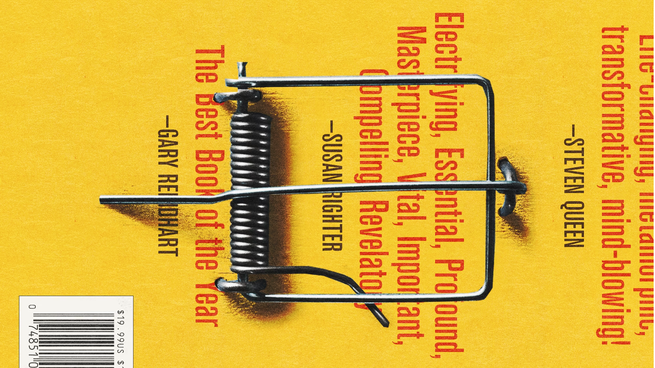
The Blurb Problem Keeps Getting Worse
Blurbs have always been controversial—too clichéd, too subject to cronyism—but lately, as review space shrinks and the noise level of the marketplace increases, the pursuit of ever more fawning praise from luminaries has become absurd. Even the most minor title now comes garlanded with quotes hailing it as the most important book since the Bible, while authors report getting so many requests that some are opting out of the practice altogether. Publishers have begun to despair of blurbs, too. “You only need to look at the jackets from the 1990s or 2000s to see that even most debut novelists didn’t have them, or had only one or two genuinely high-quality ones,” Mark Richards, the publisher of the independent Swift Press, told me. “But what happened was an arms race. People figured out that they helped, so more effort was put into getting them, until a point was reached where they didn’t necessarily make any positive difference; it’s just that not having them would likely ruin a book’s chances.”
When you buy a book using a link in this newsletter, we receive a commission. Thank you for supporting The Atlantic.