Sam Bankman-Fried Pushed One Boundary Too Many
The FTX founder is showing a surprising amount of self-confidence for someone in the midst of a serious legal battle.
Updated at 1:35 p.m. ET on August 15, 2023
This is an edition of The Atlantic Daily, a newsletter that guides you through the biggest stories of the day, helps you discover new ideas, and recommends the best in culture. Sign up for it here.
For months, the FTX founder Sam Bankman-Fried has regularly engaged with the outside world and lived in relative comfort under house arrest. Now the judge presiding over his case has had enough.
First, here are three new stories from The Atlantic:
‘Up to the Line’
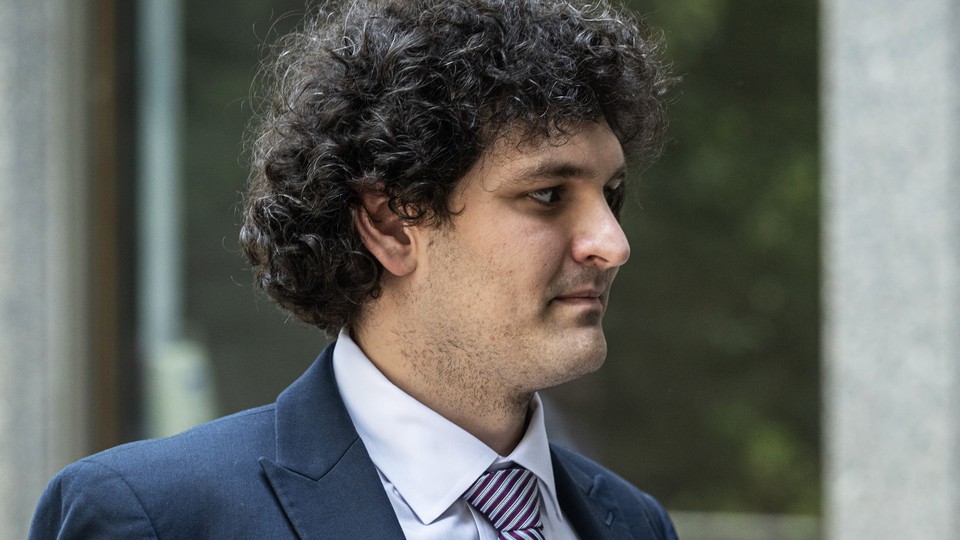
Sam Bankman-Fried has long bent the rules. The FTX founder once wowed elite investors with talk of FTX’s bright future while playing the video game League of Legends during a meeting; later, he raised a “meme round” of $420.69 million from 69 investors. For years, Bankman-Fried’s maverick approach worked in his favor: His quirky persona, unruly mop of hair and all, endeared him to celebrity backers, placated regulators, and helped propel him to billionaire status by his late 20s.
This renegade attitude has not served Bankman-Fried quite as well lately. In December 2022, he was arrested in the Bahamas and charged with fraud and conspiracy to commit money laundering, among other crimes (he pleaded not guilty in January). On Friday, a judge revoked Bankman-Fried’s bail ahead of his October trial, citing a pattern of boundary-pushing behaviors, including the alleged intimidation of witnesses while on house arrest at his parents’ Bay Area home. Bankman-Fried was sent to the Metropolitan Detention Center in Brooklyn, a jail with notoriously bleak conditions. Lawyers for Bankman-Fried declined to comment; his team filed an appeal on Friday.
Facing consequences is new for Bankman-Fried: For years, he built up a crypto empire while apparently betraying customer trust with impunity. That’s in part because he succeeded in charming Congress, which does not have a strong history of investigating “ask forgiveness, not permission” tech founders. The Silicon Valley establishment boosted him too, pouring money into his start-up and enabling him to install a board of directors that did not include any investors. It didn’t hurt that Bankman-Fried’s reputation as a pedigreed MIT whiz kid matched investors’ vision of what a successful tech founder looked like.
Bankman-Fried has spent his time under house arrest in ways that show a surprising amount of self-confidence for someone in the midst of a serious legal battle. Judge Lewis Kaplan of the Manhattan Federal District Court, who is presiding over Bankman-Fried’s case, said on Friday that the defendant “has gone up to the line over and over again.” Since the start of his house arrest, Bankman-Fried has invited a crypto influencer to swing by, talked with the author Michael Lewis for a book, and used a VPN to log on to the internet. His at-home conduct has not pleased the prosecution, which had already gotten the terms of his bail tightened earlier this year, after he was accused of attempting to contact another former FTX executive and possible witness in the case. Then his unorthodox behavior seemed to go even further: The New York Times published an article last month that included leaked diary entries from Caroline Ellison, the one-time head of Bankman-Fried’s crypto hedge fund, as well as his ex-girlfriend. Though the article did not say where the entries came from, lawyers for the prosecution later said that Bankman-Fried was the source. Bankman-Fried’s lawyers confirmed in a court filing that he had shared “certain documents,” but countered that he “did nothing wrong” in communicating with the Times on this matter. (Before I joined The Atlantic, I was part of the team of New York Times reporters covering the collapse of FTX, but I had no involvement with the recent article.)
In court documents, prosecutors argued that leaking the diaries was an attempt to intimidate and discredit Ellison—to make it appear that “Ellison was a jilted lover who perpetrated these crimes alone.” Ellison pleaded guilty to federal charges in December and is expected to be a key witness in Bankman-Fried’s criminal trial this fall. After the judge instituted a temporary gag order, lawyers from the Times and other organizations opposed the order on First Amendment grounds. As of Friday, the status of the gag order was not clear.
Learning that Bankman-Fried had allegedly leaked the diaries in an attempt to discredit Ellison was surprising, because they made Ellison sound fairly sympathetic. In the months before the fund collapsed, Ellison expressed doubts about her abilities as a leader—and, yes, hurt about her breakup with Bankman-Fried. She said in a message to Bankman-Fried in November that she had felt dread about FTX’s impending collapse, though she didn’t appear to act on those feelings. I was also struck by the fact that Ellison’s compensation package was much smaller than that of her male colleagues.
This case is a complex business and legal morass, but it’s also likely to involve much interpersonal messiness. Several of FTX’s leaders lived together in a penthouse in the Bahamas (including Ellison and Bankman-Fried). The colleagues, once friends, may now cooperate with the government against one another.
Before his downfall, Bankman-Fried cultivated an image as the responsible crypto leader in a Wild West industry. Now he joins the ranks of high-flying tech founders—including those who received fawning press coverage and massive funding—in the hot seat, accused of defrauding investors and conspiring to launder funds. For years, the tech industry rewarded risk taking, “disruption,” and “breaking things.” But a litany of recent scandals has made the public—and investors in particular—more skeptical of those tenets. In the 2010s, when money was cheap, venture capitalists taken in by charismatic leaders didn’t ask many questions of the companies they were getting involved with. But higher interest rates have led to layoffs, finger-pointing, and a period of relative austerity in Silicon Valley; it is no longer the case that anything goes. Start-up funding has plummeted, and investors are looking more closely at companies’ claims. Tech bosses are being investigated and accused of misconduct in federal court: The Theranos founder Elizabeth Holmes was convicted of defrauding investors and ordered to report to prison a few months ago, and Charlie Javice, who sold a student-loan assistance start-up to J.P. Morgan for millions, was accused this past spring of falsifying customer data. (She pleaded not guilty to charges that she had defrauded the bank.)
Even among this group of tech founders, Bankman-Fried is a surprisingly unpredictable figure. I’ll be watching how he comports himself from here—and what Kaplan does in response.
Related:
Today’s News
- Prosecutors in Georgia have secured emails and text messages connecting members of Donald Trump’s legal team to the Coffee County voting-system breach in January 2021.
- The Biden administration released new guidance on how colleges can legally pursue diversity after the Supreme Court ruling on race-conscious admissions.
-
Six white ex–Mississippi law-enforcement officers pleaded guilty to state charges tied to the torture of two Black men in January.
Evening Read

The Problem With ‘Centering Blackness’ in Everyday Conversations
By Tyler Austin Harper
The hotel was soulless, like all conference hotels. I had arrived a few hours before check-in, hoping to drop off my bags before I met a friend for lunch. The employees were clearly frazzled, overwhelmed by the sudden influx of several hundred impatient academics. When I asked where I could put my luggage, the guy at the front desk simply pointed to a nearby hallway. “Wait over there with her; he’s coming back.” …
I saw the woman he was referring to. She was white and about my age. She had a conference badge and a large suitcase that she was rolling back and forth in obvious exasperation. “Been waiting long?” I asked, taking up a position on the other side of the narrow hallway. “Very,” she replied. For a while, we stood in silence, minding our phones. Eventually, we began chatting …
Then, out of nowhere, she said something that caught me completely off guard: “But I shouldn’t be complaining to you about this. I know how hard BIPOC faculty have it. You’re the last person I should be whining to.”
More From The Atlantic
Culture Break

Read. The Ghost Forest: Racists, Radicals, and Real Estate in the California Redwoods exposes how wealthy industrialists reaped a fortune in the name of environmentalism.
Watch. You might not always know where the docuseries How to With John Wilson (streaming on Max) is headed, but you’ll enjoy the journey as it chronicles some of New York City’s strangest residents.
P.S.
In other tech-executive news, the fight might be on? Elon Musk and Mark Zuckerberg, who claimed earlier this summer that they would engage in a cage match, have since been posting on their respective social-media platforms about the battle. Musk, after saying that a problem with his shoulder requires surgery, said last week on X that “everything in camera frame” during the fight “will be ancient Rome.” Soon after, Zuckerberg wrote on Threads: “Not holding my breath for Elon, but I’ll share details on my next fight when I’m ready.” I, like Zuckerberg, am not holding my breath—though I am following along with confusion as Musk tags Zuckerberg in posts like “Knock, knock … challenge accepted … open the door” and “Thought you might want some tea, so I brought the bags.”
— Lora
Katherine Hu contributed to this newsletter.
When you buy a book using a link in this newsletter, we receive a commission. Thank you for supporting The Atlantic.