A Robotaxi Experiment
Caroline Mimbs Nyce discusses whether cities are ready for driverless cars.
This is an edition of The Atlantic Daily, a newsletter that guides you through the biggest stories of the day, helps you discover new ideas, and recommends the best in culture. Sign up for it here.
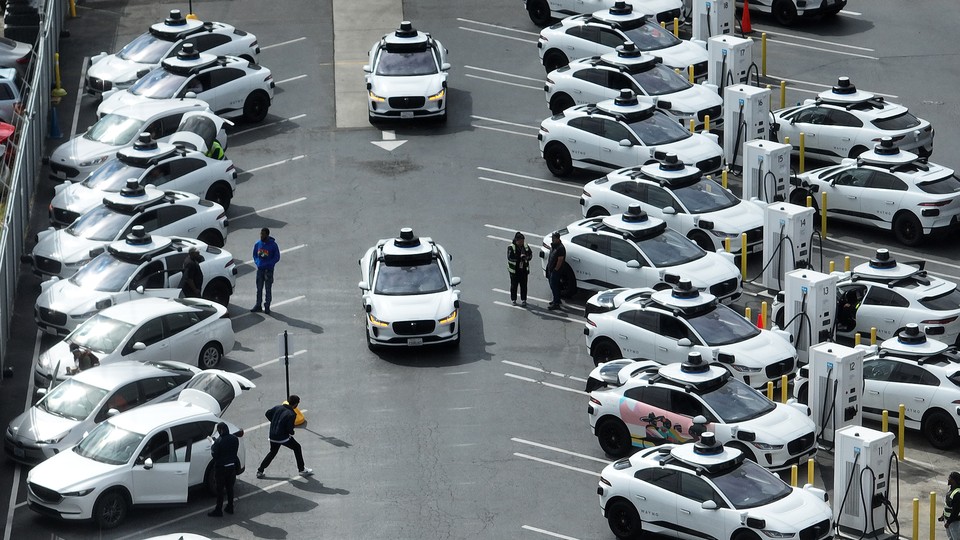
Driverless taxis have arrived on the streets of San Francisco. The self-driving car companies Cruise and Waymo got the green light to expand their robotaxi fleets in the city earlier this month. The cars’ arrival was met with creative protests, curiosity, and long waitlists to take a ride. I spoke with Caroline Mimbs Nyce, an Atlantic writer covering technology, about her trip to San Francisco to give the robotaxis a try.
But first, here are three new stories from The Atlantic:
A Guinea-Pig City
Lora Kelley: Tell me more about your experience riding in self-driving cars. When you were in the robotaxis, what did you find most strange or surprising?
Caroline Mimbs Nyce: The weirdest thing was watching the steering wheel turn itself. It was like a ghost driving the car. In the Waymo, you can ride up front or in the back, and I decided to ride in the front passenger seat. I just kept looking to my left and watching this wheel turn incrementally.
I rode in the back seat of a Cruise car with William Riggs, who’s a professor at the University of San Francisco and studies self-driving cars. It was an unseasonably hot day, so the first thing we did was blast the AC. In the Cruise, they had flat screens on the back of the headrests, and we used one of those to turn on a setting that was just called “coldest.” The Cruise car had a panic button: a little black circle that said END RIDE in all caps. I also tried taking off my seatbelt in that car to see what it would do. And it yelled at me. I do not recommend unbuckling in robotaxis unless there’s a journalistic reason to do so.
It was strange how normal it felt, and how quickly I felt like I was in a regular cab ride. When I was riding in the Cruise, we had a jaywalker. The car handled that fine. At one point we were outside a hospital in a congested area of the city, and an ambulance backed up in front of us. It handled that fine too. That’s not to say that everyone in San Francisco has had a normal experience, or that these vehicles have operated perfectly.
Lora: Human drivers are prone to errors on the road—but self-driving cars have made mistakes too. To what extent are self-driving cars replacing something unsafe with something that’s also imperfect?
Caroline: Human-driving statistics are really troubling: About 46,000 people died on the roads in America last year. You can very easily envision a future in which self-driving cars provide real benefit to our roads. But the question of whether they’re there yet is still an open one, and one that’s actively being debated.
San Francisco has been the guinea pig for this, and that’s causing some real tension. There’s a lot of potential for self-driving cars, but reconciling that with their current state can be difficult, especially following the incident where a Cruise vehicle collided with a fire truck. Even the safety experts I spoke with didn’t want to totally stifle innovation around autonomous vehicles. It was more a conversation about how to do this safely: Are we doing this the right way?
After the past few decades, I don’t blame critics of autonomous vehicles for being skeptical about a tech company making grandiose promises that can cause real harm.
Lora: You went to San Francisco to report this piece. How would you feel about robotaxis coming to your city?
Caroline: It’s actually going to happen soon: Waymo is testing in Los Angeles and preparing for the rollout here. Obviously this is a city that is not known for having great public transportation. There’s a big (human-driven) car culture here, and a car-ownership culture.
L.A. is notorious for bad traffic, and experts think that self-driving cars may actually make congestion worse. They follow the speed limits exactly. I don’t know how L.A. traffic could get worse, but I will be interested to see what happens.
Lora: You rode in a Cruise car called Charcuterie, and spotted another on the road called Winter. What is with these names?
Caroline: Cruise names its vehicles and allows people to submit name ideas for the cars. I don’t know the strategy behind it. But I was immediately anthropomorphizing the Cruise car I rode in. I’m still talking about Charcuterie and how Charcuterie performed, whereas I didn’t feel that connection with my unnamed Waymo vehicle. I do wonder whether, as we’re getting people used to these machines, these names are helpful, at least as a way of getting people to build a relationship with the car even when you remove the driver.
Related:
Today’s News
- The Biden administration named 10 prescription drugs that will be subject to Medicare’s first-ever price negotiations.
- House Majority Leader Steve Scalise announced that he has been diagnosed with blood cancer and plans to keep working during his treatment.
- Hurricane Franklin has weakened and is expected to pass northwest of Bermuda, while Hurricane Idalia will likely make landfall on Florida’s coast early Wednesday.
Evening Read

Murdered by My Replica?
By Margaret Atwood
Remember The Stepford Wives? Maybe not. In that 1975 horror film, the human wives of Stepford, Connecticut, are having their identities copied and transferred to robotic replicas of themselves, minus any contrariness that their husbands find irritating. The robot wives then murder the real wives and replace them. Better sex and better housekeeping for the husbands, death for the uniqueness, creativity, and indeed the humanity of the wives.
The companies developing generative AI seem to have something like that in mind for me, at least in my capacity as an author.
More From The Atlantic
Culture Break
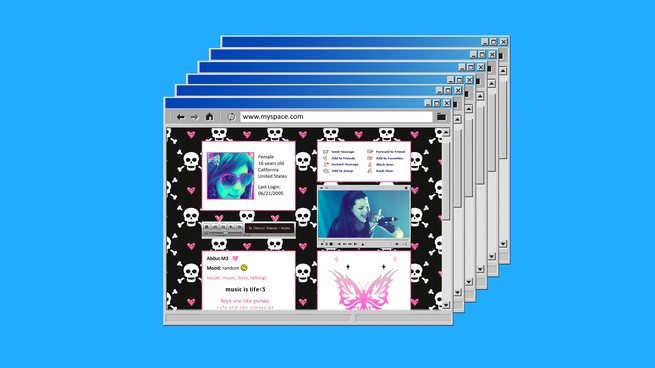
Read. A new oral history, Top Eight: How MySpace Changed Music, immerses readers in the scene of “Scene,” a visual and sonic subculture that dominated during MySpace’s heyday.
Watch. Gran Turismo, a new film in theaters now, is the rare video-game adaptation that works.
Nicole Blackwood contributed to this newsletter.
When you buy a book using a link in this newsletter, we receive a commission. Thank you for supporting The Atlantic.