The Price of Sauce
Campbell Soup Company’s acquisition of Rao’s Specialty Foods is a reminder of the power of high costs.
This is an edition of The Atlantic Daily, a newsletter that guides you through the biggest stories of the day, helps you discover new ideas, and recommends the best in culture. Sign up for it here.
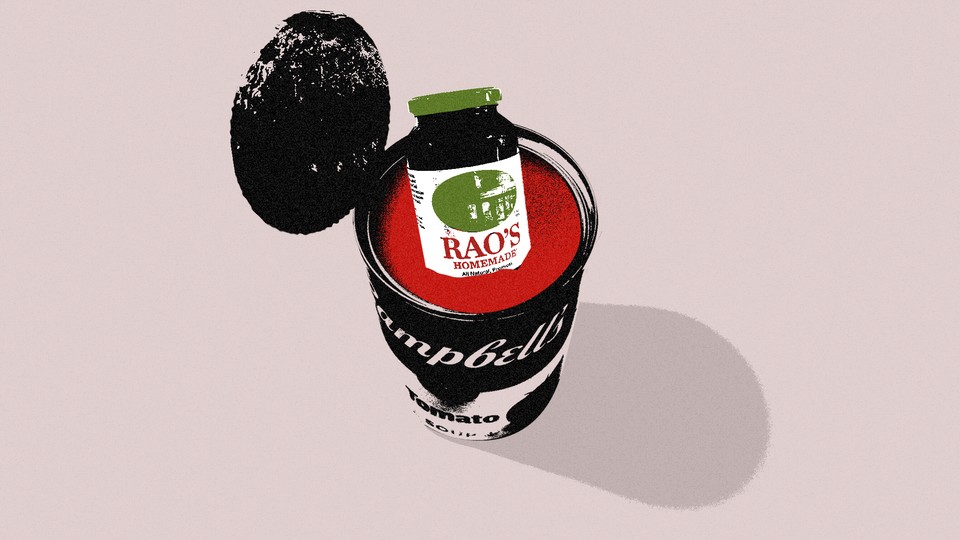
Rao’s sauce is worth billions of dollars—at least according to Campbell Soup, which just acquired its parent company. The sauce’s high price point may be key to its success.
First, here are four new stories from The Atlantic:
A Sauce Boss
The year I graduated from college, I told everyone that my favorite food was marinara sauce (an upgrade from my middle-school response of “black pepper”). So it was a revelation when, during that period, I discovered Rao’s on the shelves of my local grocery stores. Though at first I was reluctant to pay for it—a jar retails at about $8—I soon found I could not live without it. The sauce just tasted so much better to me than the cheaper options, or my homemade versions. I have stuck with it: At this moment, I have three jars of Rao’s marinara sauce sitting in my kitchen.
Rao’s Specialty Foods, a company expanded out of a historic Manhattan restaurant in 1992 that produces pricey food products such as sauce, pastas, and soup mixes, has grown rapidly in recent years thanks to aggressive marketing—and excellent ingredients. Earlier this month, Campbell Soup Company agreed to buy Sovos Brands, a firm that acquired Rao’s in 2017, for $2.7 billion. Even as a true fan of the sauces—and a consumer conditioned to pay $8 for a few servings of marinara–—that seemed to me like a striking amount of money for sauce.
It turns out that Rao’s is big business, and could get even bigger. After acquiring the Rao’s Specialty Foods brand, Sovos expanded its marketing budget to $20 million a year (up from a few hundred thousand); last year, Rao’s reported nearly $600 million in sales, up from less than $100 million in 2017. The president of Campbell called the firm’s expansion “the most compelling growth story in the food industry.”
Rao’s enormous success has been possible only because consumers are willing to keep shelling out for quality foods like these sauces. In fact, the high prices might even be a selling point. “Price is usually reflective of various cost inputs,” my colleague Amanda Mull, who covers consumerism, told me, but “it’s also a marketing tool.” People looking for a reason to buy one brand of sauce over another may look at price as an indicator of quality. “It’s one of the only pieces of information that’s reliably available across products and easily compared,” she explained. But it’s not just its pricing that makes Rao’s desirable; Amanda added that when the brand first got popular, it “became known for being legitimately better than its competitors largely by word of mouth, and I think it deserves its reputation.”
As inflation abates, companies are looking to maintain the pricing power they gained after the pandemic started. To justify maintaining their high prices, some are pushing their customers, particularly those with higher incomes, toward “premium” goods—products that are presented in some way as exclusive or higher-quality. Premiumization, the buzzword for this concept, was ubiquitous in earnings calls earlier this year. As American consumers get more and more interested in specialty goods, it is a “natural next step” that such premium brands are now part of the acquisition strategy of large food companies, Sucharita Kodali, a retail analyst at Forrester, told me.
Campbell Soup, a brand so synonymous with American mass production that it was the subject of many Andy Warhol prints, may not seem like an obvious match for a high-priced food brand. But if a large company is interested in leaning into the premium market, acquiring a high-quality brand can be an efficient way to do so, Simeon Siegel, an analyst at BMO Capital Markets, told me. That way, it can sell to an audience already conditioned to pay higher prices rather than alienating its existing customers by jacking up prices on goods. Mick Beekhuizen, an executive vice president and the president of meals and beverages at Campbell Soup Company, told me that the acquisition would help the company compete in the “ultra-distinctive Italian sauce category.”
Rao’s new owners have sworn not to mess with the sauce’s beloved flavors: “We will not touch the sauce,” Mark Clouse, Campbell’s CEO, reportedly vowed. And as long as the sauce keeps tasting good, consumers will probably not notice or care about its new ownership. “Most people have no idea what kind of corporate structure exists above the products they buy,” Amanda told me. “As long as they feel like they’re getting what they expect and what they paid for, then I don’t think most of them want to know.”
Related:
Today’s News
- Donald Trump has refused to participate in the first Republican primary debate this Wednesday.
- Storm Hilary made landfall in Mexico on Saturday and has drenched parts of Southern California with more than half of an average year’s rainfall; it is now moving into Nevada.
- A new Human Rights Watch report details how, since March 2022, Saudi Arabian forces systematically killed at least hundreds of Ethiopian migrants and asylum seekers attempting to cross into the country.
Dispatches
- Famous People: Lizzie and Kaitlyn attend a sold-out, after-hours book club to talk with strangers about the book of the summer.
Explore all of our newsletters here.
Evening Read

Revealed: The Authors Whose Pirated Books Are Powering Generative AI
By Alex Reisner
One of the most troubling issues around generative AI is simple: It’s being made in secret. To produce humanlike answers to questions, systems such as ChatGPT process huge quantities of written material. But few people outside of companies such as Meta and OpenAI know the full extent of the texts these programs have been trained on.
Some training text comes from Wikipedia and other online writing, but high-quality generative AI requires higher-quality input than is usually found on the internet—that is, it requires the kind found in books. In a lawsuit filed in California last month, the writers Sarah Silverman, Richard Kadrey, and Christopher Golden allege that Meta violated copyright laws by using their books to train LLaMA, a large language model similar to OpenAI’s GPT-4—an algorithm that can generate text by mimicking the word patterns it finds in sample texts. But neither the lawsuit itself nor the commentary surrounding it has offered a look under the hood: We have not previously known for certain whether LLaMA was trained on Silverman’s, Kadrey’s, or Golden’s books, or any others, for that matter.
In fact, it was. I recently obtained and analyzed a dataset used by Meta to train LLaMA. Its contents more than justify a fundamental aspect of the authors’ allegations: Pirated books are being used as inputs for computer programs that are changing how we read, learn, and communicate. The future promised by AI is written with stolen words.
More From The Atlantic
Culture Break

Read. In Defense of Love: An Argument is an ode to the mystery of being in love.
Watch. In the latest episode of Washington Week With The Atlantic, editor in chief and moderator Jeffrey Goldberg discusses Trump’s 91 felony charges.
Katherine Hu contributed to this newsletter.
When you buy a book using a link in this newsletter, we receive a commission. Thank you for supporting The Atlantic.