The Future of the ‘Great Resignation’
The latest jobs data suggest that workers may be losing some of the leverage they gained during the pandemic.
This is an edition of The Atlantic Daily, a newsletter that guides you through the biggest stories of the day, helps you discover new ideas, and recommends the best in culture. Sign up for it here.
The latest jobs data give a mixed picture of the economy—and raise questions about how America’s workers will fare.
First, here are three new stories from The Atlantic:
Losing Ground?
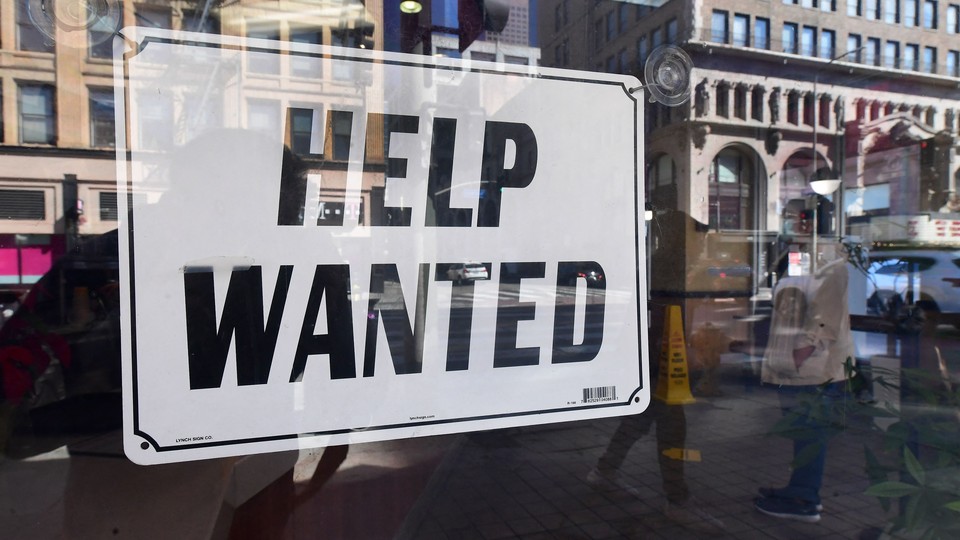
In the spring of 2021, I traveled to Pennsylvania to attend a graduation. Driving around the area, I was struck by all the signs in diner and fast-food storefronts seeking workers. As I recall, the signs had a desperate tone, advertising bonuses and high wages to anyone willing to work. I was witnessing in real time a fascinating economic moment: Low-wage workers were in high demand, and that meant they were gaining leverage.
The signs I saw in Pennsylvania were emblematic of what was happening across the economy. Restaurants are a “microcosm” of the Great Resignation, the pattern that took off in 2021 in which workers quit their jobs to seek higher wages and better benefits‚ Nick Bunker, an economist at Indeed’s Hiring Lab, told me. That spring, as freshly vaccinated Americans went out to spend their stimulus checks, they frequented restaurants. Demand for services soared, and so in turn did the demand for service workers. Businesses had to compete for staff. And when workers saw that they could find better wages and conditions elsewhere, many quit their jobs in favor of new ones.
The latest jobs data suggest that workers might be losing some of this power. The economy added about 209,000 jobs in June, according to data from the Bureau of Labor Statistics released last week. It was the 30th consecutive month of job gains, but gains were at their lowest rate since the streak began. “The picture that emerged was a mixed one,” Julia Pollak, the chief economist at ZipRecruiter, told me. “Workers are still in the driver’s seat in many industries, other than tech, but they are losing leverage.” However, she added, the job market is “still more favorable to workers than before the pandemic.”
What’s happening in hospitality, a sector that includes restaurants and bars, tells us a lot about the job market more broadly. That was true in 2021, Bunker told me, and it’s still true now. Looking at the behavior of the hospitality sector in last week’s report, Bunker noted, we can see that “the labor market is moderating but still strong.”
As the job market softens somewhat, workers may be losing some of the leverage they gained when the market was tighter. As Ben Casselman reported in The New York Times last week, “The rate at which workers voluntarily quit their jobs has fallen sharply in recent months—though it edged up in May—and is only modestly above where it was before the pandemic disrupted the U.S. labor market.” When workers quit jobs, it reflects their confidence that they can find another, better job. Casselman reported that hourly earnings for hotel and restaurant workers rose 28 percent from the end of 2020 to the end of 2022, which was faster than the rates of both inflation and overall wage growth. But now, after surging in late 2021 and early 2022, growth for low-wage workers has slowed, and fewer workers in the hospitality industry are separating from their jobs now compared with the same period last year.
This slowing wage growth could be seen as a sign that workers are losing ground. But another possible reason that wage growth has slowed, Bunker explained, is that many workers’ base pay has gone up compared with a couple of years ago. Employers are “giving raises off a wage rate that has risen a lot since the spring of 2021,” Bunker said.
The Fed will be happy to see the job market cooling off, Bunker told me, so we might see fewer interest-rate hikes in the months to come: “Reduced competition for workers is going to reduce wage growth, which is—in the Fed’s view—going to put less pressure on employers to raise prices, so that should bring inflation down.” But after pausing their hikes last month, following 10 consecutive rate hikes, the Fed is still widely expected to raise rates at its meeting at the end of this month.
The monthly job-openings report tells us more about the recent past than it does about our current reality. The patterns we saw in last week’s numbers contain new information about a moment that’s already slightly dated. And they raise fresh questions about whether the Great Resignation is over. Bunker, for his part, riffed on Mark Twain, saying that in his opinion, “rumors of the Great Resignation’s demise are greatly exaggerated.” But, he added, in a few months, we may be able to say more definitively whether the heyday of the Great Resignation really is behind us.
Related:
Today’s News
- The Kremlin stated that Wagner chief Yevgeny Prigozhin, whose location remains unclear, met with Vladimir Putin after last month’s failed mutiny.
- Joe Biden began his trip to Europe by meeting with U.K. Prime Minister Rishi Sunak to show unity ahead of a NATO summit that will likely be divided over how to support Ukraine.
- Dangerous triple-digit heat will affect more than 35 million people in the South and southwestern United States this week.
Dispatches
- Famous People: Lizzie and Kaitlyn go to an indie-sleaze 31st-birthday party and learn that the semi-ironic theme party is a delicate art.
- Up for Debate: Conor Friedersdorf gathers readers’ thoughts on affirmative action.
Explore all of our newsletters here.
Evening Read

The Secret Power of Menopause
By Liza Mundy
Don’t try to tell this to a mother sitting in the bleachers during a four-hour swim meet; or enduring a birthday party involving toddlers and craft projects; or resting in an armchair on a peaceful evening, savoring the heft of a tiny body and the scent of an infant’s freshly washed hair. Interminable or sweetly languid though they may feel in the moment, the childbearing years are startlingly brief. Fertility, which typically ends in a woman’s mid-40s, occupies less than half of her adult life. And then, if she’s lucky, she has 30 or 40 years in which to do something else.
Most people don’t realize how unusual humans are, in the way that nonreproductive females (how shall I put this?) persist. Females of most other species can bear young until they die, and many do, or at best enjoy a brief respite from breeding before death.
More From The Atlantic
Culture Break

Read. “Refugee Year,” a new poem by Bhion Achimba.
“In the week of power outages, / in the year of hunger, all we had was love, / its fused & infinite grammar, its wet eyes / & tenderness for days.”
Listen. Our kids will not have the childhood of our imaginations. In the latest episode of Radio Atlantic, Hanna Rosin explores how climate change is making summer more dangerous.
P.S.
Over the weekend, I made a six-foot-long party sub and served it to my friends in Prospect Park. One section was filled with soppressata, capicola, mortadella, and provolone; another with prosciutto and pecorino; and the final one with vegetables and hummus for my vegan pals. This was my third year making this sandwich, and I am delighted to report that inflation does not seem to have affected the price of the six-foot bread, which I purchase each year from a local Italian bakery in Brooklyn. In my biased opinion, making and eating such a sandwich is a perfect midsummer treat!
In case you’re interested in attempting your own version: I got the idea to make the sandwich in the summer of 2021 after reading Gabrielle Hamilton’s “Eat” column in The New York Times Magazine. “What other thing is as reliably cheerful as a sandwich that’s practically the size of an automobile?” she asks. What indeed! Hamilton offers great tips for a meatless version, but if you, like me, are also interested in stuffing the bread with tasty cured meats and cheeses, I recommend this Bon Appetit guide.
— Lora
Katherine Hu contributed to this newsletter.