Try Listening to Your Literature
Audiobooks are less demanding—and maybe that’s a good thing.
This is an edition of the revamped Books Briefing, our editors’ weekly guide to the best in books. Sign up for it here.
Audiobooks have never worked for me; as a rule, I don’t listen to them. I recognize this as my own failing, but while one is playing, I’m easily distracted. All it takes is one glance up at a poster on the street, or down at my phone, and I’m tuning out what I’m hearing. And unlike when I look away from a book, the story continues on without me, undisturbed. When I return to the narrative, I may be sentences—or paragraphs—behind.
First, here are four new stories from The Atlantic’s Books section:
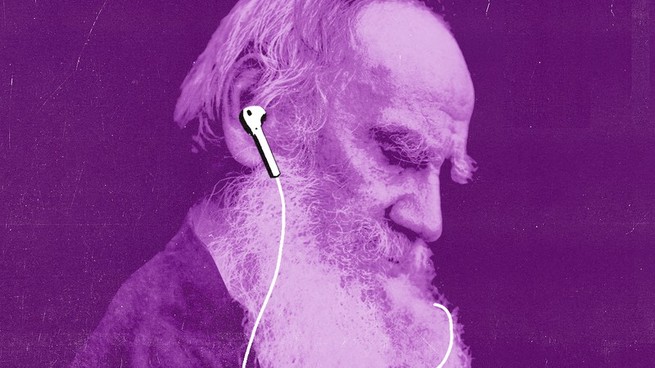
I read Sam Apple’s dispatch about the growing popularity of audiobooks with some apprehension. If everyone else is listening to their literature, does that mean I’m just prone to getting off task or somehow unable to focus on oral storytelling? I found, however, that I’m not alone. For years, scholars have pointed out that the printed word is more cognitively engrossing, and Apple agrees that audiobooks demand less from us. But he doesn’t think that’s a bad thing. They’re popular because they’re fun—maybe more fun than traditional reading.
Apple describes a dilemma that’s almost the opposite of mine: As he fell into a pattern of “Tolstoy and chill,” forgoing a Netflix binge for Maggie Gyllenhaal narrating Anna Karenina, he began to worry that he wasn’t taking the literature seriously enough, that he was somehow “cheating.” He was just tapping into a different register: The animating power of the human voice gives books the propulsive energy of television or film. Audiobooks emphasize the primacy of story. The excitement of turning a page doesn’t come from the paper itself; it stems from the desire to know how the tale ends.
Apple reports that “audiobook sales have seen double-digit increases each year since 2012,” and that “the trend is only likely to accelerate in the years ahead.” That’s remarkable at a time when schools struggle to get kids to find joy in reading, as Katherine Marsh detailed for us in March. As the literary critic Laura Miller put it to Apple, “Why would you even care about allusions or techniques if you don’t actually enjoy novels to begin with?”
My wife loves audiobooks, and she tore through Cixin Liu’s Remembrance of Earth’s Past series in just a few weeks. Meanwhile, though the premise sounds exciting, I still haven’t managed to pick up the first volume. I find myself fighting to make space for the growing stack of books on my side tables, and to turn my undivided attention toward them for even 10 minutes at a time. Maybe the answer is to lean back into an audio narrator’s embrace—to use my commute, or the half hour before I drift off to sleep, to relax and simply find out what happens next.
What to Read
Invisible Cities, by Italo Calvino
Calvino’s masterpiece has multiple layers of riddles: Its chapters are arranged in mathematical precision according to the Fibonacci sequence, it involves real historical figures but isn’t realistic, and the titular cities are full of impossibilities … Ersilia, for instance, is repeatedly abandoned by its inhabitants and built elsewhere; Eusapia’s denizens have constructed an exact copy of their city underground to which they bring their mummified dead so that they can eternally pursue the pleasures they enjoyed in life; Isidora appears when a weary traveler yearns for a city, and fulfills dreams that belong to the traveler’s younger self rather than to who he is now. Whether the places exist literally or only metaphorically, whether Kublai Khan and Marco Polo are actually conversing—well, that’s up to you to decide. — Ilana Masad
From our list: Six books that feel like puzzles
Out Next Week
📚 Directions to Myself, by Heidi Julavits
Your Weekend Read

The Fundamental Paradox of Latinidad
It isn’t often in middle age that, after an encounter with literature, you find new meaning in childhood events that you’d understood one way for decades … [Héctor Tobar’s new] book made me wonder about the racial dynamics between the two halves of my family—my mother’s side, white, and my father’s, Latino—which I’ve never asked my parents about. When Tobar writes about high-school guidance counselors who discourage their Latino students from applying to the best universities, I remembered sitting in the office of my own guidance counselor and sinking in my chair as she did the same. When he recalls the homes his aunt Gladys cleaned in Beverly Hills, I remembered accompanying my grandma while she cleaned the houses of wealthy white families in Tucson.
When you buy a book using a link in this newsletter, we receive a commission. Thank you for supporting The Atlantic.