This is an edition of the revamped Books Briefing, our editors’ weekly guide to the best in books. Sign up for it here.
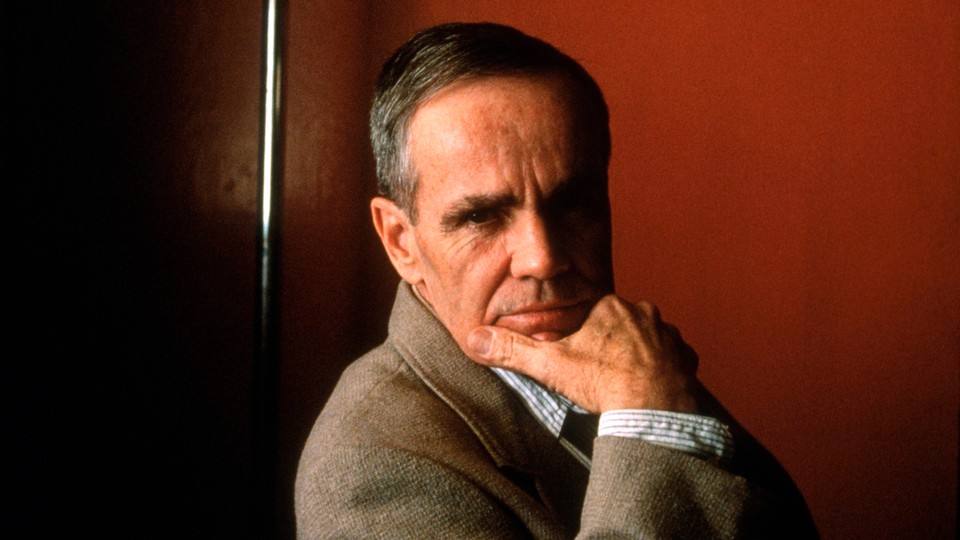
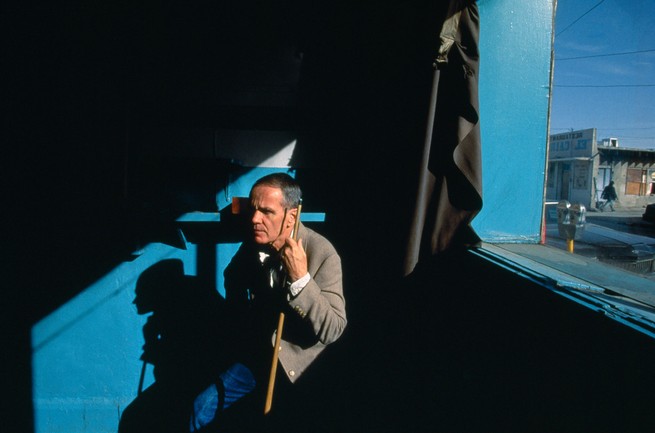
Cormac McCarthy died this week. With him went a style that seemed chiseled out of granite—biblical, as if produced by an Old Testament prophet who had somehow found himself wearing dusty dungarees and shuffling through a desert in the American Southwest. McCarthy’s commitment to writing in this otherworldly register feels like a last remnant of a literary world in which writers could push their singular visions regardless of whether they jibed with the times.
First, here are four new stories from The Atlantic’s Books section:
When I first got news of McCarthy’s death, the person I most wanted to hear from was my colleague Graeme Wood. Graeme had recently written an essay about McCarthy’s last two novels, a pair of books released in 2022, The Passenger and Stella Maris. They were McCarthy’s first in many years, and they were also the first in his oeuvre, Graeme noticed, “in which no horses are harmed and no humans scalped, shot, eaten, or brained with farm equipment.” Graeme was a fan, especially of the way these late books brought McCarthy back “to human concerns, but ones—love, death, guilt, illusion—experienced and scrutinized on the highest existential plane.”
How exactly McCarthy operated on that existential plane is what intrigued Graeme most in the appreciation he wrote for The Atlantic this week. Consistent through his novels was a voice that seemed to speak—at greater or lesser volume, depending on the book and era—from a mountain top or out of a passing cloud. It was a powerfully weird quality that Graeme captured well:
The worlds depicted in Blood Meridian and The Passenger are not built for mortal humans like you and me. They are built instead as arenas of combat for godlike figures with little interest in providing temporary solace to the humans who pass through their worlds. These superhuman characters have plans and battles whose schedules are measured in millennia, and they regard the rest of us with only peripheral attention. The subject of his inhuman novels is ironically most humane: how to live and die as a mortal being, while in the crossfire of gods and demigods on a battleground that preceded human existence and will continue long after we are all gone.
The invocation of an artist who had a unique approach to fiction that he stuck to in book after book, regardless of commercial success, put me in mind of another literary death this week. Robert Gottlieb, the legendary editor who stood behind so many giants, including Toni Morrison and Robert Caro (though the list is a lot longer than those two), died at 92. Gottlieb was as gregarious and zany as McCarthy was taciturn and reclusive—for one thing, McCarthy surely would never have owned an extensive collection of plastic women’s handbags, as Gottlieb did. But what brings the two together, in my own mind at least, is an unstinting adherence to making their literary taste manifest. For Gottlieb this meant carving up others’ manuscripts with passion and industriousness and single-minded dedication to improving his authors’ books; he cared about little else.
I recently wrote about a documentary, Turn Every Page, that explored Gottlieb’s relationship with Caro and their great yet unfinished biography of Lyndon B. Johnson—it’s painful to think of Caro’s loneliness this week. The essence of this partnership was a battle of wills fought by two men who worked hard to make what appeared on the page align with what they imagined in their minds. In describing Caro, Gottlieb in the film described himself, too, and maybe all artists—may they continue to exist—who are so intensely driven. “The great thing about Bob is also the maddening thing about Bob,” Gottlieb said about Caro. “Everything is of total importance—the first chapter of the book and a semicolon. They’re of equal importance, and he can be equally firm, strong, emotional, irrational about any of them. I’m like that too; it takes one to know one.”
On the Death of Cormac McCarthy
What to Read
Memorial, by Bryan Washington
Mike and Benson’s four-year relationship is slowly but inexorably falling apart, and neither of them quite knows why, or how to stop it. Things become more complicated when Mike drops off his mother, Mitsuko, at their apartment to stay with Benson, the Black boyfriend she’s never met; then Mike flies to Japan to be with his estranged, dying father. In sections alternating between each man’s perspective, Mike and Benson go about their days in different countries. But what preoccupies both men are the quotidian moments that constituted their life together, in a partnership whose future is now uncertain. It’s an ode to a certain kind of romance, the knotted but enduring devotion between people who simply can’t make it work. “But that doesn’t diminish the love,” one character says. “It just changes forms.” — Chelsea Leu
From our list: The best books for a broken heart
Out Next Week
📚 I Am Homeless If This Is Not My Home, by Lorrie Moore
📚 Watch Us Dance, by Leila Slimani
📚 Beyond the Shores: A History of African Americans Abroad, by Tamara J. Walker
Your Weekend Read

Who Was Cleopatra’s Daughter?
Historians should certainly try to uncover the forgotten women of classical antiquity, and to spot those whose strength has been overlooked … But understanding how women in the ancient world were silenced is equally important. What social mechanisms and cultural assumptions help explain why those who may have claimed some power were overlooked—or, alternatively, demonized? Cleopatra senior is a good case of vilification, and so is Augustus’s wife Livia, who was blamed for almost every death within the palace walls. In the end, for the historian, unearthing the reasons we know so little about Cleopatra Selene—probing into who wrote her out of the story, and how—is a more instructive project than reinventing her to fit our own template of power.
When you buy a book using a link in this newsletter, we receive a commission. Thank you for supporting The Atlantic.