The Debt Ceiling Wasn’t Always So Politicized
A guide to the current crisis and how we got here
This is an edition of The Atlantic Daily, a newsletter that guides you through the biggest stories of the day, helps you discover new ideas, and recommends the best in culture. Sign up for it here.
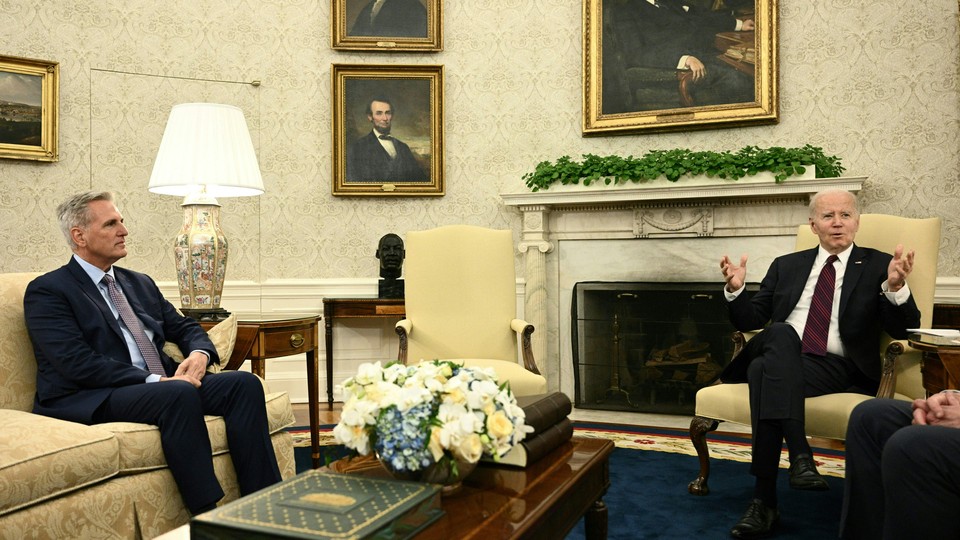
This afternoon, President Joe Biden met with House Speaker Kevin McCarthy in their first sit-down since February. The meeting produced no breakthroughs on the federal debt ceiling, even as a deadline for default looms in early June. I called my colleague Russell Berman, who has been watching the ongoing stalemate closely, for help creating a short guide to this moment.
First, here are four new stories from The Atlantic:
Debt Questions, Answered
Is this 2011 all over again?
This month’s debt-ceiling crisis comes with a dose of déjà vu. As Russell explained last week, the circumstances largely echo the 2011 showdown between congressional Republicans and then-President Barack Obama: A new GOP majority in the House is using the looming threat of a national default—which would likely lead to a stock-market crash and possibly a recession— as leverage to push a first-term Democratic president to agree to spending cuts.
But after talking with Eric Cantor, who in 2011 was the House majority leader deputized to negotiate an agreement with then–Vice President Biden, Russell reported that the crisis we’re in now is worse than that of 12 years ago. He gave me three reasons:
- Kevin McCarthy has a lot more to lose than his predecessors did. “Republicans have a much smaller majority in the House this time around,” Russell noted. McCarthy “is operating with much less room to maneuver, given how hard he had to fight just to get the job. There’s an ever-present threat that if he negotiates a bad deal or if he folds in this confrontation, he could be ousted.”
- One important subject is off the table this time around: Both parties have decided not to negotiate on the major entitlement programs of Medicare and Social Security. Russell explained that Republicans are not asking to cut those two major programs, as they did in 2011, due in large part “to the influence of former President Trump,” who endorsed a hands-off approach to the programs to avoid alienating older voters. The removal of these programs from negotiations could make it a bit easier to get to a deal, but it also means that if the GOP gets President Biden to agree to any cuts, they’re likely to be smaller than what the two parties were talking about in 2011.
- The most meaningful distinction between the 2011 standoff and today’s might also be the simplest: The two parties haven’t even started to negotiate. The deadline for America defaulting on its debt is a bit of a moving target, but Treasury Secretary Janet Yellen has said that the country could default as soon as June 1 if Congress doesn’t raise the debt ceiling. At this time in 2011, however, a lot of negotiation had already happened—“because the Obama administration conceded the premise that Republicans were offering, which was that this was something to negotiate over,” Russell said. Today’s meeting was really just the beginning of the conversation—and that’s a late start, with just three weeks until the deadline.
Why does this keep happening?
How did the U.S. wind up with such consistent debt-ceiling drama anyway? Russell explained that contentious debt-ceiling debates haven’t been the norm for America’s entire history. In fact, 2011 marked a shift away from debt-limit negotiations being anything other than a formality. “What the Republicans did in 2011 set a precedent that the Democrats really hate, in which the debt ceiling is not just automatically raised,” Russell said.
The idea of automatically raising the ceiling makes some sense if you think about what the debt ceiling actually is: “It’s essentially paying for spending that Congress has already authorized and appropriated,” Russell told me. “The common analogy is to the credit-card bill. You don’t really negotiate with your credit-card company over whether you’re going to pay the credit-card bill.”
Especially in the past few years, Democrats have put forth proposals to take these negotiations off the table and change the law, “so that Congress does not have this cudgel that can hold the United States economy hostage to what has been a very polarized, often dysfunctional legislative branch,” Russell said. Some Republicans have even expressed interest in these proposals too.
But until then … what’s next?
Russell walked me through three possible scenarios:
- The parties do not reach a deal in the coming weeks, and the country either defaults or gets very close to defaulting on its debt. If that happens, “the stock markets begin to crash, and the political pressure ramps up significantly on both parties,” Russell said. “And that’s where you might see one party blink.”
- Speaker McCarthy, President Biden, and the two parties just “agree to punt,” as Russell puts it—“to basically say, We’re going to raise the debt ceiling for a short period of time, to buy time for formal negotiations on spending and the budget.” The GOP’s concession would be to raise the debt ceiling without getting any spending cuts, whereas President Biden’s concession would be to say, We’re going to negotiate on this where we had previously said we wouldn’t.
- The parties reach a deal. What would a deal look like? “The Republicans would like an agreement in which Congress and the president commit to reduce spending over the next two years, in addition to some other issues,” Russell told me. So a deal would include “an agreement on big-picture spending levels, plus maybe one or two other policy issues that aren’t directly related to spending, where the parties can make some progress.” The exact shape that such an agreement would take remains to be seen.
Related:
Today’s News
- Imran Khan, Pakistan’s former prime minister, was arrested. He has accused the country’s military of colluding against him.
- According to new draft recommendations from a prominent national health panel, women should start receiving mammograms at age 40 instead of age 50.
- A jury has found Donald Trump liable for sexual abuse and defamation, but not rape, in the civil case brought by the writer E. Jean Carroll.
Evening Read
/media/img/posts/2023/05/bluecheck/original.gif)
How to Build (And Destroy) a Social Network
By Charlie Warzel
On a perfect spring day in 2017, I joined a gathering of right-wing internet trolls in Austin, Texas. They’d arranged the meetup to support the Infowars founder and conspiracist Alex Jones during his child-custody trial; I was reporting on all this and ended up in a stilted conversation with a prolific 4chan poster. We realized that we were born only a few miles apart from each other in Ohio, which apparently came as a shock. I thought all you blue checks were from New York City or California, he said with no trace of irony.
That was the first time I’d ever been referred to in the physical world as a “blue check.” Technically, the term meant that I was somebody who’d been verified on Twitter, but it was more familiar to me as a derogatory bit of internet slang. Sometime in the late 2010s, the moniker became a handy stand-in for a large class of mostly left-leaning journalists, celebrities, activists, and other personalities on Twitter. Blue checks were supposedly privileged and out of touch, like the “liberal elites” who preceded them.
More From The Atlantic
Culture Break

Read. Caitlin Dickerson’s definitive account of the Trump-administration policy that separated migrant children from their parents, which won the 2023 Pulitzer Prize for Explanatory Reporting yesterday.
Watch. Baby J (streaming on Netflix), a new comedy special in which John Mulaney brilliantly destroys his likable persona.
Katherine Hu contributed to this newsletter.