This is a subscriber-exclusive edition of Unsettled Territory, a newsletter about culture, law, history, and finding meaning in the mundane. Sign up for the newsletter here, and subscribe to The Atlantic for access to more exclusives like this.
A week and a half ago, I spoke to one of the most important interlocutors I consulted while writing South to America, Dr. Walter O. Evans. He’s known as both a surgeon and a collector of African American art and artifacts. Dr. Evans offered me an important correction that I assured him I will fix in later printings (I misstated that his marriage to Linda Evans was a second marriage for both, but it was only her first). I accepted it humbly, in addition to being relieved and joyful about his appreciation of the book. He shared with me some photographs related to the material in the book, of writer Albert Murray and painter Romare Bearden. I was thrilled at his approval. But most importantly, I was reminded why people like Dr. Evans were so essential to this book, and remain so influential to me as someone who cares about how the past bears on the present.
I first met Dr. Evans in the summer of 2019 because I was curious. I had planned a work trip to Savannah, Georgia, so I asked the historian David Blight to introduce me to him. The dedication to David’s Pulitzer Prize–winning biography of Frederick Douglass, Prophet of Freedom, is made out to Walter and Linda Evans. I loved the meticulousness of the story David told, aided by Walter’s collection of Douglass family photo albums and other paraphernalia. Although I didn’t really know David, we’d sat next to each other at a dinner and at a lunch, and he’d once described my book on “Lift Every Voice and Sing” as “a hell of a history,” and so I took a chance. He graciously issued an introduction. Walter invited me to his home.
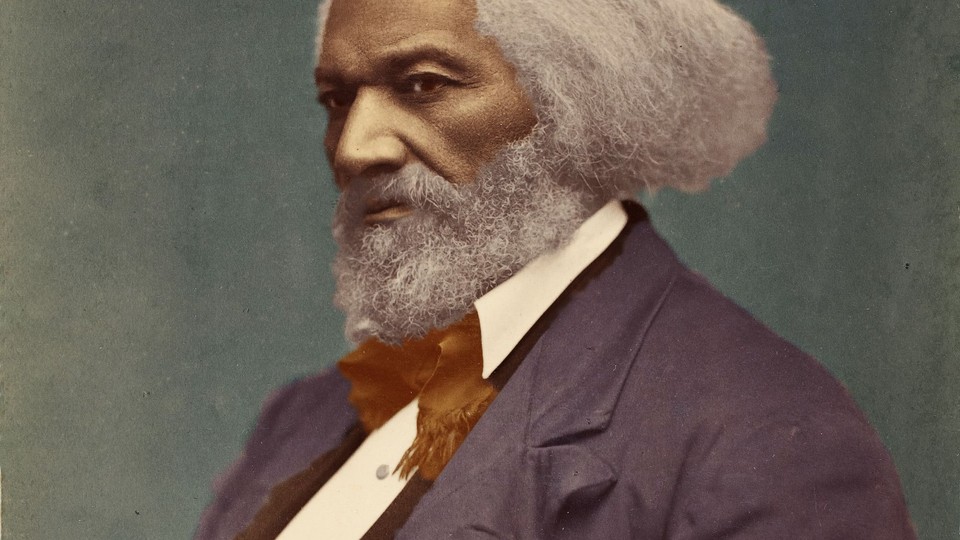
Like many Black bibliophiles, I see Frederick Douglass as a saint of our tradition. And so I was giddy to arrive at Walter’s home in Savannah. Before I knew we would be friends, before I was sure that his life would have to be recorded in some way, I just wanted to meet the man who had collected saintly artifacts and therefore made it possible for a historian to breathe more life into the stone-face portraits of Douglass.
Douglass is, among other distinctions, the father of African American literature. My favorite part of Narrative of the Life of Frederick Douglass is its crossroads moment. Master Auld has sent Fred, who has grown too aspiring and headstrong, to be disciplined by Covey. Covey crushed the bodies and spirits of the enslaved as a career. The pages barrel toward confrontation. As the climax approaches, a conjure man named Sandy offers Fred an amulet. Speaking as the narrator, Fred dismisses the traditional African power it holds. But as a narrative device, the amulet works. Fred defeats Covey in a physical battle. In recounting this moment, he utters what will become the most storied chiasmus in African American letters: “You have seen how a man was made a slave; you shall see how a slave was made a man.” My fascination with the African American tradition is centered on the late 19th century and what it meant for people who had been overwhelmingly enslaved to enter public life. The work of “freeing oneself”—beyond literally joining the Union army—entailed writing one’s own story, and the story of one’s people. It is a struggle that has continued, that effort to be emancipated from narrow conceptions of what Black people can do and be. It has been important not only to carry on that ideal, but also to record it. Walter Evans is a collector who has preserved evidence of that tradition. Les Payne, the posthumous winner of both the 2020 National Book Award for Nonfiction and the 2021 Pulitzer Prize in Biography, for the Malcolm X biography The Dead Are Arising, was Walter’s best friend. In fact, it was Walter who shared the letters between Malcolm X and his brothers with Payne, and first inspired Payne to devote three decades to writing about Malcolm X.
Walter is no less dedicated to preserving Black women’s history. One afternoon at the height of the pandemic, we talked about Harriet Jacobs’ 1861 slave narrative, Incidents in the Life of a Slave Girl. Freedom, for Jacobs, was not just to be found in escape from slavery. It was to be found in building a home of her own, a place that could hold her family safe from slavery and slavecatchers. It was as though she articulated Virginia Woolf’s idea of a “Room of One’s Own” a full 68 years earlier, while held in chattel slavery.
At any rate, after I got off the phone with Walter, I began edits on an article in which I referenced James Baldwin’s time in Birmingham, Alabama. I started down my rabbit hole of ancillary research and soon found myself on the website of the Beinecke Library at Yale. I perused, under the heading “I best not linger here,” a chilling Baldwin quote regarding the racial terror of my hometown of Birmingham, a letter written from Baldwin to his friend Mary Painter. It was on the stationery of the A. G. Gaston Motel, which was owned by one of the most prominent Black businessmen in Birmingham history and stands across the street from the 16th Street Baptist Church. In the image of the letter, one can see the outline of the folder it came in when it arrived at Yale.
The folder reads, “Walter O. Evans Collection of James Baldwin.”
I best linger here, in history, not just to recount its horror. I’m here to honor the resilient and resistant.