Like many parents, I’m entering this new year anxious about having my children return to school. Feelings of anxiety and stress have been at fever pitch over the past year and a half. All too often, as parents we feel like we face challenges alone rather than in communities of support. It has been heartening to witness the growth of mutual-aid organizations and activists who are advocating for community care in the face of our public-health crisis. There are also lessons to be learned from the past to weather this moment.
As I mentioned in an earlier newsletter, I’ve been reading Florence Tate’s posthumously published memoir, Sometimes Farmgirls become Revolutionaries, which documents her personal journey through the Freedom Movement, the rise in Black electoral political leadership, and international movements for Black liberation. She was an unsung and important organizer and activist. This book restores her place in history. In it she depicts, along with her political work, how she raised a family and struggled with depression.
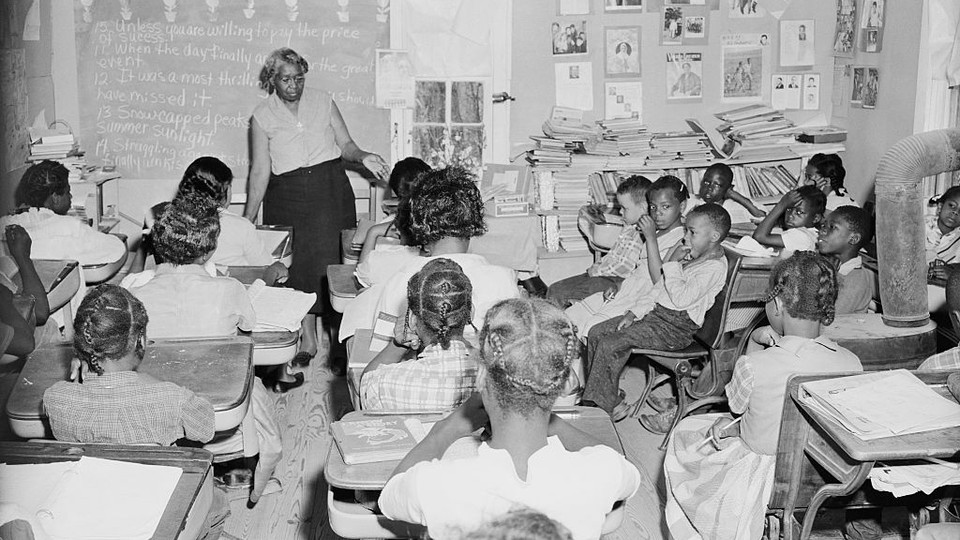
Over the past several days I’ve been dwelling on Tate’s account of attending segregated schools in Memphis. Her segregation story is one not of deprivation, but rather, of abundance. It is consistent with many other such stories I have read. You are probably more familiar with accounts of how segregated schools were inadequate. But despite inequality, there were extraordinary school communities that flourished in the segregated South. They did so notwithstanding grotesquely unequal funding, the violence of Jim Crow, and limited occupational prospects for graduates. Senior scholars like Vanessa Siddle Walker, James D. Anderson, Michael Fultz, and my mother, Theresa Perry, along with younger-generation academics like Crystal Sanders and Jarvis Givens, have worked diligently to restore a submerged history of Black education. Their books and articles are indispensable for getting a full account of life for schoolchildren during Jim Crow.
In my book May We Forever Stand: A History of the Black National Anthem, I recounted the daily rituals in segregated schools, which overwhelmingly included singing “Lift E’vry Voice and Sing” (1900). School archives were an important resource for me, capturing how the song functioned in the history of civic organization as well as political mobilization.
What most touches me about Tate’s account of her own school years is her description of how, having experienced what she describes as abandonment from her parents, school nurtured her in a way that allowed her to grow into the extraordinary woman she would become. She wrote:
I felt almost homeless through much of my childhood, shuttling back and forth between family members… But there was one good thing in my life that I came to excel in and rely on: Manassas Elementary and High School was a place where I was able to shine…In many ways, Manassas became a substitute for family. The teachers were like parents, the principal was like the father of the school… At Manassas, the faculty and administrators made it a point to make us kids feel good about ourselves and recognize us for our achievements and talents. I couldn’t wait to get to school, and I would be sorry when school was out for the summer because school was where I felt loved and appreciated.
Teachers and the larger school community were key in Tate’s development. Even in her later years, she remembered the names of all of her educators, from third grade to 12th, and could still describe their personalities and dispositions. Her book is a beautiful homage to them.
Reflecting on her story, and the present moment, I return to a conviction that I hold dear: When parents are struggling—which is virtually a universal condition these days and always the case for a critical mass of poor and working-class families—it is important for schools and the larger community to step into the breach. The kind of trust and mutuality, however, that is necessary for that to happen is only possible in communities that recognize the interdependence and value of all of their members.
These days, we too often treat the children of struggling families as shameful and disposable, while we reward children who are prosperous and healthy with praise and opportunity. And teachers are consistently devalued across the spectrum of schools. This doesn’t bode well for our collective future. Imagine if school had not provided a necessary affirmation for Tate and so many others who were integral to transforming this society so profoundly. Imagine what we are losing today by neglecting so many families and shrugging our shoulders at their circumstances.
Over the past several years, in an endeavor funded by the Mellon Foundation, I’ve been working with Jarvis Givens and Micha Broadnax on a project titled The Black Teacher Archives. At present, we are collecting and digitizing the journals produced by state and national Black teacher organizations in the Jim Crow era. This is the first phase of a long-term project that will provide a key resource for the study of education and the history of American schools and African Americans.
The journals are extraordinary documents of the intellectual life, pedagogical practices, and political commitments of educators who worked in communities facing extraordinary adversity and constraint. We have an extraordinary body of historical documents that we hope will eventually be widely available to scholars and teachers. That trove exists largely because historically Black colleges and universities have preserved these documents for generations. These are institutions that recognized and continue to recognize African American tradition and the excellence that came out of Black communities long before the larger society would even consider doing so. The teachers they trained were a lifeline to the larger world.
Tate describes this in her own experience:
Mr. Hayes, our principal, brought a parade of great Negroes to Manassas: saxophonist and bandleader Jimmie Lunceford, groundbreaking educator Mary McLeod Bethune and heralded opera singers, Roland Hayes and Dorothy Maynor. Assembled in the school’s large auditorium, we’d gather to hear these inspiring and eminent guests discuss their experiences and share their talents.
My point here is a relatively modest but important one about learning from African American institutional histories. When I read coming-of-age accounts like Tate’s, and those of teachers in Jim Crow schools in the early to mid-20th century, I am reminded that there are useful historic models of how Americans have related to each other under duress. There are legacies of generosity and collectivity at the worst of times that are at our disposal, if only we seek them out. The risk of telling our history as a story of ascent, from a terrible and painful past to a more hopeful today, is that we often assume that the bad old days offer little for imagining a better tomorrow. Nothing could be further from the truth.