January 1957
In This Issue
Explore the January 1957 print edition below. Or to discover more writing from the pages of The Atlantic, browse the full archive.
Articles
The Atlantic Report on the World Today: Washington
London
In the Interest of 103,000,000 Americans
The life insurance business in the United States has often been called a trusteeship for the millions of families and individuals who count on it for protection against income interruption. Here the Institute of Life Insurance tells the story of the role played by life insurance in adding not only to personal security but also to national progress in America.
Eyewitness in Warsaw
An English authority on Soviet affairs, EDWARD CRANKSHAWwas in Warsaw when the Satellite Revolution boiled over; he had seen it coming and wished to be on the spot when the break occurred. The article which follows was written in the Polish capital and, coming to us airmail, was the last piece of copy in this issue to go to press. Mr. Crankshaw is the author of three books widely read on both sides of the Atlantic: Russia and the Russians, Cracks in the Kremlin Wall, and his recent Russia Without Stalin.
Aliens in a Free World
A Czech who settled in the United States in 1938, JOSEPH WECHSBERG became naturalized, served as a technical sergeant in the U.S. Army during World War II, and was on duty in Germany when his first book, Looking for a Bluebird, appeared. Most of his writing has been done on and about the Continent; he keeps in close touch with Central Europe — he is revisiting Czechoslovakia as this article goes to press — and in close touch with those Europeans who come to us for sanctuary.
The Middle East
One Kind of Colloquy
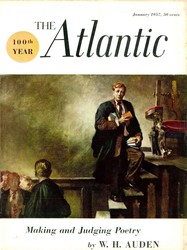
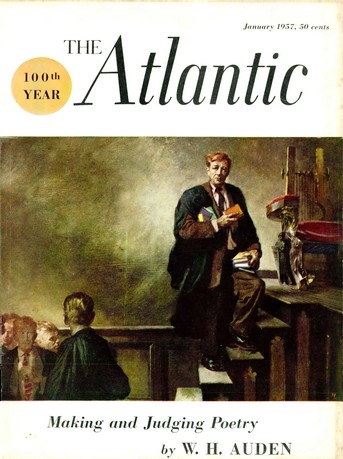
Making and Judging Poetry
Last spring two distinguished Englishmen were nominated to fill the chair of Professor of Poetry at Oxford University, W. H. AUDEN and Harold Nicolson. There was heated argument among the dons and undergraduates; signs reading“Auden for Prof” were chalked on the walls; and when at last the votes were counted, it was indeed the poet who had been elected. On his inauguration Mr. Auden, after paying his respects to the office and to the line of distinguished scholars and poets who had preceded him, began to speak of the Censor, that inner voice and self-critic who occupies and determines each individual poet in his time.
A Way of Dying
In the old days, most people approached the end of their lives in the privacy of their homes with the family to attend them and with only a minimum of medicine to prolong life. Our big metropolitan hospitals have provided care and alleviation for those in pain, but they have also made of dying, as this widow tells, an ordeal which has somehow deprived death of its dignity.
Chairman Billingsley
DILLON ANDERSON,who served as Special Assistant to the President on National Security Affairs and who took an active part in the Geneva Conference, has now resumed his law practice in Houston. Luckily for the Atlantic, Mr. Anderson has a special facility for writing on trains and planes; in these moments he has found time to compose two volumes of short stories, I and Claudie and Claudie’s Kinfolks, and to give us biographical accounts of his preposterous friend, Billingsley, his companion at the poker table and in the hunting field.
Miss Carlo
NATHANIEL LAMAR, who was horn in Atlanta, Georgia, twenty-two years ago, prepared for Harvard at Phillips Exeter. He majored in English and found particular stimulus for his writing in the courses which he took under Archibald AlacLeish. Mr. LaMar's first story in the Atlantic, “Creole Love Song,“ won the Dana Reed Award at Harvard and was reprinted in The Best American Stories, 1956. Last autumn he began to work on his first novel; and to assist in its completion, we have awarded him an Atlantic Grant in Fiction,
Pursuit
A poem
Alaska Fights for Statehood
“Alaska’s history has been one of neglect by a distant and uninterested federal government. Worse, it has been a history of continuing discrimination which makes Alaska today a flagrant example of colonialism.”
The Lion and the Throne: The Law Is the Safest Shield
Mr. Justice Holmes, John Adams, and Sir Edward Coke — to the study of these three giants in lawCATHERINE DRINKER BOWEN has devoted no less than fifteen years. The sequence is important, for each of the three built upon the edifice of his predecessor; and for this reason perhaps Sir Edward Coke, who suppressed the conspiracies against Queen Elizabeth and fought for the Commons against James I and Charles I—perhaps he is the mightiest of the trio in that he laid the foundations of our Bill of Rights. The following excerpt, which shows Sir Edward — now Chief Justice Coke—in his historic role of champion of the common law against King James’s abuse of the royal prerogative, is the third drawn from Mrs. Bowen’s new book, The Lion and the Throne. These excerpts are highlights in a volume which in its entirety runs to 200,000 words.
Eight Years in the Making
A Londoner who cherishes every vestige of the cockney, WOLF MANKOWITZ graduated from Cambridge University and now divides his time between authoritative studies of the Portland vase, humorous articles for Punch, and fiction. His first two novels, Make Me an Offer and A Kid for Two Farthings, were made into films, and his latest, Old Soldiers Never Die, was very favorably reviewed in its American edition last fall.
Coast Flight
The Peripatetic Reviewer
Reader's Choice
Accent on Living
Of Near and Far
To Market, to Market
No Letter Today
The Border Tortilla
Record Reviews
Tourist in Spain