April 1952
In This Issue
Explore the April 1952 print edition below. Or to discover more writing from the pages of The Atlantic, browse the full archive.
Articles
The Atlantic Report on the World Today: Washington
The Cure for Suspicion Is Knowledge
Of the readers who wrote us about the first Advertorial, published in the December Atlantic, a great many liked the idea and the method of presentation. But there was criticism too. One reader wrote: “It seems a waste to devote precious reading time and mental energy to a commercially biased presentation of a controversial question.”Another letter said cryptically: “ We have enough propaganda.”These letters come from people who are suspicious of business. The Atlantic believes that the answer to that distrust is knowledge.
New Jersey, Crossroads of the East
Like the ceaseless movement of tides, there is a derp-seated ebb and flow of industry responding to the pull of economic forces. Today’s management scrutinizes the latest figures on population, railroad tariffs, the availability of raw materials or semifinished parts. It is equally sensitive to new opportunities to sell its own product as customers migrate in answer to their requirements. Public Service FAectric and Gas Company, cognizant of this movement, makes known in this article some of the advantages of New Jersey, the state in which it operates.
The Strange Case of Louis Budenz
“For three long and bitter years,” writes JOSEPH ALSOP, the Washington commentator, “in the White House, in Harry Hopkins‘s office, in Chungking on the staff of China‘s Foreign Minister, Dr. T. V. Soong, and in Kunming on the staff of General Chennault, I fought the Stilwell policy because I thought it would cost us China. I still think I was right. But I never felt the shadow of a reasonable doubt about the American loyally of the men on the other side. ” Mr. Alsop now proceeds to examine the charges Louis Budenz has made.
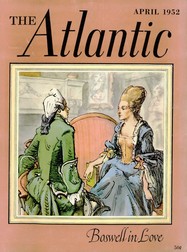
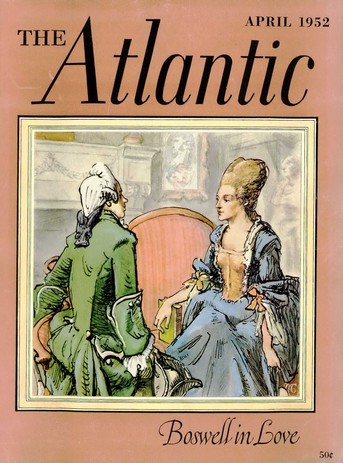
Boswell in Love: His Private Papers and Correspondence With Zélide
“Boswell had gone to London,” writesFREDERICK A. POTTLE,Sterling Professor of English, Yale University, “hoping to transform himself into a high-bred man of pleasure. Though he had the liveliest sense of piety and was strict in attendance at divine service, he prided himself on his intrigues with actresses and women of fashion, and in his frequent street affairs was ashamed rather of the grossness of his debauchery than of its immorality. But on 16 May 1763 he met Samuel Johnson, whose writings he had long admired; he opened his heart to Johnson, was strengthened in his religious faith, and got Johnson to outline a plan of regular study for him. The quest for a commission in the Guards having proved futile, he finally gave in to his father and consented to apply himself to the law. It was agreed that he should spend one winter in study at Utrecht, and that he should then be allowed to visit Paris and some of the German courts.” He was twenty-two when he sailed for Holland. The chronicle which follows is drawn from Boswell in Holland, which will shortly be published by McGraw-Hill.
The Far East
Decision by Silence
The Supreme Court, as FOWLER HARPER points out, has the right to decline to hear most of the cases it is asked to decide. But in times of tension it can he very troublesome, both to the litigant and to the people, when the Court refuses to review a critical case. Projessor of Law at Yale since 1947 and the author of many books on law, Mr. Harper was a reporter on the Restatement of Forts for the American Laic Institute, Solicitor of the Department of the Interior under Secretary Ickes, and Deputy Chairman of the War Manpower Commission in the early stages of World War II.
The Swiss Watch
Each year the Atlantic receives several thousand short stories in the form of fantasies, but it is a rare one indeed which kindles the imagination, much less the belief, of our readers; yet this is whatJOHN LEIMERThas done on three occasions. Our readers will remember his story “John Thomas’s Cube,”which has been reprinted a number of times since its original appearance in the Atlantic. A Chicagoan and a graduate of Northwestern, Mr. Leimert writes: “I make my living by selling corrugated paper shipping containers. My hobbies are watching cats for relaxation, writing fantasies for fun, and the Great Books, of which I am co-leader of a class at the Union League Club. I do not know whether the fantasies are a reaction to the Great Books, or the other way around.”
As the Heart Slows Down
The late ABRAHAM MYERSON was one of Boston’s most distinguished psychiatrists. He received his training at Tufts Medical School; he had been affiliated with several private and state hospitals, and at the peak of a versatile, rigorous career he was brought down by heart disease. He took the diagnosis courageously and so sensibly that he lived out twelve full years. This account of how he kept a stop watch on himself was written shortly before his death and is drawn from the book When Doctors Are Patients, edited by Max Pinner. M.D., and Benjamin F. Miller, M.D., which Norton will publish this month.
Annotation for an Epitaph