What If?
History’s parallel universe
by Cullen Murphy
AT the most recent annual meeting of the Society of Biblical Literature, I attended a session at which a paper was read on certain issues involving inscription fragments from ancient Palestine. When the author was finished, a ponytailed exegete arose to deliver a formal response. He was not an admirer of what he had just heard. The respondent took aim at the paper’s author for, among other things, what he deemed to be an excessive use of footnotes. The footnotes, he said, were “porcupine quills meant to protect an underdeveloped epistemology.”
Jaws dropped. A collective inhalation drew doors and windows tight. There ensued a sometimes heated debate, touched off by the respondent’s remark, on the general subject of historiography— that is, on how history
gets written. Historiography has, of course, been a bloody business for as long as human beings have taken history seriously. The epistemo-
logical question “How do we know what we know?” is tough enough to answer in the natural sciences, where there is at least an agreed-upon scientific method. It is notoriously harder to answer when the subject is our collective past. There are biases and clouded motives to contend with of an especially insidious kind. Very often there is little in the way of unequivocal information. And there is no single avenue of approach. Perhaps not surprisingly, my notes on the debate at the Society of Biblical Literature meeting, though containing some memorable statements (“Modernity isn’t a time,” someone said. “It’s a place”), give no indication of any conclusive result.
Is an underdeveloped epistemology—not being sure that we know what we “know"—really a condition to be ashamed of? Isn’t it, rather, something that most of us live with day after day while managing to go about our business? The difficulties that historians face in showing the past “as it really was"—the goal set for them by Leopold von Ranke, and now believed by many progressive scholars to be unattainable—have obvious analogues in our own lives. Anyone who has suffered from accidents of unreliable memory understands how perceptions of the larger past can go inexplicably wrong. Sometimes the winnowing power of time causes elements of the past to change their very character. Last summer much was made of the fact that we were marking the twenty-fifth anniversary not only of the first moon landing and the Woodstock festival but also of the Manson murders and the drowning at Chappaquiddick. These events have now acquired the status of a constellation, forever fixed in relation to one another. Future movies that are set in 1969 will probably show these events flickering in the background, on the television news, as if to re-create the psychology of the moment. And yet no one I have spoken with who actually remembers the summer of 1969 ever associated any of these events with the others before last summer’s reminder. It was, indeed, something of a shock to realize that they had all occurred within a period of a few weeks rather than a few years. Why hadn’t we noticed this momentous quartet at the time?
The frustrations of real history go some way toward explaining the attractions, at least for me, of the genre known as imaginary history. Whereas trying to determine what actually happened in history is often a frustrating and contentious enterprise, performing a counter-exercise—trying to determine what would have happened if what actually happened hadn’t happened— can prove almost intoxicating. Pascal had imaginary history in mind when he made his famous comment about Cleopatra’s nose: “Had it been shorter, the whole face of the earth would have been changed.”Imaginary history offers access to a parallel universe—one that does not truly exist but also one whose claims can never be disproved. The appeal of this form of historical reckoning is apparent in a great deal of popular literature, including the scores of novels that answer the question What if Hitler had won the war? (According to Robert Harris’s Fatherland, a recent best-selling novel in this vein, the United States would still have had a President Kennedy—but it would have been John F. Kennedy’s father, the Teuto-tolerant Joseph P.)
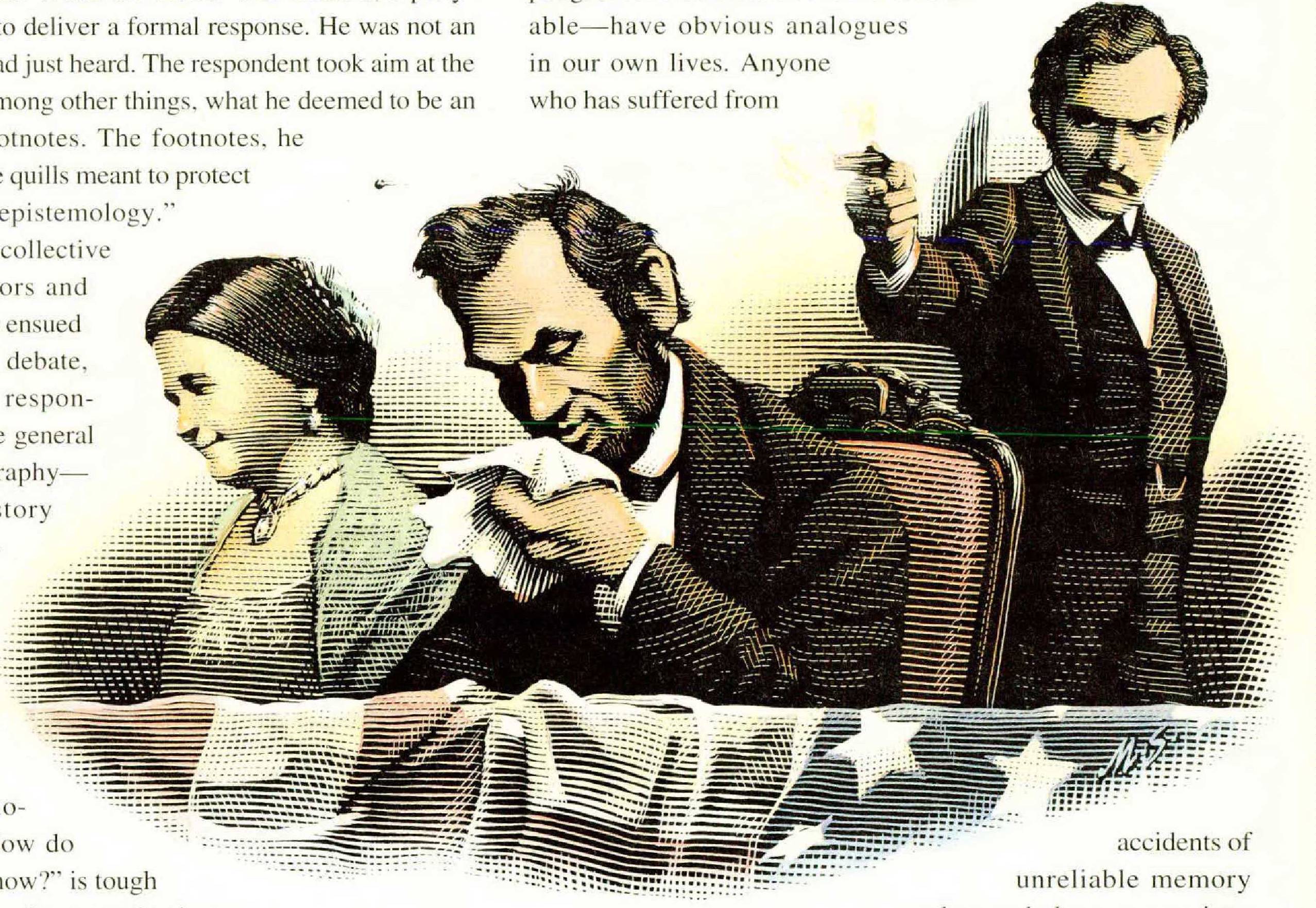
The Library of Congress, in its electronic card catalogue, maintains a separate heading for “imaginary histories.” They are not just potboilers. Serious historians have ventured into this territory. What if Julius Caesar had heeded the soothsayer’s warning about the Ides of March? What if Harold Godwinson had defeated William of Normandy at the Battle of Hastings? What if the Holy Roman Emperor Henry VI, a force for German unity, had not died prematurely, in 1197? What if Catherine of Aragon, the first wife of Henry VIII, had given Henry a male heir? W’hat if the Spanish Armada had been blessed with good weather? What if John Wilkes Booth had missed? What if Charles Stewart Parnell had never met Kitty O’Shea? What if Archduke Ferdinand had not ventured to Sarajevo?
Change a single fact and subsequent history may have to be vastly reconfigured. In an essay published in 1932 Winston Churchill played out the possible consequences of a victory by Robert E. Lee at Gettysburg. In Churchill’s view, not only would the South have won the Civil War but the First World War would not have occurred. The full sequence of events—involving. among other things, a Confederate alliance with Britain and a Confederate conquest of Mexico—is too baroque to relate. (Footnote: Shortly after writing the essay, Churchill was struck by a car on Fifth Avenue in New York City. What if he had been killed?) Arnold Toynbee, in Some Problems of Greek History, a collection of essays that appeared in 1969, wondered what would have happened if Alexander the Great had lived to the age of sixty-nine instead of dying suddenly on the banks of the Euphrates at the age of thirty-three. He painted a scenario that includes not only continued Hellenization but also the discovery of the New World by the Carthaginian general Hannibal. In History That Never Happened, a scholarly monograph published in 1984, the German historian Alexander Demandt took up a broad range of hypothetical questions, including this one: What if Pontius Pilate had pardoned Jesus in A.D. 33? In Demandt’s reconstruction Christianity is a nonstarter and the elements favoring the growth of Christianity conduce instead to the Mithras cult, with its many Christian parallels.
These imaginary excursions are often fanciful, but as Demandt pointed out, some aspects of history that never happened can in fact be accepted with as much assurance as some aspects of history that really did happen. “For example,” Demandt wrote, everything indicates that a longer reign by Emperor Henry VI would have strengthened the empire; that but for the Turkish attack, Constantinople would have remained Byzantine after 1453; that without the agreement of Hindenburg, Hitler would not have become chancellor on January 30, 1933. All of this is practically certain, even though it is a matter of history that never happened. Conversely, even the best-established historical knowledge, even within our own memory, is tainted with an element of doubt. To this extent we may discount the objection that certainty is attainable in the realm of the real whereas everything remains uncertain in the realm of the possible.
Imaginary history asks What if? sometimes out of mere curiosity and sometimes as a circuitous way of gaining insight into why things turned out the way they did. What if we hadn’t dropped the atomic bomb on Japan? What if Kennedy had been alive to oversee our intervention in Vietnam? The exercise demands that one enter the circumstances and states of mind of a time gone bythat one re-encounter the Zeitgeist. In an oddly literal way imaginary history puts a new twist into Oscar Wilde’s remark that “the one duty we owe to history is to rewrite it.”
I keep a short list of subjects I wish today’s imaginary historians would turn to. If term limits had been in existence from the beginning, which national figures would we have lost, and with what consequences? What would the economic history of America have been like if the balanced-budget amendment had been the eleventh (ratified in 1798) instead of (prospectively) the twenty-eighth?
I have a different, somewhat longer list of subjects that I hope may in the future—whether months, years, or decades from now—become the stuff of imaginary history. What if Fortune 500 executives had not instituted a voluntary system of stiff salary caps? What if television programming had never been classified as a drug and regulated by the FDA? What if Newt Gingrich had not been turned out of office after “misspeaking” in the presence of a live microphone? What if the secession of California from the United States had been resisted? What if the House of Windsor had spurned the offer of transplantation to Serbia? What if the Pope had not resigned “to spend more time with her family”? I look forward to the day when books like these can be written.