The Lay of the Language: The Decline of a Semantic Distinction, and What It Suggests About Linguistic Evolution
by Cullen Murphy

THE year was 842. The occasion was a meeting in Strasbourg between two grandsons of Charlemagne, Louis the German and Charles the Bald, to form an alliance against a third grandson, Lothar I. That alliance was embodied in what are known today as the Strasbourg Oaths, and for linguistic reasons these oaths remain significant. The scribe, fluent in Latin, wrote out copies of the oaths in two languages, the German spoken by Louis and the Latinate tongue spoken by Charles. The language of Charles looks odd (it is written out phonetically according to Latin rules of spelling), but it is unmistakably the language that is now called French. Here is why it is important: the French version of the Strasbourg Oaths is the earliest extant written evidence that classical Latin, once a standardized international language, had evolved into several vernaculars.
In thinking about the probable successors to the English language, I have often wondered what form their equivalents of the Strasbourg Oaths might take. An MTV video? An FBI wiretap transcript? Inevitably, I have also wondered when these new vernaculars will come into existence. Do candidates already exist somewhere? Certainly, as John Platt and his colleagues document in their book The New Englishes, distinctive variants of the mother tongue have by now emerged in India, Southeast Asia, Africa, and the Philippines, though in each case the speech so far remains recognizably English.
Most of us would acknowledge, I think, that a certain drifting from the anchorage of standards has been taking place, too, among native speakers of English, and even among those who would consider themselves members of the elite.
I don’t mean to be schoolmarmish about this. I want simply to note a phenomenon, and perhaps take the long view. A few years ago, in his inaugural lecture as occupant of the Chair of Latin at the University of Newcastle upon Tyne, Professor J.G.F. Powell took such a view of both Latin and English, drawing instructive parallels. The English written by his students, he said, “reminds me forcibly of some of the Latin written during the Dark Ages, after the collapse of the Western Empire and of the old Roman education.” And Powell observed that although the emergence of the Romance vernaculars was a long and gradual process, subtle signs of it can be found with the benefit of hindsight even in the classical period. The spelling and grammar in papyrus letters written by an imperial soldier named Claudius Terentianus “already in some ways foreshadows modern Italian.”The misspelling of the name “Caesar” as “Cessar” on some banking records from Pompeii suggests that pronunciation had begun to change.
It is against this background that I call attention to the rapid and, I suspect, inexorable conflation of the once-distinct English verbs lie and lay. Lie is an intransitive verb, used correctly in constructions like “lie down” and “lie around” and “the laundry lies on the bed.” The present participle is lying. the past tense is lay, and the past participle is lain. Lay, for its part, is a transitive verb, used correctly in constructions like “lay plans” and “lay the books on the shelf.” The present participle is laying, the past tense is laid, and the past participle is also laid.
The two verbs are long-standing rivals, but during the past few decades lay has been laying siege to lie with growing success. In spoken language the victory of lay is virtually complete. “Whenever I smell a cigar now,” David Letterman told a reporter for the Los Angeles Daily News, “I almost just lay down and go to sleep, they smell so good.” “Election years are hell for the Fed,” a former president of one of the regional Federal Reserve banks told a Washington Post columnist. “They just hope they can lay low, and not be accused of going in one direction or another until after Election Day.” Speaking about his fellow Democrats after last November’s Republican surge, Representative Kweisi Mfume told the Los Angeles Times, “Many have just laid down and rolled over; they just cannot get over the fact we’ve lost control of the House.” Increasingly, the substitution of lay for lie and laid for lain is occurring not only in casual speech but also in printed matter produced by professional writers and editors; you’ll quickly collect plenty of examples if you keep an eye out for them. A few months ago an advertisement appeared in these very pages bearing the words “This Christmas give a gift that’s been laying around for twelve years”—a lapse that elicited irate letters from a number of readers. “If my subscription were not a gift from my mother,” one woman wrote, “I would cancel it because of the English in this ad.”
The conflation of lie and lay is an old problem and, admittedly, an understandable one. Among other things, the verbs share a manifestation (lay). Moreover, when you lay something down, you cause it to lie. Also, there was once a reflexive pronominal use of lay (as in “Now I lay me down to sleep . . .”), which has undoubtedly sown confusion. And lie and lay as nouns, connoting a configuration of ground, can at times be used interchangeably ("the lie or lay of the land”). Before the nineteenth century the verbs lie and lay were sometimes used synonymously, by such writers as Francis Bacon and Laurence Sterne, and the Oxford English Dictionary has citations for an intransitive use of lay going back to roughly A.D. 1300. Still, the lie-lay distinction has been generally in force for the past two centuries, as grammarians and lexicographers pulled English into something approaching a standardized form.
Why is the distinction vanishing? One person I know blames the lyrics of pop and country music: “Lay down Sally.”“Lay, lady, lay. lay across my big brass bed.” “I could get used to you, oh darlin’, you’re so fine. I could grow accustomed to your body layin’ right next to mine.” Lyrics like these obviously do play a role, but something larger is at work. I observed above that in spoken language the victory of lay over lie has been decisive. Until the invention of movable type and the advent of mass literacy the influence of the spoken word was at least equal to and probably greater than that of the written word when it came to determining the evolution of language. Gutenberg altered the balance of power. With the help of the printing press, language could more easily be tamed, domesticated, made to live by rules across vast areas. The printed word was sovereign for four centuries. It brought standardized English to every continent. But ever since the development, a hundred years ago, of electronic methods of reproducing sound, the spoken word has been roaring back. By comparison with the written word, it has always been sloppy and unruly—a fact of modest consequence in, say, the ninth century, when even the most influential person’s voice could reach only a very small audience. Today audiences for words that are spoken (or sung) can easily exceed a billion. Next to this, print is a marginal force. The one place in which the written word is enjoying any sort of renaissance—in communications by means of computer—offers no counterforce whatsoever. As anyone familiar with it can attest, cyberEnglish is characterized by a penchant for grammatical laxity and semantic shorthand.
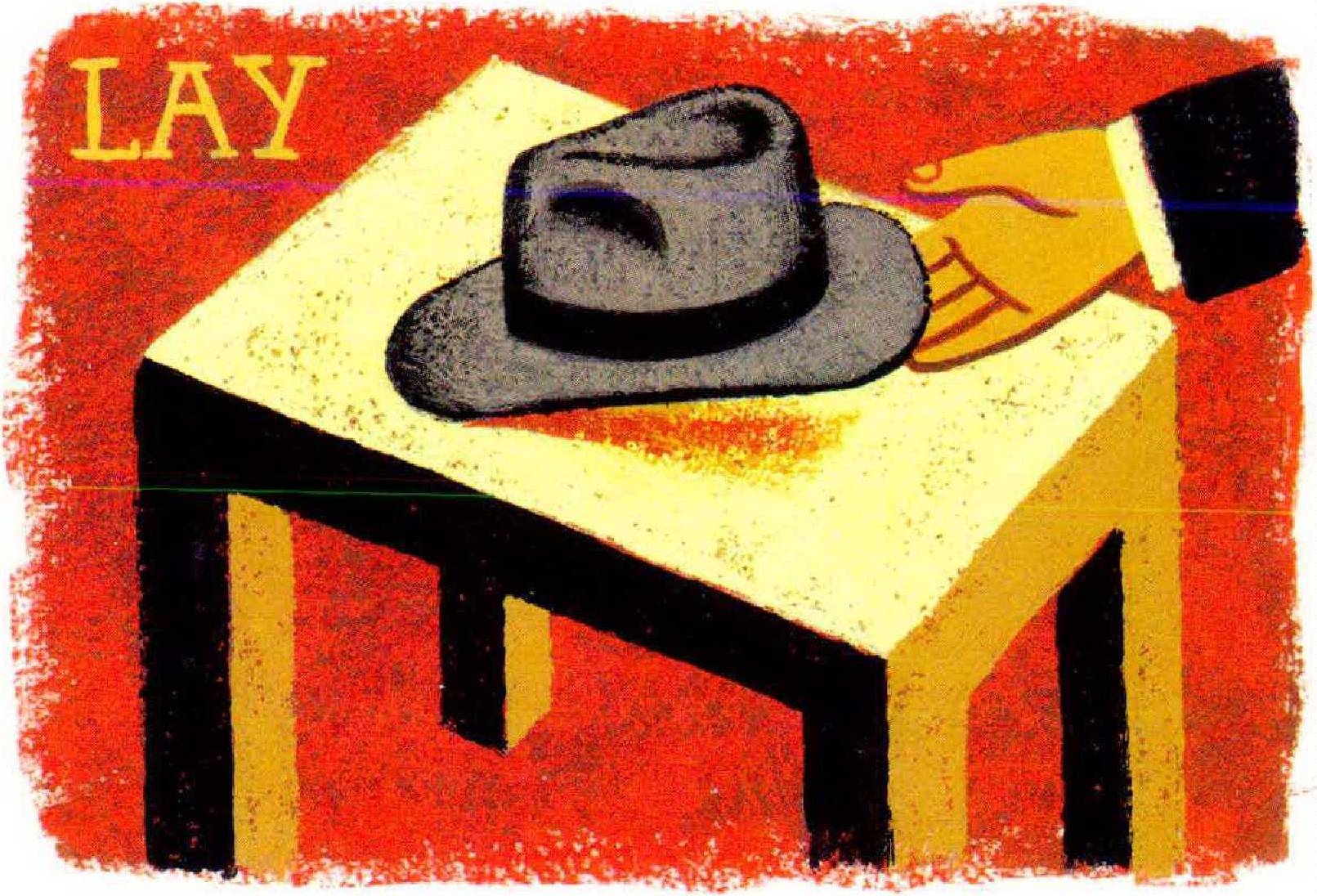
Our language, then, is embarked upon a period in which we may well be watching it—and hearing it—change faster than it ever has changed before. What is odd is that so many of its professional custodians seem prepared to take this, as one might say, laying down. On the issue of lie versus lay, for example, the editors of MerriamWebster’s Dictionary of English Usage point out in a survey of reference works that the scholarly consensus seems to have shifted from deeming the misuse “illiterate” to deeming it “disputable” to deeming it, in essence, irrelevant. The linguist Dwight Bolinger offers this verdict: “The lie/lay distinction is fragile and impractical, and the price of maintaining it is too high.” This, of course, is the attitude we have come to expect on all such language issues, though I must confess that some of the ways it surfaces can still take me by surprise. Recently Professor Richard Hogg, the general editor of the Cambridge History of the English Language, suggested that the apostrophe “may well just decline of its own accord" and stated outright that he “would not go to the stake” to preserve the distinction between its and it’s.
Language changes. Linguistic rules are arbitrary. I concede all that. It is instructive to note, though, that 1,519 years after the Fall of Rome the University of Newcastle-upon-Tyne has someone on its faculty who could have conversed with an educated citizen of the Roman Empire. In A.D. 3514. I wonder, will there be anyone who could have conversed with me?