Riviera, Relaxed: Corsica Offers Much of the Mediterranean's Best, and Little of Its Worst
by Corby Kummer
TALIANS love to vacation on Sardinia. And where do Sardinians vacation? On Corsica, I learned recently, when friends from Sardinia invited me on holiday with them. These two big, rocky Mediterranean islands off the west coast of Italy had always been lumped together in my mind, so the choice of destination seemed odd at first. Most Americans would pick one or the other depending on whether they wanted to practice French in Corsica or Italian in Sardinia.
But Sardinians see it differently. Even if the sea around Sardinia is magnificent, they say, the beaches on Corsica are better served by hotels. Even if the barren, rugged mountains of Sardinia are an astonishing sight, the mountains of Corsica were not logged out in the past century, and the hikes and walks in the evergreen forests of Corsica’s interior rival those of Switzerland. For anyone, it is rare to be able to drive in less than half an hour from a long sandy beach in the sun, near rocky Mediterranean fields covered with rosemary and lavender. to a pine-scented forest path still dusted with snow.
Too, Corsica is better equipped for tourism than Sardinia. Because over the centuries a stream of varying invaders ruled Sardinia, the natives came to distrust the sea and what it brought, and the coasts remained undeveloped; the single exception, the Costa Smeralda. was built up only in the past few decades. For centuries Corsica was dominated, with many tempestuous interruptions, by Genoese seafarers, who built fortified ports. Today these port towns have not only picturesque Genoese citadels and charming old districts to stroll through but also pleasant inns and cafes with stylish French touches. I found a number of those inns and restaurants to be memorably charming, and a few of the towns to have the easygoing atmosphere that Saint-Tropez is said to have had in the late fifties, with the gaily colored flags and pastel-colored stucco houses one sees in Raoul Dufy watercolors.
The extraordinary beauty of Corsica should be enough to draw any visitor, especially since several big wild areas are close to comfortable places to stay. The reasonable prices for lodging (although not, unfortunately. for food) and the lack of crowds, except in July or August, should make any visitor want to return. Too, it’s hard to get a fix on the place, which will draw a curious visitor back: the people are proud and wary, by turns voluble and aloof. It’s not hard, though, to understand their fierce love for their native land.
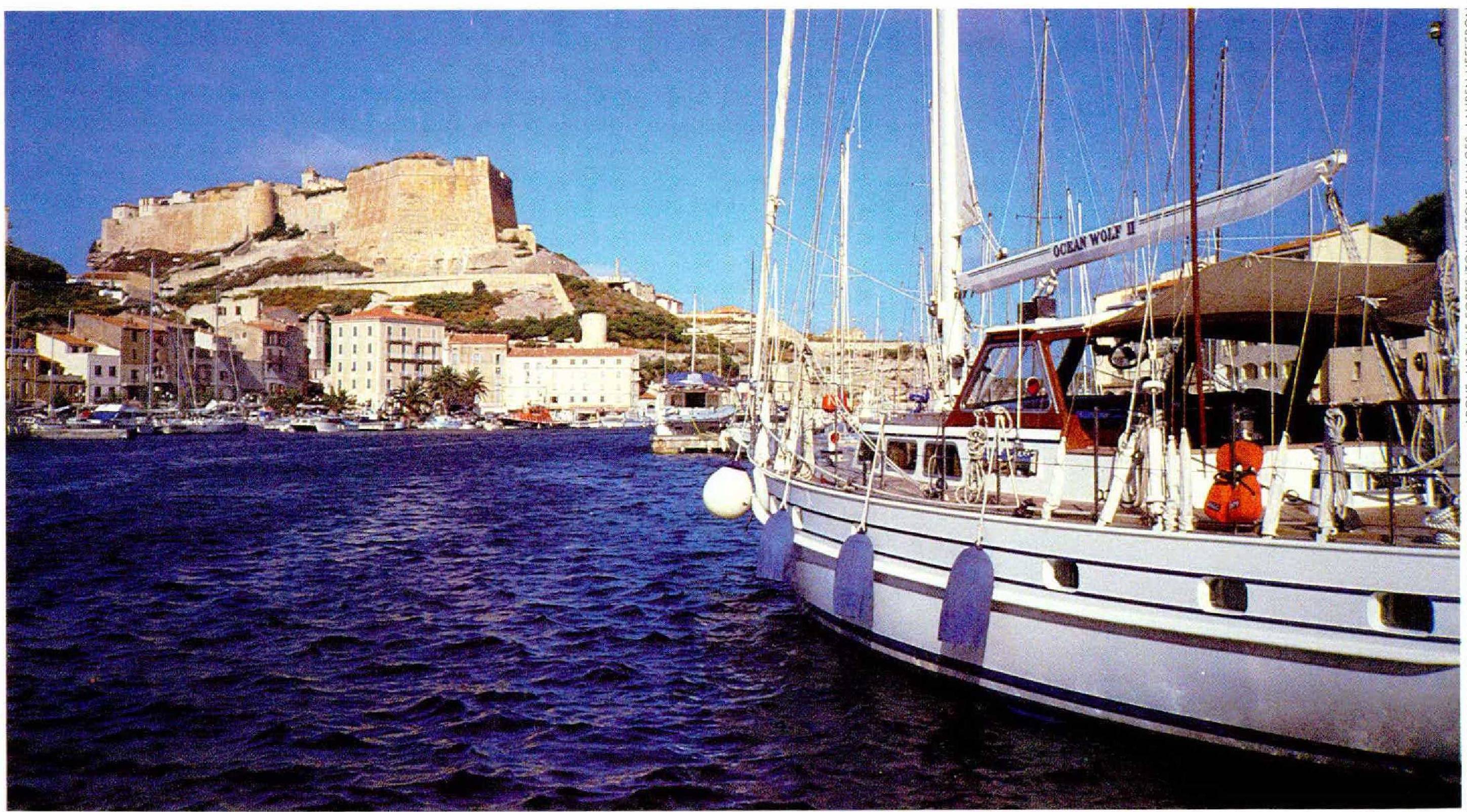
I ARRIVED by ferry in the southern town of Bonifacio, one of many Corsican ports with a Genoese stone citadel perched on a craggy outcropping. This one is particularly dramatic, because the outcropping is not granite, as elsewhere on the island, but sheer white limestone. I came with the sirocco and left with the mistral. Corsica lives by its winds, giving names to many: when you walk the cobbled streets of the high citadels your constant companion is one of them, whistling at your back or insinuating itself in your path, as much a figure as any fortress or castle.
Bonifacio, like a surprising number of cities on Corsica, has an airport with frequent service to mainland France; you can often find government-subsidized bargain prices. Ferries arrive regularly from France and Italy at several Corsican ports. Jetfoil service from Nice will begin next month, cutting the travel time in half. You’ll need to rent a good car to navigate the curving roads.
Although the island is smaller than Connecticut, its geography means that you can’t see everything from one base. My friends wanted to show me every part of the island, and took me from Bonifacio straight up the east coast to Bastia, the island’s principal port and largest city after the capital, Ajaccio. Apart from a long and airy square facing the water, it’s dreary, but just above the city is Cap Corse, a large promontory covered with the prototypical Corsican flora: the maquis, a Mediterranean scrub of herbs and wildflowers—mostly myrtle, heath, juniper, laurel, and the evergreen bush cistus. The ma-quis blooms in some way nearly all year; from April through June it is magnifice n t ly fragrant and colored red and white and yellow and purple with fennel and geraniums, violets and orchids, mimosas and tiger lilies, cyclamen and broom. The word maquis, which was lent to Italian as macchia, is of Corsican origin, and came to have a patriotic meaning: guerrillas lighting the island’s various occupiers were said to have “taken themselves to the maquis.” and the name was revived for French Resistance fighters.
A short drive from Bastia is Saint-Florent, a small, lazy port dominated by a marina filled with glossy yachts and lined with restaurants and bars. It’s a lovely place to lose an afternoon drinking past is and watching the comings and goings of the apparently well-heeled sailors. Or you can drive a quarter hour into the hills to try the local muscat and white and red wines of Patrimonio, as both a town and the wine-producing region around it are called. There every few hundred feet a roadside cellar offers visitors samples of wine and brocciu, a mild and creamy sheep’s-milk cheese, or homemade jams and marmalades. A bit farther into the interior are hill towns so reminiscent of those of Provence that the whole area seems like the Riviera, relaxed.
THE real Corsica is inland. Guidebooks warn that the city of Corte, at almost the exact center of the island, is unwelcoming, perhaps because of the constant car and truck traffic up and down the main drag. But I was strongly drawn to Corte, the island’s only university town, because I had a sense that I was seeing Corsica’s heart. The city’s desire to preserve and impart native culture made its people more open than the Corsicans I met elsewhere. Corte is a center of the island’s strong separatist movement. Hostility against the French is active on Corsica, leading to terrorist attacks against French institutions and officials (these have so far not harmed tourists or affected Corte) and, especially in towns more frequented by tourists, to a kind of double French hauteur.
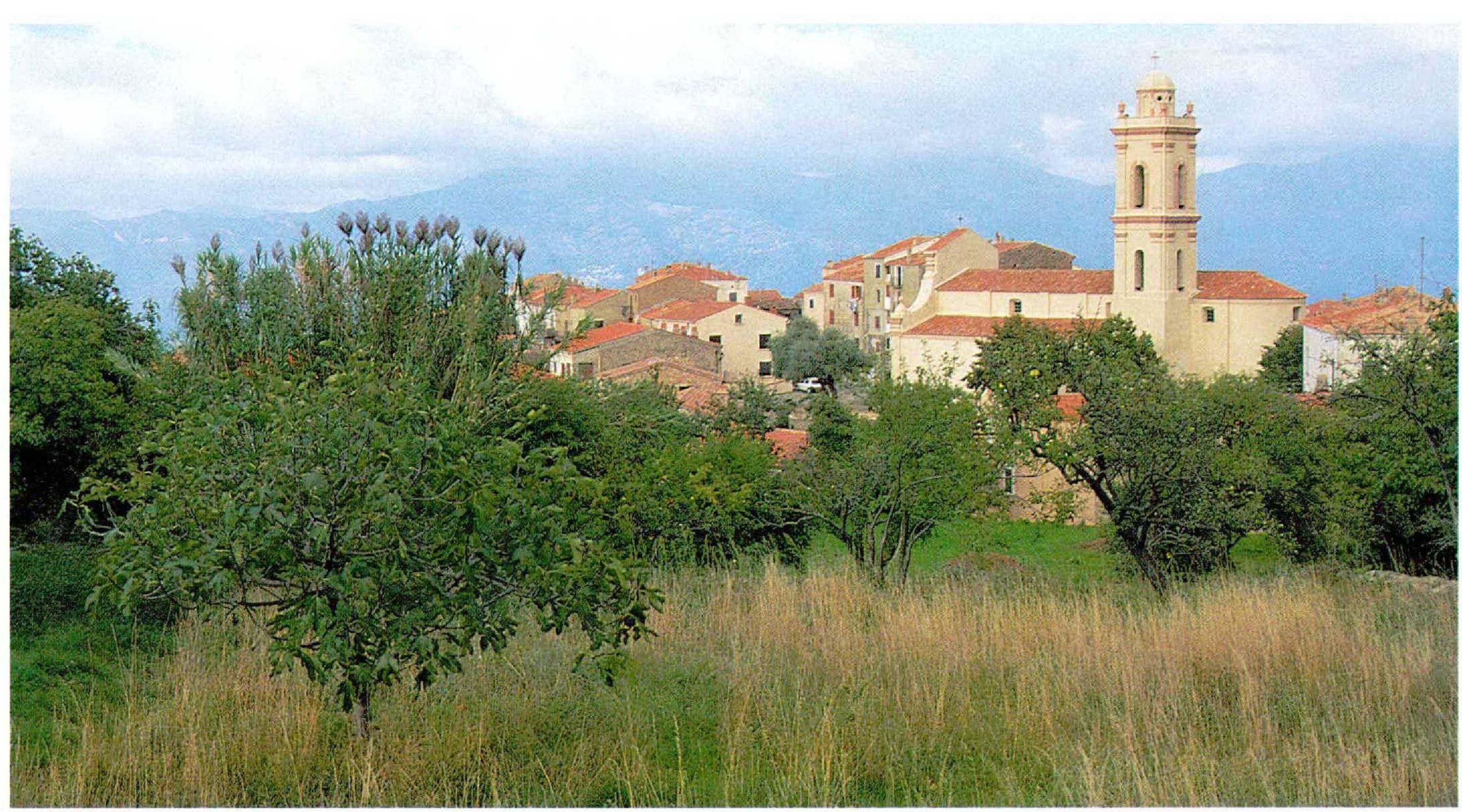
The Bonaparte family lived for a time in Corte, and a brother of Napoleon’s was baptized there, but the Corsicans don’t much care to commemorate the family or its most famous member— Napoleon never did much for his native island or spoke very well of it. and the feeling is still returned. Instead Corsicans prefer to remember Pasquale Paoli. who in the mid-eighteenth century led successful rebellions against the Genoese, gave Corsica its first democratic constitution. and established the university at Corte, which he made the island’s capital from 1755 to 1769. The city’s main street is named for Paoli. as is a street or square in nearly every Corsican town: Place Gaffori. the center of Corte s old town, is named for another general who rebelled against the Genoese. The winding streets of the old town, with its Baroque churches and its shops selling local pottery and comestibles such as wild-boar sausage and various kinds of honey, have the quiet charm of the back streets of an eighteenth-century French city.
At a modestly luxurious inn a mile or so from the center of town my friends and I had our coziest dinner. The Auberge de la Restonica, named for the rushing mountain stream that all the rooms face (the noise lulls you to sleep), is in two parts: a modern hotel with twenty-eight comfortable rooms, and a converted old house, somewhat like a Swiss chalet, with eight rooms and also a good restaurant. After an aperitif by the stone fireplace we started with home-cured ham and the best version we found of one of the traditional dishes—thrush pate, which was so good we ordered a second ramekin. The main course was rivercaught trout sauteed a la meuniere, accompanied by a light red Patrimonio. Not just the simplicity and quality of the meal but also the casual warmth of the family—the patriarch. Dominique Colonna, is a Corsican soccer hero of the sixties, and during dinner several generations of the family and their dogs wandered in and out—made this the most relaxed evening of a relaxed trip.
The hotel, in a chestnut and pine forest, would make a convenient base for excursions by car or on foot to the island’s vast Parc Naturel Regional de la Corse, a national park that covers more than a third of Corsica. About an hour’s drive south of Corte is the popular Forêt de Vizzavona, crisscrossed with well-marked hiking trails; out of earshot of a Corsican. I can say that it is as beautiful and salubrious as any Swiss forest. A narrow-gauge train runs twice a day from Corte to Vizzavona. stopping at every village on its way to Ajaccio; the train is popular with hikers. who report that it’s a dramatic w-ay to get to the next trailhead. The stucco and half-timbered little station in the forest, and the glorious views of the jagged snowcapped peak of the 7.900-foot Monte d’Oro, make the region seem like something out of The Magic Mountain. Indeed. the Grand Hotel du Monte d’Oro, in Vizzavona. was once a sanatorium.
More stunning still are the cliffs and gorges on the fifteen-mile drive along the river Asco, about an hour north of Corte and also part of the national park. At first the scenery is alpine, like that of Vizzavona. and around many curves of the road you can see Monte Cinto, at 8,900 feet the island’s highest mountain. Past the steep, foreboding stone village of Asco the narrow road is flanked by spectacular grotesque tafoni formations of eroded orange-tinged stone. These look like fairy-tale figures of terror or something imagined by Maurice Sendak.
CAL VI, a port at the top of the island’s west coast, has the best of Corsica: a long and lovely beach; a busy but not diesel-fumed port lined with restaurants; an extensive citadel just big enough to wander in without getting lost, with mazelike streets and a lovely Baroque church at its heart; many good hotels: and even a pleasant modern town—and all a short drive from severa I entrances to the national park. In the summer yachts pull up and disgorge fashionable Continentals for their evening stroll.
Calvi lacks something the rest of the island does too: moderately priced and decent restaurants. In most places there is a choice of good and well-priced lodging (many luxury hotels cost $100-$200 a night, and half that during the low season), but restaurants charge very high prices for dull food—a typical example is $25 for a bowl of bouillabaisse or $30 for a fish main course.
True, I didn’t try the garden restaurant of the Hotel Le Magnolia, a converted turn-of-the-century mansion in the middle of Calvi on a street with antique shops; the prices on the menu at least seemed warranted by the pretty dining room. I certainly enjoyed staying at the hotel. The rooms have themes—I stayed in the “Verlaine”—and Rococo-style decoration in colors like peach and sky-blue. They’re a bit precious but pleasant, with big and well-equipped bathrooms. Rather than go to a restaurant, I furnished our group with a picnic from a market that happened to take place right next to the hotel that morning; farmers and bakers had come in from the hills with rustic pies made of wild greens and brocciu. For dessert I bought a big square of fiadone, a wonderful airy Corsican cheesecake scented with lemon and made with sheep’s-milk ricotta.
Calvi has perhaps the widest choice of pleasant hotels of any Corsican city (the big Art Deco Grand Hotel in Calvi, closed when I visited, is said to be as appealing inside as out); most of the top-flight hotels, in fact, are along the west coast, the area most developed for tourists. Travelers in search of beaches should stay near Propriano, where there are long sandy littorals in view of mountains, although not in the town itself, which has been spoiled by tourism. The Miramar, a couple of miles away (on its own beach), is a luxury resort that my friends recommend highly.
A base in Bonifacio, on the southern tip of the island, gives access to the beaches around Propriano, an hour’s drive away, and to Porto Vecchio, a half hour’s drive, with its generous gulf that is popular with sailors and swimmers alike. Porto Vecchio has what my friends told me is Corsica’s best restaurant, Lucullus (closed when we visited), and the Cala Rossa, another luxury hotel with a private beach, decorated with pastel-colored majolica and popular with cognoscenti. We stayed high in the citadel of Bonifacio in the very pretty Genovese hotel, newly and plushly outfitted.
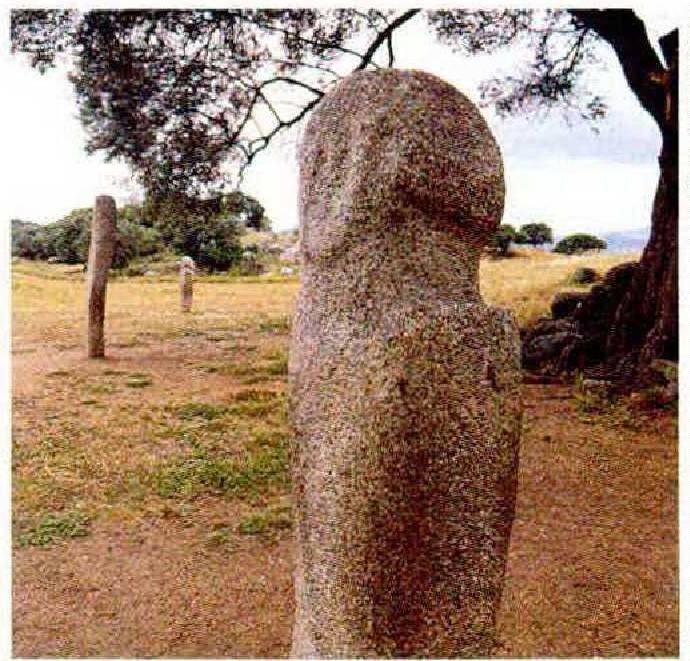
On the roads and paths between Porto Vecchio and Propriano are menhirs. Neolithic stone figures that rise mysteriously from the landscape. The cult of stone, prevalent in Sardinia as well, is still unexplained—4,000 years ago the Torrean people carved the menhirs, but little is known of them—and its traces are evocative. The largest gatherings of Corsican figures are in Palaghju and Filitosa, near Propriano, but a surprise on many hikes is coming across an unmarked menhir, usually on its side. The best reference books for stories of menhirs and the evolving spirit of Corsica are the recent Rough Guide and Dorothy Carrington’s definitive 1971 book. Granite Island: A Portrait of Corsica.
I’VE saved the best for last—something you might do too, if you leave Corsica from Ajaccio, which has the island’s busiest airport. I found little to recommend in the city, apart from a good Titian at the recently renovated Musee Feseh, and the historical interest and bourgeois comfort of the Bonaparte house. But a few miles south, along the built-up coast, is Le Maquis, a smallish hotel of complete luxury, where every room is big and decorated in a different, mostly rustic, style, and where the restaurant is superb. In mid-season, until June 15 and after September 15, double rooms start at $300 —and they’re worth it, even if just for a night. It’s the kind of hotel that’s a world in itself (there’s even an indoor pool)— one that makes you reluctant to return to the world you know,