Word Histories

bribe
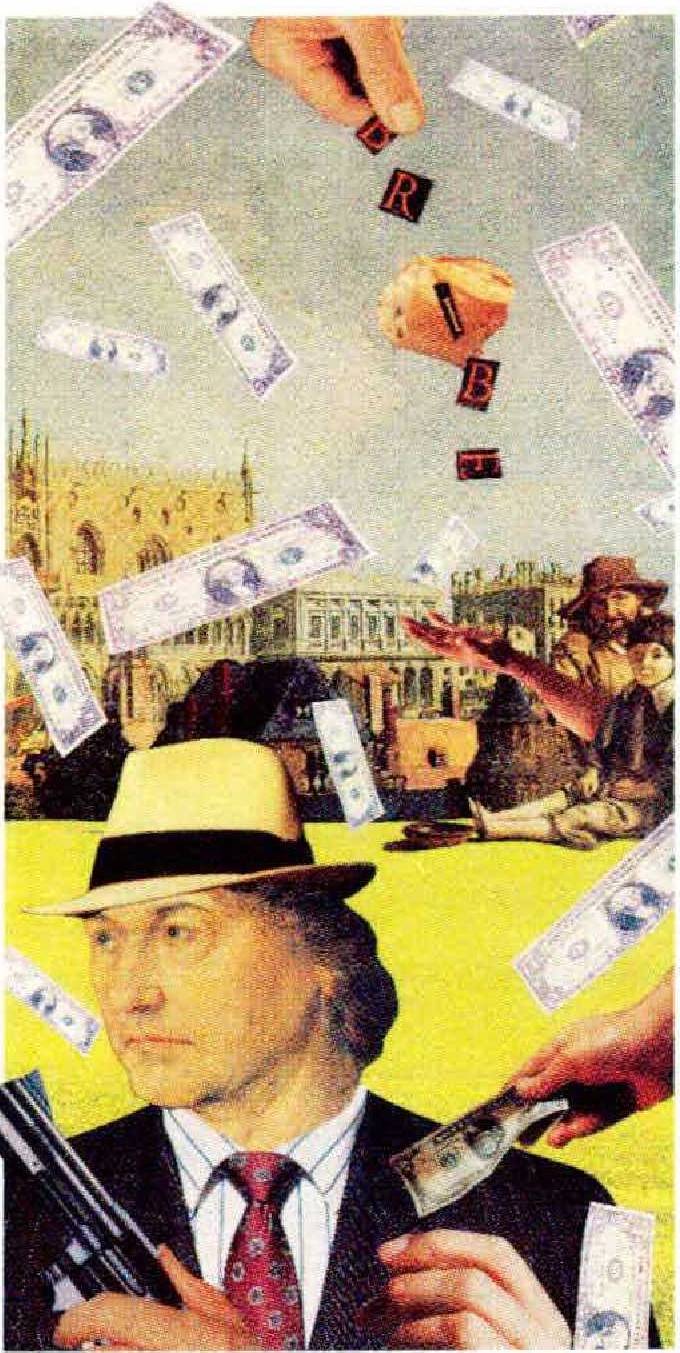
During the investigation of business and political wrongdoing in Italy earlier this year a source told the London Times, “Gianni Agnelli [the head of Fiat] has almost been mortally wounded by the bribe and corruption scandal.” Although the ulterior origin of bribe is unknown, the word can be traced back to the Old French bribe, “a morsel of bread,” which came to refer more specifically to a scrap of bread given to a beggar. This sense led to the
French briber or brimber (to beg) and bribeur or brimbeur (a beggar, mendicant). These forms spread through several parts of Europe, leading to the Walloon brib (alms), the Spanish bribon (vagabond), the Italian birba (vagabond’s trade), and the Middle English bribour or briber (impostor, thief, scoundrel). Bribe thus acquired the meaning “to steal or rob” (“For ther is no thef withowten a lowke, / That helpeth him to wasten and to sowke / Of that he brybe kan, or borwe may”— Geoffrey Chaucer, The Cook’s Tale, ca. 1386). Subsequently a bribe became the thing stolen, and a briber was a robber or thief (“To lette brybers that wold a robbed a ship undyr color of my Lord of Warwyk” —J. Paston, The Paston Letters, 1461). A judge or governor who exacted monetary favors from petitioners came to be called a briber (“A judge were better be a briber than a respecter of persons; for a corrupt judge offendeth not so lightly as a facile” — Francis Bacon, Advancement of Learning, 1605). Later the receiver of extorted money or bribes became confused with the giver, and eventually the former meaning died out. Likewise the meaning of bribe gradually shifted from “money extorted” to “money given for the purpose of corruptly influencing someone.”
gay
The controversy attending President Clinton’s support for homosexuals’ serving openly in the military has put gay (homosexual) regularly in the media. Gay is probably from a Germanic root that found its way into Old French as gai (merry, lighthearted) and was adopted into English around the thirteenth century. Merriment being often linked with hedonism, gay came to mean “given to dissipation,” as in gay Lothario. By the nineteenth century gay when applied to women referred to prostitution (“The gay women . . . are worse off than American slaves”—James Ritchie, The Night Side of London, 1857). Randolph Trumbaeh, in Hidden From History: Reclaiming the Gay and Lesbian Past, says that slang terms for prostitutes have historically been “appropriated for sodomites (e.g., queen, punk, gay, faggot, fairy, and fruit).” But no evidence that gay meant “homosexual” in the 1800s has ever surfaced. Alternatively, gay with this meaning may have come from the American hobo slang gay cat, “a young or inexperienced tramp" (“Nothing arouses [the hobo’s] scorn more than the dilettante, or ’gay-cat,’ as he calls him”—Josiah Flynt in Forum, 1897). Gay in this compound originally denoted the hobo’s carefree life, while
cat—a frequently stray animal —was standard for a hobo or an itinerant worker. An older hobo commonly took on a gay cat as an apprentice, and the two were often sexually intimate. Thus gay cat came to refer to a homosexual. By the 1930s gay was sufficiently current to be used in the movie Bringing Up
Baby (1938); Cary Grant, answering the door dressed in a flouncy nightgown, declares to the bewildered woman standing there, “I just went gay all of a sudden.”
hectic
Early last year the Recording Industry Association of America announced chat starting this April compact disks would be shedding some of their wasteful packaging, though the shift to smaller boxes would take five or six months. “It’s a hectic transition,” said Jim Donio, the communications director of the National Association of Recording Merchandisers. Hectic (characterized by feverish activity or haste) is from the Indo-European root *segh- (to hold), which yielded the Greek ekhein (to have, hold, continue) and eventually hexis (habit). (Habit itself is from the Latin habere, “to hold, have.”) From hexis came the Greek hektikos, “continuous, habitual, which by the early seventeenth century was used to refer to wasting diseases, because of their persistent symptoms. Through the

Latin hecticus the word came into Old French as étique, meaning “consumptive, feverish,” which the English adopted to mean the fever itself (“Like the Hecticke in my blood he rages, / And thou must cure me”—Shakespeare, Hamlet, 1603). So me times hectic refe rred specifically to the hot, dry flush accompanying a fever (“One man’s cheek kindled with the hectic of sudden joy”—Thomas De Quincey, The Spanish Military Nun, 1847). Not until early in this century was hectic used metaphorically to describe feverish activity.