On a Bike, Reluctantly: Discovering the Many Delights of Touring the Countryside Under Your Own Power
by Corby Kummer
IT HAD NEVER occurred to me that I could enjoy a bicycle trip. I have seldom been on a bike since I was seventeen. I am jealously independent when I travel, as unwilling to wait for stragglers as I am to be on time for a prearranged schedule. Photographs in travel brochures of happy cyclists make me querulous: the cyclists seem to be smiling because they are naturally athletic, unlike me. Also, my unvarying uniform abroad is a blue blazer and gray flannels. I couldn’t imagine appearing in a new town wearing a goofy helmet and indecently tight bicycle shorts.
Nonetheless, last year I was impressed by a young Canadian expatriate I met in Italy, Matthew Watkins, who had come to know the region we were in, Apulia, as a scout for a company specializing in bicycle trips. So well informed was he about the hidden grottoes, obscure museums, and places to find the best pasta and olive oil in the region that he persuaded me to consider a trip with his former employer, Butterfield & Robinson. As one does on learning a new phrase, in the next months I heard frequent endorsements of Butterfield & Robinson. Several came from outdoors-resistant, even outdoors-phobic, people whose eyes unaccountably went out of focus when remembering their trip. This past spring I decided to join a B&R bicycle tour of southern Spain, between the Andalusian capitals of Cordoba and Seville.
The very idea of a luxury bicycling trip was as unknown to me as the company. Sweating all day seemed incompatible with dinners at excellent restaurants and rooms at the best inns: didn’t outdoor exercise mean roughing it? The idea did have a natural appeal, since I usually spend my touring days either walking through towns or riding through landscapes. This way I could do both and feel that I had earned the day’s sixth or seventh dish of hazelnut helado (ice cream). It all seemed a lark, because for once while traveling I had no appointments to keep—and, even more important, I knew that whatever scrapes I got into while exploring independent of the group, help was just a phone call away.
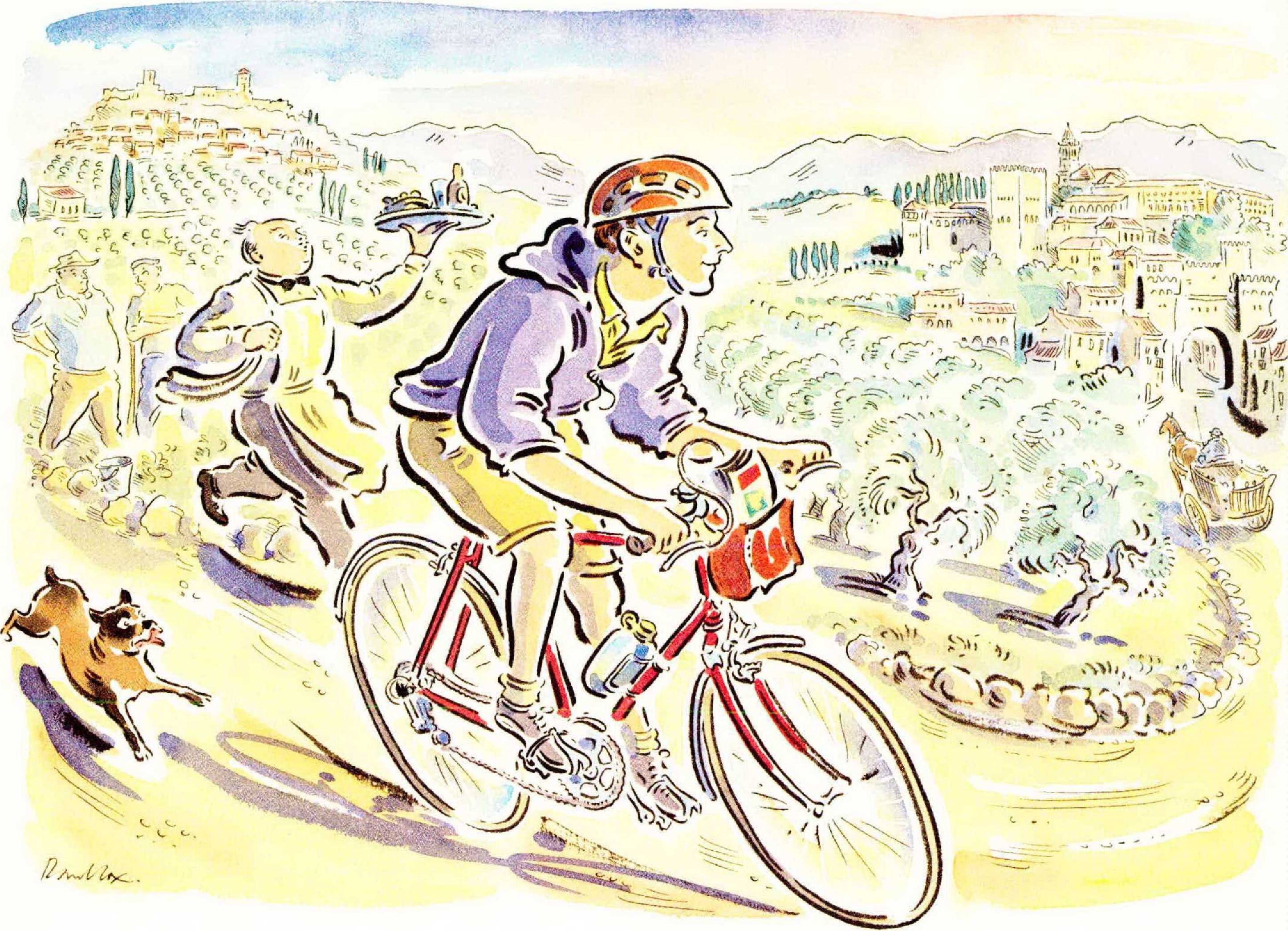
Still, I was full of trepidation when I arrived in Cordoba. Had my cyclist friends advised me well on what to bring? Would I know how to use more than three speeds on the intimidating multi-geared bike the firm supplies? Would I be able to keep up the pace the day’s routes required? Perhaps most urgent, would saddle sores make every sunlit hour an ordeal?
So grumpy was I while dressing for the warm-up ride on the first day, trying to negotiate unfamiliar clothes in a field on an old Andalusian estate (we had been instructed to appear at our pickup point dressed to ride, but I was just off a plane), that Catherine Donnell, one of the two guides for our group, said evenly, “You know, this is supposed to be a vacation,” and offered a lift to our first hotel. Testily I refused, and took a quick lesson in gear shifting from Donnell’s colleague, Victoria Bake. The women later admitted that when I arrived, they were sure they had spotted real trouble, and wondered if they’d ever get me on a bike. For the next week their trouble was getting me off one.
AFTER I returned home, I found myself daydreaming about the trip to a nearly alarming degree, my eyes going out of focus, because Donnell had been right: it was a vacation, offering the sense of abandon and possibility, along with the safety and the coddling, that one associates with an ocean liner. Instead of shipboard confinement there was the exhilaration of being outdoors, and the fragrances one often misses behind a windshield: pine, new grass, and, overpoweringly, orange blossoms. I had forgotten that exercise can be joyful and not just the best way to release the tensions of the day. I now tell gym-bound friends that this kind of trip is the reward for bothering to get into any kind of shape. It’s the StairMaster with wildflowers and hill towns.
In fact you don’t have to be in tiptop shape to perform admirably on a cycling trip. If you are unable or disinclined to practice bicycling where you live, the best preparation is not. as you might expect it to be, a stationary bicycle. As Lauren Hefferon, the founder of Ciclismo Classico, a company based in Cambridge, Massachusetts, that specializes in tours of Italy, explained to me before my trip, a stair-climbing machine like the StairMaster best mimics the motion of cycling. (The pre-trip booklet Hefferon sends out includes excellent introductory articles about bicycling technique and safety, and also a better crash course on Italian culture, food, and logistics than most guidebooks supply.) My fellow travelers were in their forties, fifties, and sixties; some had been exercising regularly, some had not, and all chose their own pace. Couples of different abilities frequently separated, meeting in a particular village or at one of the farms or happily odd rendezvous points our guides had sought out.
The B&R daily drill is similar to that of most other cycling tours. One guide rides with the group and the other drives the van, which holds a seeming warehouseful of biking gear and food and drink. Everyone following the arranged route is offered fruit, juice, cookies, and tempting tidbits whenever the van passes by, and can ride in it over challenging passages. Also, the van holds repair equipment, including the all-important pump. It was my luck to change inner tubes three times during the trip, once because I didn’t realize that the valve on a gas-station pump is often the wrong kind for a bike and when attached to a tire lets out all the air (all right, twice; when I got home, I bought a valve adapter for a dollar). Even if everything else B&R supplied was exemplary, my portable pump broke, making a slapstick routine of my efforts to follow the tire-changing instructions everyone carries along. This gave me the chance to practice my rudimentary Spanish and hitch rides from obliging passersby, who helped me learn how to fit a bicycle into a small trunk.
The van is a crucial element of the success of the trips: it is a traveling safety net for those who are unfamiliar with bike repair, and of course it transports the luggage.
The other crucial element is the guides. Unflappable and wonderfully resourceful, they set the tone. Before our warm-up ride a couple who had been on several B&R trips (alumni are loyal; I was the only first-timer) said, “Once we get here, it’s all in their hands. Anything that goes wrong, it’s their problem.” I found this callous. By about the fourth day I had adopted the same attitude. I reveled in the freedom of being able to pack just a notebook, map, sunscreen, snack, and windbreaker in my handlebar bag for a full day, and of knowing that when we were changing hotels (roughly every third day), the guides would be sure our luggage was waiting in our rooms. I simply picked up my key and headed for the shower.
Too, the guides were utterly in tune with the region, both having lived in Spain (Victoria Bake grew up in Madrid). They urged us to adopt the local customs, which meant not just eating late but extending the evening with beer and sherry at tapas bars, conversing with anyone who looked interesting. Donnell, a bullfight fanatic who wears little bulls dangling from her ears, took a group of skeptical firsttimers to the Cordoba arena and managed to make us all want to go back. If anyone had a special interest (local pottery, traces of Moorish architecture), the guides kept an eye out. Mine was olives, and one day they found an olive nursery for me to visit.
On our first morning Bake and Donnell came in to breakfast bearing paper conesful of churros, or crullers, which one dunks in hot chocolate thick enough to be a dip. One afternoon they led us to a rehearsal at which an animated group of teenagers was practicing songs for this year’s pilgrimage to El Rocío, an Andalusian town where the Virgin is said to have appeared; every year pilgrims learn new songs to keep up their energy for the days-long walk. The unexpected force of harmony slapping against stucco walls in a tiny courtyard brought most of us to tears. Afterward rhe chorus members demonstrated the steps to this year’s variations on the Sevillana, a classic form of flamenco, and invited us to join in.
One day we were treated to a surprise picnic lunch on the terrace of a farm and hunting lodge overlooking vineyards and orange groves; the guides artfully set out local cheeses, the superb local ham, a tortilla, or flat omelet with potatoes, the season’s first asparagus and strawberries, and local wine and sherry. Another day they arranged for the chef of our hotel to journey into the nearby hills and prepare us an enormous, and very good, pan of paella. The van even yielded tatami mats for a siesta under the olive trees.
WARY AS I AM of any enterprise that requires new clothes, especially if they weigh down luggage, I packed a few items recommended by friends, and was glad to have most (but not all) of them. Stiffsoled sneakers help you pedal more efficiently than the normal thick-soled ones, which in any case won’t fit easily into toe clips. Toe clips are optional, because some people find them tricky to slip in and out of, but I quickly got used to them and came to rely on the help they offered when going uphill. An eighteen-speed bike, the kind B&R supplies, might sound overcomplicated, but in fact the choice of gears enables you to negotiate virtually any terrain comfortably: the lowest “granny gear” will keep you pedaling up steep hills, and the high gears make whizzing downhill safer. I found a pair of Shimano brand shoes, flexible enough for walking but rigid enough for biking, for less than $50. Wearing a helmet is mandatory, although companies don’t enforce this rule. Soon I felt naked without one (and in the first days I kept reaching for a seat belt). Padded gloves help keep your hands from going numb as you clutch the handlebars while riding downhill. They also cause stigmata of which I became inordinately proud: suntanned ovals on the backs of the hands, which semaphore “cyclist” to those who merit the name.
An unexpected benefit of a cycling tour is how light you can pack. Biking clothes weigh next to nothing, and you need many fewer changes of good clothes than usual, since you will wear them only a few hours each evening. Two items I took back to the store were a fanny pack, unnecessary with the handlebar bag and the zippered pockets in my shorts, and a biking jersey with the pockets on the back—evidently convenient for cyclists hunched over dropped handlebars, but silly on a touring bike. I wore T-shirts all week, and had a flimsy but effective windbreaker for morning and evening. One that’s waterproof will help in the case of rain; rain pants, though, will stick uncomfortably to your legs.
The most important goal of my advance shopping was to guard against saddle sores, and so I bought the most heavily padded shorts I could find—not too clinging, luckily, since one part of biking I will not embrace is ridiculous clothes. I also ordered a padded seat cover from B&R. The cover, brandnamed Spenco, has a hard foam lining that conforms to your body, and was worth the $50 it cost, though you can get one for about half that price at your local bike store. If even this is insufficient, you can follow the advice of an experienced friend of mine for additional padding between backside and seat top: “Sanitary napkins.” she whispered.
IN CHOOSING a part of the world in which you might want to bicycle, consider the condition of the secondary roads, the only kind you will want to ride on. Those in Andalusia were often gravelly and full of potholes. If so many companies seem to concentrate their tours in France and Italy, it’s because French and Italian roads are in good condition, and because whenever you feel fatigued, there is likely to be an inviting village coming up—not the case in Andalusia, starkly handsome as much of the olivetree-covered landscape is. Find out when the rainy season is, since wet weather is even less desirable than usual when you are spending the wholeday outside.
You can also choose among tour companies, depending principally on your budget. Butterfield & Robinson (416864-1554 or 800-678-1147), although the best-known luxury-bicycle-trip firm, is by no means alone. Its closest rival is Travent International (802-2445155 or 800-525-3009), a company started by two former B&R employees. Travent groups stay in similarly luxurious inns and pay similarly high prices: $2,500 to $5,000 for a week in Europe, not including airfare or a supplemental single-occupancy charge of $175 to $500. Backroads (510-527-1555 or 800462-2848), probably the largest biketour company in the United States, offers tours in Europe, North and Central America, Asia, and the Pacific, at somewhat lower prices.
Several smaller companies reflect the passions of their owners, who want to share their pleasure in cycling through a country they love. Ciclismo Classico (617-628-7514 or 800-866-7314) offers the widest range of Italy tours—at moderate prices, which likely explains why its average customers are younger (in their late thirties and early forties) than those of the luxury companies. ExperiencePlus! Specialty Tours (303484-8489), formerly called Italian Specialty Tours, owned by Rick Price and his Italian-born wife, Paola, offers a limited number of tours at very reasonable prices not only in Italy but also in Oregon and Colorado; accommodations, naturally, are simpler as prices get lower.
Other companies about which I’ve heard good reports include Timberline Bicycle Tours (305-759-3804), with tours mostly in the American West; VCC Four Seasons Cycling, with tours mostly in the East (802-244-5135); Bicycle Adventures (206-786-0989 or 800-443-6060), with tours in Hawaii and the Pacific Northwest; Classic Adventures (716-964-8488 or 800-7778090), with tours in many European countries and in North America; and Gerhard’s Bicycle Odysseys (503-2232402), with tours in Switzerland, Germany, Austria, and other northern European countries. Other companies can be found in the advertisements in Bicycling magazine.
I couldn’t wait to go on another trip, and so I broke away to Umbria, in Italy, for four days of cycling just six weeks after my first trip. This was a larger group—twenty, an average size for most companies. As before, there were mostly B&R veterans, including two couples who once a year leave their children behind to go bicycling, because, one woman told me, “ This is about the farthest thing away from kids.”
The several groups of friends, and one family having a kind of reunion, proved what I suspected: a bicycle trip, with its daytime adventures and evening companionship, is the ideal way for friends to see each other. And see each other at their best. It’s hard not to stay in a good mood when you’re revitalized—and tanned where it counts.