DMZ
His father had told him that one day he would wake up in the morning, look at his wife on the other side of the bed, and wonder what he was doing there
A Short Story

by Alien Dixon
THEY WERE FIGHTING AGAIN. THEY DISAGREED while they drove, occasionally lapsing from argument to remark about the design of a house or the particular color of a horse grazing beside the highway. Then one of them would continue as if the interruption hadn’t occurred.
“I usually help you with the dishes, or we trade off,” he told her. He drove with his right hand, straight-arming the steering wheel while resting his other elbow on the bottom of the window frame, his head leaning on his left hand.
“You’re not always home. I’m not always home. We don’t always have the time. We both work.”
“Whatever happened to ‘You wash and I’ll dry’? Remember?”
“We’re not newlyweds anymore, Walter.”
“Oh, I see. The thrill is gone, right?”
“That’s not what I meant,” she said. She sat looking straight in front of her and spoke without a glance at Walter.
Ahead, several hundred yards from the highway, they could see a huge old farmhouse
highway, they on top of a hill, at the end of a long winding driveway.
“Look,” he said. “A big porch all the way around the house. Do you know what you’d pay to put that on a house today?”
“Weeping willows,” she said. Two enormous weeping willows were in the front yard, on either side of the driveway. “You don’t see many weeping willows anymore,” she said. “Not in the city, anyway.”
The trees looked to Walter like two female sentries with wild hairdos, guarding the house.
“There’s a city ordinance against planting them,” he said.
“Really?”
“Yeah. They have a large root system. The roots head for water and tear up water and sewage lines.”
The house was so beautiful that they both turned as they passed until their view was blocked by the shell of a two-story Motel 6 under construction.
“What about the money? We’re not rich, you know,’ he said.
He looked over and saw that she was taking a moment to refocus.
Finally she said, “It’s not as though a dishwasher is some extravagant newfangled gadget for the rich. We’re the only couple I know without one. It’s very little money for the convenience.”
“Convenience,” Walter said. “Everything has to be convenient. Convenience stores. Convenient drivethrough car washes. Automatic tellers. I saw on the news where somewhere in the U.S. you can drive through and have your pet groomed.”
“We don’t have a pet,” she said. “Besides, that’s probably in California. It’s not part of the U.S.”
“It’s getting so you could spend entire weeks or months without contact with a single human being.”
“You’re exaggerating,” she said. “But what does that have to do with owning a dishwasher?”
“Humans,” he said. “Us. We wash the dishes as people have washed dishes for thousands of years, since the first primate with an imagination grabbed a flat rock to hold the ants he was eating.”
She shook her head. In a disgusted monotone she said, “Humans load and unload dishwashers.”
“It’s not the same, and you know it,”he said.
“How about we stop and trade the car for a horse and buggy? Or better yet, hire some humans to pull the buggy—or you could pull it yourself. It would take us three days to get home, but what the hell, if it will make you happy.”
He looked at her. “Cute.” he said.
They passed an Ohio state highway sign informing them that they were leaving Fairfield County and entering Hocking County.

“You know it’s not the money. And you’re not worried about the loss of newlywed bliss, either,” she said.
He didn’t answer.
“You don’t like to buy anything for the house. It makes you feel permanent.”
“ I hat’s not true,” he said, but it was true. A dishwasher would add another large, heavy appliance holding him to their one-floor, two-bedroom, ranch-style house in the Corn Belt, in which the empty extra bedroom (perfect for a nursery, or so she had said) remained to be filled with a responsibility and a weight that he had yet to let himself fully imagine. Lately he thought that he had caught himself walking around with his shoulders stooped just from the thought of it all.
It was a late Sunday afternoon in autumn, and they kept passing cars that were similar to theirs, containing couples that looked similar to them, taking the same Sunday drive to see the turning of the color of the leaves. The only difference was that in many of the other cars small heads were bobbing up and down in the back seat. He disliked their car. It was practical. Four cylinders, four doors, with velour-and-vinyl seat covers.
The straightness of the highway and the white lines bordering the asphalt irritated Walter. He felt like turning off and down the embankment, breaking through a fence, and plowing through the fields of corn. It was only a thought. All he did was to allow the right tires to slip partly onto the berm for a moment. Gravel hit the bottom of the car.
“You’re off the road,” she said.
“Sorry.”
He looked over at her. He was thinking that she was still lovely, but he had always thought that her arms were too thick.
Then he turned off the main highway into rolling hills sixty miles southeast of their house in Columbus. Walter knew this area. As a teenager he had gone hunting with his father near here. He thought about his father and the advice that his father had given him before Walter’s marriage.
“Son,” he said, “one day you’re gonna wake up in the morning, look over on the other side of the bed, and say to yourself, What the hell am I doing here? But don’t get excited about it. Emotions change back and forth. You can’t expect to be crazy in love every minute. Your mother and me have had our problems, but we always knew that we wouldn’t trade each other or you for anything. Getting married these days is like having your haircut. If it doesn’t grow out right, you just find another barber. Hell, half don’t even bother to get married. Why buy the cow when you can get the milk for free?”
Walter knew that a problem had developed during his parents’ marriage, a short period, early on, before Walter was born—an estrangement or a separation mentioned only by accident during the telling of another tale of the early days, the reference always ending in an incomplete sentence. But for the most part things seemed very simple to Walter’s father. Problems were identified and then overcome. Conflict was clear-cut, like the Second World War. An aggressor bent on taking over the world had to be defeated. His father had been in the Normandy invasion and had received a Purple Heart for being wounded during the Battle of the Bulge.
Walter had been in Vietnam. That was not so clear-cut. There was the division between North and South Vietnam—the demilitarized zone—but that was only on maps. And then there was the conflict at home. Walter had a Purple Heart too. Miles from the enemy he had stepped on a sharpened stick concealed just below the surface of a shallow stream.
“During the war, before I enlisted,” his father had told him, “if someone was driving too fast, wasting gasoline, people along the road or in other cars would make the Vfor-victory sign with their fingers, and the driver would send the V back and slow down. Everyone knew a war was on. Your mother worked in a factory. Everyone had to do their part.” At that point he would pause before saying, “That was the good war.”
For the twenty years before he retired, Walter’s father had worked in a factory on the same machine. The machine coiled various sizes of wire into springs.
WON’T DO ANYTHING TO IMPROVE YOUR home,” she said. “You won’t take care of the yard, and God forbid that you should plant any trees. In the summer we get sunburned sitting in the living room.”
“So wear a hat,”he said. He was getting tired. He knew that she was looking at him.
“You won’t put our name on the mailbox.”
“The mailman knows who lives there,” he said.
She shook her head.
He had gone as far as to buy the letters for the mailbox. They were gold-enameled tin with adhesive on the back. He had never found time to put them on.
Walter liked the smaller road. The trees seemed larger and denser. He thought about frontiersmen and the stories he had read as a child, of forests so thick that people could walk for days without seeing the sun.
He looked over at his wife. Wife. He could recall the first time he had ever referred to her in that way. It had been on the steps of the church after they were married. Relatives and friends filed out to them in a single line. One of Walter’s uncles from out of state appeared, and Walter shook his hand, turned to the girl at his side, and said, “Uncle George, this is my wife, Ruth.” It had sounded strange. It still did.
The leaves of the trees mixed colors in a blend of dark orange, deep red, and yellow which made Walter think of a bowl of Trix cereal. Trix had been his favorite cereal as a boy.
Ruth was looking at the dashboard of the car. She said, “Just like my father and all those years in the Army. Sometimes when we moved, he wouldn’t let us unpack things for months, expecting to be transferred again, overseas or to another sta—”
“Why did you stop?” he asked.
“We’ve been all through that,” she said.
“Have we?”
“You know we have.”
Walter wanted to go to Texas to live. She couldn’t stand the thought of leaving their house. He worked for the newspaper in Columbus, but had been offered a better job at a paper in Dallas. Ruth worked for a bank.
In the best John Wayne impression he could muster, he said, “Don’t ya wanna go ta Texas with me, Missy?” She smiled.
At work lately Walter had begun to imagine that his desk and his humming word processor had become his father’s vibrating spring machine. The job, Texas, and thoughts of the prairie plains intrigued him, he supposed, in much the same way the empty bedroom in their house enticed her to procreate.
A sign ahead by a gravel road read SAM’S CREEK ROADNO THRU TRAFFIC. Walter slowed the car and turned onto the road, which disappeared into the tree-covered hills. Ruth made no objection and seemed content to explore. We don’t disagree about everything, he thought. They were silent for a while. The road was dusty, but as long as the car was moving, the dust stayed behind them. He looked in the rearview mirror and saw the dust billow out from the back of the car like a trail from the engines of a jet plane and then spread at angles like the wake of a boat.
Houses, barns, and trailers clung to the hills; clothes of all sizes and shapes, and of more colors than the leaves, hung drying on ropes strung between tree trunks. Rusted shells of cars rested on cement blocks surrounded by tall grass. Almost everyone waved at them, from porches, from tractors: fat women, skinny men sucking on cigarettes, shaggy-headed boys holding back mongrel dogs who wanted to chase their car. Ruth smiled and waved back. Then for miles they saw no buildings, just the trees hanging over the road, making dark, cool tunnels for them to drive through.
Several times Walter almost turned back, thinking of the NO THRU TRAFFIC sign and the time that it would take to return to the highway. He sensed the same feeling in Ruth. She would frown as though she thought they had gone too far, and then in the next moment become engrossed in the view of a stand of pine trees, their trunks slicing the sunlight as if they were vertical Venetian blinds.
Walter was glad that they had stopped arguing. He began to think that if he stopped the momentum of the car, the moment he turned north toward the city and the house they would begin again. He wished that they could continue on south across the Ohio River, and down the Mississippi to the Gulf, and beyond to the islands, where he imagined people eating out of shells, in a place where dishwashers didn’t exist.
A building was just ahead, after miles of no houses or other signs of people. Walter drove on and found what had once been a church. Nearly all the paint had peeled off it, and plywood was nailed over the windows. Weeds and grass grew in the decaying foundation. Across the road from the church was a small graveyard surrounded by a sagging wire fence. The gravestones leaned in all directions.
“Shouldn’t we be getting back?” Ruth asked.
“I suppose so,” he said. He didn’t want to go back. “I need to stretch. Want to look at some of the stones?”
“All right,” she said.
He parked the car next to the church, and they walked across the road. At a low place in the fence Walter jumped over and held Ruth’s arm as she stepped across. They had awakened that morning in the same bed; they had shared a bathroom, she showering while he shaved, and then the two of them passing each other, he to shower and she to brush her hair. They had eaten breakfast in the same kitchen, passing again, one to check the eggs and the other to blend the juice. She had pushed eggs onto his plate with a spatula. He had poured coffee into her cup. They had eaten sitting at the same table and then they had sat together in the car for hours. Holding her arm late that afternoon, as she crossed the fence into the graveyard, Walter realized that it was the first time all day they had touched. He felt a tenseness in her arm and thought that she was aware of it too.
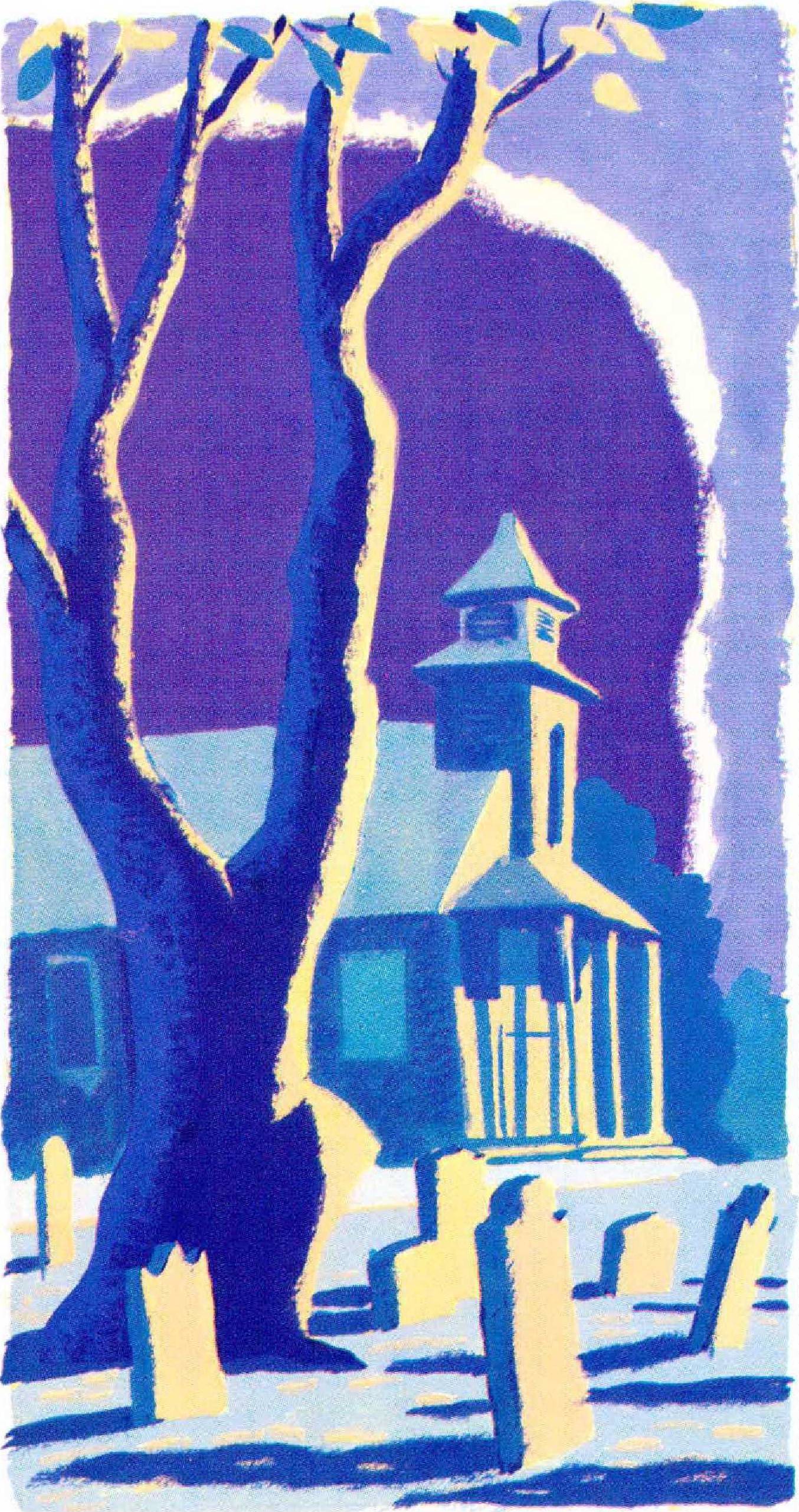
Between the rows of graves someone had recently cut the grass. Walter looked at the lines made by the mower wheels, and thinking of the distance they had covered without seeing any houses, he pivoted once, checking to see if they were alone. He saw no one but Ruth, bending down to rub the dust off a stone with her long thin fingers. He let his eyes follow her fingers up her arm to her face, linger for a moment, and then move down her back, along the inward curve at her waist, and outward over the larger half circle of her denim-covered hip.
She turned toward him. “Some of these—” She saw Walter watching her.
He turned and walked up the row. “What?” he asked over his shoulder.
“Some of these are very old,” she said.
Walter knelt down to an old-looking, plain stone and read the chiseled letters.
JOHN A. MONROE BORN 1902 DIED 1944
Forty-two years old. Walter had a birthday coming up. He would be thirty-eight.
They found the graves of infant twins and of a man who was a hundred years old when he died. The old man’s stone was joined at the base by an eroded rectangular slab of granite that covered the grave. It made Walter think of the concrete slab on which his and Ruth’s house was built. Ruth had wanted a basement, but the houses built on slabs were cheaper. Their feet stayed cold all winter.
In the back corner of the graveyard on the right was one large stone surrounded by a short picket fence. They walked there together and stood by the fence. The stone was for two people, and flowers were engraved around its border and down the middle. On one side was JAMES BOYD 1932—1951. On the other was WIFE CARLA BOYD 1934 1952 OF A BROKEN HEART. They smiled for a moment at the sentimentality of it, but only for a moment.
Walter wondered whether he or Ruth would be stricken with a broken heart if the other died, or if anything resembling a heart could be found inside him. He had recently renewed his driver’s license, and the girl behind the counter had asked if he would like to donate his organs if he met an untimely end on the highway. Without thinking about it Walter had said, “I guess so. Sure.” It had seemed like the generous thing to do. He imagined being surrounded by surgeons and nurses in an operating room. Outside, the helicopter waits, engine running. The incision is made, and one of the surgeons searching the chest cavity of the victim looks up and says, “There’s something wrong here.”
HE HEARD THE SOUND OF CRACKLING LEAVES and turned around so fast that the man behind him jumped back a step. “I didn’t mean to scare ya,” the man said. Walter smiled uneasily. “That’s okay,” he said, and then looked around for a car. “We didn’t expect to see anyone so far from any houses.”
What were left of the man’s teeth were rotten. He was heavy, and his belt buckle was hidden by his stomach. The work pants he wore ended inches above ragged tennis shoes. A tuft of blond hair was visible behind his leg, and a small hand clung to his thigh. They belonged to a boy of about six or seven. The boy would timidly glance around the man’s leg and then disappear again.
“We live over there,” the man said, motioning across the road beyond the church with one hand and pulling the boy out from behind him with the other. The boy’s eyes were green.
“See the smoke?” the man asked. Walter looked and saw a thin gray stream rising above the trees behind the church.
“I’m Raymond,” he said. “I take care of the cemetery.”
The boy was watching Ruth. Walter introduced Ruth and himself and glanced at the mowed aisles between the graves, nodding his head. “You do a good job,” he said. Raymond stood up straighter and wiped his nose on his shirt sleeve.
Raymond rubbed his chin. “I’m from West Virginia,” he said. “I used to live in the city. Took care of a cemetery there. Worked in a factory for a while. Made nothing but ball bearings. Hated that. Moved to Circleville, where I took care of another cemetery. Then my wife ran off with my uncle and left me with the boy. This woman I’m with now has family out this way. We don’t see many people, though.” He licked his lips.
The boy had slowly moved closer to Ruth. She leaned down and spoke to him. He said something indistinguishable.
“He don’t talk so good,” Raymond said. Ruth knelt closer to the boy and listened.
“You live in the city?” Raymond asked, looking at Walter’s shoes.
“Yes.”
“What do you do?”
“I work for a newspaper.”
“Used to have a cousin that worked on a press. That what you do, work on a press?”
“No, I write for the paper.”
“You mean tell about the news?”
“Yeah, sometimes.”
He looked at Walter and then gazed out over the graveyard. “See that grave there? That’s the old lady’s father’s grave. The one with the flowers around it.”
The flowers were dried up, but the ground looked freshly dug, the dirt still in a mound.
“Put him down a couple weeks ago,” he said nonchalantly. “He got a little crazy at the end. Got to talkin’ to beech trees. You know, the ones with the almost-white bark?”
Walter shrugged. “I don’t know much about trees,” he said.
“There’s one over there,” Raymond said, pointing high into the woods.
Walter sighted down Raymond’s finger and saw a tall tree with smooth, silvery-gray bark. “So that’s a beech?”
“Yeah. The old man wouldn’t say a word to a hickory or a maple, but he’d talk a blue streak to a beech.”
Ruth and the boy were talking. “See ma birts,” the boy said, and pulled Ruth’s hand so that she would follow him. He kept running back to her, pulling her hand, and running on again. Ruth began to run, and Walter heard her laugh. The sound seemed a striking contrast to the graves and the barren church.
Raymond and Walter followed.
“You have a house in the city?” Raymond asked.
“Yes, we have a house.”
“I bet you don’t have a cow or a goat.”
“No, I’m afraid not.”
“We got a cow and a goat. Cow’s milk or goat’s milk, we got either one.”
Ruth was on her knees listening to the boy as he pointed at what looked like a bird’s nest under the decaying front steps of the church. As they got closer, Walter could see baby birds stretching their necks, their mouths wide open. He looked at Ruth and knew that her jeans would be dirty and that she wouldn’t complain about it.
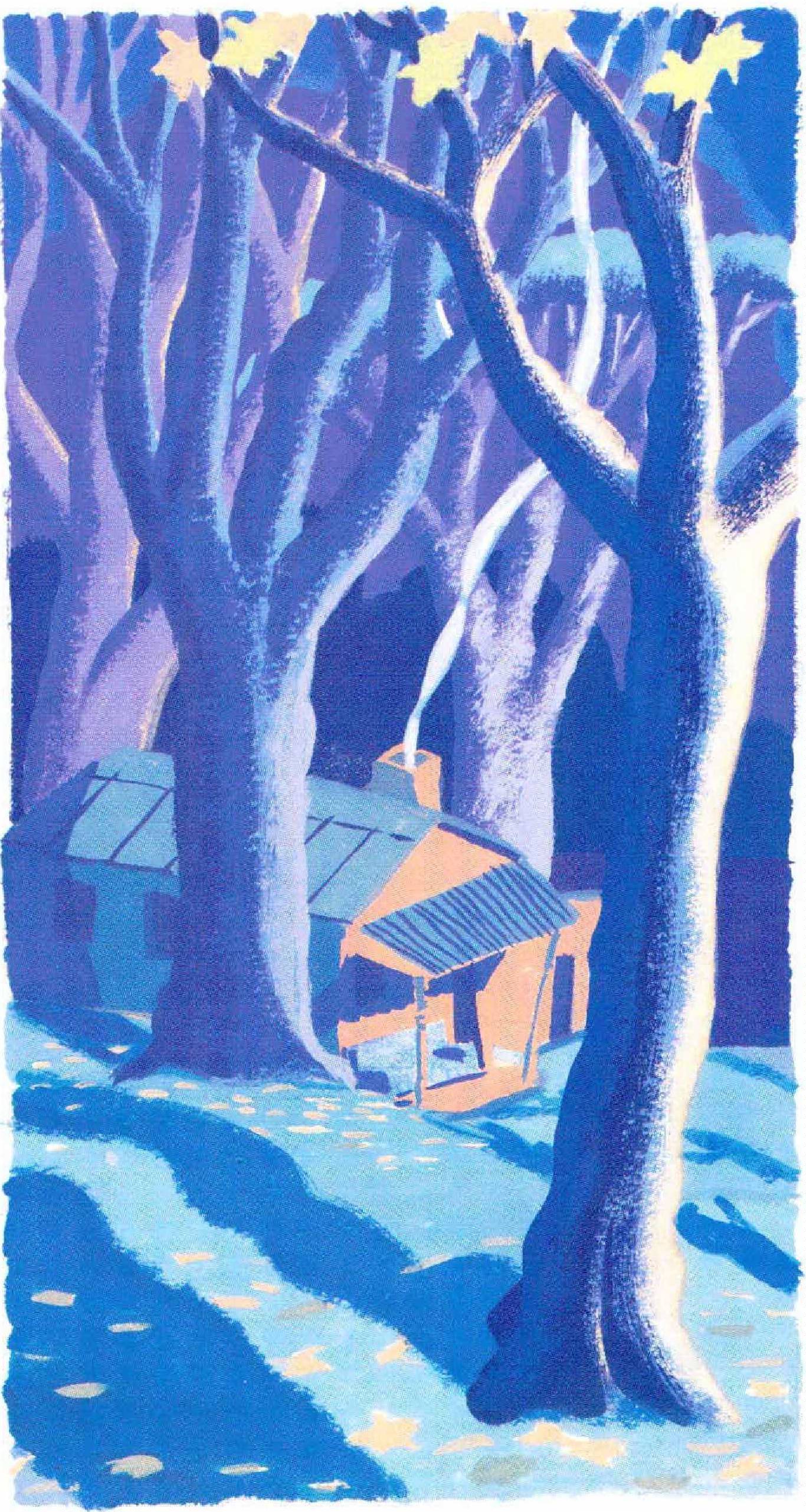
Then the boy led her into the trees, and Walter could see down a path into the woods to where the smoke was rising from the top of a small structure that looked more like a shack than a cabin. He was surprised to see an electric-power cable leading from the direction of the road to its roof. He hadn’t noticed utility poles. He wasn’t as far from the city as he had thought. If the cable was long enough, it could be the other end of the cable attached to his own house. It could be the same cable that fed into the wiring inside the walls and supplied power to run all their appliances.
It was almost dusk. They should be going. But driving was supposed to be dangerous at dusk. Your depth perception changed. He remembered dusk in autumn when he was a kid, playing baseball, waiting to be called for dinner, chasing a fly ball that seemed to hang in the sky and then descend in slow motion, as if the consistency of the air itself were altered.
He and Raymond walked farther down the path and into the cool dampness under the trees. Beside the shack was a shed and a pile of firewood. A chicken-wire fence divided the shed’s open space. On one side stood a cow, slowly chewing on something. At the edge of the other section Ruth was standing with the boy, petting a goat.
Walter did not often see Ruth out of doors at such a distance. Their house was connected to a two-car garage. When they arrived home from their jobs, they used their remote garage-door openers, so their first sight of each other in the evening was inside the house.
He looked at Ruth at the end of the path, and his first thought was of her at the end of the aisle in the church where they were married. She had appeared at the door on the arm of her father, as Walter stood by the altar and the waiting minister. Suddenly all nervousness and doubt had left him. She had been so beautiful. It hadn’t been the dress or the occasion that moved him; it was her, looking not at friends and relatives in the pews, or at the photographer, but only at him. And all he had been able to think was How in the world can I possibly be this lucky?
The memories came in flashes, like the fading sunlight through the branches of the trees as he walked. The first time he had ever seen her was at the other end of a hospital corridor: his mother had pneumonia, and Ruth’s father had had a heart attack. They had waited together, watching the waiting-room phone on the wall. She was a listener and a patient waiter. After both parents had improved, they laughed together, the laughter of relief, at nurses, doctors, people passing. But her laughter had never been mean-spirited. Then they had played gin-rummv games, in which, by the end of their parents’ convalescence, neither cared who won or even what cards were played.
As he got closer, he could see that the goat was licking her arm and that there was dirt on the knees of her jeans. He watched the trail of wetness left on Ruth’s arm by the goat’s tongue and he remembered other things. Dirt and wetness make mud, he thought. Mud not just on her jeans but on her knees and on his knees. Mud in their hair, mud all over them, the car parked at an awkward angle above a creek bank after a summer shower during just such a drive as this. Broad daylight, the passenger door hanging open, keys dangling from the ignition, light on inside, the ignition buzzer sounding, their car like one abandoned by suspects in a TV cop drama, and her strong arms holding on, never letting him slide off. Ruth looked up from the goat and watched Walter approach.
“That’s Sheila,” Raymond said. Walter hadn’t noticed that a woman was standing at the door of the shack. She was as heavy as Raymond, but she had fewer teeth. She wore polyester stretch shorts over her stomach and had a soiled white patent-leather handbag over her shoulder. She looked as though she were going shopping.
“I didn’t hear anybody drive up,” she said. “I usually hear when people drive up.”
“Yeah, you got eagle ears, all right,” Raymond said, without looking at her.
“You from Columbus?” Sheila asked.
“Yeah, they’re from Columbus,” Raymond said. “1 already asked them.”
Over the door of the shack was a square wooden board, and on it letters made from aluminum foil.
THE HOWARDS RAYMOND, SHEILA, DANIEL
Behind Sheila a single bare light bulb hung from a cord.
“We got chickens,” Raymond said. He walked a short distance behind the shack to what looked like an oversized doghouse. Hens clucked and strutted out the door, flapping their wdngs as he reached inside. He pulled out a brow n egg and brought it to Walter, placing it carefully in his hand as if it were a gold watch. Walter remarked at its beauty, and Raymond carried it back and replaced it.
Walter looked toward the fence w here Ruth was standing with the boy. A breeze blew through the branches of the trees, which swayed while Ruth’s hair blew about. She turned to face the wind so that her hair would blow out of her eyes. It was tangled. She bowed to let her hair hang almost to the ground and then stood straight up, whipping her hair back and smoothing it with her hand. Walter had always loved that, the split second when she straightened up with her hair flung back, her chin raised. It reminded him of one of those carved women on the bows of old ships. He walked over to Ruth and stood beside her.
“You don’t know Jack and Etta Rhinegarten, do you?” Sheila asked. “They live in the bottoms on the west side.”
“No, I don’t believe we do,” Walter answered.
“How about James and Juanita Simms? They live on Parsons Avenue.”
“Simms,” Walter said, taking a moment to think. “No.” Ruth shook her head.
“James works at General Motors.”
“No, it doesn’t ring any bells,” Walter said.
“You didn’t know Freda Mason, did you? She used to—”
“Don’t say that name,” Raymond said, almost yelling.
“She’s your cousin,” Sheila said.
“I don’t care. I told you I never want to hear about her again.” Raymond turned to Walter. “What do you think of a woman married to a man twenty years—”
“They weren’t married,” Sheila said.
“They were so. Common law. That’s as legal as anything else.”
“Huh,” Sheila said, and looked away.
“Twenty years,” Raymond repeated. “Twenty years she lived with that man. Had children with him. One day she gets out a jar of homecanned string beans. Sees a bulge in the top. So she gives the cat some. The cat gets as stiff as a two-by-four in about a minute.”
“He deserved it,” Sheila said.
“Shut up,” Raymond told her. “So what does she do?
She gives them beans to her husband for dinner.” Raymond shook his head. “She as much as admitted it. In the courtroom there’s them jar of beans with a tag on it. She’s now at the state prison for women, where I hope she stays.”
“That man beat her for years,” Sheila said.
“That man treated her like a queen.”
“If you call being blackand-blue a queen.”
Ruth hid a laugh against Walter’s shoulder.
“He got drunk once or twice and hit her,” Raymond said. “She probably needed it.”
“Once or twice, hell— twice a week is more like it,” Sheila said. They glared at each other, and then Raymond turned his back on her.
It was nearly dark. Walter looked at Ruth and asked, “Are you about ready to go?”
She looked up at him. On the other side of her the boy had taken hold of her free hand and was looking up at her. Walter thought that the expressions on their faces were almost identical.
“Are you?”
“Any time,” he said.
They all walked to the car together as if they were old friends. Across the road the graves were barely visible against the dark backdrop of the woods. The boy was still holding Ruth’s hand. Raymond and Sheila stood by the church. Sheila had her arm through Raymond’s.
“Come back,” Raymond said.
“Thanks for showing us around,” Walter said, as he slid behind the steering wheel. Ruth leaned out of the car and kissed the boy good-bye. Walter turned the headlights on and drove slowly, closely watching the curves. They were silent until they were almost at the end of the gravel road.
Finally Walter said, “Cute kid.” Ruth looked at him to see if he was being serious. He was.
“He has a speech problem,” she said. “The city schools would have a special class for him.”
“Let’s buy a goat.”
She smiled and said, “I don’t think the neighbors would approve.”
She was right, Walter thought: they wouldn’t.
He couldn’t take his eyes from the road for very long, but when they reached the end of the gravel road and pulled onto the pavement, he could look away. She was watching him. Beyond her, through the car window, he could see trees and houses moving past. Walter thought of a movie set where the fake car is stationary and the landscape rolls by the windows, creating the impression of movement for the camera. He drove with his left hand now, his right hand resting lightly on the edge of Ruth’s seat.
After a while they could see the headlights of the cars on Route 33 speeding by on the embankment ahead. He drove onto the entrance ramp and they began to climb toward the lights.
“Are you getting hungry?” he asked.
“What? Oh, I’m beginning to,” she said. She was turned in her seat, her left ankle pulled up under her right leg.
“Where would you like to eat?”
“It doesn’t matter,” she said.
Walter began checking the rearview mirror. “I don’t care so long as the vegetable of the day isn’t string beans.”
Ruth laughed. “How about that new Mexican restaurant downtown?” she said, as they merged with the main highway and into the traffic headed home.