Ross Is Boss
The “Perot 19" control the politics of this historical moment: any hope the Democrats have of building a new presidential majority rests on them, as does any hope of the Republicans’ returning to power. And there is a third possibility: Perot himself could run again
BY GUY MOLYNEUX AND WILLIAM SCHNEIDER
BILL CEINTON’S FIRST TRIP OUTSIDE ARKANSAS as President-elect, other than to his new home in Washington, D.C., was to California, There he paid a courtesy call on the man whose policies he had often excoriated on the stump: former President Ronald Reagan. This was not as surprising as it might seem. Clinton considered Reagan’s successful transition and honeymoon a model to be emulated, despite the two men’s very different policy agendas.
Actually, Clinton might have been better advised to visit another former President from California: Richard Nixon. It is Nixon who last faced the challenge that now confronts Clinton—namely, converting a plurality victory into a governing majority. Nixon, in 1968, got elected President with 43 percent of the vote in a three-way race. So did Clinton.
Republicans who claim that Clinton is destined to be a weak minority President should remember what Nixon did. He built his 43 percent into a majority coalition that dominated American politics for almost twenty-five years. The central question of American politics today is whether Clinton can duplicate Nixon’s feat.
Nixon did it by absorbing the Wallace vote. George Wallace got 13.5 percent of the vote in 1968. President Nixon and Vice President Spiro Agnew used a “southern strategy” to go after that vote. They moved to the right on social issues like law and order, patriotism, and traditional values—and it worked. In state after state the 1968 Nixon vote plus the 1968 Wallace vote became the 1972 Nixon vote. The silent majority was born.
And it thrived. The Nixon coalition of the 1970s became the Reagan and Bush coalitions of the 1980s. The formula was to keep the economy prosperous and run against the Democrats on values. It worked for Nixon in 1972 (“acid,” amnesty, and abortion), and it worked for Bush in 1988 (the Pledge of Allegiance, the death penalty, and Willie Horton).
The formula failed in 1976, however, when the Republicans under Gerald Ford allowed prosperity to lapse and did not run on values. The Democrats took advantage of the situation by nominating a moderate southerner. The formula failed again in 1992, when the Republicans under George Bush allowed prosperity to lapse and ran an unconvincing campaign on “family values.” Once again the Democrats took advantage of the situation by nominating a moderate southerner. In fact, they nominated two moderate southerners, just to make sure the voters got the message.
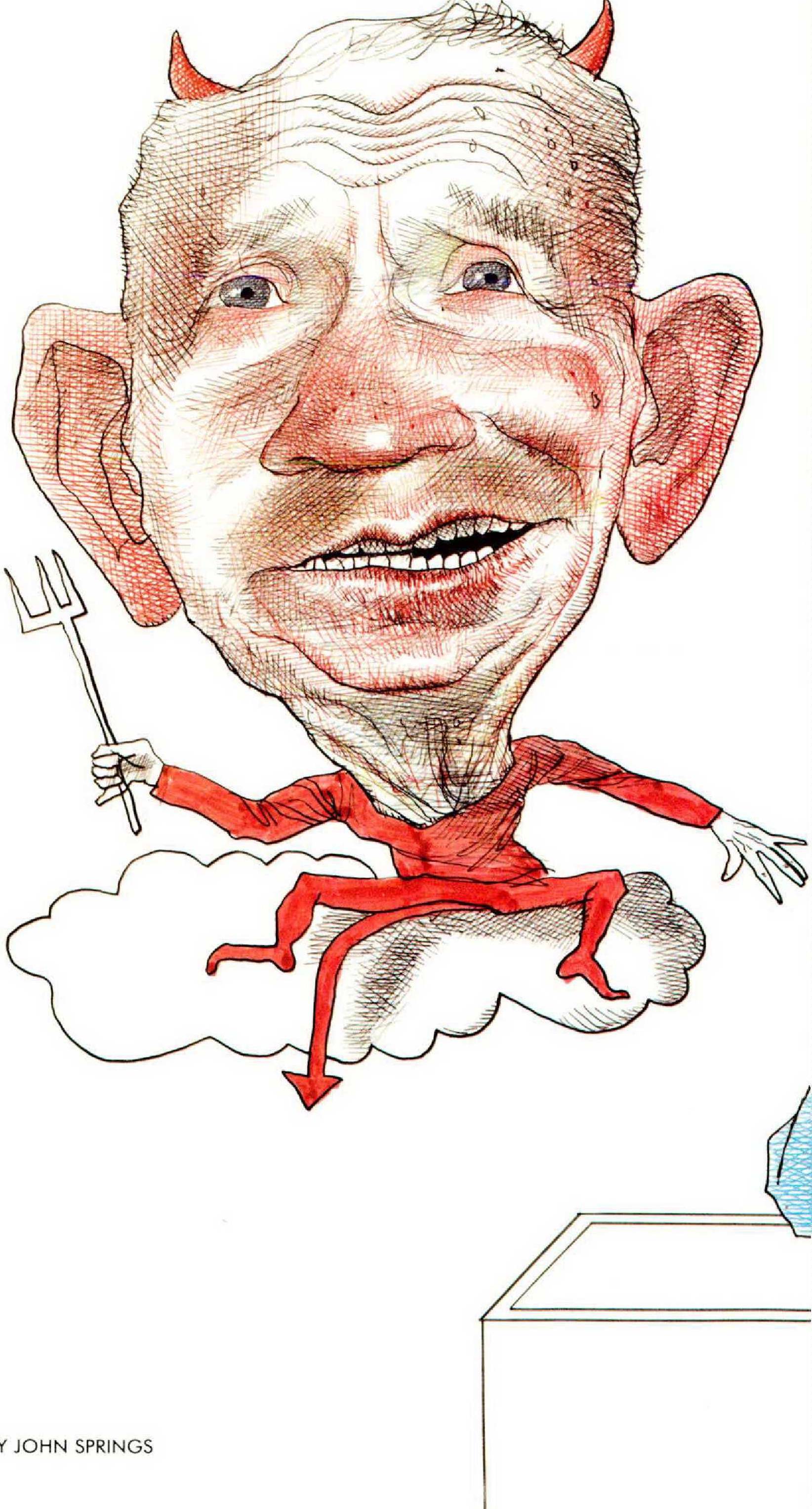
Was 1992 like 1968, a major turning point in the nation’s electoral history? Or was it more like 1976, when an incumbent was thrown out for what proved to be shortterm reasons, leaving the underlying balance of political power unchanged?
As one might expect, Democrats and Republicans disagree on the answer. Clinton’s pollster Stanley Greenberg unhesitatingly proclaims 1992 a “watershed election.” Fred Steeper, his Republican counterpart, confidently told us recently that 1992 “doesn’t have long-term implications—it was a performance type of election, and people voted against Bush’s performance.”
We won’t know for four years which assessment comes closer to the truth. For example, although 1968 gave the Republicans an opportunity, the Republican majority of the past generation wasn’t consolidated until 1972. Similarly, 1932 gave the Democrats an opportunity, but the New Deal Democratic majority was not firmly established, political scientists agree, until 1936. The failure of one party only opens the door to realignment. To establish a new majority, a party must succeed in governing.
The year just past looks like 1932 and 1968—election years that created openings for a new majority. The scale of Bush’s decline (16 points), the increase in voter turnout, and the exceptional vote for an independent candidate all suggest an electoral turning point. The Republican coalition of Nixon and Reagan has almost certainly been shattered. We can say “The King is dead.” It is not yet possible to say “Long live the King.”
A lot depends on what happens to the Ross Perot vote. The 19 percent of the vote that Perot received last year was the best showing by an independent or third-party candidate in eighty years. Strong third-party showings usually signal the end of an era. The emergence of the Republicans and the Know-Nothings in the 1850s marked the end of the Jacksonian party system. The Populists of the 1890s fractured the Civil War parties. The Progressives of the early twentieth century presaged the end of Republican dominance. The Wallace vote in 1968 signaled the end of the New Deal Democratic majority.
The implication is obvious. Perot’s vote may signify the end of the Republican presidential majority: b. 1968, d. 1992—R.I.P In 1924 Robert LaFollette won 17 percent of the vote as the Progressive candidate. In the 1930s Franklin Roosevelt’s economic liberalism pulled the old Progressive vote into the New Deal Democratic coalition, and a new majority was born. Similarly, after 1968 Nixon folded the Wallace vote into the Republican vote, only this time the theme was social conservatism. From the Democrats’ point of view what held the Republican coalition together was racial backlash. Republicans preferred to think of it as traditional values. It was actually some of both—but whatever the exact proportions, a new majority was born.
That majority has now collapsed. To replace it. Democrats can’t simply revive the old Roosevelt coalition. They have to build something genuinely new. The 1992 Clinton vote was a start: it didn’t look like the Democrats’ traditional winning coalition.
The Democrats did best in the nation’s liberal belt: the East Coast, the West Coast, and the upper Midwest. Clinton rolled up big margins over Bush in Massachusetts (19 points), New York (16 points), Illinois (14 points), California (13 points), Minnesota (12 points), and Washington (11 points). According to the exit polls, the Democrats won majorities among blacks (83 percent), Jews (80 percent), gays and bisexuals (72 percent), self-described liberals (68 percent), Hispanics (61 percent), big-city voters and poor people (both 58 percent), and single parents and voters from union households (both 55 percent). Clinton got about 40 percent of the vote among whites, middleincome voters, and suburbanites. In those key middleAmerican constituencies the Democrats and Republicans ran neck and neck.
The Democrats may have nominated two southern white male Baptists, but the ticket fared worst in the South, the only one of the four major regions of the country where Bush came out ahead last year. Whites born in the South, once the backbone of the Democratic Party, gave Bush a 19-point margin over Clinton.
Clinton’s vote was not the old Roosevelt coalition, or either of the coalitions that elected John F. Kennedy in 1960 and Jimmy Carter in 1976. It was a liberal coalition. The Democrats have gotten that kind of vote before. They got it in 1972 with George McGovern, and in 1988 with Michael Dukakis. But until last year they had never won with that kind of vote.
At 43 percent, Clinton actually did three points worse than Dukakis did in 1988. If the Democrats want to turn the Clinton vote into a majority, they have to realize two things. First, they will not be able to rely on the South, even if they nominate an all-southern ticket; Clinton did about as well as the Democrats can expect to do in the South these days. Second, the Democrats must make California theirs. California has voted for the Democratic presidential ticket only twice since 1948: for LBJ in the 1964 landslide, and for Clinton last year. California is not a base Democratic state. It will have to become one if the Democrats want to secure a governing coalition. That is why Clinton went to California so soon after his election. He’ll be going back there—a lot.
The Perot Movement
THE PEROT VOTE IS THE KEY TO THE POLITICAL future, but it is not clear how either the Democrats or the Republicans can get it. Third parties have typically been protest movements with a clear issue or ideological profile: anti-slavery for the early Republicans, agrarian radicalism for the Populists, political and economic reform for the Progressives, racial backlash for the Wallace movement. All a major party had to do was endorse the protest issue, steal the third party’s thunder, and take its votes.
The Perot movement is hard to define in those terms. It was a protest movement, all right, but not one based on a specific issue or ideology. Perot’s supporters tended to come from all across the political spectrum. They expressed broad dissatisfaction with the way things were going in the country. What held the movement together was not ideology but alienation from politics as usual. The Perot movement looked like a collection of discontent, not a single concern that could be straightforwardly addressed. It may not be so easy for a major party to steal the Perot movement’s thunder.
Ross Perot represented something genuinely new in national politics; the meaning of his candidacy cannot be understood within the boundaries of the debate that has defined national politics for the past quarter century. Moreover, his 19 million-plus votes ensure that the concerns he spoke to will shape politics throughout the 1990s. It would be a mistake to write off the Perot phenomenon as an anyone-but-Clinton-or-Bush protest vote. For one thing, from mid-May to mid-June, Perot was actually running ahead of both Bush and Clinton in most national polls—an unprecedented showing for an independent candidate. More important, Perot inspired a genuine social movement. It was driven by two powerful forces.


The first was economic anxiety. Voters who felt that their economic situation had gotten worse over the past four years were much more likely to vote for Ross Perot than those who felt it had gotten better. Fear about the future especially marked the Perot vote. By two to one, those casting ballots for Perot thought that the country was in a “serious long-term economic decline,” rather than experiencing a normal economic downturn. Fully 43 percent said they expected life for the next generation of Americans to be worse than life today. Perot voters were even more pessimistic about the future than Clinton voters.
This was not a movement of the poor or the disadvantaged, however. At its core Perotism was a movement of the squeezed middle class, the white-collar victims of the recession. We spent some time last year with Perot activists in Orange County, California. A lot of those we met could be characterized as “yappies”—young angry professionals.
Most of them had voted for Bush in 1988, but they felt that Bush had betrayed them. The breaking of his nonew-taxes pledge was a symbol of that betrayal. What angered them was not the taxes so much as the lying. In Orange County and other normally Republican parts of the country the Perot movement looked like a twelve-step program for recovering Bushaholics. According to Stanley Greenberg, Bush “wasn’t on their radar screens.” If you asked them what came to mind when they thought about Bush, Greenberg told us, “it would be something like ‘stooge,’ ‘for the rich,’ ‘done,’ ‘goner.’ Bush didn’t require any further conversation.”
Of course, Clinton also sought to address voters’ economic insecurity. His campaign was above all an economic indictment of the Bush Administration. What prevented Clinton from gaining the support of these voters was the second force behind Perotism: disgust with politics. Perot supporters are deeply skeptical about both government and politicians. We spoke with Clay Mulford, Perot’s son-in-law and a key adviser. According to Mulford, Perot voters believe that “the government has nothing to do with their day-to-day lives, and yet they see terrible problems with politics.” In their view, “politics is not designed to address issues; it’s designed to gain re-election,” he told us. “These are the people who are alienated from the political system.”
Clinton, a Democrat and a career politician, was at least as suspect as Bush on this score. He may have portrayed himself as a new kind of Democrat, but Perotians didn’t see anything new. In order to defeat Paul Tsongas in the primaries, Clinton had run as the son of Walter Mondale, a typical Democrat. Worse yet, after the sex, drugs, and rock-and-roll stories, Clinton came across as a typical politician—slick, evasive, and consumed by ambition.
Perot’s status as a nonpolitician was tremendously appealing to these voters. They saw him as a man of action —which politicians, almost by definition, are not. Perot promised to make government work, to “get under the hood.” And that’s just what his people were looking for.
Disgust with politics had a positive side. The Perot activists we spoke with had a tremendous faith in technology and problem-solving. Both the positive and the negative forces were neatly packaged in the diminutive person of Ross Perot. He advertised himself as a successful hightech businessman who knew how to get things done. Perot proposed to deal with the deficit and other pressing problems by changing the way government did business. The process would be opened up to average citizens through electronic town halls and similar forums. He would bring knowledgeable experts together in Washington and have them determine sensible, rational policies. Exactly how all that would work was far from clear.
What was clear was that politics—partisan politics, special-interest politics—would be eliminated from the equation. Instead, political issues would be treated as technical problems with right answers. You look under the hood, see what’s wrong, and fix it. Perot supporters didn’t seem to believe that gridlock results from conflicts of interests or values. They saw politics—forging compromises, building coalitions, making deals—as part of the problem, not part of the solution.
We saw no evidence of a sinister agenda among the activists we met. These were educated people, and they made a great display of tolerance. Women and minorities were given prominent positions in the local Perot organizations. When Perot supporters talked about “us” against “them,”they meant the people—all the people—against the politicians.
The agenda of the Perot movement was not undemocratic—but its implications were. For example, a favorite theme was that government should be run more like a business. We asked Perot activists what that meant. They said, “Honest, efficient, well-managed. Get things done.” But when we pointed out that a business is not a democracy, they said, “That’s not what we mean,”
Similarly, Perot himself was fond of repeating the Three Musketeers motto, “One for all and all for one.” All for one? If you pointed out what that implies—no legitimate opposition—Perot would surely say, “That’s not what I mean.” And he’d probably call you a Republican dirty-trickster. How about the slogan “Ross for Boss”? To them, it didn’t mean “dictator.” It meant “leader.” Their critique of the political system was quite sophisticated. But their prescription for government without politics was hopelessly naive. It was dangerous, too, because it denied the legitimacy of contending interests.
The Perot movement was a peculiarly American phenomenon, with peculiarly American roots and parallels. In many ways it was a continuation of the old Progressive tradition. Progressives, too, hated politics. They believed that government should be based on rational decisionmaking. The historian Richard Hofstadter described the Progressive idea of political participation as “intellectualistic.” Voters, he wrote, “would study the issues and think them through, rather than learn about them through pursuing [their] needs.” In his view, “The Progressive notion of good citizenship was the culmination of the Yankee-Mugwump ethos of political participation without selfinterest” (emphasis added).
The Progressive agenda sounded democratic but it had undemocratic implications. Hofstadter was aware of those implications in 1955, when he wrote, in The Age of Reform,
We are in a certain sense moving closer to the plebiscitarian ideals, the mass democracy, that the advocates of direct government had in mind. But they would not have been pleased with the prospect of having their goals approached in this way, for the means of influencing mass sentiment on a grand scale require the big money and the crass manipulative techniques that the Progressives were trying to eliminate from politics. This brings us back again to a central problem of the modern democrat: whether it is possible in modern society to find satisfactory ways of realizing the ideal of popular government without becoming dependent to an unhealthy degree upon those who have the means to influence the popular mind.
No one had more means to do that than Ross Perot.
It is far from clear where the Perot vote is going to end up. Republican leaders regard Perot’s supporters as renegade Republicans. There is some truth to their view. According to the networks’ 1992 exit poll, a majority of Perot supporters voted for Bush in 1988. Haley Barbour, the Republican national chairman, believes that the party lost them because it failed to live up to its principles. He argues that if the party returns to those principles—anti-tax, anti-spending—the Perot voters will come back home.
Democrats prefer to view Perot’s supporters as Republican voters who have seen the light. Just as Progressives gave up on the Republicans in the 1930s and Wallace voters gave up on the Democrats in the 1970s, so Perot voters have left their ancestral home. All the Democrats have to do is figure out the right welcoming message. Clinton seemed to do that last year. When Perot dropped out of the race, on July 16, he declared the Democratic Party “revitalized.” Two thirds of his supporters went to the Democrats, according to a Times Mirror survey that interviewed the same voters before and after the Democratic National Convention. Like the Wallace movement in the 1960s, Perot’s movement looked like a temporary refuge for voters who were on their way from one party to the other.
There is another possibility, however. Perot may try to hold on to his vote. In January he formally reconstituted his organization, United We Stand America, as a pressure group. Perot supporters say that it is not a political party and it will not nominate or endorse candidates. It is supposed to lobby for political and economic reform. But the organization is in place, and, God knows, Perot has enough money for another run. All he has to do is ask his volunteers what they want him to do. The answer would be about as unpredictable as the nominating vote at a national party convention.


The Republicans
THE TWO PARTIES NOW CONFRONT QUITE DIF ferent tasks. With Democrats in control of both houses of Congress, they have the ball, and the Republicans can only play defense. Republicans have limited control over their destiny. Their goal is to build internal unity and present an attractive face to voters in the event the Clinton presidency fails. That may not be easy.
At the Republican National Convention last year Patrick Buchanan spoke of a raging “cultural war.”He was referring to the nation, but the phrase better describes his party, which now faces deep divisions over its stated commitment to conservative cultural values—especially on the issue of abortion.
Some Republicans believe that the prominent role of religious fundamentalists in the party and the uncompromising platform plank on abortion cost them the White House in 1992. They have formed an organization, the Republican Majority Coalition (RMC), devoted to pushing the party toward the political center. It has been modeled after the Democratic Leadership Council (DLC), which was organized by moderate Democrats in 1985 to bring the Democrats back to the center. (One of the DLC’s founders and chairmen was Bill Clinton.) Moderate Republicans intend to resist efforts by the religious right to expand its influence in the party. They also hope to push the party toward a pro-choice position on abortion, or toward no position at all.
On abortion, at least, the RMC has a strong argument: the party’s official position is not widely supported. In the nationwide exit poll on November 3, only nine percent of the voters said they thought that abortion should be illegal in all cases; an additional 23 percent said it should be illegal in most cases. That compares with a total of 63 percent who said abortion should be legal in all (34 percent) or most (29 percent) cases.
The abortion issue could also hinder Republican efforts to reach Perot voters, who are far closer to Clinton voters than to Bush voters in their opinions on abortion. Fully 69 percent of Perot’s backers believed that abortion should be legal in all or most cases—a percentage just a little lower than that of Clinton voters, but half again as high as the figure for the Bush camp.
We asked Orson Swindle, a conservative Republican who served as Perot’s campaign spokesman, how the party could appeal to Perot supporters. His advice was this: “They’ve got to move back toward the middle of the road, realizing that that’s where 70 percent of the American people are. They’ve got to counter the image that came out of the convention of being exclusionary.” The rhetoric of the Republican convention crossed the line between promoting values and stigmatizing those who disagreed. Perot voters, many of whom have a libertarian political orientation, will be difficult to attract with that kind of message.
Nevertheless, the Republican Majority Coalition misses an important point. Republicans cannot afford to give up culturally conservative voters. Three in ten Bush voters were white born-again Christians; 50 percent said abortion should in most or all cases be illegal; 55 percent attend church at least once a week (compared with a third of Clinton and Perot voters). Many of these people are closer to the Democratic Party on issues like health care and the economy. When they voted for Bush on November 3, they were voting their values.
Over the past twelve years religion has become increasingly important in differentiating support for the two major parties. Religious voters of all persuasions have been gravitating to the Republicans, while nonreligious voters have tended to vote Democratic. If religious voters see no significant difference between the parties on the values front, many will do what they did in the past—either vote their pocketbooks or stay home.
The Bush campaign pollster Fred Steeper told us that he fears his party will be “bluffed off the religious vote by the liberal press” and will therefore lose this critical bloc. In his view, “The traditional-values appeal the Republicans picked up with Reagan is very important to the party politically, because we picked up a new segment. It gets us a lower-end vote that we wouldn’t get on just economic issues.” Conservatives point out, correctly, that the Republican position on social issues, including abortion, was the same in 1980, 1984, and 1988, years when Reagan and Bush won, as it was in 1992.
Without cultural issues the party loses the principal source of its populist appeal. It is difficult to imagine how the party can win many battles with neither economic nor cultural populism in its arsenal. It will go back to being what it was before Nixon—the minority party representing the economic elite.
In some ways the Republicans’ problem with religious voters is similar to the problem the Democrats used to have with the black vote. Starting in the 1960s many conservative whites were turned off by the impression that blacks held too much power in the Democratic Party. But the Democrats could hardly afford to purge blacks from their coalition, as some moderate Republicans now seem to want to do with fundamentalists. A purge would polarize the party and make a weak coalition weaker. “The politics of exclusion is the politics of defeat,” Haley Barbour told Republican governors last November. “Takeovers of the party and purges from the party are equally unacceptable.”
The leaders of the DLC, including Clinton, tried to create a broader, more inclusive definition of their party that would appeal beyond its black and liberal base. Look at how Clinton won: He built a strong biracial coalition, both in the primaries and in the general election. He took steps to reassure white voters by emphasizing “personal responsibility” and advocating welfare reform. Many blacks very likely agreed with Clinton on those issues. His public skirmish with Jesse Jackson in the Sister Souljah affair probably helped him with moderate and conservative whites, and there is no evidence that it did him any harm among blacks. Ironically, the real glue for Clinton’s winning coalition was the issue that Jackson has always emphasized— “economic common ground.” Clinton won by focusing attention on issues like jobs, health care, and education, which white and black Democrats largely agree on.
RMC moderates have to do what the DLC did—formulate a broader, more inclusive definition of their party which has appeal beyond its conservative and religious base. The trick for Republicans is to find enough common ground to hold the religious conservatives without alienating middle-of-the-road independents and moderates. It will be difficult but probably not impossible. Reagan did it by building a diverse coalition united by resentment of the federal government. That was something economic conservatives, religious conservatives, racial-backlash voters, and middle-class taxpayers had in common.
Remember that many analysts said the Democrats could never overcome their “race problem.” But they did. On the other hand, it took them a quarter of a century to do it.
The Democrats
BILL CLINTON, MORE THAN MOST PRESIDENTS, was elected to do one thing. His job is to fix the economy. To build a new Democratic majority, Clinton will have to persuade Americans not just that the economy is getting better but also that the nation is on a sound economic footing for the long term. That’s critical for securing a middle-class base for the party.
What the middle class wants out of government isn’t programs; it’s prosperity. They don’t want government to solve all their problems. They want it to protect their jobs and keep their incomes secure from the threat of tax increases, inflation, and out-of-control health-care costs. If their income is secure, middle-class voters believe, they can solve their problems for themselves.
Back in the 1970s the Democrats briefly flirted with the idea of no-growth economics—Jimmy Carter’s era of limits, Jerry Brown’s “Small is beautiful.” Clinton must prove that the Democrats have learned their lesson— namely, that economic growth is necessary for social progress, even if it is not sufficient. Democrats know that the economic growth of the 1980s made some problems worse (such as economic inequality and the instability of financial institutions) and had no effect on other problems (such as the decay of the nation’s cities and the healthcare crisis). But Democrats now understand that before they can make progress toward solving problems like inequality and urban decay, they have to make sure the middle class feels economically secure.
In developing his economic program Clinton had to navigate among conflicting pressures. The desire to capture the Perot constituency pulled him toward the center: 53 percent of Perot voters were moderates; only 20 percent called themselves liberals; two thirds said they preferred less government and lower taxes. Clinton’s toughest test with Perot voters will almost certainly be the deficit. For them, it is a test both of willingness to confront politics as usual and of seriousness about tackling the economy. A failure to demonstrate real commitment to deficit reduction would make it difficult for Clinton to gain Perot supporters’ trust.
But Clinton has to be careful to listen to the music of the Perot movement (anti-establishment) and not just read the lyrics (deficit reduction). The Clinton program includes some gestures toward political reform, such as campaign-finance reform and the elimination of the business tax deduction for lobbyists. An awful lot of the Clinton Administration, however, looks like the Washington and Wall Street establishments. To many Perot supporters, we’ve still got government by insiders.
At the same time, the Democratic Party base will pull Clinton toward the left. Although the Democratic majority in Congress is not any larger than it was before the election, it has a more liberal cast. There are five new women and minority senators, all Democrats, and forty-three new women and minority representatives, thirty-seven of them Democrats. Many liberal interest groups have been starved for public funds for twelve years. They’re going to pressure Congress and the Administration for more spending. As noted earlier, the contours of Clinton’s vote were decidedly liberal: blacks, Jews, gays, Hispanics, liberals, poor people, and city dwellers. Those voters expect, and deserve, some kind of payoff for their loyalty.
Between the two camps is Clinton himself. The commentator Ben Wattenberg has observed that there seem to be two sides to Bill Clinton. One is the liberal, antiwar, Hillary side. The other is the moderate, southerngovernor, DLC side. He was careful to keep the two sides balanced when he made his top-level appointments last December. The liberals got labor, environment, and health and human services. The moderates got treasury, budget, defense, and intelligence.


But Clinton would be the first to say that there’s really only one Bill Clinton. He believes that his politics represents an important new synthesis, that he is truly “a new kind of Democrat.” He has denounced the “brain-dead policies” of both political parties. He has rejected liberalism and conservatism as “false choices.” He has said that his policies represent a “third way,” different from discredited Republican trickle-down economics and discredited Democratic tax-and-spend economics.
In that spirit, Clinton maintains that he can reduce the deficit while elevating the living standards of the poor and the middle class, by increasing spending on the right things—investment, as opposed to consumption. He calls it “invest and grow” economics. As political rhetoric it is a proven success. The question now is whether it will work as a governing philosophy.
The President’s Challenge
CLINTON BEGINS HIS PRESIDENCY WITH TWO IMportant advantages over the Republicans in pursuing the Perot vote. First, Perot voters have substantially more confidence in the Democrats than in the Republicans to handle their two greatest concerns: the economy and the deficit. They have their doubts about Clinton, to be sure; that’s why they didn’t vote for him. But they still have an open mind about the new President, as they no longer did about Bush. And they hope he succeeds.
Perot supporters’ initial response to Clinton’s economic program, announced in the President’s speech to Congress on February 17, was, like that of other Americans, quite positive. That was not surprising, because there was a lot of Ross Perot in Clinton’s speech—notably the emphasis on political reform and deficit reduction. The day after the speech a CNN-Time magazine poll asked people whether they thought Clinton was “now much closer to Ross Perot’s economic positions than he was during last year’s campaign.” By two to one, Perot supporters said yes.
Second, although Perot supporters are on the whole a little more conservative than Clinton, pragmatism is their real philosophy. If the economy grows, there are no ideological barriers to their entering the Democratic fold. The Republican quandary is how to appeal to a group of pragmatists when you have no political power. Clinton may or may not deliver the goods, but at least he has a truck.
Not all is rosy for the Democrats, though. A big part of what attracted voters to Perot was that he was not a conventional politician. Bill Clinton, however, has been a politician all his life. Many of the skills that have gotten him where he is today—among them his instinct for compromise—are precisely what Perot voters hate about politicians. And in 1996 he won’t be able to run as a Washington outsider.
Then there’s Ross Perot. For much of 1992 he directed his fire at George Bush and the Administration. His critique of Bush’s economic management was politically devastating, coming as it did from a non-Democrat whose only motive appeared to be concern for the country. But now it is the Clinton Administration that Perot will be trying to hold accountable. And he lost no time in signaling the critical stance he will take, blasting Clinton even before the new President was sworn in.
Clinton is clearly concerned about Perot’s influence. The President went to the trouble to telephone Perot the day he delivered his economic program to Congress and brief him on what was in it. Perot’s response to the plan was guarded. “I don’t really know what to say about the new Clinton economic plan,” Perot told a rally in Florida. “The President only laid out the outlines.” Perot said in a television interview the night of the speech, “The devil is in the details.”
Like many of the President’s critics, Perot expressed concern about the ratio of spending cuts to tax increases. In a telephone interview with The New York Times the morning after Clinton’s speech, Perot asked, “Are the taxes really going to be used on the deficit, or on more spending? Is spending really going to be cut, or are you going to end up with a dollar eighty-three in new spending for every dollar raised, the way we have so many times in the past?”
Clinton’s Republican critics argue that almost all the deficit reduction in the President’s plan comes from defense cuts and tax increases, and that the domestic-spending cuts are more than counterbalanced by increased spending on what the Administration calls “investment.” If that is the case, then Clinton’s program seeks to achieve something Democrats have been dreaming of for twelve years: undoing the Reagan Revolution.
Ronald Reagan cut taxes and increased defense spending. For all his tough talk, however, Reagan never succeeded in making a deal with Congress to cut domestic spending—so the deficit went up. A lot of Republicans thought the deficit set a perfect trap for the Democrats. Sooner or later the Democrats were bound to get elected. With a huge budget deficit, they wouldn’t have any money to spend. They would either have to raise taxes and destroy themselves politically or accept the reality of limited government.
But Clinton may have outsmarted the Republicans. His program eludes the deficit trap. Here’s the secret: the Democrats adopt the cause of deficit reduction. That gives them a justification for doing what they have wanted to do since 1981—increase taxes and cut defense. Walter Mondale got blasted for saying he would raise taxes to reduce the deficit in 1984. Now Clinton is being applauded for it. Why the difference? Because two things happened between 1984 and 1993. The economy went sour under George Bush, making a lot of people believe that it needed fixing. And Ross Perot identified the deficit as what needed to be fixed.
What Clinton wants to do is a reverse Reagan—increase taxes and cut defense spending. For all his tough talk about domestic cuts, Clinton will probably do no better than Reagan did. Remember, the Democrats have an ambitious new investment agenda. But at least some of the revenues from the tax hikes and the defense cuts will go toward deficit reduction. A smaller deficit lets Democrats be Democrats. They can spend money again, as long as they are careful to call it investment. That way Bill Clinton can continue to depict himself as a new kind of Democrat.
First, however, Clinton has to sell his program. He has to do that in the new political context established by the 1992 campaign. The message of 1992 was, instant democracy works. Perot bypassed all the established institutions and procedures when he ran for President. He took his campaign directly to the people and did surprisingly well.
Instant democracy also worked for Clinton. When his campaign got into trouble during the primaries over marital fidelity and the draft, Clinton, too, went directly to the people. He bet that the voters would be more interested in his economic proposals than in his personal life —and he won that bet. The voters set the agenda for the 1992 campaign.
The problem is, the voters want to continue setting the agenda now that Clinton is President. No sooner did he take office than the voters insisted on having their say about Zoe Baird’s qualifications for attorney general and about Clinton’s plan to lift the ban on homosexuals in the military. In an era of instant democracy it may be more difficult than ever to build a majority coalition and hold it together for any length of time.
Idtimatcly, Clinton will be judged by his ability to turn the economy around. Once he docs that, he can move in any direction he wants. Franklin Roosevelt sold the New Deal, a vast expansion of federal spending and power, because the economy improved. Reagan sold Reaganomics, a retrenchment of federal spending and power, because the economy improved. Jimmy Carter and George Bush had major foreign-policy achievements, but they couldn’t sell the voters anything because they allowed the economy to deteriorate; they were defeated for re-election, and their parties paid a heavy price.
Whether Clinton succeeds or fails, one thing is clear: Americans want to move beyond the Reagan-Bush era. At the end of February, shortly after President Clinton announced his economic plan, the CNN—USA TodayGallup Poll asked people how they would vote if the 1992 presidential election were “held again today.” Among 1992 voters Clinton’s support went from 43 percent in the election to 47 percent four months later. That’s up a bit, but still less than a majority. Perot’s support also held up surprisingly well—19 percent at the polls, 22 percent in 1993. The big loser, once again, was Bush, whose standing dropped from 38 to 31 percent. The February poll had even worse news for the Republicans. By 61 to 29 percent, Americans said that Ronald Reagan’s economic policies were a failure. T he public may not be sure about where Clinton is going. But they don’t want to go back to where they were.
If Clinton fails to put the nation back on track toward broad, middle-class prosperity, the prospects for a new Democratic majority will evaporate. But that won’t necessarily mean a return to the status quo ante. Even if the Republicans can bind up the wounds of their cultural civil war, they have lost substantial credibility on the economic front. With both parties discredited, national politics could be more wide open than it has been at any other time in this century.
That’s the view of Clinton’s pollster Stanley Greenberg: “If Clinton succeeds, he will create a new Democratic majority with a new social base, which incorporates a good part of the Perot bloc. If he doesn’t succeed, I don’t believe it will go back to the Republican coalition we knew, which is in disrepute. I think you’d end up with a volatile three-party politics, maybe a Latin Americantype politics.”
Greenberg’s forecast is a bit apocalyptic. If the Democrats fail to govern effectively, however, after raising so many hopes, they could very well leave American polities in disarray. The possibility of a successful independent presidential candidacy, by Perot or someone else, cannot be ruled out. Remember that Perot was winning in the polls last spring. The distrust of politics and politicians which Perot addressed remains very much alive. So does United We Stand America.
In order to get the Perot vote, Clinton is going to have to prove that a professional politician can actually solve the nation’s problems. What’s at stake here is not just the future of the Democratic and Republican parties. It’s also the viability of the American political process.