Meeting the Queen
AT KNOPPER’S Bank, Steven was a nephew with a place to make where two sons and a brotherin-law had precedence. When the American was announced, he broke off dictation, clapped his hands to tell Audace to close her book, and released her. Not much had to be explained to her. In the two years she had been with Knopper’s she more often cued him than the other way around.
The American was waiting in the reception hall. Audace had acquired the firm’s taciturn manner, and said only, “How do you do, Mr. Rowell. Mr. Steven Knopper is expecting you,” paused, and indicated that she was to be followed. “Please?” Fie didn’t mind at all. Her few words rang musically, Huh do y’ doooP Mr. Rowellll? His ear said Irish or Scottish. How nicely she had accented How, as if she expected an answer.
An impression of a freckled face chimed off her loosely pinned hair. He regretted that he had so few seconds to appreciate her figure before she stepped aside for him at the office door. He looked directly into her face and saw, in the biblical phrase, that it was good—that is to say, well formed, with intelligent bronze eyes, and a thumblike nose that gave her the look of wading in, taking things on. For her size, a formidable field-hockey player: she would have a leg or a stick or a hip in when the opposition thought it was in the clear.
He was already thinking in campaign terms: She would be congenial to talk with. She carried herself as if she could dance. He liked figures he didn’t have to turn the lights on to see. If she was Scottish, the odds were good that religious issues would not be a problem between them. He decided she was Scottish. He thought of introducing her around at annual gatherings of the Murdocks, his mother’s side.
Calvin Rowell had been sent over to straighten out the U.K. operation—the first time the eyes of the top bosses would be on him, If he did as well here as he had in Bangkok and Sydney, the numbers would be impressive and the chairman and CEO would know. The road to manager of Fanston, Europe, was open. In Dallas they didn’t know such a job existed. It was in Cal Rowell’s head.
This was his first meeting with the London bankers who would introduce him around. In the course of the meeting he learned that the Englishman had been with Alexander, Auchinleck, and Montgomery in Africa. Rowell had been on destroyers in the North Atlantic. The men bonded so thoroughly that one of the introductions Cal said he would like—on second thought, not an introduction, clearance, he wanted clearance ("If it’s in order, Steven. I don’t want to do anything that will make anybody uncomfortable. I expect you to be candid with me”) to ask the young lady to have dinner with him.
“Right. Audace, a hell of a girl. Go ahead, ask her, it that’s what you’re thinking of. Only don’t steal her. She’s been with me two years and she’s priceless.”
In 1954 women at Knopper’s were still thought of as girls at twenty-seven, and it was understood that it they took work with the firm, they should not aspire to something different from secretary. When they were in their forties and had been passed along to their second partner, they were addressed no longer as Agnes or Cynthia but as Talbott or Merlydock. Talbott, can you take care of that? Merlydock, how do we do this? This was thought of as a promotion. Steven’s wife would have preferred that he have a secretary of Knopper’s Bank’s surname generation, but settled for the conviction that the bank was his shot at a very high place and that he had too much grit to be distracted. She was right.
Steven felt that Americans of the business class took girls out without making any kind of inquiry, and he was gratified that Rowell had foreseen complications in asking to date the secretary of a man he did business with.
Audace was neither Scottish nor Irish; she was Welsh. Her name was not Jones, Edwards, Evans, Cadwallader; it was one of those railroad-station names that looked as if the typist’s fingers had shifted on the keys.
“Audace Elanrwst. Have J got it right?”
“Right. Lenrist. Let me introduce you and say a word on your behalf.”
“All right. Don’t make it an order.”
“You will be serious with her, won’t you? Think of her as my sister.”
“I’ll do better. I’ll think of her as mine.”
He took Knopper’s suggestion and left up to her what to do on a May evening in London. She didn’t accept “Whatever you think,” nor did she nag for answers. She offered alternatives and inspected his replies. He imagined friends saying, “Cal Rowell’s wife knows how to throw a party.” He liked to see sights, he liked restaurants that served people from the neighborhood and whose kitchens did simple foods well.
The Thames launch made a ceremonial pass under the bridge to review the roofs and spires of Parliament. Standing beside him, she read off the cardiogram of the British heart that had, within that decade, on the word of an authority, survived in its finest hour: the Clock Tower, Westminster, Jerusalem, St. Margaret’s, Victoria Tower.
“Love you, love,” the launchman said, “you’ll have me job,” and reversed to head downriver. The launch bucked as it met the tide. They had to lock themselves in place. Their eyes met, amused.
“Reminds you of the North Atlantic, does it?”
“It lacks only a submarine watch.”
“You got the radar from us, didn’t you? That was part of our share. Between friends, it isn’t well to count everything in money, is it.” It was a philosophical observation, not a question.
They came back to London every year or two after they were married, and the city for him always was Audie at the rail of the launch, ringing the names of Parliament, of buildings and bridges decorated like desserts—There now, Cal, the Tower of London, the Tower Bridge-—designed to be served by men wearing pantaloons and nutty hats fit for an English queen. Saying the names of wrecked majesties of the Industrial Revolution and Nazi air raids —docks, warehouses, iron masses of derrickage, and power plants: Cannon Street, Oliver s Wharf, St. Katharine’s, Deptford. Of empire: Greenwich, Royal Observatory, Naval College.
That evening, respectful of her Thames-guide performance, he asked, “How do you know all that? You’ve lived here only two years.”
“We were taught it was impolite not to remember.” She would remember family birthdays, the names of aunts.
They exchanged biographies. Released from the habit of the office, she spoke freely, and he missed a detail here and there only because he kept falling into entrancements. He had given up thinking of her as his sister. Thinking of her as Steven’s was feasible. She had been brought up at St. Cyllans, the keep of Lord and Lady Rhysden, one of the great castles on the Irish Sea coast of Wales—“But not that part of the castle. We had our own cottage. My mum was the cook, and my papa was an agriculturalist. Rhysden azaleas are famous. In the catalogues you see many well-known cultivars worked up by Evan Llanrwst.”
He thought he understood what a cultivar was by the context. People would say, “Azaleas! If you want to see azaleas, take a look at Audie Rowell’s.” They would want her for president of the garden club.
“The Rhysdens and Clynnevins are quite important families. When I was a child, the royals came often to St. Cyllans, the old Queen, and the Yorks with Elizabeth”— whose coronation had been the pageant a year ago. “She was my age.” Audie showed a slyly humorous grain he had suspected. “It must be some distinction to be the same age as a Queen. You might ask your new advertising agency if it would get my name in The Times.”
“Why don’t you ask directly and save the commission?”
“It seems self-serving. If you had the distinction of being the same age as the Queen, wouldn’t you want somebody else to mention it first? Ha! I’ll tell you who else came to St. Cyllans when George was still York—Lord Rothschild. The Duke of York and Lord Rothschild were agriculturalists. ‘They came especially to see Papa. They talked by the hour in the greenhouse. The French Marshal Foeh was a guest at St. Cyllans.” That was all past. “I clerked at Birmingham Hospital during the war, took a degree, did a bit at Radnor Charter Bank, and came to London to do better.”
“And you did.”
“Oh, yes. Mr. Knopper is very fine to work for, and I have met an American.” She slid it in so that it took him a second to hear that she had kidded him, and she was on to something else, asking with acute interest, “Is your work going wellll? Mr. Knopper is set on your doing well. He spoke to Mr. Porcelli. He told him the bank is highly interested in Fanston. Do you find Porcelli a competent firm?”
Yes, the subcontractors had the facilities, and they had not flinched at the proposed stocking arrangements. He was interviewing sales managers and thought he had a hire. He would probably take the accounting manager introduced by Knopper.
“You work at a ripping American speed, don’t you. I like that.”
He wondered how somebody as good-looking as this, who kept the ball in the man’s court, had escaped marriage if she wanted it. Had so few English men survived the war? Was she a lesbian? No, she would have said as much. She knew how to make known what she wanted. Was she holding out for somebody with evidently greater gifts than his? Did she already have somebody? Being a competitor, he got off that track. He had long ago decided that there was no benefit in making cases against himself.
The light dissolved in another coronation as the sun fell behind western chimneys. May or not, it was cool on the water. He thanked her for bringing her brother’s sweater. She was wrapped in a scarf the size of a hammock. Her brown felt hat bore a badge that would have bluffed a sheriff. The English sure knew hats. The evening rapidly went from cool to chilly. Her cheeks bloomed; she cuffed a handkerchief to her nose. The meaningless act, an intimacy implied, bred desire in him.
The launch pulled shoreward. She said, “Wouldn’t we be pleased if a fire is lit in the dining room?”
They were let off at an iron stairway up to a street where a restaurant had a cannel-coa! fire and a window side toward the river. Men with open collars and women in sweaters and skirts had supper and draft at tables around them and seemed as much at home as the more obviously affluent. The barley soup was thick and hot, the sole fresh-caught, the asparagus as edible at one end as the other. White potatoes snapped under the fork. Oil barges, hooded refuse lighters, launches, police boats, became firefly lights, while in the higher sky black bulks were profiled by the retreating sun.
The way to the taxi was narrow and cobbled, silent, dark; all commerce had tied. A single building walled in the street on the side they walked; on the other, dark facades irregularly admitted doorways and alleys. Each next light was twice as far away as his eye judged it should have been. The lamps of Europe that had gone out in the first great war had not yet come on after the latest. He supposed the area was safe. He didn’t want to ask. His mood was that she trusted him. He would give a good account of himself if necessary. Enough light remained for a sign lettered beside a door to be read: NO HIRING.
“Were you ever without work?” she asked.
“No. I went from college into the Navy. When I came out, Fanston took me on as a sales trainee.”
“How well you’ve done! I think that must be the deepest ditch, between work and no work.”
“Were you ever without work?”
“I was fortunate not to be, and my mum and papa were secure on the estate, but Wales—you could cry at the willing men with families and no work in Wales. Except in the war, it’s been that way since I was a child.”
He told her that his father and uncle had had a small nail factory that had gone under with debt during the Depression. He had never been close to his father and hadn’t been comfortable being taken for a walk around the block and talked to about choices that were made in life. He had thought his father was telling him to study harder. That night his father had shot himself. He was glad to have the cover of the dark, and clenched his jaw to keep his eyes dry. He found his arm linked with hers without intending it.
They would say, “You can talk to Audie Rowell. She understands.” He thought that after waiting for it longer than others he knew, this might be a love that would last. He thought how to go about it with Steven’s sister.
He came back again in August for a family wedding in the parish church attended by the Llanrwsts. He apologized to Steven Knopper for stealing her—something he had been explicitly instructed not to do. Steven said it was unforgivable, the apology unacceptable, and sent a brass desk set: a village of inkwells, salt trays, seal boxes, quill holders, dogs, cats, landscapes, and other relevant Georgian matter.
NOW, THIRTY YEARS LATER, THE CALVIN Rowells were in London for a few days, quartered in a hotel’s corporate suite that when first leased, in the sixties, had been dirt cheap, and now outpriced anything in New York. Cal made a note to think this over before his audit committee raised the question. Today Audie had people to see, and the chairman of Fanston International was having lunch in Knopper’s Bank’s dining room with his old friend the managing partner.
Neither of them had anything to do anymore with ad agencies, sales managers, subcontractors; that was the business of younger men. The shop they talked, at a table set with baroque silver, carved glass, china thin as a Dixie cup, on linen of strawiike shining grain, was of acquisitions, government policies, their mutual health and the health of their wives, the adventures and progress of their children, simple gossip about mutual acquaintances who had run off the road—
“How could I have forgot!” Steven interrupted himself with the exclamation. “Would you and Audie like to meet the Queen?”
Did anyone answer no to a question like that?
“Day after tomorrow, Thursday, at four o’clock. This won’t be at Buckingham, although, if you’d like it, on the next day honours are listed—”
“Let’s first get past Thursday. What happens Thursday?”
“Thursday, Her Majesty will dedicate a collection at the London Small Treasures Vaults. This is an extraordinary group of sporting subjects of considerable antiquity, gold and silver and glass and so on. I have been somewhat instrumental in gathering the pieces and furbishing the gallery. I have only to ring up the Queen’s deputy secretary and have your name put on the list. Shall we do that:”
“Audie will want to know what she has to wear. I want to know for myself.”
“Audie will know what to wear or whom to ask. This is an informal occasion. People will be standing about, looking at the objects.” He pretended to try for a look at his friend’s feet. “Come as you are, if you aren’t wearing brown shoes.”
“Striped shirt?”
“Quite all right. You’re an American. It will be rather official for me, so I’ll wear striped trousers and black sack.”
“Not a striped shirt.”
“Ask Audie. She’ll know.”
Steven had not said, “Ask Audie to ring up Constance if she has any questions,” and the two men knew why. The first time Steven had them down to Usselton Hall, Lady Constance had been flawlessly courteous, if austere. The second time, they met mostly people who had business with the bank. The third time, Lady Constance had been unavoidably in Edinburgh on a family matter. Audie understood perfectly and explained it to Cal. Lady Constance could not be expected to associate in an intimate way with a woman who had been her husband’s secretary and was the daughter of a cook.
“Steven and Lady Constance have had a discussion,” Audie said. “Steven didn’t quite lose, but he didn’t quite win.”
Cal said angrily, “We don’t need that. It won’t happen again.”
“I would feel very bad if this interfered between you and Steven,” Audie said. “It doesn’t bother me. It’s the way she was brought up. If you look at it the right way, don’t you see its comic side?”
“I see it as deliberately insulting.”
“Constance thinks the opposite. She thinks she is being very good at avoiding insult. No insult has occurred if none is intended. She is the one obliged to wiggle; we’re not. Think of it as a comedy.”
“I don’t want to be an obligation on Steven’s social calendar because his firm underwrites a hundred million dollars of Fanston paper.”
“You and Steven would be friends however you happened to come together. You are cut from the same cloth. Keep on playing it by ear. just let’s talk it over before you accept any invitations Steven extends for weekends in the country.”
They had gracefully avoided Usselton in the years since. However, the invitation to meet the Queen on the neutral ground of the Small Treasures Vaults was certainly not anything like an invitation to Usselton. It presented no issue of snobbery or sycophancy. Queens were scenic, like pyramids or cathedrals. If you were in their vicinity, you looked.
Rowell treated the invitation as a surprise package and didn’t open it until they had showered and robed, folded down the silk cover, and lay flat out to nap before dinner and theater.
“How would you like to meet the Queen?” he asked the circlet of plaster roses on the ceiling.
He waited so long for the answer that he thought she might have missed the question.
“I’ve met the Queen.”
He got up on an elbow. “You never told me that. You told me the royal family visited the castle.”
“You may not have listened. When I was a child at St. Cvllans. Lillo came every year. We played together.”
“You called her Lillo?”
“We were eight, nine, ten.”
“I thought she was Lilibet.”
“Not at St. Cvllans.”
“You played with her? What do you play with royalty? Hopscotch? Dolls?”
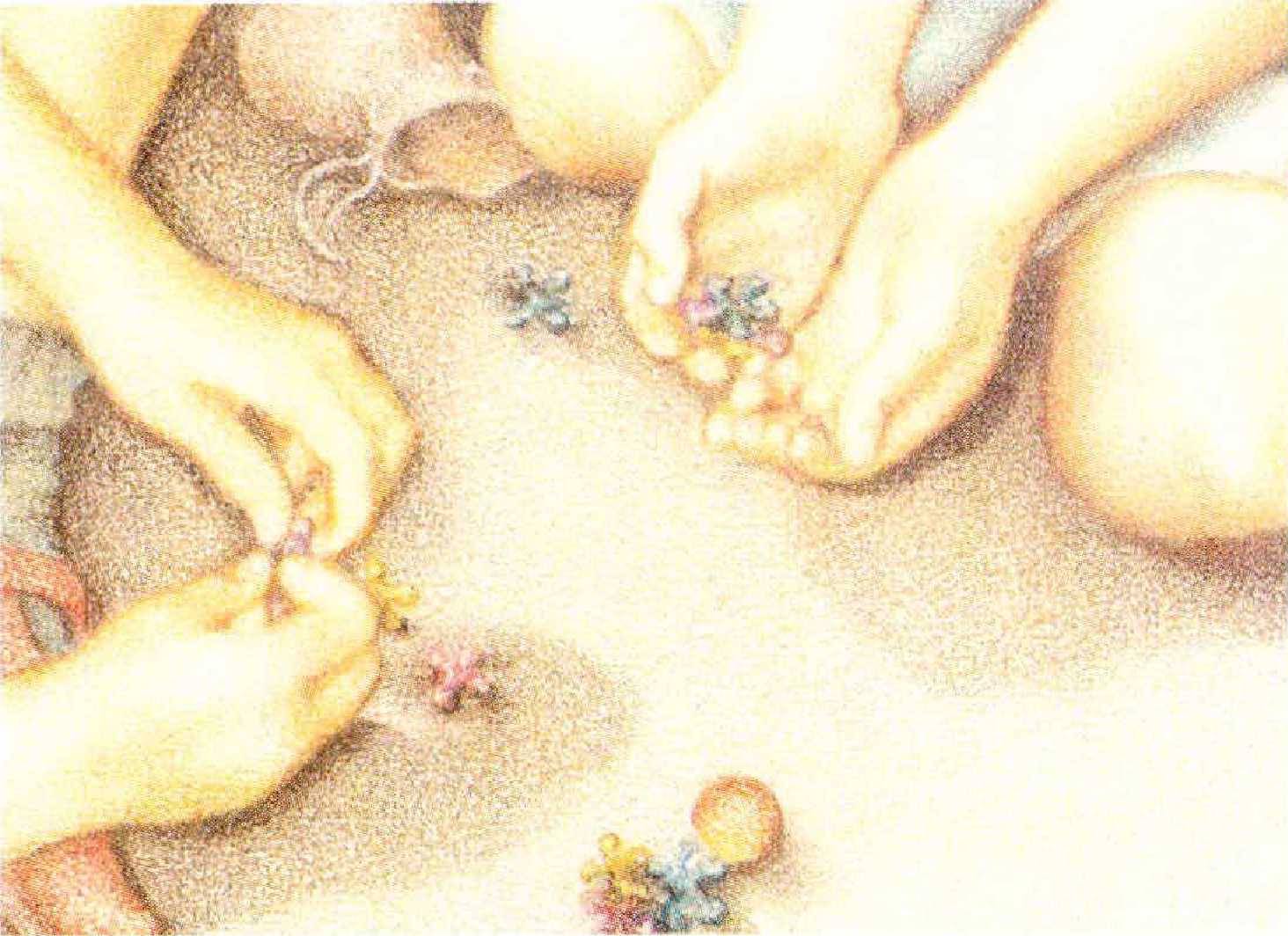
Audie locked her hands together to hold the memory. “We had a playhouse at St. Cvllans, like a real house, except that the ceilings were too low for grown-ups. The door openings cut off grown-ups at the chin. It was our house, for the children of the estate. After the Yorks arrived, Lillo would rush for it as soon as her nanny let her. We played Receiving Queue. Like all children, we played Doctor. We played Cook. The people of Wales had a house made exactly like it and sent it to Windsor. Y Bwthyn Bach—” She inched back to the scene. “The Little House. Ours at St. Cvllans and Lillo’s at Windsor had the same name. I contributed my shilling at church. Lillo was quick at jacks.”
“Jacques?”
“Jacks. Throw and pick up. You know? We said rhymes with the tosses. Maudy Bominam . . .” She set herself to recall the rhymes. “I guess that was ‘Birmingham.’ Children just say sounds—
’Maudy Bominam
Throws clown
Picks up
Throws down / Picks up
This way / counts two
Maudy Bominam / takes one / that’s done
Takes two / don V rue
Takes three / chase a bee
Try again / Not in vain’
“The others shout,
’In vain! In vain!
Maudy, Maudy / Try again!'”
Audie could not contain her joy. She swung out of bed with an agility maintained by trowel gardening and two miles a day on the nearest park path or treadmill. She poised to curtsy, saying with the act, “Extend left leg, point toe, dip right knee, back straight, eyes down.” She held out her hand limply. Imagination dripped off her fingertips.
“Wouldn’t miss seeing Lillo! She never came hack to St. Cyllans after Edward took off with Mrs. Simpson. She was suddenly the daughter of a King and being made ready to reign. Do you think Queens are extraordinarily happy people? I don’t.”
The next day Audie had shopping to do. She especially needed a little off-the-face hat, something she seldom wore and hadn’t had any reason to pack.
AS INSTRUCTED, THE PARTY OK MORE OF LESS forty guests assembled in the gallery a half hour ahead of the appointed time. The treasures were displayed in cases and on tables, so conversation among strangers was easy, for if it failed to take fire from the runners carved in rock crystal (Egypt, 11th century), another strike could be tried at a hunting scene enameled on silver gilt (France, 16th century). Lady Constance, who came right up to the mark of kindness without crossing it, and Sir Steven introduced the Rowells to guests who were charmed (glad, pleased, delighted) to meet them, and others who may or may not have said something complimentary; their views could not be determined through immobile lips and eyes that regarded the Rowells as if they might be sheltering a communicable disease. Offense could not be taken, as it was the way they looked at their wives and husbands.
“All now, please,” said Sir William llessley, the deputy, a feisty gentleman who gave the impression that he would be more at home on a less cultural assignment. They should refer to the list and queue over there in sequence, as they would then match his list. He spoke to them as if he were making it up as he went along.
“That is to say, Tommy’s list. He will have it. He will prompt me. You know, I can’t know everybody. Often I don’t even know the people I know. I get stagestruck. That doesn’t sound right. Stage fright. That’s better. The sponsors will be astute enough, I’m sure, to stand in the area of the presentation to catch up Tommy if he has a problem with a name. Her Majesty and party, including Sir Seymour Teagle, Governor of the Vaults, will enter through that door in fifteen minutes and be announced. The guests will come forward behind Tommy. I will present. Everything will be quite informal, you know. The curtsy is not—not—necessary. An indication of a bow would be nice, don’t you think? Like so. Well, if you laugh, that will only encourage me to play the fool. If Her Majesty offers her hand or a word or two of conversation, why of course respond. You all have common sense. You need not go on and on. If you require an audience, that’s quite another matter; write to me at Buckingham. Her Majesty will speak briefly, and then proceed to view the treasures, guided by Sir Seymour and Sir Steven Knopper and Lord Cunningly. As Her Majesty has already viewed them privately, that should go quickly. We shall follow at a discreet distance, not to hurry those ahead of us. The royal party will proceed to the Governor’s suite, where we shall all have a cup of something and a protein. Now, if you will assemble . . . Loosely is well enough.”
The Queen and party entered.
“I should say ten minutes for the presentations. Your Majesty.”
Scholars, dealers, donors, spouses, began to move toward the Queen behind Tommy’s lead. Without exception, they would have been annoyed if pressed to say exactly why they had cleared their schedules, refreshed their wardrobes, rehearsed their manners, for the privilege of having their names uttered to a woman whose achievements did not surpass theirs, certainly did not surpass their spouses’—whose position was not of her own making, for whom not even the League of Empire Loyalists claimed a power to heal the sick. Some things do not want to be looked at too closely: it was unnecessary (even undesirable, considering that it led in one direction to hilarity and in another to whatever civil arrangement the Brits would devise to replace revolution) to go beyond the fact that the Queen of England, Scotland, etc., was the foremost person in any room in the world she chose to enter, save in Italy, Iran, and China. Of course one wanted to meet her.
This was far from a unique occasion for Sir Steven and Lady Constance, and when they arrived before the Queen, she gave her hands at once to both and was forward in saying their names unprompted. They inclined their heads and said, “Your Majesty.”
“This collection is certainly splendid. You should feel gratified, Sir Steven.”
“It has been a privilege and a pleasure to be part of it. Majesty.”
“How did you get the two Hedwig glasses? Our German friends must have bid for them.”
His bone-lean face creased to show he would very much enjoy telling the story, but there was Hessley’s queue to keep in mind. He stripped it to essentials—
When he had been with Alexander in Cairo, an Egyptian boy had made himself useful, especially turning up with condiments and sweets not in the ration. The boy had a large wen on the lid of his left eye. Knopper had asked a medico if he could whisk it off. Two years ago Knopper had been in Cairo. He had looked up a dealer, Aboufari, he had heard great things about. They had been chatting for a few minutes when the fellow said, “You were in General Alexander’s army, were you not?”
Yes, he had been with Alexander.
Aboufari put a finger on his eye. And of course—
“If Your Majesty will allow me to reserve the rest of the story until later—secretary wants to move the queue.”
“Later, then.”
“Your Majesty, may I present our American friends, Mr. and Mrs. Calvin Rowell. Mrs. Rowell is our own, born in Wales. Mr. Rowell’s name you will recognize; he is a foremost industrialist, chairman of Fanston International.”
“Oh, yes,” said the Queen. “How nice that you are with us, Mrs. Rowell, Mr. Rowell,” and extended her hand to a woman as aging as herself, whose head, wearing a clever rainbow-ribboned toque, lifted from a slight, concealing kowtow. The woman’s hand advanced to take the royal hand.
Her Majesty saw dozens of vaguely familiar faces every day. When she was onstage, any face in the United Kingdom caught by her eye was rewarded with the greeting that the always-known—film stars, politicians, royalty— have for the abstractly known. Audace Rowell received such an acknowledgment and saw immediately, as she had suspected, that Lillo could not be relied on to remember the face of a ten-year-old playmate at St. Cyllans.
Nor did Audie plan to pile on words of recollection while the Queen struggled with the message, pretended she had it, and the deputy secretary chafed at somebody’s going on and on, giving the rest of the queue a bad lead. Knopper’s Egyptian inning had already been unsuitably long.
Audie relied on the handshake, in which she transferred a spiky object from her hand to Lillo’s, and said, “From St. Cyllans, Your Majesty.”
The Queen’s hand involuntarily snapped back an inch until caught by the firm thumb and forefinger of the American’s wife.
Seeing the Queen startle, the deputy secretary stepped forw ard to give his life. He flashed on the idea of a poisoned Borgia ring, which had impressed him, when he’d read of it in his youth, as a hell of a topping idea. Anytime an Italian was in the queue, Hessley looked at hands carefully. But Knopper had said this person was one of the U.K.’s own—
Coming alive in the background were two men the American industrialist had already classified under Queen’s Security. Restraining himself from making an unseemly fuss, Calvin Rowell nevertheless leaned to interpose his body between them and his wife. In Dallas two or three bystanders would have been within a second of being blown away. Audie would escape with a scratch from the bullet that first went through him. For a month the spokesman for the department would maintain that the first shots had come from the Rowells.
The historical reflection of the deputy secretary on the crimes of the Borgias, the alert of security and the counteralert of the American industrialist, the arousal of the Queen’s physician, who daydreamed through these things, all occurred in the same instant Queen Elizabeth needed to hear “St. Cyllans” and identify tactilely the shape in her hand.
She showed the jack to the deputy secretary to disarm him while she tried to compel the presence of a St. Cyllans name to go with the tomboy face and the clever hat. She had not been brought up to lose names from where they were supposed to keep. They sometimes lingered on her tongue. She opened her mouth and one popped out:
“Audace!” Probably the first authentic delight she had experienced all year. Her upper lip rose to the gum, exposing strong and perfect teeth. A mask of laugh wrinkles sprang across the bridge of her nose, squinching her eyes.
“Audace!”
“The very, Your Majesty.”
“It’s a joy to see you.”
Astonished at its own sudden unsteadiness, the ship of state began at once to right itself. Her Majesty tamped her emotion. She had to consider the queue, the Queen’s day, with another dedication and a diplomatic dinner before it ended. This event was rather fun but had run its course.
“My dear Audace, it is so very thoughtful of you, and amusing. I shall keep this treasure very near my hand.”
“I thought it might give Your Majesty a pleasant memory.”
The Queen nodded assent. Sir Steven Knopper moved his party ahead. Behind them the deputy secretary said, “Your Majesty, may I present Dr. Estrella Martin, the well-known Egyptologist.”
The Queen must have had a sense of unfulfillment in the episode, for after the queue cleared and she made her dedicatory remarks and moved on to see the collection in its installed splendor, she said something aside to Sir Steven Knopper that brought him back to the guests, who now idled in the wake of the royal party.
“Audace, the Queen requests that you join her. Not you, Calvin”—he put a restraining hand on his friend’s arm. “Not at the moment. As we move along, however, drift forward. We’ll fall together.”
NOT UNTIE THEY WERE ALONE ON THE leather cushions of the hired car, being driven back to their hotel, did they have a chance really to talk to each other. She apologized.
“I didn’t tell you ahead because I thought you might try to talk me out of it. I was determined to hand her that jack.”
“I wouldn’t have said anything. You’re a better judge than I am of anything like that. But you overlooked a detail. I’m surprised. You’re usually more thorough.”
“Oh?”
He told her about the security men, and his guess that if anything like that happened in Dallas, “it would be the last scene in Hamlet. The Queen would be the first to go.”
She thought that was comic. “But not as comic as Lady Constance’s face. It was like a purse something had been stuffed in and she couldn’t snap shut. The Queen was going on about St, Cyllans and how I liked it in America and how you and I met—and yes, mind you, our children. I thought Her Majesty was going to show me family snapshots. All the while Constance was trying to make her face stay closed and it wouldn’t. I did enjoy that. You must be sure to tell Steven again how much we appreciated the invitation.”
“Steven said something about getting us invited to the next honours announcements. Would you like that?”
She thought about whether she would like it or not.
“Oh, I don’t think so, Cal. I wouldn’t want to have to come back to England again for anything like that. 1 don’t want it to get to be one of those things where I have to entertain her if she comes to America.” And more: “I don’t want to start exchanging Christmas cards and wonder if I should wait to get hers first, so she won’t feel forced to reply to mine, or if she will feel I didn’t intend to send her a card until I got hers. I’m trying to simplify my life. If it’s all right with you, I think Lillo and 1 have done it.”
Cal chuckled at the absurd string ball Audie was picking at.
“Up to you. There’s nothing going between Her Majesty and me.”
THE MOST ENVIABLE LIVES HAVE MORE than a fair share of loss, hardship, and monumental disasters, and it was something to be If married to a woman who was a curator of life’s small treasures as well: gardens, the names of distant aunts, memories waiting to be drawn out of others to their delight. He knew’ he was going to hear that monologue again as a star turn at one of Audie’s famous dinner parties. He closed his hand on hers to express his satisfaction.
“When you think of it,” she went on, “she hasn’t had an easy life. Her dear cousin Mountbatten was assassinated, and his grandson and Lady Brabourne. They were family. They were people who telephoned on rainy days to say, ‘We’re coming over.’ Slaughtered. Every blessed moment must be planned so nothing like that happens to Lillo and hers. Her papa died when she was only twentyfive. You would expect your grandpapa, not your papa, to die when you’re that young. And then she had to be Queen. It isn’t as though she looked forward to it. Going around to these dedications, meeting strangers all the time, being called ‘Your Majesty.’ I’ll tell you something, Cal. I don’t doubt that I am as good a friend as Lillo has. That’s the truth.” □