Notes: Huiswants Es
Words to live by
FIVE TIMES a year the U.S. government’s National Endowment for the Humanities publishes a list of which institutions have received how much money for what scholarly purposes. As soon as it arrives, I look first under the heading “Language & Linguistics” to see if any new dictionary-of-dead-language projects have received a green light, or if any of the old dead-language standbys have received extensions of support. Something along those lines is almost always there. For example, the most recent list, which arrived a short time ago, announced new funding for The Assyrian Dictionary, a project that scholars at the University of Chicago have been working on since the 1920s. The endowment has also helped to finance work on the Thesaurus Linguae Graecae, The Sumerian Dictionary, The Comprehensive Aramaic Lexicon, A Dictionary of Jewish Babylonian Aramaic, A Dictionary of Jewish Palestinian Aramaic, the Demotic Egyptian Dictionary, and The Hittite Dictionary, and a dozen more such efforts are under way. At least insofar as scholarly attention is concerned, there has never been a better time to be a dead language.
Necrolexicography, as the making of dictionaries of dead languages has been good-naturedly called, has always struck me as being about as seductive a scholarly endeavor as can be. It has, to begin with, a certain stodgy romance. It brings the word “lucubration” naturally to mind, with all its pleasing associations: cracked leather bindings, a whiff of tallow under the eaves, a chill cobalt night beyond the leaded panes. The work partakes of a long and venerable tradition, stretching back at least a century and a half. It is essential to the study of history. It is also that great rarity, an academic undertaking of distinguished pedigree that is multicultural to its very core, being concerned by definition with diverse peoples. Those peoples, moreover, are usually no longer around to complain. Disputes do arise, but they tend to be over issues that are technical, sort of fun, and unlikely to do major harm to the human race: for example, over whether one can differentiate a distinct Middle Hittite, in addition to Old and New Hittite. Finally, to have one’s name associated with the definitive dictionary of a dead language guarantees one a measure of immortality roughly equivalent to that which the dictionary has given the language itself. Had it been my lot to labor in academe, a career devoted to fashioning a dictionary of Moabite or Philistine would probably have been irresistible. And whenever I come upon the roster of newly funded ventures into dead languages, I feel a momentary pang of opportunity forgone.
THAT IS no doubt why, after seeing the latest list, I resolved to look into necrolexicography a little further, a search that eventually led to several amiable conversations with Professor Harry Hoffner, at the University of Chicago’s Oriental Institute. Hoffner directs the team that since 1976 has been laboring to produce a dictionary of Hittite, a language in which written records dating from about 1750 B.C. to about 1200 B.C. exist in the form of cuneiform on clay tablets. The Hittites, as you may remember from high school history or Sunday school, lived in what is now Turkey. Their military prowess was legendary, enhanced, some sources say, by an advanced form of chariot. I have always had a fond regard for the Hittites. They built one of the great ancient civilizations, but their accomplishments, unlike those of other Near Eastern cultures, have yet to be immortalized in English fable and verse. In Byron’s poem it is an Assyrian, not a Hittite, who “came down like the wolf on the fold.” (As Hoffner reminded me when we spoke, for all their might the Hittites generally preferred diplomacy to force of arms—“and I am not being a Hittite chauvinist,” he hastened to add.)
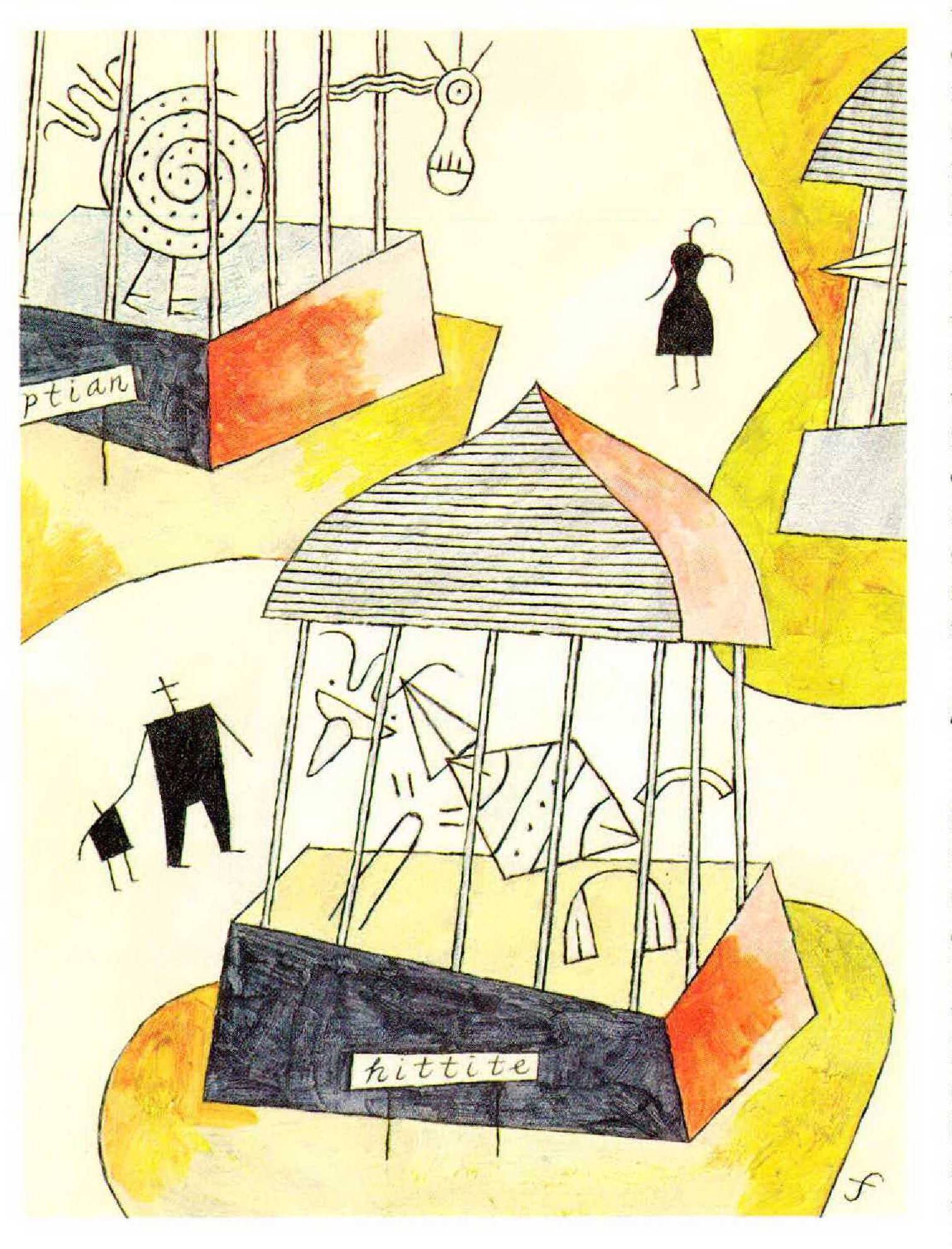
The Chicago project, which aims to produce what Hoffner calls “the OED of Hittite,” with many textual citations for every known word, is actually one of two Hittite dictionaries in the making, the other being the product of a Herman team in Munich. The Munich and Chicago scholars are divided on various issues, mostly having to do with how to date the writing on clay tablets (is there a Middle Hittite, and if so, which texts are written in it?), and so the projects proceed independently. The Munich team started with Hittite words that, when rendered phonetically in Roman script, begin with the letter A. So as not to give the impression that it was ploughing planted ground, the Chicago team, which started its work later, began with the letter L. It has done M, N, and P, and has ahead of it S, T, U, W, and Z (there is no O, Q. V, X, or Y in Hittite, and no words begin with R), plus, eventually, the front end of the alphabet—A, E, H, I, and K (there is no F or J in Hittite; B words fall under B; C and G words under K; and D words under T).
Hittite is an important language, and there is a lot of it to work with: some thirty thousand clay tablets or fragments of tablets, most of them from literary archives uncovered at the Hittite capital, Hattusha, beginning in 1906. The language remained undeciphered until 1915, when a Czech Assyriologist, Bedrich Hrozny, showed that Hittite was not a member of the same language family as Assyrian and Babylonian even though it was written in the same cuneiform script. Hittite turned out to be an Indo-European language, not a Semitic one, and indeed it belongs to the oldest known branch of Indo-European, the language family of which English is a member. Hrozný and others worked out the basics—how the verbs and nouns worked, what the pronouns were—and over the years scholars compiled word lists and glossaries. By the 1970s enough was known to make possible a full-fledged dictionary. The Chicago project was launched by Hoffner and his colleague Hans Gustav Güterbock, who is now eighty-three and continues to be involved in its affairs.
I asked Hoffner if he could explain some of the intricacies of his work. “The Hittites,” he said, “are so remote in time and place that there are lots of words whose meanings we still don’t know—especially words for things like trees, bushes, fruits, and animals. What sometimes saves us is that in cuneiform the Hittites often made use of Babylonian symbols, which they employed as a kind of shorthand. We often have several copies of the same text—like having several editions of Alice in Wonderland, say—where one copy of the text will be entirely in Hittite and another will have all these Babylonian symbols in it in various places. So it works like a Rosetta stone.”
By this means Hoffner himself, some ten years ago, discovered the Hittite word for “brother.” He had come across the phrase “brothers having the same father,” in which the Hittite term for father, pappa, was combined with a Babylonian symbol for “brothers.” “I just thought I’d look at all the pappas on our cards to see which ones had other Hittite elements attached, and I eventually came upon pappanegnesh. I tried translating the singular noun negna- as ‘brother’ in other citations we had, and it worked. I made the discovery just in time to include negna- in the N volume.”
Hoffner offered another example of the sort of chance encounter that can lead to a sudden connection. A similarity had long been noticed between two Hittite words—armizzi, which means “bridge,” and armizziyah, which means “to divulge.” Morphologically the relatedness seemed indisputable. But how might the two meanings be linked? Professor Güterbock found the probable answer one day when he happened upon this epigram in a Hittite text: “The tongue is a bridge.” There is a lot of wordplay in Hittite texts. Some of it shows up in words for alcoholic beverages. One drink was called walhi, a name that seems to be related to the verb meaning “to hit hard.” Another drink was called marnuwan, a name that seems to be related to the verb meaning “to disappear.” Hoffner said, “We’ve even found a Hittite magie ritual in which, after a patient is given marnuwan to drink, the magician uses this verb to command the patient’s ills to go away.”
Was there anything else Hoffner found particularly fetching about Hittite? “Well,” he said, “the word the Hittites used for the verb ‘to put on,’ as in ‘to put on an article of clothing,’ was different for each garment.” He thought for a moment. “I’ve also always liked the way the Hittites said hello. The standard form of greeting was Huiswants es, which means ‘Be alive.’”
I asked Hoffner how the Hittites said good-bye. He could not tell me. No recovered text, he said, contains a situation in which anyone needs to say it. “Maybe,” he added, “as in Hebrew, they just said ‘hello’ again.”
THERE IS something affecting about even a brief encounter with a once-living language. Partly, I suppose, this is because such encounters allow us to see familiar human traits turn up convincingly in strange contexts. Partly, too, it is because they remind us that when these dead languages were spoken, people felt themselves to be living as much in the present as we do now. We may soon be made more aware of the reasons, whatever they are.
I mentioned that there has never been a better time to be a dead language. Sadly, there has also never been a better time to become one. It has been estimated that more than six thousand languages are spoken in the world today. Of these, about half are now spoken by fewer than five thousand people. As many as a thousand languages are classified by linguists as “dying” or “moribund,” the helpless victims of cultural engulfment. Some of these languages may have just entered the terminal phase, the chief symptom of which is that they are no longer being taught to children. Others are moments from death, with only a handful of speakers left. Among the worst-hit languages are those of the native peoples of the New World. Klallam and Gros Ventre, for example, are down to fewer than twenty speakers each. Mandan is down to six. Tolowa is down to four or five. Indigenous languages in Australia have also been dying off rapidly. The process is occurring everywhere. In the Caucasus a language called Ubykh, which is renowned for being the language with the most consonants (about eighty), has one remaining speaker.
Some three thousand years elapsed between the death of Hittite and the birth of a Hittite dictionary project. Nowadays, the interval between death and dictionary is typically a small fraction of that length, and the chronology is sometimes even reversed: for today’s threatened languages, dictionary projects are desperately coming to life a decade or two before the language’s projected demise. A Klallam dictionary has been in the making for some years (and is supported in part by the National Endowment for the Humanities). So has a Gros Ventre dictionary. So have a number of others. Hundreds of languages, of course, are destined simply to disappear, having been committed neither to writing nor to tape. The world’s languages are as endangered as the world’s species—indeed, in terms of percentage loss, language is in more desperate straits.
For such languages as can be caught, the most likely route to survival is captivity. An extinct language trapped in the amber of a dictionary may be a poignant thing to behold, and yet it enjoys an incomparable advantage over an extinct plant or animal: it has not in fact wholly died. The iguanodon, the Steller’s sea cow, the Tasmanian tiger, the dodo—they are gone, never to reappear. But a language, no matter how long in suspended animation, can again partake of life and resume its evolution any time people decide to speak it. I’m not sure whether it was an invitation, but at one point in our conversation Professor Hoffner said, “You know, Hittite is actually easier to learn than Latin or Greek.”
Fortunately, the survival of Hittite and other dead languages depends not on me but on the necrolexicographers who quietly tend the embers. I don’t know if they have a motto, but Huiswants es would do just fine.
—Cullen Murphy