Notes: Natural Selections
Anthologizing the world
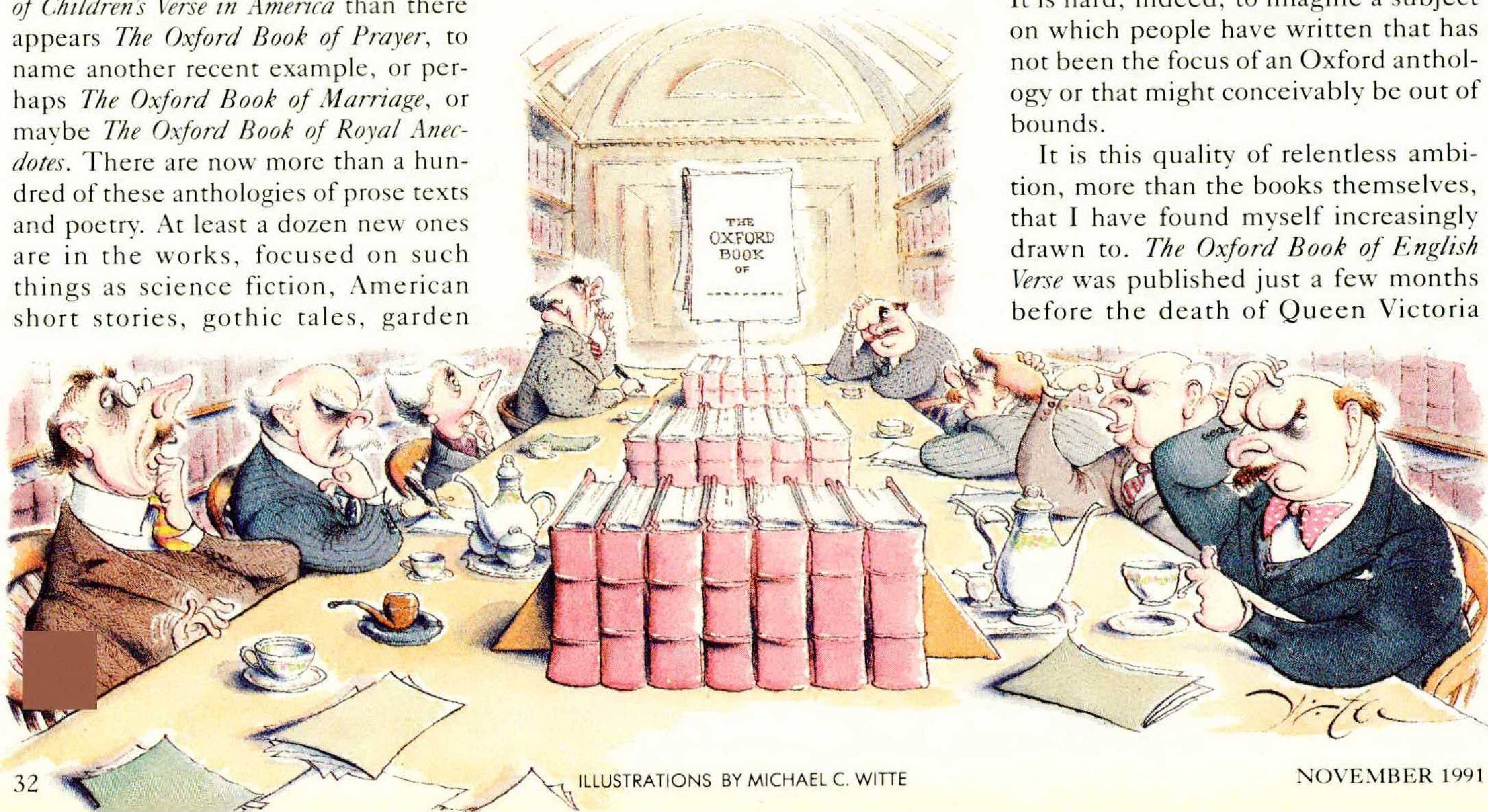
EVERY FEW MONTHS, it has begun to seem, there is brought forth upon this continent, and in Europe, Asia, Africa, and Australia, yet another thick, dense volume in that long-running series of anthologies whose titles begin with the words “The Oxford Book of. . .”I still look forward to the arrival of these books, but I can’t keep up with them anymore. No sooner have I found the time to delve into, say, The Oxford Book of Children’s Verse in America than there appears The Oxford Book of Prayer, to name another recent example, or perhaps The Oxford Book of Marriage, or maybe The Oxford BHook of Royal Anecdotes. There are now more than a hundred of these anthologies of prose texts and poetry. At least a dozen new ones are in the works, focused on such things as science fiction, American short stories, gothic tales, garden verse, childhood, aging, London, city life, money, villains, and the sea. Not long ago, while I was still occupied with The Oxford Book of Royal Anecdotes (and learning, for example, that one of Henry VIII’s finger bones was made into the handle of a knife, and that one of Charles I’s vertebrae was made into a salt cellar), the mail brought not one but two new specimens, The Oxford Book of Friendship and The Oxford Book of Essays. Each new tome eventually winds up on a shelf with the previous ones, temporal milestones on a long road whose end, the people at Oxford University Press assure me, I will not live to see.
I must admit that Oxford does a pretty good job with its compendia. At worst they are useful, dutiful reference books; at best they are that and also fun. To be sure, one does get the impression from time to time that an editor has managed to slip the leash and satisfy some unfortunate obsession (this might account for a volume like The Oxford Book of Tudor Anthems), but the subject matter for the most part has been broad, solid, and more or less of a piece with the tradition established by the first volume in the series, The Oxford Book of English Verse, which appeared in 1900. This tradition demands that whatever the subject matter happens to be, the material selected be wide-ranging, representative, and choice. There are now Oxford Books of French, German, Irish, Scottish, Scandinavian, Italian, American, New Zealand, and various other kinds of verse (including light, mystical, and late-medieval). There are Oxford Books of short stories, of aphorisms, of dreams, of ballads. There has been an Oxford Book of Canadian Military Anecdotes and an Oxford Book of English Talk. It is hard, indeed, to imagine a subject on which people have written that has not been the focus of an Oxford anthology or that might conceivably be out of bounds.
It is this quality of relentless ambition, more than the books themselves, that I have found myself increasingly drawn to. The Oxford Book of English Verse was published just a few months before the death of Queen Victoria (she went down, according to an eyewitness quoted in the royal-anecdotes volume, “like a great, three-decker ship”), and there is something grand and Victorian about Oxford’s anthologizing enterprise, something reminiscent of one of those nineteenth-century British expeditions into the unknown to gather specimens for science and colonies for the Crown. Oxford can no longer send out her sons to colonize the world, but the anthologizing of it remains well within her power.
THE IMPULSE TO anthologize must reflect something fundamental in human nature—the need, perhaps, to impose order and value, or at least the illusion of them, on a few parcels of the vast, trackless expanse of the written word; the desire, too, to set those parcels aside for the ages. How deep the impulse runs is suggested by the fact that anthologies, in the form of what today is known as a Sammeltafel, or “collection tablet,” appeared as early as the second millennium B.C., when people were still writing in cuneiform. The word “anthology” comes from ancient Greece, where its original meaning, “a garland of flowers,” came to be associated with collections of poems and epigrams. Anthologies have flowered everywhere and at every period of time, and their convenience and seeming authority have made them a durable kind of work.
At their most characteristic, anthologies comfortably display a number of contradictory qualities, just as people do. An anthology is stern, reflecting a recognition that relatively little of human creation is worth saving. At the same time it is optimistic, reflecting a hope that some things are worth saving. And it is pragmatic, acknowledging that however many the things worth saving, there is room for only so much. An anthology may seem confident, even authoritarian. And yet it may also bow to popular will, the editor understanding that some things simply must be included, no matter what he may happen to think. An anthology is informed, finally, by the struggle between a wish for diversity and balance on the one hand, and the nagging tug of personal preference on the other. Taken together, these strike me as a congenial jumble of stances. Most of us are capable of running through all of them in the course of a mundane task such as cleaning house or negotiating a salad bar.
In nineteenth-century England the most popular and influential anthology of poems was for many years Sir Francis Palgrave’s Golden Treasury of English Songs and Lyrics (1861). It was this book, deemed passé by critics but still much beloved, that Oxford University Press had in its sights when it laid plans for The Oxford Book of English Verse. Oxford had two formidable assets. One was its development of India paper, which was exceedingly thin but nonetheless opaque, and which made possible the creation of a book that had many more pages than Palgrave’s anthology but remained manageable in size. The other was Arthur QuillerCouch, in his day known to all simply as Q—the somewhat eccentric novelist and dandy whom Oxford chose to be the anthologist.
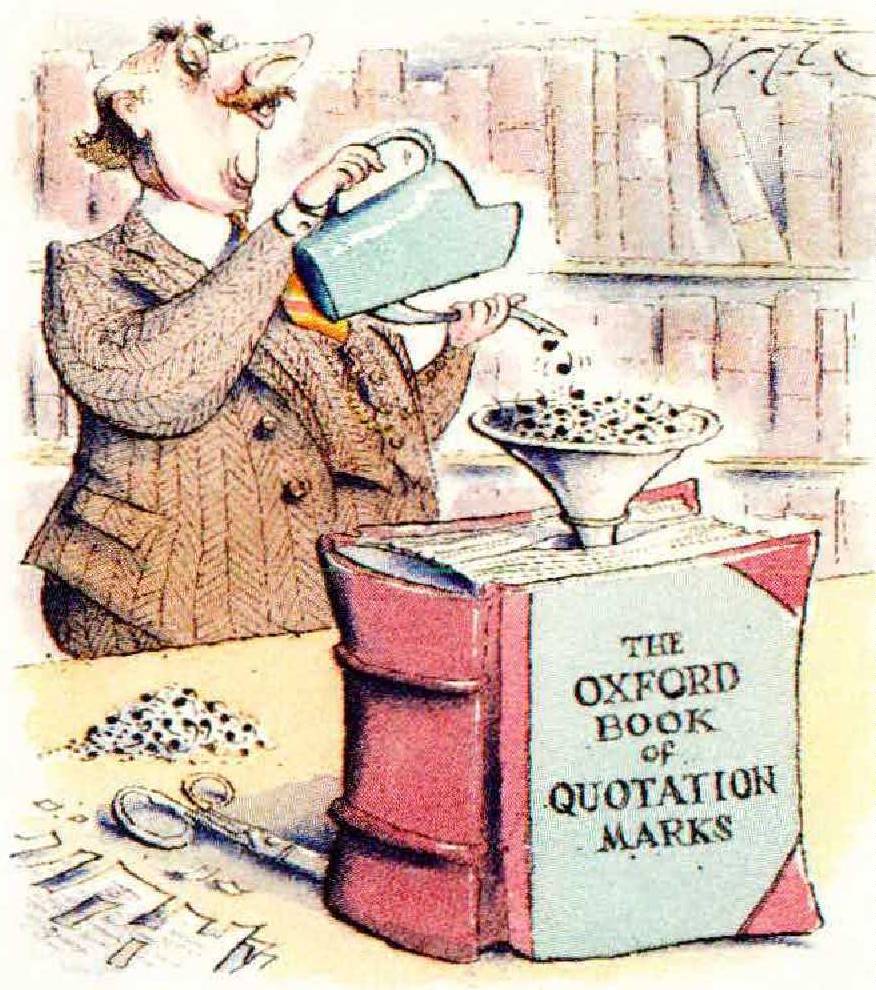
Q has been described by the official historian of Oxford University Press, Peter Sutcliffe, as “not strictly speaking academically respectable at that or indeed any other time,”but he had great good sense and an enormous capacity for work. Starting with material from the thirteenth century, he eased through English poetry like a ravenous whale, taking in great mouthfuls and straining it through the baleen of preference and expertise, retaining only what he found to be meet and good, or somehow mandatory. (Q felt compelled, Sutcliffe notes, to keep Robert Burns’s “A man’s a man for a’ that,” which he disliked, on his initial list, because, he explained, “no Scotsman will do without it.”) The book that Q produced was a big success, and sold some 500,000 copies before its first revision, in 1939. By then Q had become, in effect, a professional anthologist ( The Oxford Book of Ballads, The Oxford Book of Victorian Verse, The Oxford Book of English Prose), and Oxford, having seen the money to be made, was permanently in the anthology business.
Today, of course, the editors pursue their prey with catholic abandon. Look—over there! British political anecdotes! And look: New Zealand plants! Welsh poetry in English! Canadian ghost stories! Australasian verse! Death!
IN THE END, the most important thing about anthologies is that they tend to survive. The roster of works of history, literature, and philosophy that are available today because someone anthologized them five hundred or a thousand or several thousand years ago is distinguished. It includes much of the extant writing from ancient Israel (fashioned into an anthology called the Bible), a great deal of the ancient Greek science and philosophy that has come down to us (anthologized by the Arabs from Greek texts that no longer survive), and much of the known Middle English poetry (preserved in several medieval anthologies). It is tempting to believe that communications technology today being what it is, the danger that anything will ever again be truly lost, even when this would be desirable, has greatly diminished. Still, when I look at a shelf of Oxford Books, I can’t help thinking of it as a kind of prudent safeguard—a Noah’s ark (speaking of anthologies) of our civilization.
I must confess, though, to some slight worry that a few species may be forgotten. Diet books and self-help books are mainstays of modern society. Are plans afoot to anthologize them? What about personal advertisements? Or the financial-disclosure statements of public servants? Or the official postmortems on technological disasters? Or the college-admissions essays of notable people? Or radio talk-show colloquies? Or documents obtained under the Freedom of Information Act? Or court-ordered-wiretap transcripts? I offer these in a spirit of friendly assistance, mindful that the editors of The Oxford Book of Italian Madrigals don’t leave many stones unturned.
—Cullen Murphy