Tiptonville: Across the Mississippi
In search of ferries past
WHEN I WAS twenty years old, I drove from Kansas City to Chicago to visit a girl I knew. I had been reading a lot of first-person novels that year, and I had developed a romantic point of view.
Well, things don’t always turn out in life the way they do in books, and a very short time later I found myself driving back to Kansas City. I was in a bad mood and in no hurry to get home. My route meandered through Illinois, Indiana, Kentucky, Tennessee, the bootheel of Missouri, northern Arkansas, and another part of Missouri. The trip covered 1,500 miles and lasted four days. I ate in diners that served fried fish, french fries, and fritters in the same meal. I slept in motels where the rooms cost practically nothing and the soap was a normal-sized bar of Lifebuoy that somebody had already used.
Some of those highways I drove on were as smooth and black as electrical tape. They wound around hills and between farms and through towns where there seemed to be nothing for sale except liquor and gasoline. I had a twoseater convertible in those days, and I took off the top and let the wind blow through my hair as I—Hey, wait, that is the way things turn out in books! The compact farmhouses seemed haunting and familiar, like places I had visited in dreams. The air flowing rapidly over the open passenger compartment created a zone of low pressure that gradually slurped up my sorrows and left me feeling light-headed and emotionally unencumbered.
Toward the end of the second day of my trip I found myself traveling west on a small highway in northwestern Tennessee. On my map the line representing the highway came to an end at the eastern edge of the broad blue stripe representing the Mississippi River. Directly across the stripe, on the Missouri side, the line began again, with a different number. On the map there was no indication of a bridge.
The sun was going down. The highway turned into the main street of a small town called Tiptonville. I saw the people closing their stores and heading home to their families. Then the town petered out. The street became a road. I drove past some rundown houses and through a soybean field and up onto the levee.
There at the edge of the river I saw how the two lines on my map were connected. Moored at the bank was a small towboat with a small barge attached to its side: a ferry. A man who had been smoking a cigarette on the bank walked slowly down to the edge of the river. I drove behind him and eased onto the bumpy deck of the barge; then I got out and stood beside my car. There was another man in the boat’s tiny pilothouse. We pulled into the river. There were no other passengers.
At Tiptonville the Mississippi River is more than a mile wide. I could see a lot of trees on the opposite bank but no houses or farms. The sun was red and huge and directly in front of us. It seemed to be dropping into the water, where its reflection spread out like a path of fire. I reached into my car and pulled out a bottle that I had bought earlier at the House of Bourbon.
By the time we reached Missouri, the sun had set and a heavy darkness was consuming the trees on both banks. All of a sudden I felt that I was about to begin a mysterious new chapter of my life, and that the great roiling Mississippi River was a spiritual frontier I had been destined to cross in what I now realized was not just a lazy car trip but an uneasy metaphorical journey into manhood, or something. Also, by this point I was mildly inebriated. The barge thudded into the bank. I paid the deckhand, got back into my car, and drove off into the night.
AMERICA USED to have thousands of small ferries, the kind that stick in my imagination. Any river that was too deep to ford and too wide to bridge needed a ferry to connect the people who lived on either side. Ferries carried crops and animals to market. They carried people to and from farms and towns. At the historical museum in the Connecticut town where I now live, there’s an old picture of a cow being hauled across a local river on a ferry the size of a station wagon. Like many early ferries, it was powered by horses pulling ropes. Some others were powered simply by the current, which nudged them along a stationary guideline, or by people pushing poles against the river’s bottom.
The advent of the automobile initially made small ferries more important rather than less. Cars got stuck in fords that horses and wagons handled with ease. But then cars became more numerous, and highways got better, and bridge-building technology improved. Except in the relatively few places where bridges were not an alternative, or where existing ferries had developed a strong sentimental following, small ferries began to disappear.
Many states still have at least a few small ferries. You can find a lot of them on the maps in the Rand McNally Road Atlas, where they are usually identified by the abbreviation “FY.” The best places to look are on wide rivers and skinny lakes. My state has two. One operates on the Connecticut River between the towns of Chester and Hadlyme. It can carry eight cars. There is a children’s book about this ferry, called Ferryboat, by Betsy and Giulio Maestro. The other, which for some reason isn’t on the map, carries three cars at a time between Rocky Hill and Glastonbury, about twenty-five miles up the river from Chester. This ferry, whose predecessor made its first crossing in 1655, is said to be the oldest continuously operated ferry in the United States. According to Sarah Bird Wright’s Ferries of America, a wonderful paperback guide that lists 270 ferries of all sizes in thirty-nine states, the Rocky Hill ferry was at one time powered by a horse that walked a treadmill in the middle of the boat.
I’ve ridden on a few small ferries over the years. I took a six-car ferry across Bull Shoals Lake, in northern Arkansas, during that same aimless car trip fifteen years ago. On several occasions I have ridden on the three-car ferry that operates between Edgartown, on Martha’s Vineyard, in Massachusetts, and Chappaquiddick Island. Shortly before my wife and I got married, we took a twelve-car ferry across the Illinois River and then a sixteencar ferry across the Mississippi River twenty or thirty miles above St. Louis. The sixteen-car ferry (which is based in Golden Eagle, Illinois, and is the only paddlewheel ferry still operating on the Mississippi) was very nice. Still, it was a bit big for my taste.
There are several small ferries that I would like to ride on someday. There is a three-car ferry that crosses the Rio Grande between Los Ebanos, Texas, and Ciudad Diaz Ordaz, Mexico. It is powered by the arm muscles of Mexican laborers, who pull it along a cable stretched across the frontier. There is a four-car ferry at Buena Vista, Oregon, that used to be piloted across the Willamette River by twin brothers named Willie and Willard. There is a three-car ferry that, in addition to hauling passengers, carries the mail between Cheboygan, Michigan, and Bois Blanc Island, in Lake Huron.
Of course, there are also plenty of big ferries, such as the ones that carry people and cars between Cape Cod and Nantucket, or between Seattle and Alaska, or across Lake Michigan. My state has several big ferries, all of which operate on or near Long Island Sound and two of which can carry as many as a hundred cars and a thousand passengers. I like these ferries, and I happily ride on them when I get the chance. But there is something about a small ferry that—for me, anyway— conjures up images not only of oldfashioned American colorfulness but also of dark yearning and Charon-related going-to-hellness.
For fifteen years after my crossing at Tiptonville, I thought frequently about that momentous evening on the Mississippi River, and I longed to take another ride on that ferry. But I didn’t do anything about my longing. Then, a few months ago, on a day that did not seem radically different from any other, I suddenly called the Missouri highway department and asked whether anyone there knew anything about the ferry I had taken. The man I talked to said that there had once been several ferries in that area, but as far as he knew, they were all gone. To make sure, he went to check a map. When he came back, he said that there did appear to be one ferry left down there, but it wasn’t at Tiptonville. It ran between Dorena, Missouri, and Hickman, Kentucky, just north of the Tennessee line. A few weeks later I flew to St. Louis and rented a car.
THERE IS A pretty big difference between the kind of metaphorladen journey of discovery one takes at twenty and the kind one takes at thirty-five. For example, when one is thirty-five, the car one drives may not be a convertible and it may have a telephone activated by one’s Visa Gold card. Also, at thirty-five one may have a complicated child-care arrangement with one’s wife whereby each spouse has to pay back the other for time spent away from home. I couldn’t just set out in any old direction, as I might have fifteen years before, and figure that I would eventually end up in Hickman. Instead, I had to take the interstate down to Sikeston, Missouri, about 140 miles south of St. Louis, and spend the night in a pretty nice motel.
Early the next morning I drove to Dorena. Sikeston is a good twenty miles west of the Mississippi, but I could tell right away that I was in river country. The fields were as flat as lakes, having been planed down by floods and by the shifting course of the big stream. People’s yards were littered with fluffy white stuff that looked for all the world like—and, as it turned out, was—cotton (one of the crops growing in those flat fields).
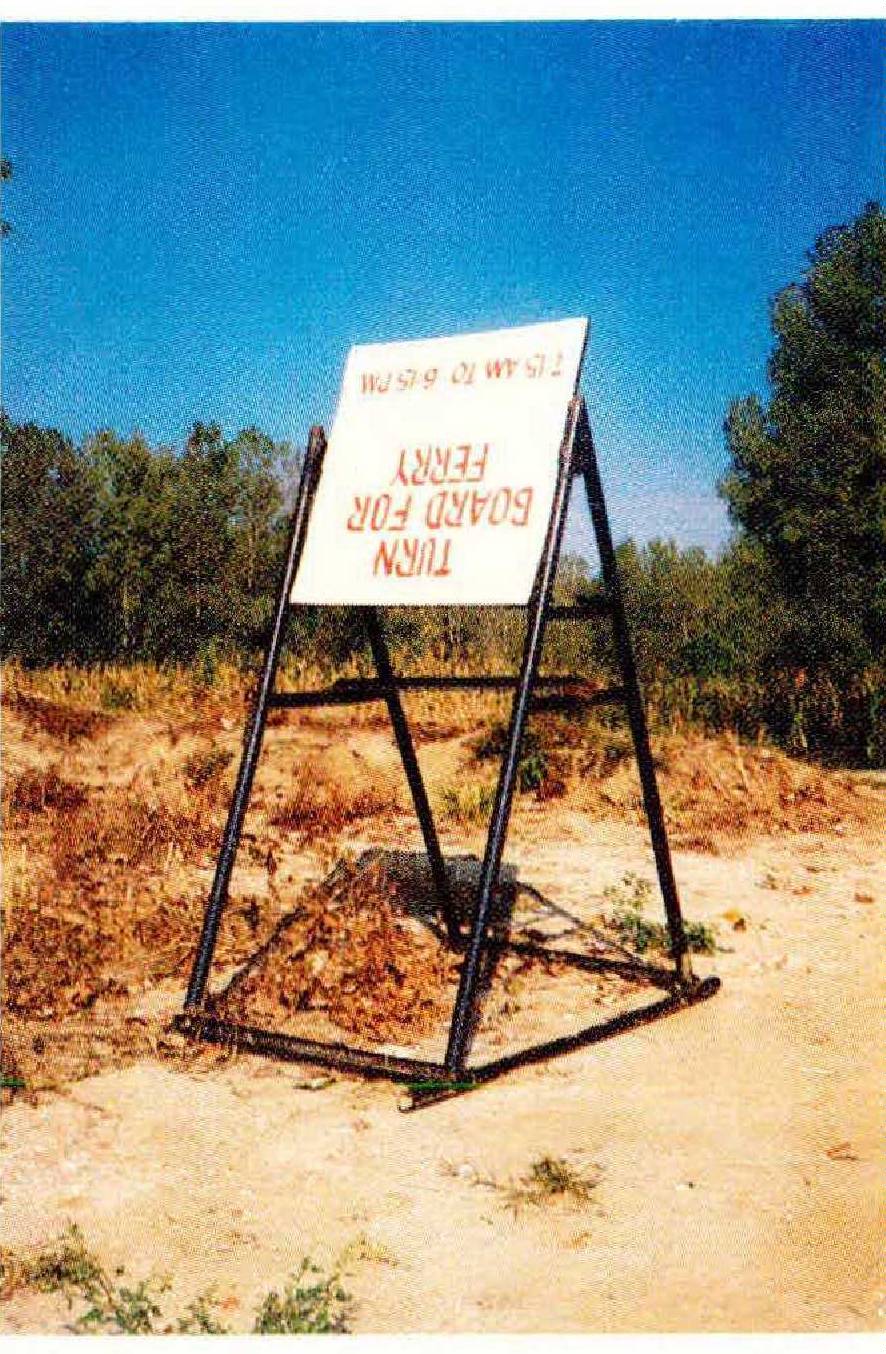
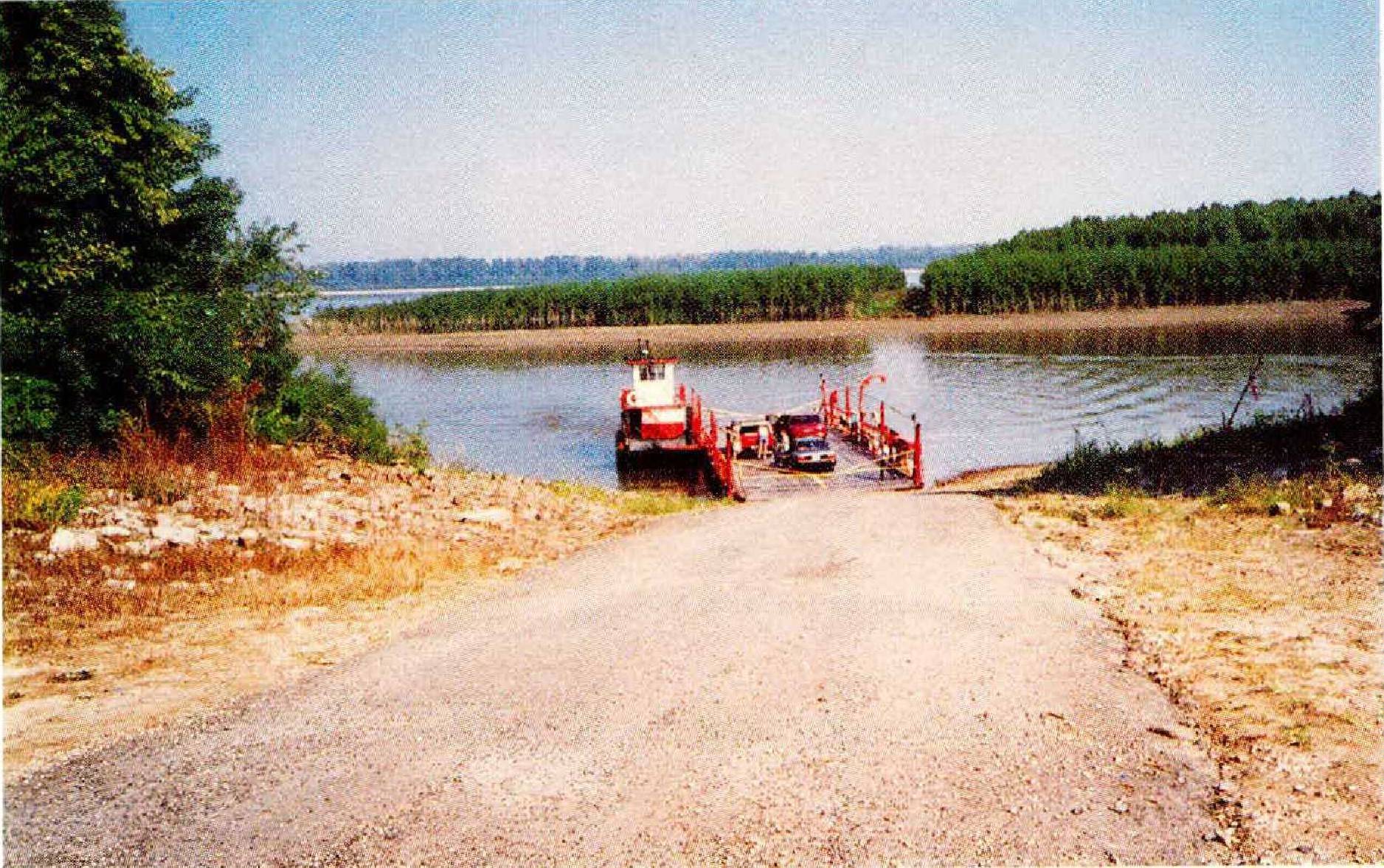
I found the ferry landing before I saw much evidence of Dorena. It was a steep, sandy, open place. I could see the ferry in the river, making its way to Kentucky. Like the old Tiptonville ferry, it consisted of a small towboat with a small barge attached to it. It was painted red and white, and looked nice against the brownish-blue of the water. The Hickman landing was mostly hidden behind a long, narrow bar covered with short trees. Someone had cut a swath through the trees on the line of sight between the two landings. On my side was a sign that said TURN BOARD FOR FERRY, so I turned it and sat on the hood of my car to wait. If I squinted, I could just make out a tiny black square on the Kentucky bank— the back of the other signal board.
When the ferry returned, I flipped the board back over and drove down the ramp onto the deck. By making a few phone calls the week before, I had learned that the owner of the DorenaHickman ferry is Hugh Lattus, a local farmer. I was hoping that Lattus would be on board, but he wasn’t. The deckhand let me climb a ladder to the tiny pilothouse and use the radio to call Lattus’s son, who was in his tractor harvesting corn somewhere in Hickman. The son said that his father would meet me at the landing after lunch.
I climbed down and we backed into the river. There was a metal arm on the bow of the towboat that was attached to another arm sticking out from the middle of one side of the barge. The stern of the boat was lashed to the barge with a big rope. When we had backed a little way into the river, the deckhand untied the big rope, permitting the boat to pivot slowly on the metal arm until it was facing Kentucky instead of Missouri. Then he used the big rope to retie the barge, and we continued on our way.
The Dorena—Hickman crossing is two miles and takes about fifteen minutes. I walked around on the barge, which can hold twelve cars, and looked at the river. The Mississippi seemed a bit low to me, but the deckhand said there was plenty of water. The channel, he said, was twenty-five feet deep. A huge mass of rusty grain barges, being pushed by a boat called the John D. Geary, churned in front of us. The Geary, out of Cincinnati, was carrying the autumn harvest to New Orleans. We plowed through its wake.
When we got to the other side, I drove around in Hickman, which has a population of about 3,000. The night before, the high school football team (called the Pilots) had been beaten by Fulton City, and some men at a gas station were grumbling about this. I saw an abandoned jailhouse, an old bank, and a store whose signs advertised GIFTS and LIVE BAIT. Mark Twain mentioned Hickman briefly in Life on the Mississippi, describing it as “pretty.” (Hickman is just a few miles upriver from the area where the Shepherdsons and the Grangerfords feud in Huckle-berry Finn.) Nowadays the town looks a little tired. Its most striking feature is a massive concrete floodwall that blocks the downtown’s view of the river and gives the tiny business district a claustrophobic feeling.
Hickman aspires to greater things. Its chamber of commerce has a new executive director, who hopes to attract new businesses, new residents, and more tourists. The ferry has a role to play in this revitalization, many residents believe. The Hickman Courier I read over lunch mentioned the ferry several times. In an article about efforts to increase ferry traffic a state transportation official was quoted as saying, “Coming together is a beginning; keeping together is progress; and working together is success.”In his regular front-page opinion column the newspaper’s publisher chastised the makers of a new town map for putting the ferry in the wrong place. In the letters column a man named Bobby Ham wrote, “I feel that behind the blindfold the lady in the symbol of justice is weeping, for today the system has failed.” (This had nothing to do with the ferry.)
When I returned to the landing, three cars (eighteen dollars!) were waiting for a ride to Missouri. A few minutes later Hugh Lattus pulled up in a pickup truck. He gave me a baseball cap with a picture of his ferry on it, and we stood between his truck and my car and talked. Lattus is a big man with graying hair and a farmer’s hands. He was born in 1924. His voice is a deep, steady rumble that he turns into words by chipping off little ends here and there. As he approaches the end of a sentence, he takes smaller chips. I sometimes had trouble understanding him. But I got the general idea.
The Hickman ferry was founded in 1840, Lattus said, and it has operated continuously since. (The original barge was powered by horses pulling a rope.) The ferry came into the Lattus family in the late 1920s or early 1930s, when Lattus’s uncle bought it. Business in those days was very good. Roads on the Missouri side were primitive, while roads on the Kentucky side were sound. To get their crops to market, Missouri farmers had first to transport them across the river. The only way to do that was by ferry.
When Lattus was about thirty, he began leasing the ferry from his uncle. Because controlling the ferry made it easy for him to move equipment back and forth, he began farming on both sides of the river. In 1962 he bought the ferry outright and named the towboat the Barbara Don, after his daughter and son. For a while he had plenty of business. Passenger traffic more than covered the cost of hauling his tractors and combines. Lattus had competitors — at Columbus, Kentucky; Tiptonville, Tennessee; Caruthersville, Missouri; and Heloise, Tennessee—but there was plenty of traffic for everyone.
Then, in the mid-1970s, two big bridges were built. One was near Dyersburg, Tennessee, about fifty miles to the south. The other was at Cairo, Illinois, about fifty miles to the north. The bridges provided easy links between the highways that had grown up on both sides of the river. The stream of ferry-bound cars and trucks became a trickle. One by one the competing ferries—including the one at Tiptonville—went out of business.
Lattus alone hung on. His ferry, which is roughly halfway between the bridges, still provided a useful shortcut to anyone who didn’t feel like driving a hundred miles just to go to, say, New Madrid, Missouri, which lies twenty miles west as the crow flies. Still, the demand for rapid transit was low. If Lattus hadn’t needed to move his own farming equipment, he probably would have quit too. Over the past eight or ten years, he estimates, the ferry’s losses have ranged from $10,000 to $25,000 a year. Some days he doesn’t haul any cars at all.
If his ferry is to survive, Lattus believes, it needs to develop more of a reputation as a tourist attraction. To this end he has been lobbying various officials in Kentucky, Missouri, Tennessee, and Illinois. Just a week before my visit his efforts had led to the installation of a big blue WELCOME TO KENTUCKY sign near the Hickman landing. A dedication ceremony for the sign drew not only Lattus but also the mayor of Hickman, a county judge, various officials from the Kentucky departments of transportation and tourism, members of the Fulton County Tourism Committee, the new executive director of the Hickman Chamber of Commerce, and a photographer from the Hickman Courier, among others. After the ceremony, according to an account in the paper, “the group boarded the ferry for a trip to the Missouri side where they viewed the ‘Welcome to Missouri’ sign.”Lattus believes that the signs will eventually help to pull in new customers.
As Lattus and I talked, his ferry returned. There was no one waiting to ride on it. Lattus used to have a second barge, which held six cars, but he had to sell it. He told me that he wasn’t sure how much longer he would be able to hang on. “My insurance just went up,” he said. “Diesel’s up. We can’t charge more than six dollars, because if we do, people will just go around. If we don’t get some assistance from the states, we’re just going to have to tie it up.”
SHOULD CONGRESS establish a superfund to ensure that the nation’s small ferries don’t all disappear? No. That would be kooky. Still, it’s sad when small, interesting things disappear for good. To make myself feel a little sadder, I decided to drive down Highway 94 to Tiptonville to see if I could find the old landing.
One of the first things I saw when I turned onto the main street of Tiptonville was a sign that said FERRY CLOSED. I drove past it, turned left at the high school, and found the house of Wade Yates, who used to own the ferry. I had called Yates earlier in the day, and he had said I could visit him.
Yates was finishing an ice cream cone when I arrived. We went into his family room to talk. I learned that he was born in 1908; that his nickname is Foots, because his feet are so big; that one of his sons has been a maintenance man for Sears in Chicago for thirty-seven years; that his other son owns a big hardware store in Tiptonville and used to be the co-owner of the ferry; that Yates got his first job on the Mississippi River, as an oiler on a survey boat, when he was sixteen; that he worked on dredges operated by the Army Corps of Engineers for about nineteen years; that he took a job as a deckhand on the Tiptonville ferry in the early 1940s, in order to be able to spend more time at home; that he stood watching from the Tennessee bank one morning while a big boat ran into the ferry, sinking it and killing a deckhand; that he bought the ferry in the early 1960s for $80,000.
During the first years that he owned the ferry, Yates said, he made a lot of money. He had two barges (one of which held fifteen cars and the other of which held twelve) and three boats (one of which was a spare). He operated the ferry twenty-four hours a day, with two boats running during the daytime and one running at night. One evening in the early 1970s he drove over to his landing and found twentyeight semi-trailers lined up on the road, waiting to go across. The fare for a truck in those days was five dollars. Over the years he carried enough of them to pay off all his loans, to build a new boat from scratch, and to buy a comfortable house for his family and a Cadillac for his wife.
Then the bridge was built and the traffic disappeared. Shortly afterward Yates decided to pack it in. He sold one of his boats to a local grain elevator and one of his barges to the owner of a McDonald’s restaurant in St. Louis. The restaurant is a reproduction steamboat that sits in the Mississippi River. Yates’s old barge connects the steamboat to the bank. It’s what you walk across when you go in to order a Big Mac. A few years later Yates sold his other barge and two other boats to a group of investors in Sistersville, West Virginia, who operate a ferry on the Ohio River between Sistersville and the fly-sized town of Fly, Ohio. Yates said that he would like to visit Sistersville someday but he probably never will, because he doesn’t leave his house much anymore.
When we had finished talking, Yates gave me directions to the old landing. I drove back to the center of town and then over toward the river. I drove along for a while. Things looked sort of familiar, but not really.
Then I saw it, a little gravel turnoff. A pickup truck was parked there. A man standing in the bed of the truck was pitching trash onto the ground. I could see a rifle hanging in a rack in the truck’s rear window. The road leading down to the landing was covered with old stoves, garbage, broken toys, a smoldering mattress, some other junk. I kind of wished I hadn’t come.
It was raining a little. The man in the pickup truck threw a broken stroller onto the ground and gave me a look that said, “Let go of the past, son. Go back before Hertz charges you for an extra day.” I took a picture and drove away.
—David Owen