Consider This, Señora
ONE SUMMER, SEVERAL YEARS ago, a widow named Morgan Sloane, barely past forty, mother of two, came to live among a dozen exiles in the Mexican town of Santa Felicia. The hill where the foreigners lived, with their bridge tables, vegetable rows, and wide green view, bordered the southern edge of town. An overgrown strip of park and a zoo of fifteen cages divided the slope from the houses of the poor, who crowded together on the outskirts of the city. On clear evenings jukebox music and an occasional lion’s roar rose in the still air and reached the expatriates’ open windows.
The first time Morgan heard the lion, she asked Carlos about it.
“Where is that animal?”
“In the zoological garden,” he said. “Monkeys are there also, and macaws. You will hear them all.”
Carlos was the mozo who came with the house. He polished the floors, watered the roses and the limes, drove the car, and, when guests arrived, put on a white jacket and served vodka and Cuba libres. The moment he was out of the room, some woman would say, “So handsome,”and another would add, “Those eyes.”
Morgan spoke to him in abbreviated sentences of the Castilian Spanish she remembered from a college year in Seville.
“How many houses are there on the hill?” she asked soon after her arrival, and Carlos said, “Eight. Four are owned by North Americans, two by English, one by a French, and one by Danes,”
“Why have these people come here?”
“Consider this, señora,” Carlos said, and from the edge of the terrace where they stood he embraced the landscape, drawing to him the municipality of Santa Felicia, the presidencia the cathedral, the zoo, and all the plowed and wooded world beyond. “Consider the sun, the pure air, and the view. Consider the tranquillity. These people have abandoned their other lives. Now they have this.” He lifted his hand.

Morgan listened while Carlos, in these words, described flight.
Like the other dwellers on the hill, Morgan had fled. She had taken flight from the sheer weight of the events of the past year. These included a loss of patience with infidelities, a legal separation from her husband, and her widowhood a few months later, when, stricken without warning, he died.
“Your husband has given you this house,”Carlos remarked on the day of her arrival, and she said, “Yes,”without adding that this husband, or former husband, Ned, had left her everything he owned. Whether by mistake, believing he had half a lifetime left to change his will, or by intention, she might never know.
“And you will live here alone,” Carlos said. “Until your family comes to visit you.”
Morgan said nothing. She chose not to mention her daughter or her son, children who still existed but somewhere out of sight, lost in the tumult of their causes, inhabiting communes, organizing marches, tossing away their past.
On her first night in Ned’s Mexican house Morgan shivered for an hour between sheets that had been folded damp, and wondered whose side of the bed this was, Ned’s or a woman’s. Awake in the white room, she had heard the rain stop and had walked barefoot to the window to push it open. A gust of wind blew in the smell of drenched earth and a shower of scattered drops. Below her, at the foot of the hill, lights glimmered: Santa Felicia, most of its citizens asleep at home, the rest huddled in portals to keep dry, wearing newspapers for capes and paper bags for hats.
Morgan turned back to her wide bed. Behind it hung a long red tapestry, and now, for the first time, she noticed the headboard. It was made of heavy pine, stained dark. Across it, carved in high relief, swam two mermaids, tails curled, breasts high.

MORGAN ADJUSTED QUICKLY TO THE PACE of life in her house on the hill. Each empty day was a prism to hang on a chain. Stretched out on a long chair in the shade of a plum tree, she watched Carlos at his work. His smooth, honey-colored fingers tied up vines or clipped grass with easy familiarity.
“You have had experience with gardens,” she said.
Carlos denied this. “No, señora. Ever since primary school I’ve worked for my uncle, who is a potter.” He looked up and attached his steady gaze to her face. “Until your husband employed me last year,” he went on, “and gave me better pay.”
And Morgan realized that his talent with plants was the result not of training but simply of instinct.
Another morning, while Morgan half sat, half lay in the garden with a straw hat tilted over her eyes, she asked, “Where do you live?” and Carlos pointed his arm in the direction of a village on the back of the hill, where the slope was less steep. Later she visited this place, where a scattering of adobe huts appeared to have been spun off by a derelict plaza into fields and gullies and a stand of tall weeds.
Goya, the cook, also lived behind the hill. Like Carlos, she had come with the house. Morgan made one inspection and after that avoided the kitchen, where the gaunt, lined woman padded barefoot across the spotted floor. Goya’s parrot, when not released to roam the shelves, hung by its beak from the wires of its cage and sent seeds and feathers showering over platters of enchiladas and pots of refried beans.
The cook, like Carlos, had a thin curved nose and deep eyes.
“Is she your grandmother?” Morgan asked.
“No, my mother,” Carlos said, and Morgan suppressed a gasp. So great a space of time between them, one so old and one so young. But the resemblance was there, the inheritance of fine bones, handed down through long generations of Tarascan Indians, whose land this state of Mexico once was.
WITH THE MERMAIDS AT HER HEAD, MORgan woke every morning to a brilliant early sun and the sound of a girl singing. The high clear voice, which at first she confused with birdsong, came over the wall from the garden of the house next door.
Tracing its source, Morgan found that one bedroom window overlooked an enclosed jungle of honeysuckle and morning glory. In one corner a trumpet vine strangled a mimosa; in another a fig tree bent under a climbing rose.
“That is the house of the sick Inglesa,” Carlos told her. “The girl who sings is her maid, Lalia.”
“She is very young for that work,” Morgan said.
“She is fifteen,” Carlos said. “She lives in my village.”
The sick Englishwoman was Fliss McBride. Morgan learned her story from other neighbors on the hill. Soon after Fliss had moved here, ten years ago, she contracted pneumonia. The case was simple, followed by complete recovery, but from then on Fliss never left her bed.
When she was convalescing, the doctor told her, “Sit in a chair tomorrow. Go downstairs Sunday. Spend some time outdoors,” and, finally, “You are well.” But he had to give up in the end.
The people on the hill visited Fliss and brought her gifts, custards and sweets and sometimes slips of plants for Lalia to press into the crowded earth. At Christmas they came with poinsettias and hand-knit throws, and hung tin stars and angels from her bedroom walls.
Morgan, a week after her arrival, noticing an excess of flowers in her garden, thinned them out and delivered a basketful by way of Carlos to her neighbor.
Fliss sent back a note. “You have turned my room into a bower. Come for tea some afternoon. Lalia will tell you when. I am not strong.” But, Morgan told herself, sequestered as she is, feeding as she does on gossip and desserts, she is bound to outlive us all.
Morgan had never seen anyone as happy as Lalia. Singing, she emptied dishwater on the scruff of grass behind Fliss’s house. Singing, she rode home on the bus from the downtown market, carrying cheeses, melons, cooking oil, and kilos of sugar and rice in a basket she could barely lift. Scarcely breaking her song, she staggered down the steps of the bus, allowing the driver to pinch her as she passed.
Sometimes at night Morgan imagined she heard her mozo’s voice rising out of the tangle of stems in her neighbor’s garden. From her window she would see a flicker of apron strings, and early the next morning she would hear song again.
Morgan saw that Carlos also was happy, but in a different way. He was a man content with himself. One day Lalia told her that other men respected Carlos for his customary even temper and occasional quick right fist. Women looked out from the doorways where they swept or sewed, or, in the case of foreigners, stared from the windows of their imported cars, as Carlos passed.
Morgan, too, noticed him. In the sala she abandoned the letter she was writing to watch him as, wasting neither time nor motion, and in silence, he laid a fire. When he drove the car, she sat in front and saw him in clean Indian profile as he spoke.
“There is talk of improving the zoological garden,”he would say. “The cages are too small. A number of the animals have died.” He would point. “Over there, señora, you will see the monkeys’ hut. It is a barbarity.”Morgan, unmoved, consistently refused to look.
She spent hours of sunshine on a terrace chair, eyes closed, measuring her past, drawing blinds against the uncertain, looming future. Not far away her neighbor, Fliss, also reclined flat on her back, facing south. Day after day Morgan and the Englishwoman lay on separate sides of the wall in independent retrospection as the mornings of their lives slid by.
Every day Morgan imagined the unrevealed places where her children might be. She had reached them with the greatest difficulty, one in New Mexico and one in Quebec, to tell them of their father’s death. The telephone connections were bad. She had scarcely recognized their toneless voices.
“Tell me how you are,” she had said, and they replied, “All right.” But what else was there to say to the woman who had rejected their father only months before he died?
These children were Morgan’s hourly torment. She tried and failed to invent futures for them. Meanwhile, the girl, Stevie, and the boy, Greg, both scarcely out of adolescence, remained in peril. Morgan longed to push them back into infancy, contain them again in cribs and strollers.
Day after day she cultivated hatred against her dead husband, and daily failed to achieve it. At any moment of any hour she would have had him back if she could.
And she continued to watch Carlos, as he bent over a geranium or a pot of mint with the grace of a man about to kiss a woman’s hand.
JUST AS LALIA’S SINGING WAS THE FIRST THING Morgan heard in the morning, the watchman’s whistle was the last thing she heard at night. This watchman, a retired clerk, arrived among the foreigners’ houses on the last bus each evening and left at daybreak by way of a path that dropped straight down the hillside from the Frenchman’s pear trees to the zoo. The watchman’s whistle was his only defense against trespassers and thieves. It had a lilting, uncertain tone, and he blew it once every hour in front of each house. Neither he nor his eight employers contemplated the purchase of another weapon. Even though the cooks and mozos returned to the village at night, leaving the foreigners—mostly women, children, the aged, and the tipsy—behind, the stone houses circled by stone walls were considered impregnable.
Of the houses on the hill behind Santa Felicia, Morgan’s had the heaviest iron gate. Her wall was higher than the others and was topped with a fiercer dazzle of broken glass. Even so, she understood that it was not too great a barrier for a determined man to climb.
Before long Morgan’s days fell into a routine. She woke to singing, breakfasted on mangoes and sugared rolls, sat in contemplation on the terrace in the sun. At eleven o’clock Carlos drove her headlong down the road to the fruit and vegetable stalls, the bakery, and the post office. She herself chose the papayas, the fresh corn, the hard rolls, but at the post office she waited in the car. Cripples and deformed children sometimes approached her at these times, and she averted her eyes as she handed them coins.
Carlos soon realized that the letters the señora addressed to her children all came back. He would push his way toward her down the post-office steps, through the ranks of incoming clients and seated beggars, and hand her letters marked “Unknown.”
“Look, señora,” he would say. “Another letter has been returned. Why not investigate the address?” And then they would drive home in silence.
Morgan had lived in the house a month when she asked Carlos to hang her mirror, a long rectangle of glass framed in scalloped tin which had leaned in a corner since she came. In her bedroom the mozo, instead of taking up the hammer and nail, paused in front of her chest of drawers. On it were two photographs, one of a lighthaired freckled boy with so much trouble in his eyes that he might just have learned that his dog was dead. The other was of a girl, also fair, who could have been any age—fourteen, sixteen, twenty—a blue-eyed girl on a swing, smiling.
“Let me show you the place to drive the nail,”Morgan said.
Carlos continued to look at the pictures. “Are these your children, señora?”
“Yes. Stevie and Greg.”And when he didn’t recognize the nicknames, she gave the full renderings. “Stephanie,” she told him.
“Ah, Estefania,” Carlos said. And when he heard the name Gregory, he said, “Gregorio.”
Morgan saw he had further questions. “Here is the hammer,” she said quickly, and showed him the spot where the mirror was to hang.
Carlos pounded in the nail. “Your husband bought this glass,” he informed her. “But it was never put in place.”
Morgan felt relief. She was wrong, then, to have believed she had caught glimpses of Lalia there.
Carlos stood back. “Look. It is defective.” He pointed to the top, where a wavy band ran across the glass. “Step in front of it, señora.”
Morgan realized at once that this mirror had a magic glaze. The crown of her head dissolved and undulated, but from the forehead down a beautiful woman stared back at her. Out of a smooth young face a pair of Welsh green eyes met hers, a wide mouth smiled. Years fell away. This was how she used to look. It had all come back.
The mozo’s face appeared in the glass at one side. From over her shoulder he cast his eagle’s glance at her reflection. Leaning forward, he touched it where it was flawed.
“The defect is only at the top,” she pointed out.
“Permit me, señora,” Carlos said. “I have a friend in the alley behind the cathedral. His business is mirrors. He can cut you a perfect glass.”
Morgan shook her head. “This one will do.”
No sooner was the mirror hung than Morgan saw a change in Carlos. He began to seek her out with questions. “Am I to repair the kitchen drain?” “Shall I set these two loose bricks?” Wherever she was, in the house, outside, he found work to do not far away. He often gazed at her for so long that she began to invent ways to deal with the remarks she imagined he was about to make.
The more Morgan looked in the mirror, the more the mozo looked at Morgan. Or so it clearly appeared to her.
NOW IT WAS SEPTEMBER. SUMMER WAS ENDing, though tropical storms still regularly produced spectacles of light and sound against the evening sky. On the hillside the leaves of cactus were beaded along their edge with magenta fruit, and small pale flowers embroidered the banks of ditches. Morgan gave Carlos seven invitations to deliver.
“For the people on the hill,” she told him. “For next Friday.”
On the Monday before the party Morgan, with a straw hat over her face, lay motionless in a long chair on the terrace. A loud interior silence prevented her from hearing Carlos until he spoke, directly above her. As far as she knew, he might have been standing there, looking down at her, for half an hour.
“Allow me a suggestion,” he said. “If you invite your children by telegram, they can be here by Friday, and sleep one in the small room upstairs and one on the sofa in the sala.”
Morgan removed the hat from her face. Carlos was regarding her thoughtfully. A current generated behind the mozo’s eyes ran between her ribs with the speed of light.
She shook her head. “That is impossible,” she said, and almost went on, The places where they live are unmarked. Their houses have no numbers. Their streets have no names.
AT SIX O’CLOCK THURSDAY, AT THE HEIGHT OF a tropical storm, Morgan’s daughter arrived uninvited at the gate. She had come up the hill on the last bus with the watchman.
Carlos recognized her immediately through the downpour. “You are the señora’s daughter,” he said.
“Good evening, señorita.”
“Hi,” Stevie said.
Carlos looked for luggage, found only a knapsack, and led this Estefania to a chair in front of the fire. Then he took from her, as she removed them, a plastic poncho, a man’s red vest, two long scarves, and a pair of boots of the sort that soldiers wear. The girl leaned toward the flame in a torn black sweater as tight as skin and a green skirt so long it had trailed in gutters, wet and dry. Hair fell to her shoulders and covered half her face. This was not the light hair of the picture in the bedroom. This hair was the color of frying oil that had been used too many times. It was the eyes Carlos recognized, bright blue jewels.
“Permit me to call your mamá,” the mozo said.
When Morgan came into the sala, she looked only into those eyes. The hair, the feet, the broken nails, the torn sweater, the unhappy skirt—these things she ignored. She talked to her daughter in trial phrases, tentatively. Neither asked a question of the other. Morgan did not say, “Oh, Stevie, where have you been? Oh, Stevie.” Nor did the girl accuse her, saying, “What happened between you and Dad? Were there other women? Do you hate him now?”
“I’m taking the Saturday bus to Chiapas,” Stevie said. Morgan did not ask why Chiapas, hundreds of miles away from here. They skirted the pertinent issues of the heart and spoke of peripheral things— Santa Felicia, the house, the other people on the hill, the lush countryside with its brimming lakes and ponds.
“I’m going to give you my room,” Morgan said. “It has a window that overlooks the town.” And she asked Carlos to take Stevie’s knapsack to the large bedroom.
After dinner Stevie spoke again of Chiapas. “I’m going there to see Greg.”
An extended pause followed. Then Stevie said, “He’s working in San Cristóbal.”
The relief Morgan felt at these words was like a soft south wind blowing across frozen steppes. So he was somewhere after all. She saw him in San Cristobal, still freckled, still seventeen.
“He sits on the sidewalk in Indian clothes,”Stevie said, “and sells jewelry to tourists.”
This was something Morgan could easily imagine, Greg on a steep street of the old colonial town. She saw him in native dress, the loose white pants and shirt, the white sarape with the cerise border, the flat sombrero with the braided ribbon band. An unreasonable contentment filled her.
ON THE DAY OF THE PARTY STEVIE, INSTEAD OF Morgan, drove with the mozo to the market.
“Today you can take my place,” Morgan said, and stood at the gate to see them off. The car stopped almost as soon as it started, to pick up Lalia, who waited for the bus, singing, in front of the house next door. Then the three went on together, two who spoke Spanish and one who spoke none.
That afternoon Stevie, dressed in a caftan of her mother’s, washed all her clothes and spread them on the terrace, where they dried flat like poorly cut dresses of a paper doll.
“Seven-thirty,” Morgan had reminded her daughter, but at eight o’clock, long after the six Americans and two English, the Frenchman and the Danes, had gathered in the sala, Stevie was still upstairs. Morgan invented things to say to the guests. My daughter is ill. You are not the sort of people that interest her. She washed her clothes and they’re still wet. Instead, she asked Carlos to knock on Stevie’s door.
Five minutes later the girl appeared and lights burned brighter of their own accord. The guests turned. Morgan turned. Stevie came toward them.
At first Morgan thought she was seeing an apparition, one who had pale gold hair with blue ribbons in it. Where had all this come from? The narrow white skirt that hung straight to white-sandaled feet. The fitted top, cut so low it barely contained Stevie’s high young breasts.
From the bedroom window of the house next door Lalia reported the party to Fliss. The long windows of Morgan’s sala revealed the guests moving about, and all through the moonlit evening there was activity on the terrace. The gentlemen, one at a time, took Stevie outside and, each according to the degree of his longing, kissed her.
Lalia described all this to Fliss, who lay against three pillows on the bed.
“That is the dress from the shop at the market. Those are the ribbons we found. The eyes and the ribbons, the same blue. Now Estefania is outside with one of the American husbands,” Lalia went on. “Now with an English. She is back in the sala again, standing next to her mother. Two beautiful women, one young, one a bit older. Carlos is passing wine and pastries on a tray. He is serving Estefania again and looking at her dress. The Danish gentleman has come up to lead her to the terrace. He is kissing her hands, her neck, her eyes. He loves her.”
“How do you know that?” Fliss said.
Lalia made a correction. “He tells her he loves her.”
“Go on,”Fliss said.
The party ended at midnight. Half an hour later Morgan and her daughter, with a wall between them, lay in their beds, ringed about by the rainbow of splintered glass that topped the wall.
In an unfamiliar room, on an unaccustomed bed, Morgan waited for sleep. For an hour she listened to the night. Wind on the magnolia leaves, an owl, a frog, and once, from the zoo, the distant protest of the lion. She was still awake when Carlos entered the house. She heard the watchman’s whistle and soon after that the mozo’s familiar footstep on the stairs. She held her breath in the silence that followed. Then the door of the large bedroom opened and closed. Morgan suffered a brief attack of lunacy. He has made a mistake, he has forgotten, he believes I am there in my bed.
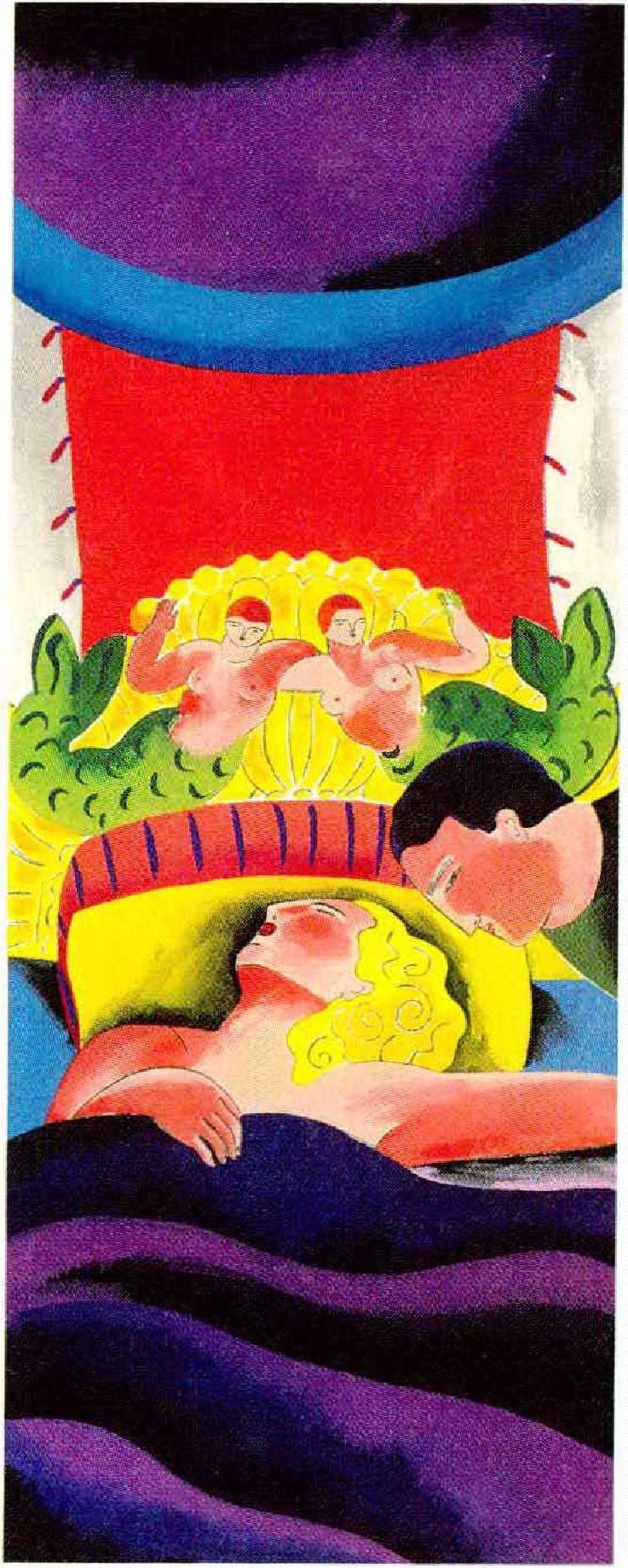
Returned, seconds later, to sanity, she heard, in this order, Stevie’s light cry of surprise, the mozo’s reassurance, laughter, silence, a gasp, laughter again, a long silence. The bedsprings creaked. Stevie spoke. The carved mermaids knocked against the tapestried wall and knocked again.
Morgan covered her ears with pillows.
HOW DID YOU SLEEP?” THEY ASKED EACH other at breakfast.
“Perfectly,” they both said.
They passed butter and spoke of the fine day. Stevie spooned honey onto her toast. “My bus leaves at two,” she said.
“Carlos will drive you to meet it.”
Sun slanted the length of the table. Morgan saw everything turn gold, the tangerines in a bowl, the toast, the honey, her daughter’s hair and skin. Time telescoped. Stevie could have been eight years old, golden, forgivable.
On the same wide panel of sunlight Carlos entered the room from the terrace. His long shadow fell across the plates and cups as he greeted first mother, then daughter. The day was beginning without confusion, without tears, like any other.
“The señorita’s bus will leave at two,” Morgan said.
Carlos immediately offered an invitation. “Then that will allow time for you to witness a mass in the most historic chapel of Santa Felicia. My family is sponsoring the service.”
Morgan’s silence extended so long that he understood it to mean consent.
“In that case, señora, would you be kind enough to bring your camera? For a few pictures.”
So it came about that at twelve o’clock Carlos drove mother and daughter to his infant’s christening.
The chapel was pink and old and streaked by recent storms. Carlos led Morgan toward the small crowd gathered at its arched entrance. Stevie followed, saw Lalia, and waved. A woman, grown thick at the waist with bread and rice and pregnancies, stepped forward.
“My wife,” Carlos said. He pointed to three small boys at her side. “My sons.” They were grave replicas of Carlos, graduated in size.
Now here was Goya, wearing high-heeled pumps and a lace mantilla. A baby with skin the color of cambric tea was sucking its fist in the curve of her arm.
“Imagine it, señora,” Carlos said. “This baptism and my mother’s birthday all at one time.”He gazed into the worn face of his parent. “She has completed forty-five years today.”
My God, Morgan exclaimed in silence. That old woman and I are the same age.
After the mass Morgan took pictures of mother and child, father and child, grandmother and child. Of the three sons and a street dog that wandered into range by mistake.
“Now you,” everyone said to her, and Stevie caught her mother holding the baby with Carlos at her side.
“One of us all together,” they finally demanded.
Morgan had to cross the street to include everyone. She focused her lens and waited while a hunchback begged from the christening party. Trucks and bicycles passed. As she lifted her camera, she was shoved from behind by a lottery-ticket vendor. A sparrow of a child tugged at her skirt. Across the street hands waved and faces smiled. Morgan believed she saw the lovely, hapless infant smile.
At the instant she pressed the shutter, a legless man seated on a child’s wagon propelled himself into the foreground and was included in the group. Then a military van stopped in front of her, and she took quick, repeated shots of its brown and battered side until the film ran out.
Stevie’s bus left three hours late. It was after five when Carlos drove Morgan up the hill. As they passed the zoo, she turned toward the cages. She had time to see only the aviary, where a few listless herons pecked at a water trough and moulting macaws dropped their indigo and scarlet feathers on the dust.
But Carlos had news. “A new manager is coming to the zoological garden,” he said. “A person of experience. A Swiss.”
He turned to look at his employer, who said only, “Good,” and kept her eyes on the road.
As they climbed the hill, Morgan observed the cloudless sky and for the first time was conscious of Mexican evening light, the clarity of insect, leaf, and pebble.
Carlos noticed it too. From the top of the grade he pointed down to the plaza of Santa Felicia and advised Morgan to examine the panorama from her room.
“Consider this, señora,” he said. “On a day like today you can tell from here what kind of ice cream the vendor is selling. You can see the banker’s polished shoes and the blind man’s patch. From as far away as your house you can watch the big hand move on the cathedral clock. You can count the coins that fall into the beggar’s hand.”
Accordingly, Morgan went directly upstairs. She dropped her camera on the mermaid bed, glanced without mercy into the tin-framed mirror, and, as Carlos had suggested, crossed to the window to consider the view. □