Notes: Real Originals
The difference between expatriates who go back and people who really go back


JOURNALISTS, NO less than athletes, need to keep their reflexes sharp. Certain phrases turn up so often and so formulaically— “breakaway Biafra” twenty years ago, “crisis of the schools" year in and year out—that it helps to be able to type them with only one synaptic burst. After several years’ practice my fingers can now produce “dynamic Pacific Rim” with almost no interference from above. But when I notice what my hands are doing, I worry that the language doesn’t quite capture the poignance of a dynamism that obliterates some parts of a society’s traditions while leaving other parts mysteriously intact.
Last summer my family was in Malaysia again, two years after we had moved away. Suddenly we understood why we had found the place so comfortable. The same period that we thought of as a cheap and luxurious interlude, Malaysians thought of as the Great Crash. The country had grown rich in the years after the Second World War because of its three abundant commodities: rubber, tin, and palm oil. It felt poor in the mid-1980s because the prices of all three collapsed at the same time. No one was starving in Malaysia in those days, at least not anyone we ever saw or heard about. But not many people were prospering, either. Hotels begged for visitors’ business. Waiters beckoned you into restaurants as you passed. I learned in those days that any price was negotiable—for an airline ticket, a bottle of pills. Recently I’ve had to stop myself from saying, “Okay, what’s your best price?” when bringing a shirt or a soda to the cashier in an American store.
In our innocence we first thought the country was simply overbuilt, or undercrowded: so many facilities, so few people competing for their use.
We moved into a big old tile-roofed colonial mansion, which would already have become an office block if not for the crash. Two weeks after we arrived, we awoke to find a notice from Dewan Bandaraya, the Kuala Lumpur City Hall, slapped across the front door. Our landlord had defaulted on the mortgage, which should hardly have been a surprise. The rent we paid him couldn’t begin to cover the $4 million he had borrowed on the property, back when he thought he could put a skyscraper on the front lawn. In Malay, Tamil, English, and Chinese the notice invited all comers to bid on the property at a foreclosure auction. On auction day no one showed up, and the Dewan Bandaraya let us stay in our home.
Here in the dynamic Pacific Rim money moves quickly. In two years everything has changed. Rubber is up now. Tin is up. Palm oil is up most of all. Foreign investors have begun to find it crowded in Singapore and Thailand. The elbow room we’d noticed in Malaysia they have noticed too.
Kuala Lumpur has become a boom town. The papers are full of arguments about whether the supply of water or electricity or engineers can keep up with the growth in demand. The school for expatriates’ children, which was constantly laying off teachers when we lived in Kuala Lumpur, has sprouted new classrooms. Restaurants are crowded now, to say nothing of the jam-packed roads. Hotels laughed at our attempts to haggle over room rates. The view across the city had formerly been obscured on many afternoons by the daily thunderheads. This summer it was blocked by smog as well.
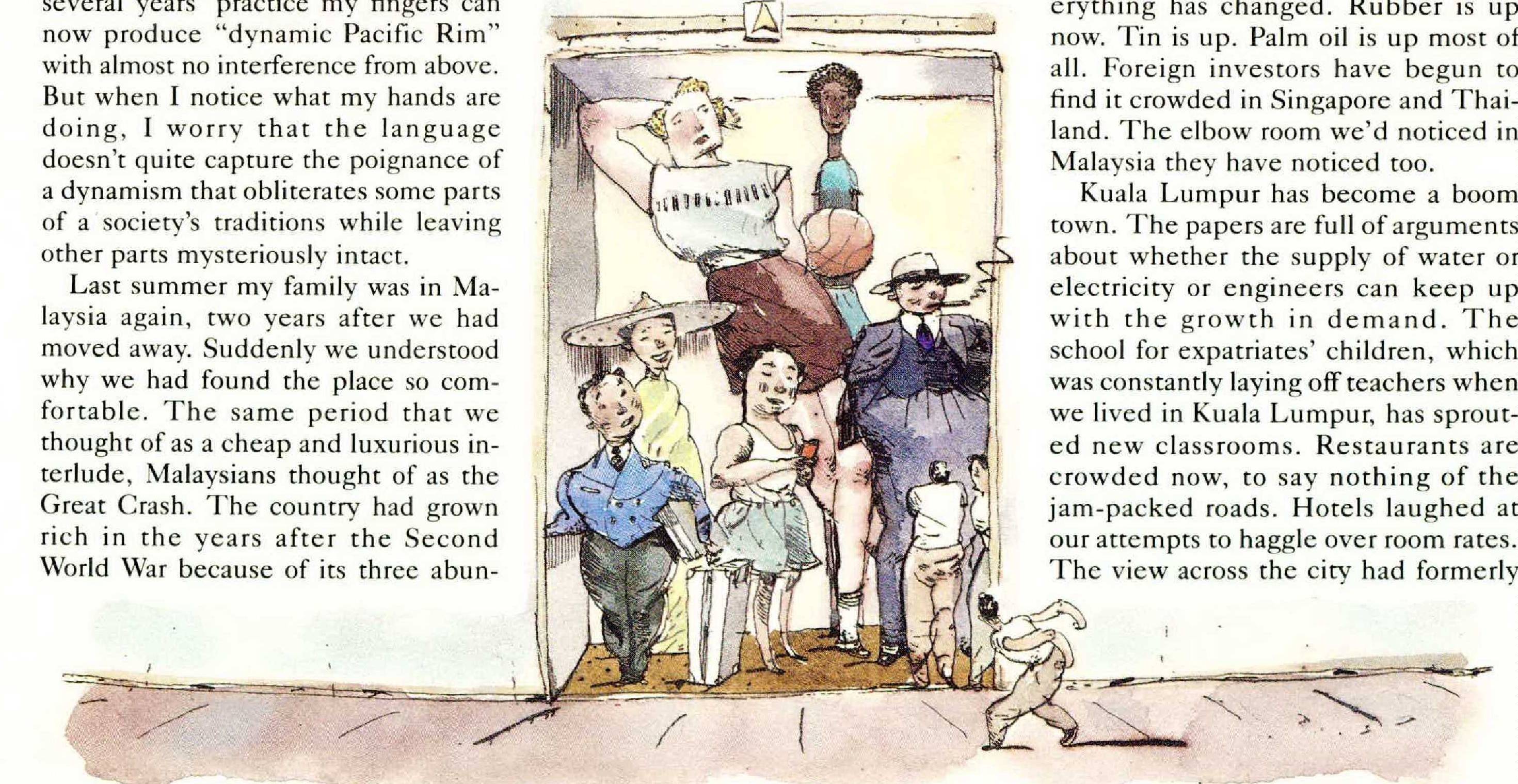
BACK BEFORE it knew there would be a boom, the Malaysian government had tried to induce one, by declaring 1990 to be Visit Malaysia Year. Festivals and gala events were planned for every week of the yearincluding, for one week last summer, the finals of the Eleventh World Basketball Championships for Women, in Kuala Lumpur. This conjunction of event and venue could never have occurred without government intervention. Malaysians, like Filipinos, are generally much shorter than the populations of great basketball powers— and unlike Filipinos, they do not try to compensate by erecting a basketball court as the central element in every village square. The national sport is sepak takraw, a hybrid of volleyball and soccer. (The play is like volleyball, but you use your feet instead of your hands.) The Malaysian women’s basketball team, given a host-nation honorary slot among the sixteen international finalists, typically lost by seventy-point margins to the likes of teams from Italy and Brazil. As the victorious teams strolled through town— long-limbed, broad-shouldered, the Africans tall and slender, the Eastern-bloc teams tall and square—Malaysian onlookers seemed barely able to believe that they and the visitors belonged to the same species. At the Merlin Hotel, where the teams were housed, the bustle of lobby activity instantly ceased when the players came through to ask for keys or change. A bellman stared dumbfounded, suitcases dropping from his hands, at his first encounter with the Yugoslavian team’s center, a 240-pound giant who resembled John Lithgow’s transsexual tight end in The World According To Garp.
One group of Malaysians did manage to take the giant women in stride— which was convenient, since they were sharing the same hotel. These were orangasli, aboriginal people of the Malayan jungle. Linguistically the country honors them. Orang means “man” in Malay, and asli means “pure” or “original"; therefore the orang asli are Malaysia’s Original Men. In the wonderfully vivid Malay language an orang utan is a “man of the forest.” Cacat, pronounced cha-cha, means “broken.”
Above some restrooms in Malaysian airports or office buildings is a drawing of a wheelchair and a sign saying ORANG cacat—“broken man.”
Like other native peoples, from North America to Australia, the orang asli have not thrived in the dynamic age. Those who still live in the jungle are often hired by logging companies. Because they know the hills and trees so well, they are expert at felling, and they can earn a pittance cutting down their home. But the government has launched a number of welfare and uplift programs for the orang asli, and it brought a group of their chieftains to Kuala Lumpur for a conference last summer and housed them, with the athletes and with my family, at the Merlin Hotel.
Orang asli are typically shorter and slighter than Malaysians in general. They rarely did double takes when they walked past the basketball players; they seemed to view such tall women simply as part of a continuum of oversized strangers, beginning with Kuala Lumpur shopkeepers who stood a full five feet tall. In elevators the orang asli would stand pressed into a corner, avoiding the eyes of the women, who in any case were often looking two feet over their heads. Usually a group of orang asli would have an elevator to themselves. But in other cases the elevator doors would open, foreign and Malaysian passengers would enter, the orang asli would hang back, and the doors would close. The doors would open once again, and close, and reopen— until finally several orang asli would approach on tiptoes and leap into the elevator as if springing across a chasm in the wild.
In the evening the women were out at the arena, and the orang asli were resting after meetings throughout the day. Although the shock of the new Malaysia must have been more intense for them than for me, they seemed to meet it with great calm. They opened the doors of their hotel rooms and sat in the hall, smoking and chatting through the evening as if in a jungle longhouse. As we walked past the open doors to our room at the end of the hall, we could see that the mattresses had been flung off the beds and placed on the greater security of the floor. Their memories of the days before dynamism were more vivid than mine.
—James Fallows