The Prose (And Poetry) of Mario M. Cuomo
The New York governor likes to distinguish the “poetry” of politics—the cheers, the charisma—from the hard “prose" of government. As the presidential-election cycle approaches, its a good time to ask, How has this poet done with that prose? What kind of governor has he been and what does his record say about the kind of President he might make?
IT’S FULL-BORE SUMMER IN QUEENS, AND THE AIR in the Sunnyside Community Services Senior Center auditorium is close to unbearable—it feels like breathing through a hot sponge. Perspiring beneath a gaggle of ceiling fans is a crowd of some 300 people, almost all of whom are old enough to be called senior citizens, and many of whom are waving fans printed with the name of a local funeral home. Despite the oppressive heat, they are wreathed in smiles. A local boy has come back to visit, and he has brought good news with him.
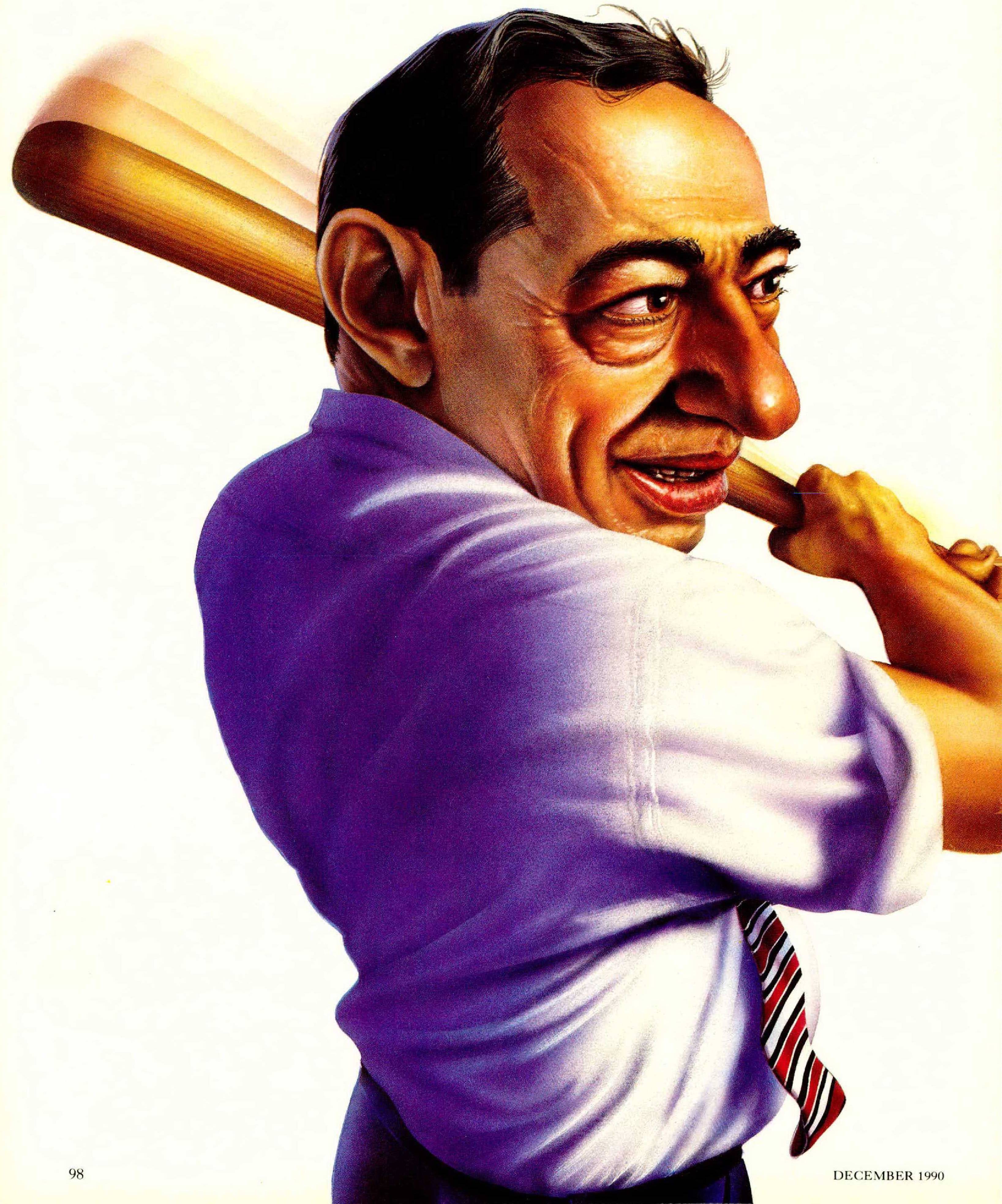
The dais is crowded with reporters, photographers, community activists, and minor political luminaries, but the center of attention is a man with the shrewd, pouchy face of the likable tough guy in an old movie. He wears a blue suit of no particular cut, black shoes of no particular style. With his sleek, bulletlike head tucked into his powerful shoulders, he is instantly recognizable. He is Mario Cuomo, the governor of the state of New York.
Because the governor usually plays the starring role on ceremonial occasions, he is almost always the last person to speak. Thus Cuomo spends a surprising amount of time before audiences who are waiting for him to take center stage—something that one might see as a metaphor for a man whom Democrats have longingly invoked as a presidential candidate for six years, and whose every public appearance is dogged by questions about his designs on the White House. Such questions are unavoidable as long as Cuomo remains, as a recent National Journal poll indicated, the two-to-one favorite of Democratic Party operatives for their 1992 presidential nomination. Today, however, Cuomo is not running for President. Today he is going to sign two bills, one capping what doctors may charge Medicare patients, the other expanding a program called EPIC, which insures the elderly against high drug costs. Both are wildly popular in this chunk of Queens.
Cuomo advances to the podium. He moves with the zest natural to anyone who has been greeted at the door by a marching band of young girls in adorable yellow sequined dresses. The crowd is palpably with him. He wants to talk; they want to listen. In the course of the next few minutes he will unapologetically extol the virtues of his eightyeight-year-old mother, who came to New York from Italy and struggled all her life to give her children a chance; claim that stories such as this are why the United States is the most wonderful place on earth; argue that we grew to our present stature despite having one hand tied behind our collective back, because until quite recently we kept black Americans and women from adding their special genius to the national effort; urge the audience not to give up on government, because the capacity to enact programs like EPIC is a sign that government can work; bemoan the failure to ban assault rifles, which is a sign that government is not working well enough; decry the federal government for walking away from social programs; and repeatedly thank the people who made this moment possible—especially the Republicans who control the state senate—thus firmly associating the opposition with the $75 million annual cost of EPIC.
“We are begging the federal government for a billion dollars to fight crime and do something about drugs,” he’ll say. “They say there’s no money! They can’t fund it. But where are they going to get five hundred billion dollars for the savings-and-loans?” Shrugging, he will cock an ear toward an imaginary Uncle Sam at stage right. “Okay, okay, we accept it,”he’ll tell Uncle Sam the welsher. “But didn’t you promise our people they wouldn’t have to sleep on sidewalks? Didn’t you promise that people would live a decent life? And now you’re telling me you can’t think of national health insurance? Every other industrial nation in the world has it! We have more of everything than they do, but you’re saying we can’t do it? You’re saying we have to leave thirty-five million without insurance? And twenty-five million illiterate? People who can’t even read the label on their prescriptions? Of course you can do it! You’re the greatest country in the world and you haven’t even tried!”
These themes—particularly the one about Mom, in this audience of Moms—will go over like thunder. Cuomo will he applauded rapturously. But for now, as he stands on the dais, everyone is going to have to wait just a little bit longer. The man many believe to be the finest political orator in the country is being drowned out by a spidery old fellow in a faded blue shirt. “Cuomo for President!” the man bellows, at astonishing, improbable volume. “Cuomo for President! Cuomo for President!”
“Nobody Has Any Idea What He’s Been Doing”
MARIO MATTHEW CUOMO HAS JUST BEEN ELECTed overwhelmingly in a contest in which the outcome was regarded as so definitely a foregone conclusion that last August a senior editor at a major New York City newspaper was not sure whether his publication would bother with its customary election-year evaluation of the governor’s record. “We’d have to find out the guy was an ax murderer to affect the results,” this man said. “I’m not sure we have the resources for futile gestures.”
In some ways Cuomo’s invincibility is mystifying. The word “liberal” is said to be anathema, but New York has been run for eight years by someone to whom it is applied more often than to anybody save perhaps Senator Edward M. Kennedy. The governor, who detests labels, claims that such a description is meaningless; but it is not if taxing and spending is any measure, because New York taxes the average citizen more heavily than any other state and, except for unusual cases like Alaska, spends more money per capita, and Mario Cuomo is therefore a “tax-and-spend Democrat” of the sort that is supposed to have vanished with the California tax revolt of the late 1970s. New York, moreover, is in the same financial predicament that has toppled or threatened governors in nearby Connecticut, Maine, Massachusetts, Vermont, New Hampshire, and New Jersey. The state government has piled up a $5 billion deficit at a time when tax revenues are less than expected, and welfare costs are soaring. Months of deadlock between the governor and the legislature over the budget were resolved only by a series of accounting gimmicks that included arranging for the state to “sell” some of its prisons and highways to itself and then issue bonds to pay for the “purchase.”In the process New York’s bond ratings became the third lowest in the country.
The consequences of failure would seem everywhere apparent. Schools and universities are in parlous condition; city emergency rooms overflow with the poor, the addicted, and the deranged; and even the highways are shaky, with 60.8 percent of bridges on federal highways in New York (which are maintained by the state) not meeting U.S. standards for design or maintenance. Violent crime has increased steadily during Cuomo’s tenure, and children are being caught in the crossfire—twentytwo were shot in New York City between July 22 and September 23 alone. Why, it is fair to ask, have the voters returned Cuomo to the governorship?
Part of Cuomo’s hold on New York is surely that he is a Democrat in a state without a functioning statewide Republican Party. Despite having a popular senator, Alfonse D’Amato, control of the state senate, and heavy support in suburban and rural areas, the New York Republican Party has never managed to run a well-known professional politician against Cuomo. “It’s strange when you think about it,” says Alan Chartock, a political-science professor at the State University of New York at New Paltz and at Albany, who hosts a weekly radio talk show with the governor. “The Republicans could run a dog and get forty percent of the vote. And that’s more or less what they’ve been doing.” Cuomo’s first opponent, in 1982, was a zillionaire chain-store owner who wore big red suspenders everywhere and criticized Ronald Reagan for insufficient adherence to supply-side economies. Next, in 1986, came a little-known county executive from the suburbs who walked around with a lifesize cardboard cutout of Cuomo that he “debated” when the governor, as incumbents will, set tough conditions for accepting real debates. Cuomo’s most recent opponent was a rich economic consultant named Pierre Rinfret who was picked to run as a Republican despite not being registered in the party. Soon after the nomination reporters discovered that Rinfret, who claimed to have a Ph.D. from the University of Dijon, had actually neglected to earn one. Matters did not improve from there on.
But another, greater part of the governor’s hold on New York has to do with his ability to transmit his vision of things—a skill that many non—New Yorkers became aware of during his televised speech at the 1984 Democratic convention. In that address, which caused a flurry of presidential rumors, Cuomo urged the citizenry to “surrender some small parts of our individual interests, to build a platform we can all stand on, at once, and comfortably.” And that is exactly what Cuomo has tried to do, slowly and cautiously, in New York State. During his tenure New York has, willy-nilly, conducted an incremental experiment in the ability of government to deliver services to the people, especially the poor, the elderly, and the helpless. At the same time, it has been testing the willingness of its taxpayers to pay for those services—all in an era when government’s very ability to plan, monitor, and respond has been under attack from the highest officials in the land.
It is hard to depict Cuomo’s popularity as the public’s reasoned acceptance of these policies. Despite its evergrowing importance, state government is a kind of black hole: money goes in, and almost nobody knows how, or if, anything comes out. Albany, the capital of New York, is no exception. Just three hours from New York City, it is treated by the metropolis’s media as if it were three time zones away. “Because the media only cover political scandals and the annual budget fight, the public has no way of knowing what’s going on,”says Meyer Frucher, a former state official who has been described as one of Cuomo’s closest advisers. “I’m a big supporter of the governor, but I have to tell you that I think almost nobody has any idea of what he’s been doing up there for all these years,”
Taxing & Spending #1: Taxing
ON SPRINGTIME MONDAY MORNINGS THE 7:35 A.M. Amtrak to Albany leaves Grand Central with a full load of bleary-eyed Democratic legislators and their aides. Before long the train is out of New York City and rumbling north along the lush Hudson River valley. The country is green, agricultural, conservative; Republicans come aboard at almost every stop. Lobbyists and reporters appear as if from nowhere. The discussion gets hotter, the cigarette smoke thicker; because it is budget season, the word “taxes" is in every second sentence. By 10:15, when the train arrives, the legislative day is in full swing.
As one comes into Albany, it is easy to see who has been to the capital before. While the regulars argue, the newcomers are pressing their noses to the window in disbelief. Atop a hill in the center of town is an immense white marble plaza crowned with white marble skyscrapers of remarkable ugliness. Although 10:15 is coffeebreak time, not one of the thousands of workers has chosen to sit outside; the harsh stone of the plaza is empty. This is the Empire State Plaza, seat of the government of New York State.
In its overweening scale the plaza seems to epitomize what fiscal conservatives loathe about the Democratic Party. But the plaza, like much of the governmental machinery it houses, was created by a Republican, Nelson A. Rockefeller. Rockefeller, people in Albany say, was the greatest Great Society liberal of them all. First elected in 1958, this rich, ruthless, idealistic man utterly dominated New York for fourteen tumultuous years. By the time Rockefeller left, per capita state taxes had jumped sevenfold and state and local taxes absorbed an amazing 16 percent of New Yorkers’ personal income. With the money Rockefeller built what was then the biggest public-university system in the world, thousands of miles of landscaped highway, hospitals by the score, dozens of state parks, and, of course, the Empire State Plaza, which alone cost the equivalent of more than $4 billion in today’s dollars. To a large extent the job of every governor since has been to cope with this legacy.
Rockefeller chose to locate the plaza on a hillside, and its designers balanced the whole gigantic structure on a huge platform that is periodically checked by engineers to ensure that it is stable. The plaza did not collapse; the government nearly did. By the end of 1974, the year after Rockefeller left office, some state agencies were on the verge of default. New York City almost went bankrupt in 1975. Governor Hugh Carey, a Democrat, was forced to pick up the pieces: he cut taxes a bit and held spending steady. Ultimately Carey was rescued by the inflation of the Carter years, which pushed more New Yorkers into higher tax brackets. As his secretary of state, Carey picked a lawyer from New York City, Mario Cuomo. It was Cuomo’s first major public office.
By most measures the legislators pouring from the train into the plaza are full-time civil servants. Yet New York’s legislature, like most other state legislatures, is based on the long-ago ideal of a government by gentleman amateurs. Enough of the Ted Mack flavor remains that Albany can be easily lampooned. New York has a state muffin: the apple muffin. It also has a state fossil: Eurypterus remipes, a sea scorpion. Both were selected and debated by the legislature. At the same time, Albany must deal with closer, harder truths than its more august uncle in Washington, D.C., has to face. New York, like many states, is required by law to balance its budget. And because states have neighbors, they must worry about driving people away with high taxes.
Such matters seem more pressing than usual on this particular spring morning. The 1990-1991 budget is more than a month late; this is the sixth year in a row that the negotiations have gone overtime. The budget itself is not the issue. Instead, the fight is over projections of how much money the state will get from this year’s taxes. The estimates come from two well-known private economicforecasting firms: DRI/McGraw-Hill, hired by the governor’s office, and Wharton Econometrics, hired by the state senate. Both seem to have guessed wrong. According to the governor, actual receipts indicate that there will be a shortfall of more than a billion dollars, and so a scheduled tax cut must be put off. The senate is arguing that the governor’s revenue and spending estimates are too pessimistic by more than $300 million, and so the tax cut can go through.
Humiliatingly, it will soon emerge that the governor is right and the Republicans are being fiscally irresponsible. But the senate majority leader, Ralph J. Marino, is addressing a real concern with his plaints that New York’s taxes are too high. The past decade has transformed “tax” into the dirtiest word in American politics. Although the reaction to taxes is sometimes hysterical, it does mirror a real public-policy concern: that higher taxes make it harder for people and businesses to stay in a state. Unfortunately, it is unclear when taxes are “too high.”Too high compared with what? What are the bad effects? And how would you know?
State tax systems are far from alike. Seven states have no personal-income tax; five have no corporate-income tax; five have no sales tax. All states tax gasoline, cigarettes, and estates, but at different rates. Alabama doesn’t tax prescription drugs for the elderly; Rhode Island taxes sports clothing but not formal wear; Kentucky doesn’t tax some kinds of coal. Only fifteen states have a state property tax. Because of the differences, comparing state tax systems seems impossible. Does a state that raises money by taxing an asset like property burden the citizen more than one that raises money by taxing incomer Is a low sales tax in a poor state as burdensome to its poor citizens as a high income tax is to the relatively richer people in a rich state?
Widely used comparisons emanate from a little-known federal agency called the Advisory Commission on Intergovernmental Relations. Every two years a small platoon of ACIR statisticians estimates the depth of the tax pocket available to each state government, and compares it with its fellows. The national average is set at 100; New York, at 152, has the highest tax effort of any state in the nation. (Massachusetts—“Taxaehusetts”—has an ACIR rating of only 94; its high per capita income cushions the impact of its taxes.) That figure is what people mean, or should mean, when they say New York is highly taxed.
The number, slightly reduced during Cuomo’s tenure, implies that the governor is betting that taxes 50 percent above the national average are not a recipe for disaster, for the state or for his own political future.
He may be right: economists argue that the simple amount of taxes can be less important than the type of taxes levied. The influence of taxes in South Dakota, which has no income tax but very high death and gift taxes, will be different from that in North Carolina, which has a high gas tax (almost twenty-one cents a gallon) but a very low cigarette tax (two cents a pack). New York’s high ACIR rank may make little difference to its economy overall if the state has the right mixture of taxes. But here one enters the realm of folklore, because the consequences of state tax policy are rarely studied systematically. According to the former governor of New Jersey Thomas H. Kean, it is generally thought—but far from proved—that the “most dangerous” tax for states is the progressive personal-income tax. (A progressive tax is one that requires richer people to pay a greater proportion of their income than poorer people.) “For the working class, any raise in the income tax is going to be less than the cost of moving (out of state],” Kean says. “But when you sock it to the wealthy, a high percentage of their fixed costs are going to be in that tax, and it starts to be worthwhile for them to move. Then what happens is they take their companies with them, even though strictly speaking the economic justification might not be there. And we’ve benefited from that in New Jersey— companies following their CEO out of New York.” The problem, as Kean points out, is that this logic induces states to rely increasingly on flat taxes that disproportionately hit the poor; indeed, Elliott Dubin, an ACIR analyst, has calculated that the use of regressive “non-taxes” like parking fees and school-lunch charges has more than doubled since the 1950s.
If state income taxes especially induce business and the upper middle class to seek greener, tax-free pastures, New York should be in trouble. Although Democrats Carey and Cuomo have cut Republican Rockefeller’s top rates by more than half, ACIR computations show that New York still relies on income taxes more than do all but two other states. In other words, New York raises money on a system that weighs on the poor much less than do the systems of most other states—but shifts the burden to precisely those people who can most easily flee it. If they flee it, Kean says, “you get in this kind of cycle I think Massachusetts has gotten itself in at times, where in order to keep the state services you have now, you increase taxes again.” The spiral gets out of control, and the state’s finances are wrecked.
New York sometimes seems to have begun that cycle. Cuomo likes to trumpet that New’ York has generated a million new jobs in the past decade, but on a percentage basis that figure is a quarter below the national average, according to the U.S. Bureau of Labor Statistics. (These numbers always refer to nonagricultural jobs, partly because many farm workers are nomadic and thus are hard to assign to a particular state.) Worse, in the past five years New York actually lost 134,000 manufacturing jobs, which are usually well paid—at a time when even an economic basket case like Michigan held steady.
People left too. In the past decade, New York’s population grew by only a quarter of the national average, indicating that thousands of New Yorkers moved out. Although such counts are notoriously uncertain, it is sometimes proposed that New York gained population only because it absorbed a large number of poor immigrants, suggesting that many, if not most, of those who left were in the middle class.
Cuomo’s conservative opponents naturally like to quote such figures. But it seems reasonable to ask if taxes actually caused the state’s relative decline. If tax policies were a principal reason for businesses and their workers to relocate, one would expect that over the long haul states with low taxes would generate more new jobs than states with high taxes. That isn’t necessarily the case. New Hampshire, with tax policies ranked by Grant Thornton, a Chicago accounting firm, as the most attractive in the nation, created jobs at twice the national rate during the 1980s. But neighboring Vermont, a high-tax state ranked thirty-sixth, created them at almost the same speed. One must believe either that the businesses that chose to expand in Vermont rather than in New Hampshire were foolish or that, notwithstanding the hoopla surrounding the tax revolt, taxes were not the most important factor in their decision.
Most economists argue the latter. “The major factors,” says Bruce Fisher, the research director of Citizens for Tax Justice, a Washington lobby, “are the average hourly wage, which state and local governments don’t have much control over, and things like education and other services, which they do. Businesses like places with good schools, good health-care systems, and good roads. The cost difference is going to have to be enormous before they’ll take a chance on illiterate workers and potholefilled streets. And if that’s what they want, they’ll go to Mexico, not a low-tax state.”
In other words, once you’ve established that a state’s taxes are high, you’ve learned nothing other than that they raise a lot of money. A more useful question is how that money is spent. Does, so to speak, a dollar of tax buy a dollar’s worth of government? If tax revenue is employed carefully and efficiently, then a relatively high rate of taxation may be an appropriate response to a relatively high level of need, as when there are more poor people than average, or more children to educate. It might also indicate that the citizens of the state, through their government, have decided to buy something expensive, like beautifully landscaped parks, or a top-notch public health-care system. “Judging government’s performance is extremely difficult,” says Harry Hatry, of the Urban Institute, who recently co-managed a project with the Governmental Accounting Standards Board which attempted to do just that. “It’s a question of the level of service. With high per capita costs, like New York’s, if you’re getting value, it’s one thing. If you’re not, it’s really bad.”
“What one has to ask is, are we getting our money’s worth?” a former top New York City official says. “Are the hospitals, schools, and bridges worth the price the state is charging? If you need a reliable car, you’re willing to pay more for one that runs well than one that doesn’t. But is Mario asking us to pay for a Mercedes—and giving us a Rent-a-Wreck?”
“The Smartest Person I Ever Met”
IF YOU SIT BEHIND HOME PLATE AT A NEW YORK METS game and look over the center-field fence, you can see the spot where Mario Cuomo began his political career. It looks like a bunch of junkyards. In fact, it is a bunch of junkyards—the “Cuomo Memorial Junkyards,” as the governor puts it. Next to them a New York State potentate named Robert Moses decided to locate the 1964 World’s Fair. A paladin of big government, the seventy-six-year-old Moses was a preternaturally energetic man whose multiple positions within the city and state had allowed him to construct a gigantic network of parks, roads, beaches, bridges, and housing projects. In so doing, he destroyed dozens of neighborhoods and displaced hundreds of thousands of people. Moses was also the president of the World’s Fair. For its site he chose a near-vacant marsh called Flushing Meadows. At the north end of the marsh, just beyond the fair site, was a small group of scrap-metal dealers. Their establishments were piled high with rusty metal. Moses thought the whole setup unsightly, and wanted to replace it with a stadium for Little League baseball.
The dealers felt trapped. Because not much of New York City was zoned for junkyards, they couldn’t move. Having few skills, they couldn’t find other work easily. They decided to fight. They ended up with a lawyer who was just thirty-two years old. But he was from Queens, and, like many of them, he was Italian-American. His name was Mario Cuomo.
Cuomo took the case, he says now, because he thought the idea of playing Little League in a full-tilt stadium was ridiculous. Moreover, a city without junkyards is a city in which amateur mechanics can’t paw around for parts on Saturday afternoons. “The proposal I made,” Cuomo says today, “was to reduce all the piles, to build magnificent corrugated green fencing, with Lombardy poplars, at our expense.” When Moses brushed aside the fencing and poplars, Cuomo commenced the now-familiar round of threats, injunctions, hearings, appeals, and press conferences by which small organized groups of citizens thwart the will of their leaders. Eventually Cuomo won. His grateful clients responded by trying to stiff him on his fee.
One public struggle begat another, and that begat a third. In both the new cases Cuomo strove to make the political establishment sensitive to the concerns of neighborhoods that felt threatened by the means planned to accomplish liberal goals like building low-income housing. In return Cuomo was given the punishment that a democracy always metes out to a successful crusader from outside—he was invited inside, and asked to run for office. He failed several times before becoming governor, a position whose duties had been set out in the 1920s by Robert Moses. Moses had wanted to be governor; he did not stint on the authority he awarded the job.
Cuomo has often expressed ambivalence about being in charge. He was not a politician until he was over forty, and has always clung firmly to his social roots, which are among people who did not expect to wield power or to move in elevated circles. He was born and raised in Queens, the largest of New York City’s five boroughs. Visitors to New York can learn all about Queens’s place in the city,
Cuomo likes to say, by reading the signs at the expressway entrance from John F. Kennedy Airport.
The signs say TO NEW YORK CITY. JFK Airport is in Queens. “We’re Queens, you’re New York City,” Cuomo says. “Technically, of course, we mere New York City, but we weren’t Manhattan, we weren’t power, we weren’t nightclubs, we weren’t anything like it. We were every poor neighborhood in the United States of America.”
His parents, Andrea and Immaculata, emigrated in the 1920s from a village near Naples and eventually set up a small grocery store in South Jamaica, Queens. In those days Queens was much more a collection of villages separated by open country than seems possible today, and South Jamaica was a reasonably self-contained unit. It was separated from the richer settlement of Jamaica by an embankment with a railroad track on top. (Yes, Mario Cuomo was born on the wrong side of the tracks.) The third and youngest child, he spent his first years playing alone with the boxes in the back of the store. He scarcely spoke English until he went to school.
Andrea Cuomo worked fearfully hard. Cuomo claims never to have had a long talk with him, because he was always working. He was as fierce a taskmaster with his family as he was with himself. He set aside all his money for his children, and expected them to do well in school. “He couldn’t read the report card, right?” Cuomo says. “The only thing he knew were the marks, the A’s. . . . But he would look at it and he would say, ‘A, A, A, A— B!’” Each B earned a box on the ears. “He didn’t know what the subject was or what you got the B for, but he knew you were supposed to get an A.”
With such encouragement, Cuomo did well in school. Eventually he finagled a scholarship to a Catholic high school, St. John’s Preparatory, run by the Community of St. Vincent de Paul. Cuomo was one of the poorer kids, an argumentative, competitive, terribly hardworking boy who found his social niche on the baseball team. When there was time, he played basketball in several leagues— under aliases like Glendy La Duke and Lava Libretti. He went at it street style, scrappy and fast, elbowing in a little harder than they do in the suburbs. (He still does; when a TV news crew recently filmed him playing basketball with his son, viewers sent angry letters because he was so rough.) A classmate, William Tash, recalls a day when he managed to drag himself to the subway particularly early. It was barely daybreak, and there on the train was Mario. Gee, Tash said, you’re getting to school early. No, Cuomo said. It’s not early. Tash was stunned to learn that Cuomo got up at 4:00 every morning to study and work in the store. Tash was not surprised to find there was something about his friend that he hadn’t known; then, as now, Cuomo held his cards close to the vest.
St. John’s steeped its students in the intricacies of theology—a kind of intellectual seduction of the believer with an interest in argument. For Cuomo, who was and is a practicing Roman Catholic, it was a terrific place to be. When he graduated, he went across the street to St. John’s College. Now on another, bigger campus, St. John’s was then a small place with perhaps 800 students. The Vincentians lived in the “priest house" just off campus; the seniors wore black gowns. It was quite conservative, recalls Jim DeNike. who graduated with Cuomo. “There was a lot of discussion about McCarthy,” he says. “The general feeling was pro-McCarthy, probably from some of the faculty.”
Cuomo didn’t give a rap about politics. He wanted to get As and go to law school and marry his girlfriend, Matilda. A BMOC, Cuomo was a top student and athlete. His reputation as a baseball player brought him to the attention of the pros. In 1951 he was signed by the Pittsburgh Pirates—with the proviso, which Andrea insisted upon, that training not interfere with his education. Cuomo’s Bull Durham period didn’t last long. In his first season on the farm team he was hit on the head by a fast ball. Hospitalized for weeks, he was told that he might not recover from a second hit. He went to law school at St. John’s. A year later he married Matilda.
Although Cuomo did well in his first two years, the arrival of his first child, Margaret, made him realize how far away real security lay. “It’s 1956, you don’t know anybody, nobody in your neighborhood goes to school, let alone law school—they don’t go to college. Where am I going to go for business? ... So I, gee, I nearly worked myself to death that last year. I got A in everything. I just knocked everything dead. I did very well on the bar exam.” Tied for first in the class, Cuomo waited for the job offers to fill his mailbox. They didn’t come. He couldn’t even get an interview with a Wall Street firm.
The irate Cuomo was approached by his law school dean, Harold F. McNiece, who gently suggested that he change his name to something without a vowel at the end. “Take a good look at me,” the governor likes to say now, pointing to the long nose, the deep brown eyes, the saggy, stubborn, Latin features. “Can you imagine me as Mark Conrad? Can you imagine me in white sneakers and a tennis racket”—he drops into a startlingly good imitation of an oatmeal-faced WASP—‘“Hi. Mark Conrad, from Debevoise and Plimpton’?”
Cuomo eventually landed a prestigious clerkship at the New York State Court of Appeals, but the slight remained vivid. When he went into private practice, he joined a firm in Brooklyn, becoming part of the throng of lawyers whose offices crowd Court Street to this day. The term “Court Street lawyer” has curious connotations in the city’s legal profession; it is used to refer to the mob of assembly-line attorneys who fill the borough’s personal-injury and nuisancesuit courts. (In one legal broil a professor at Brooklyn Law School actually countersued a colleague for calling him a Court Street lawyer.) Cuomo, as it happens, worked for Corner, Weisbrod, Froeb, and Charles, one of the two or three prestige firms in the area. But, as the firm’s first litigation specialist, he was not entirely separate from the contentious ambience of Court Street.
Going to trial requires a fantastic level of commitment. When court is in session, good litigators work round the clock in a state of meticulously controlled fury. Cuomo loved it. It became apparent that he possessed what lawyers call confrontational skills. After just a few weeks at the firm, Cuomo was taken to lunch at the Brooklyn Club by Richard Patrick Charles, a tough Irishman who was a senior partner. In Cuomo’s recollection, Charles opened the conversation by growling, “You’re pretty good. What are we givin’ you?”
“Seventy-five hundred,” Cuomo said.
“Make it eighty-five,” Charles said grandly.
Cuomo quickly became a well-known presence at 32 Court Street. James Starkey, a St. John’s law school graduate who worked for another firm in the building, sometimes met Cuomo for a drink after work. “I noticed that something was occurring I was unused to,” he recalls. “I kept losing arguments.” Starkey’s brother, who had known Cuomo in college, asked if the new man was as smart a lawyer as he seemed to think he was. “My response was that he may be the smartest person I’ve ever met,” says Starkey, who is now a judge on the state court of claims. “Nothing that happened since has caused me to change that opinion.”
Cuomo won case after case and built up his firm’s litigation department. Nonetheless, in the opinion of Fabian Palomino, who had become Cuomo’s friend when they were law clerks together, the work was not, finally, satisfying. “Making other people rich wasn’t enough,” Palomino says. When Cuomo began taking on jobs like the junkyard fight, things became more interesting. “Fighting politicians, he learned that government had a lot of power,” Palomino says. “It could do a little bit of good. ” With that realization, Cuomo took his first, gingerly step toward elective office. Years later, when Nelson Mandela came to New York, Cuomo and Palomino, who is now special counsel to the governor, greeted him at the airport. Cuomo had been asked to introduce the hero of the South African resistance at a special session of the United Nations. While waiting for Mandela, Palomino asked him: Mario, when we were law clerks together, did you ever think you would end up addressing the United Nations?
No, Cuomo said. Inconceivable—what had happened in his life was beyond belief. Entering the airport, they passed the signs: TO NEW YORK CITY. The sky was blue, merciless, hot. A battalion of photographers waited outside the gate. All the nation seemed to focus on the resistance leader’s arrival.
Governor Cuomo! A woman thrust a microphone in Cuomo’s face. Governor Cuomo! Are you running for President?
Confrontational Skills
“CAN I TELL YOU HOW RIDICULOUS THAT IS?” the governor asks pleasantly. He is sitting in a stiff, back-saving chair in the executive mansion, speaking into a phone connected to one of the radio talk shows that are a staple of Cuomo’s contacts with the media. In this case the host is a conservative Long Islander who thinks the state is shoving special-education programs down the towns’ throats without providing the funds to pay for them. The host is a member of his local school board, and is trying to take the governor to task. But the governor is not interested in being taken to task. “We said, ‘You have to educate the children,'” Cuomo explains. “What you’re saying is, ‘You have to pay for it, governor.’ But what are you really saying? You don’t want to take care of the disabled children unless I raise income taxes to give you money for it? You won’t do it with your own taxes?”
Cuomo listens to the response. A vulpine smile steals across his face. The host has just said that his community will flip if they have to raise property taxes, giving Cuomo the opportunity to eat him for breakfast. “You can’t have it both ways, Bruce,” he says in a warm, chiding, avuncular tone. “You can’t say you’re against tax increases, but, Mario, you raise the income tax so that I don’t have to raise the real-estate [property] tax, because they’ll kick me out of office if I raise the real-estate tax. ” Isn’t that asking people in Schenectady, Buffalo, and Utica to foot a bill that Bruce doesn’t want to pay?
During the past eight years, the governor says, the state has increased funding to Long Island schools at twice the rate of inflation. “The net result: you people are blaming us for raising taxes. We were so generous to you, we wound up taking the heat. Isn’t that true, Bruce? Haven’t you on your program said the taxes are too high? Yes or no? Yes? Well, then why are you asking me for more money?”
The Bully Pulpit
IT IS TOWARD THE END OF THE GOVERNOR’S SPEECH in the Sunnyside Community Services Senior Center, and the room is rapt, silent, and hotter than ever. The fans overhead might as well be trying to stir aspic. Even the flies seem stunned by the heat. “Nobody knows better than I what tough shape our budget is in in Washington,” Cuomo is saying. “I know all of that. But I know some other things, too. Despite all these problems, when you take this country and say no matter how expensive it is, we must do it—we do it. Take,” he says slowly, “the savings-and-loans crisis.”
Cuomo waits for the buzz; the term “savings-andloans” now evokes visceral responses in Americans. Here it has suddenly conjured a world of rich thieves, of insurance executives and investment bankers who are about to reach into the pocket of each citizen and extract several thousand dollars. One hazards the guess that Cuomo’s mention of the debacle is related to the one thing all Americans know about insurance executives and investment bankers: they are Republicans.
“It’s important,” he says. “Not just because people said they stole it, though they did. But because it’s an example of a commitment we need to honor.” The commitment in this case is to the S&L depositors, many of whom will lose a lot of money if Uncle Sam does not step in. “They”—the savings-and-loan operators—“said they needed freedom to operate. So we gave them their freedom. We let them do their own thing—and they stole you blind! The hit: five hundred billion to a trillion dollars.”
It is difficult to describe the impact that Cuomo’s voice has without sounding like a campaign commercial. He speaks simply, in short, clear sentences that roll quickly into one another, like surf. His voice is both deep and sharp, the words etched against the humid air, imbuing his speech with the passion of a defense lawyer arguing for a doomed client. Playing against his street-kid presence, he talks about intellectual issues; playing against his bullish demeanor, he talks about love. He works hard to avoid being above his audience, looking down. He speaks in the terms most people use when they think about choices: right and wrong. It is wrong, he says, to let social problems stew in their own juice. And it is right for people to demand more action from their government.
Given the country’s commitment to the savings-andloan bailout, Cuomo says, “it’s a disgrace to say we can’t afford national health insurance! It’s a disgrace, it’s an abomination, to say we can’t help the homeless! But you”—he points to the perspiring audience—“you can do it if you try! Keep demanding it! Keep shouting for it! You’re absolutely right!”
The crowd roars. Cuomo is here exercising what a onetime adversary, the former New York City mayor Edward I. Koch, calls his “cheerleader quotient.” Koch was hardly being derisory. Not the least of a politician’s duties is assuring the public that somebody is at the wheel. Cuomo being what Koch calls “the eight-hundred-pound gorilla” of New York politics, he is in an unmatched position to shape the agenda of political discourse. His strength is magnified by his ability to communicate, which is of Reaganesque dimensions. He has again and again used what Teddy Roosevelt called the bully pulpit to manifest concern for the disenfranchised. (“He’s the best the system produces,” says Douglas White, a former state human-rights commissioner. “I mean that absolutely sincerely.”) It is the common duty of all citizens to care for their weaker fellows, the governor argues, and the mechanism to accomplish that is called government. To dismiss the possibility of helping, he suggests, is a moral lapse—an ignominy unworthy of Americans. Applied to national health insurance, this stance has clear appeal to this group of elderly people in Queens. When he leaves, the air is still quivering with applause.
The cheering demonstrates why some Democrats have long wished that Cuomo would seek a national stage. For the past ten years, these people believe, the White House has been in the hands of men who have pushed beyond the economist’s natural skepticism of government into the realm of Dr. Feelgood. The nation is beset by any number of crises. Homelessness, education, health care, child poverty, environmental damage, decaying infrastructure, and the drying-up of investment capital caused by the deficit and the low savings rate are often on the short list. The present Republican leadership, it is argued, has bet that the nation can do little and emerge unscathed. We will float to prosperity without having to increase government services. No thought will be required, and not many taxes. To some Democrats, this is a fool’s paradise. Someone will have to push the country to get its house in order. Someone will have to point out that other industrialized nations do not share our rates of addiction, illiteracy, and infant mortality, and that almost all these countries have vast government initiatives to address those problems. Why, they ask, can’t this country have national health insurance?
Unfortunately, past social programs in the United States have sometimes been badly thought out, or even counterproductive; the tottering, murderous urban-renewal apartment projects are among their mausoleums. Clear goals were not set; programs were sneaked in through the back door, without public support; and, above all, the inexorable realities of the market were ignored. The legacy of such failures is the bored cynicism about government that has been a hallmark of the past decade. To many Americans,
Uncle Sam is like one of those vending machines that dispense packets marked SURPRISE! for fifty cents: the only thing certain about the contents is that they are not worth fifty cents. Getting people with this view of government to support significant new services—national health insurance, for example—will require a leader with enormous powers of persuasion. But no amount of persuasion will be enough if, in the end, the reality does not match the rhetoric, and the expanded services are not worth the price.
Surrounded by legislators and officials from the community center, the governor walks down a corridor of institutional gray, stops for a photo session, and then steps outside, where TV cameras wait in battle mode, a mass of lights and wires and mikes and camera sights leaping out like a prehistoric beast to block Cuomo’s path. While technology makes it possible for rock stars to sing into microphones the size of marbles, the microphones of television reporters keep getting bigger, in order that the station logo can be mounted on them and photographed for the news. In New York the press competition is fierce, so Cuomo has to speak into what is effectively a forest of tiny billboards.
If body language is any guide, this is not the governor’s favorite situation. Bristling, he tucks his head into his shoulders and flicks his eyes from side to side, checking out the mass. With his alert sleekness and strong shoulders, one is suddenly reminded of a seal—a quick, rough, elegant beast. The trick here, as in every encounter with the media, is to use an unpromising situation to send a message.
Governor, are you going to send in state troops to New York City to stop crime? Governor, how are you going to pay for the health-care program you just signed? Governor, are the oil companies gouging consumers after the Iraqi invasion of Kuwait?
Cuomo snatches the last question from the air. He looks the reporter directly in the eye; the reporter looks down at the pad on which he is taking notes. “It takes weeks for the more expensive oil to reach the pump,” the governor says. “Why do they raise it immediately? Oh, they say, it’s because the price depends on futures. Well, does the price ever drop in anticipation? No! These guys are out to get every last penny they can get!” Cuomo says that if the oil companies don’t bring the price down, he’ll call for price controls.
The reporters’ heads nod in agreement; everybody hates Big Oil, and the governor’s populist language will get a lot of airtime. Unfortunately, this very intelligent man is here spouting nonsense. ‘The price of the “old" oil is rising in exactly the same way that in a suddenly hot housing market a home bought for $100,000 six months ago can sell for $125,000 today. It’s the same building; it’s just worth more. The oil companies are like the family that owns that house. One may not admire them, but the price is rising because of the free-market economics this country is based on, not because the oil companies came up with some gouging scheme. In addition, Cuomo is wrong about the price of gas. It does come down. With inflation accounted for, the price that prevailed at the pump was lower before the Iraqi invasion than it had been in 1949. (If the oil companies are in league to chisel consumers, they are inept at it.) Finally, most mainstream economists believe that the price controls of the past worsened the oil shocks of 1973 and 1979, because they created shortages.
This, of course, is the downside of the bully pulpit. The prickly, charismatic presence that has just inspired the old people in the auditorium to think about government is now being used to promote ideas that have twice knocked the economy askew. But no one questions him. In fairness, a curbside press conference may not be the place to discuss economics. Sometimes, in fact, it’s not the place to discuss anything at all. Even as the reporters scribble down Cuomo s assault on Big Oil, a red pickup truck swerves by to see what the knot of cameras is focusing on. Inside are three teenagers, grinning ear to ear as they practice the ancient adolescent rite of playing at top volume the sort of music designed to bring grimaces to grown-up faces. Heads on the sidewalk swivel at the approach of the throbbing bass; jaws drop inside the truck as the three boys recognize Cuomo.
“Yo, Mario!” one of them screams, giving the governor a clenched-fist salute. “Run for President, man!”
More Confrontational Skills
“LET ME TELL YOU ABOUT HIS CONFRONTAtional skills,” says Alan Chartock, the professor and talk-show host. “One show during the Mondale-Reagan campaign he was trying to convince me that Mondale would win. He was giving me every argument he could think of. I kept saying no, and he would try something else. Finally, he said, ‘Do you really think that Ronald Reagan will be the next President of the United States?’ ‘Yes,’ I said. He turned, smiled that fatherly smile, and said, ‘Who cares what you think?’ ”
MEGO
FIFTY REPORTERS AND CAMERA OPERATORS DRIFT aimlessly by a tableful of untouched coffee and muffins. They are milling about the Manhattan headquarters of Consolidated Edison, the city’s biggest electric utility. Judging by the air of sleepy boredom, the press believes that it has been rousted out of bed this cool May morning for an event of epochal tedium. It is being asked to inform the public about a new pact among the city, the state, and Con Ed extending the current freeze on base electric rates.
Outside, a black Chevrolet pulls to the curb. A man in the back seat throws on a blazer. Stepping out, he is instantly surrounded by aides; they move ahead slowly, as if a phalanx. The man in the blazer shakes hands, laughs, speculates on the political implications of the Mets’ current slide. He claps an arm over the shoulders of David Dinkins, Ed Koch’s successor as mayor. As the two men laugh, Cuomo’s eyes flick across the room in quick, millimeter-wide glances; seeing an unknown face, he gives it three, four, five stabs before giving up on its identity. The governor is at ease; a significant part of his job is to appear at ceremonial gatherings and to charm and exhort the attending media.
Around a corner is a makeshift assemblage of chairs and a dais with the seal of New York State. Various dignitaries speak, including Dinkins; dutiful notebooks are hauled out by the media people, including Gabe Pressman, the Human Trenchcoat, likely New York City’s most famous television reporter. Cuomo is reserved for last. When he rises to speak, he puts on his glasses—a sign, one imagines, of high purpose—and stares through them at Pressman. “When you talk about things like rate agreements,” the governor says, “can you think of anything less likely to get the attention of The New York Times and Gabe Pressman?” Other, more significant events— Marla Maples’s appearances come to the governor’s mind—always seem to eclipse this kind of news. “So, Gabe,” he says, “if you can pull yourself away from all the terribly important things in your exotic programs to just say a line to the people in Jamaica that their rates will be stable, we’d appreciate it. But even if you don’t, we’ve saved sixty million dollars.”
The governor argues that the projected annual savings of $60 million is equivalent to a tax cut of the same magnitude. It is important, moreover, as a signal to those who seek to do business in the city that New York is trying to stabilize costs. The governor may be right, but he’s losing his audience. Utility regulation is what journalists call MEGO, an acronym for “my eyes glaze over,”which is supposedly the reader’s reaction to this kind of story. It is an example of what Cuomo likes to call the prose of governance, the slogwork of programs and bond issues and fiscal calculations, as opposed to the poetry, which occurs when political leaders use their position to lift people’s hearts. Prose is the deficit; poetry is the flag. Today the governor is trying, as he often does, to raise prose to the level of poetry.
“I’ll take all the credit I can,” he says. “Especially this year. That’s the way the business is. But the truth is, the governor didn’t do it. Everybody did—the legislature, the utilities, the advocacy groups. They could tie it up if they wanted. Nobody would care. The legislation of escrow accounts”—Cuomo makes a face of feigned boredom, drawing a chuckle—“Who knows? Who cares? Who has any idea what escrow is? But these are important services to people that government doesn’t get credit for. It’s too bad, when government needs a shot in the arm.”
Government needs a shot in the arm. Cuomo contends that Americans are not conscious of the network of government that makes their lives easier, and that if they were, their beliefs about government—perhaps even their attitude toward taxes—might change. Government delivers legions of services, from garbage removal to air-traffic control, that are as necessary as the elevator in an apartment dweller’s building, and as seldom thought about. They make the papers, the governor notes, only when something goes wrong. When things go right, they are invisible. They are boring. They are MEGO. But in truth, Cuomo argues, this governmental prose is a sturdy, elegant thing, and should be celebrated. That is why, he says, he is here this morning. He turns the podium over to a man from Consolidated Edison. “Okay,” he says, “I’ve done everything I can to get your names in the papers—especially Gabe Pressman.”
Twenty minutes later Cuomo drifts to his car. In his wake reporters talk idly about the story. The rate agreement will get little airtime, and none from Gabe Pressman. Few of the reporters are sure whether the pact is a great success or a rationalization of the inevitable or a payoff to some interest group. Consumers will save $60 million, but should they save $80 million? Or will this agreement force Con Ed to postpone needed investment? Are voters getting their money’s worth? No one knows. The governor’s car pulls up outside. Inside, the muffins remain untouched, afloat on a sea of MEGO.
Taxing & Spending #2: Spending
DEMOCRACIES ARE, BASED ON THE NOTION OFcitizens’ evaluating their leaders’ performance. Unfortunately, it is often difficult to tell just what those leaders have done. Few people would hold Cuomo responsible for, say. the recession afflicting the Northeast, or for failing to eliminate the problems grouped under the rubric of “the underclass.” To what extent are the sad conditions in New York City emergency rooms the fault of Mario Cuomo? To absolve him completely is to challenge his own belief that government can make a difference. How is the voter to judge the governor’s performance, or, for that matter, the performance of any elected leader?
“The question is very difficult to answer,” says Harry Hatry, of the Urban Institute. “Still, one must try.” New York is a high-tax state run by a strong advocate for government services. Logically, one might try to judge the governor’s performance by examining whether the services provided correspond to the level of taxation. The simple amount of money spent tells you little, Hatry points out. “In the case of public assistance,” he says, “you’ve got the problem that high payments may be because you’re doing the job.”Is that the situation in Mario Cuomo’s New York?
Cuomo has staked out a distinctive intellectual position on the taking of human life, vetoing a state death penalty eight times and upholding New Yorkers’ relatively unrestricted access to abortion. He rammed tough ethics rules down the throat of a legislature that wanted no part of them. And, risking MEGO, he has conducted innovative experiments in utility regulation, including the shutdown, over the protests of a furious federal government, of a completed but never licensed nuclear-power plant on Long Island. But these actions, important as they are, have relatively little immediate impact on the daily business of the state—providing services.
To a large extent the task of New York, or any other state, is to provide services. It is what the budget is spent on; it is what the bureaucracy is paid for; it is what Cuomo is elected to do. Evaluating the governor’s performance necessarily involves examining how well his government delivers on its promises. The obvious place to begin is Medicaid, the single biggest state program directly under Cuomo’s control. “Whenever money is being spent,” says Frank Mauro, of the Rockefeller Institute of Government at the State University of New York, “it’s important to ask what it’s being spent on.”
Created in 1965 as a kind of afterthought to Medicare, the national health scheme for the elderly, Medicaid provides basic medical coverage to certain types of poor people. The chief recipients are those enrolled in two other federal programs: Aid to Families with Dependent Children (mothers and children), and Supplemental Security Income (the blind, the disabled, and the aged poor). Variotis special efforts to aid small children, foster children, and—a recent addition—pregnant women are included as well. States are also free to add in the “medically needy,” within certain limits. A medically needs person might be a single man who makes a lower-middle-class living but needs brain surgery that will bankrupt him. Or the term might refer to a family of three that earns a few hundred dollars more than its AFDC income level, which in New York State is $8,500. Whatever groups the state chooses to cover are provided with a package of basic Medicaid services, such as physician and hospital care. The state may also dispense up to thirty-two optional services, ranging from paying for prescription drugs, which most states do, to hiring Christian Science nurses, which only five states cover. Payments are split between Washington and the state according to a complex formula based on the state’s per capita income.
The result of this free-form choice, as one might imagine, is a patchwork of wildly diverse programs that have grown since their founding into a $60 billion administrative nightmare that few experts seem willing to defend. Up to a third of the money is spent on elderly people who cannot afford huge bills for long stays in nursing homes and hospitals. Because Medicare covers little of these costs, Medicaid has become the chief safety net for the old. As lifetimes lengthen, the proportion of elderly people rises, and more and more people end up in that safety net. Medicaid was not intended to become the de facto insurance vehicle for long-term elderly care; nonetheless, it has done exactly that. Nobody wants to pay for it, but nobody relishes the prospect of dooming the nation’s elderly to penury either. As a consequence, Medicaid grows at double-digit speed, and the states find themselves cutting other programs to make room.
Given that Medicaid was established while Rockefeller was New York’s governor, it is unsurprising that the state has historically been a generous provider of Medicaid benefits. Indeed, New York’s program was designed from the first to grab as much federal money as possible to pay for initiatives Rockefeller had already taken. According to Stephen Long, a health economist at the Rand Corporation, the state was spending almost twice as much per AFDC recipient as the rest of the nation in 1975. During Cuomo’s tenure the cost of Medicaid has increased by two thirds, even though the number of people in the program is only slightly larger. Today the rate of increase has moderated somewhat, but in 1989, New York Medicaid payments still cost $568 for every man, woman, and child in the state. By almost any measure this is an amazing sum. It is higher than that in any other state, and more than two and a half times the national average. The next state on the list, Massachusetts, spent only $405 per capita. At $10.2 billion. New York’s Medicaid payment is higher than those of Illinois, Indiana, Michigan, Minnesota, Ohio, and Wisconsin together, which have more than twice the population.
Establishing why Medicaid in New York costs so much is not easy. The New York State comptroller, Edward V. Regan, a Republican, reported last year that the state “offers more services, has less limitations on the services offered and has authorized more categories of individuals to be eligible for such services” than other states. New York provides twenty-eight of the thirty-two optional services, and gives them to all eligible participants. Delaware, by contrast, doles out only seventeen of the options, and won’t give even those to the “medically needy.”But California’s Medi-Cal program pays for twenty-seven options and serves one million more people than New York does, while costing $4.7 billion less to operate. Such numbers, the comptroller said, indicate “the potential for a significant reduction in New York’s Medicaid costs"—a bureaucratic way of saying that the program is hugely wasteful.
“The comptroller is so wrong on this,” Cuomo says. “I think frankly he said his piece so often he’s embarrassed to admit now that he’s been caught.” In general, Cuomo says, such per capita cost comparisons are “ridiculous.” He says, “There is no comparison because the state gives different services in California. A lot of things that we do that are in the Medicaid budget, the state of California does not include in its budget; it gets delivered by local governments.” In New York, for example, mentally ill people in community institutions are covered by Medicaid, at considerable expense. In California many of these patients are paid for by the counties. “So how can you compare us?” the governor asks. “I mean, you can’t. There is no comparison. You would have to take like services. When you take like services, we do very well.”
Most Medicaid experts agree with the governor that comparing Medicaid systems across states is difficult. But it is far from clear that taking like services shows his government in the best light. The interstate variation in costs, says Jo-Ann Costantino, the Medicaid director for New York, mostly comes from having made different choices about long-term treatment for the elderly and the disabled. As a consequence, services for these groups are hard to compare fairly. But one can examine the benefits for recipients of Aid to Families with Dependent Children, because children and young mothers have relatively uncomplicated needs, and the services offered them are therefore similar. Most of these health needs have to do with things like children’s ear infections, school health certificates, and pregnancy monitoring; there is no a priori reason why these should cost more in Binghamton, New York, than in Birmingham, Alabama. According to data from the Health Care Financing Administration, which is the division of the U.S. Department of Health and Human Services responsible for tracking health costs, New York in 1989 spent $1,287 per recipient on care for the women and children in AFDC, the third highest amount in the nation. (Highest was Alaska, where labor costs are unusual; next was Minnesota, which runs a huge child-care program.) If New Yorkers paid the national average of $902, Medicaid bills would go down by $550 million—more than a third of the state’s 1990 tax increase, taken from one chunk of one program. What are New Yorkers getting for the money?
One possibility is better service. A major initiative of Cuomo’s, as it happens, has been the “Decade of the Child,”announced in 1988, which seeks to improve the lot of families with small children. “We must make a commitment to our children, in every conceivable way,” he said then. “Not just this year, not just next year: we must make the next ten years the Decade of the Child!” But if the Decade of the Child is why the price of Medicaid is so high, statistics do not reflect this. New York’s infant-mortality rate is thirty-ninth in the nation, and its percentage of low-birth-weight babies has risen by a tenth since 1985. The Decade of the Child, Ed Koch says sardonically, “is a wonderful phrase—but where is the child? Which child?” Informed of the high per capita cost of Medicaid for poor mothers and children, Koch, who believes Cuomo’s reputation is at variance with his achievement, raised his eyebrows and said, “Oh, my.”
Another possible explanation is that everything costs more in New York, especially New York City, and that medical care is no exception. This theory—the “city-assinkhole” theory—is not well substantiated. In general, according to Robert W. Rafuse, Jr., of the Advisory Commission on Intergovernmental Relations, the extra cost of government in New York is not attributable to higher than average input costs. His remarks are backed by Hal Hovey, the director of State Policy Research, a private research group in Alexandria, Virginia, which tracks state behavior. All systematic comparisons, Hovey says, have shown that New York has but slightly higher prices than the rest of the nation. “If you want a two-bedroom, onebathroom bungalow for a family of three, you would be well advised to locate in certain portions of New York City,” he says. Costs are higher for the minority of “people who go to cocktail parties,” he concedes. “But people who empty bedpans, which is what drives up Medicaid costs, can easily live in New York City.” The major costof-living difference, he says, is state and local taxes. “Blaming the price of government on the need to compensate for costs driven by taxes—can you see the circularity in that?”
An explanation advanced by state officials is the distribution of health-care providers. A routine ear infection can be treated by a family doctor or by an emergency room. The doctor and the hospital are not reimbursed equally, however. According to Costantino, the doctor would typically be paid eleven dollars to treat a child’s ear infection, while the hospital would receive more than seventy dollars—seven times as much. Unsurprisingly, relatively few doctors accept Medicaid patients—with dire implications for the budget.
New York’s departments of health and social services have consistently pushed to change the balance between doctors and hospitals by paying doctors more. They have also put through several widely praised reforms to limit hospital charges. Ultimately, however, structural change can come about only by hurting the hospitals, which depend on Medicaid to till their beds. (New York has almost as many hospital beds as California; without Medicaid, many hospitals would collapse.) Hospitals being universally described as one of the strongest lobbies in the state, such change could occur only if Cuomo made a major effort to focus public attention on health-care costs. This year his office worked hard for reforms. But diligent inquiry among observers outside the health-care system failed to turn up anyone willing to credit Cuomo with fighting his utmost to restructure the system properly— for instance, by taking the necessary steps to ensure that the poor would get much more of their health care from individual doctors than from emergency rooms. Whether such a passive stance is appropriate for a program of Medicaid’s importance is a question for debate.
“I’m a liberal Democrat,” says a former high city official and an ostensible Cuomo supporter, “and I have nothing but bad words to say for him. I don’t care how many beautiful words you speak, to pay so little attention to how your government works is a kind of betrayal of the ethic of public service. The state government is mindbogglingly screwed up, and everybody knows it. Eventually people are going to find out and they’ll bring in Republicans, who instead of making it better will insist on making it smaller, whether or not the programs need to be cut—which is even more pernicious.”
Historically, liberal social programs have often been jerry-built on weak foundations, leading to later discontent and large-scale retrofitting. Medicaid is a prime example. If, as the governor has said, the United States, like other industrialized nations, should have a national health scheme, it should be thought through from the beginning. Otherwise the price of good intentions may escalate unacceptably, as has happened in the past. All workable national-health-insurance schemes depend on controlling access to nonessential serv ices. Our present system has surgeons removing moles on one floor while gunshot victims wait for emergency attention on another. Almost certainly a humane national health insurance would delay vision checkups, nose jobs, and perhaps some major surgery of uncertain effect in order to direct care to the most needy. The principle of service on demand would vanish. Cuomo advocates national health insurance; he has shown no relish for explaining to audiences that they will have to give up something to get it.
In New York’s political circles the governor is often described as being reluctant to pick the fights necessary to ram through change. Faced with a state Republican Party that cannot field an effective gubernatorial candidate, Cuomo has been able to keep taxes high enough to avoid being tough on his own supporters. In the nation beyond New York, however, the Republican Party is far from dormant, and sweeping problems of governance under a rug of high taxes is not good politics.
To fend off a tax revolt while finding the resources to make imperative social investments, a post-Cold War President will have to spend heaps of political capital to achieve his—or her—goals. That President will have to make government work and convince the voters of the need to pay for it. Cuomo has shown that he can accomplish the second task; that’s what the poets of politics do. But he has yet to realize the promise of his poetry in the hard prose of government, at least in New York State. To be sure, that is no easy task. But politicians are judged by the possibilities they evoke, and it is Cuomo’s blessing and curse to make people expect of him what his father demanded—As in everything.
One More Question
“OKAY, ONE MORE QUESTION,” THE GOVHRnor tells Bruce, the radio host. The host asks it. Cuomo rolls his eyes; a press aide stops holding his breath. “I have no plans to run for President,” he says, “and no plans to make plans. I never expected to get to be governor. . . . This is more than I ever dreamed, and I don’t have any aspirations that go beyond it.”
Bruce starts to argue that Cuomo must have presidential intentions, because he speaks out on national issues. Cuomo rolls his eyes again. Even if he has made up his mind to run, one is stretched to imagine the circumstances under which he would declare before 1991, or even 1992. The Republicans in the state senate are unlikely to ease up on next spring’s budget fight if they can help torpedo a presidential bid. In any case, a politician who preaches the supreme importance of circumstances, as Cuomo has, would not likely box himself into a race two years away. When Cuomo lost elections in the past, he has said, it was because he had nothing to run on. If there is a recession in 1992, and if voters are still angry about the savings-and-loan crisis, and if people have rethought their support for U.S. policy in the Persian Gulf—then the governor may consider his options.
As it is now, he talks about national problems “because there is an umbilical connection between the state and the federal government in Washington,” he tells Bruce. “It’s like a mother and child are connected. We can’t live without them. Everything they do affects us. They raised our Social Security taxes; they closed down defense contracts for Grumman—we’re all in trouble. We need them to save the lighthouse [near Bruce’s home, on Long Island], to save the beaches there because of the erosion problem.” It’s simple, he says. Speaking out “is part of what you pay me for, Bruce. The way you call on me to reduce taxes and give you more money at the same time— that doesn’t mean you want to be governor, does it?”
The Spikes of Reason
ELEVEN POLITICIANS SIT BEHIND A TABLE IN THE auditorium of the National Press Club. Facing them is an audience of reporters with enough electronic equipment to have made a fair contribution to the trade deficit. The men represent the Coalition Against Double Taxation, which has called a press conference to promote the idea that the federal government should not, as it has proposed, eliminate the deductibility of state and local taxes. The coalition is composed overwhelmingly of state and local officials, who feel that ending the deduction would hurt their ability to raise money. To ensure a press turnout, they have promised a star: Mario Cuomo.
As ever, Cuomo is the last to speak. Under Reagan and Bush, he says, the federal government cut taxes without cutting expenditures. The result? They’re in a hole, he says. They’re desperate to raise money. They’ll do it by any means they can, other than by raising the federal income-tax rates for the rich. “They raised thirteen different taxes,” he says. “While saying ‘Read my lips,’ they were taxing us over and over!” These taxes—Cuomo is in full swing now, leaning over the lectern as if to grab his audience by their lapels—have one thing in common.
They’re all regressive. “They will deny you police, roads, and bridges,” he says. “Anything to avoid raising taxes on the wealthy! They conveniently forgot about states’ rights [with this proposal]. We’re saying, don’t come to us for money and deny us services! Go to the people whose taxes you cut from seventy to twenty percent!”
As he speaks, Cuomo keeps veering toward an underlying subject—New Federalism. Early in the past decade the Republican Administration and Congress removed many constraints on how states run federal programs. They also provided less money, on the theory that the states would be more efficient. Federal grants to state and local governments fell 11.2 percent in the 1980s— enough money, the New York budget office has calculated, to account entirely for the state’s budget shortfall this year. As it was, most states had to raise taxes. In theory, that might make little difference to the economy. But because states are afraid to lose businesses, they didn’t make up all the difference by raising taxes. They also cut services. This makes fine economic sense, but it is hard to justify if one believes that the purpose of health-care programs is to provide health care, or that the purpose of schools is to teach. America’s public sector, Cuomo argues, was crippled. Without federal leadership, the system is hard-pressed to produce the educated, healthy work force business needs. The solution, he says, is simple: federal leadership. That will take a federal tax hike.
A tax hike! Cuomo mimes the shocked reaction of a Republican loyalist. “He said, ‘Don’t do it! It’ll take wealth out of the economy,'" the governor confides. “This is the same guy who told us that cutting taxes would raise government income. Last time, you were two trillion dollars off; why should I listen to you?” The reporters laugh—the laugh that, to cite a saying attributed to Molière, allows the spikes of reason to penetrate the brain. One can almost see light bulbs flashing; Cuomo is using his oratory and charm to feed public debate on an important issue. It is the kind of dexterous performance that keeps even his most ardent detractors among New York Democrats secretly hoping that he’ll decide the time is right to go on the national stage, and that he’ll do good things there.
Afterward the crowd streams out, filling up all the elevators. The governor follows more slowly, trailed by questioners. Then he, too, gets into an elevator. Reporters pack in with him. They ride down in uneasy silence. At each floor the doors open, and muttered curses are heard. People who have been waiting through several elevators full of reporters cannot believe they have to wait longer. Then they see Cuomo and their mouths snap shut. Some of the reporters begin to snicker. Cuomo, as is his wont, gives no clue to what he is thinking. He might be alone. Finally someone breaks the silence.
“Governor,” a small voice says, “are you running for President?” □