A Short Story
by E. S. Goldman
TO GET CLEAR LUMBER I HAD PAID A PRICE. I would never forget, and I had seen no knots in those boards. Now coin-sized spots were scattered across the footing edge of the balcony. I walked closer, thinking knots and knotholes, because I couldn’t think of anything else, but I knew there had been no knots in that wood.
The holes varied slightly in size. They were cleanly bored and uniformly round. They were—whoa! whats going on?—bullet holes!
Instinct took hold. I ducked to protect my neck as I swung around in reconnoiter mode to see where rifle shots might have come from. My wife and baby were inside that house. Who would walk the shoreline or sit out there in a boat and plink at it? Forget plink—this was heavy stuff, .30-.30 maybe.
Three small craft idled in midchannel. Vehicles, at this distance the size of Cracker Jack prizes, were parked at the town landing on the far shore. Gulls searched the tide for something to hold them until dinner.
I kept thinking bullets, but I didn’t believe bullets any more than I had believed knots. All I knew was that holes had materialized on my new house—overnight, as far as I knew . I counted seventeen holes the size of small change in the narrow house-length strip. They were not all as neatly round as I had first seen them to be. Some were oval. Some had been bored at slight angles. Every hole was in the fascia, not one above or below. Not a window was drilled.
“Paula!" I hollered. She opened the balcony door. “Did you ever notice any holes in this fascia board?”
She wasn’t sure what a fascia board was. She bent over the railing to see what I was talking about.
“We have holes all across here. Come on down a minute. Bring the binocs.”
Paula had been born and raised on Cape Cod and had never heard of holes in houses except from red squirrels and woodpeckers; these holes were too small, too neat. I speculated with her again about knots and bullets. I arced the binoculars slowly across the view and didn’t see anything that could explain these holes. No, I didn’t believe in bullets, but I was a father and had to express a responsibility I didn’t know how to deal with right then: “Where’s Ruth?”
She was in her playpen.
“Let’s keep an extra eye on her until we figure out what this is all about.”
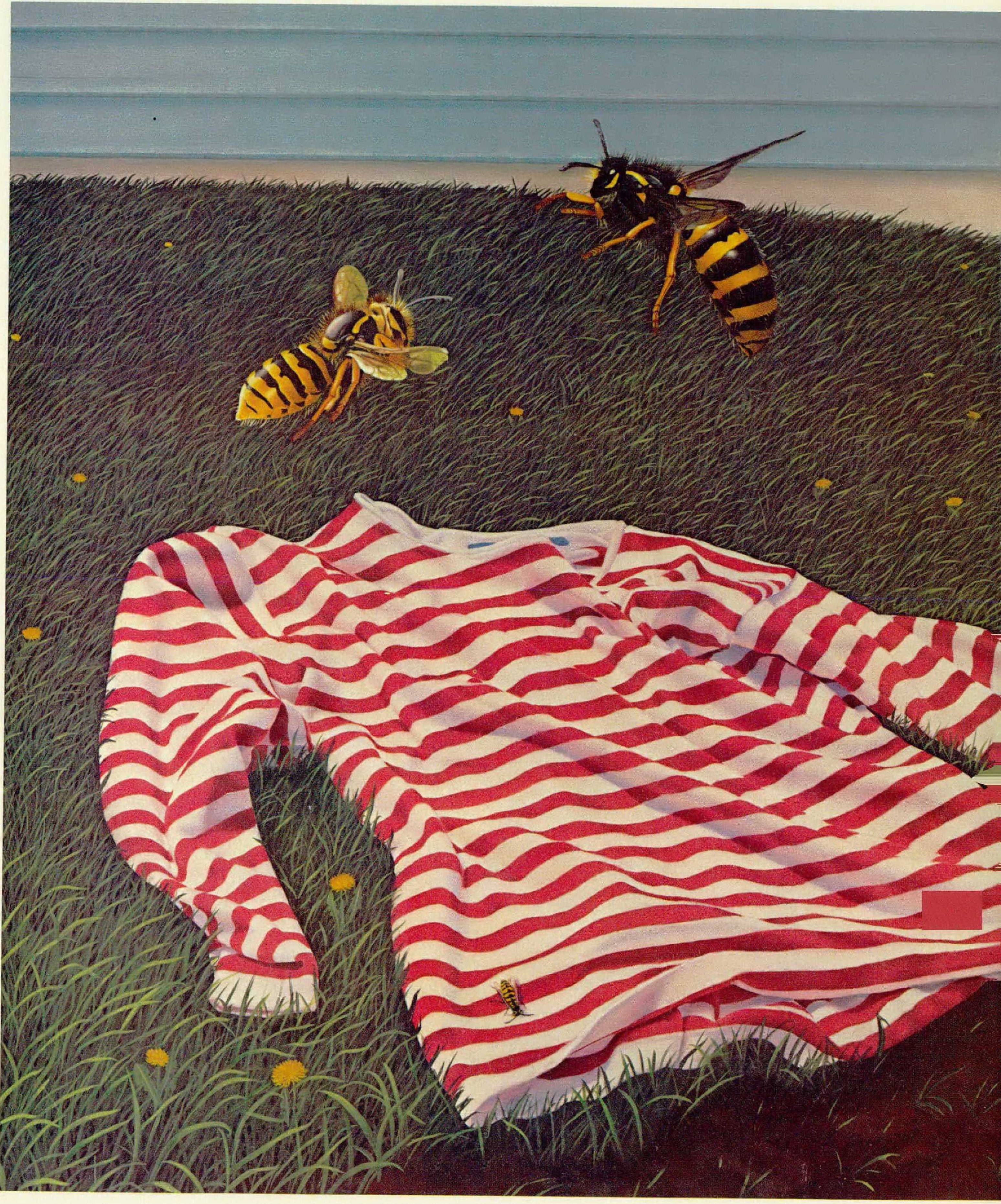
While we discussed the mystery, a bumblebee big enough to saddle came out of nowhere, fastened on to the board, staggered toward a hole, and heaved itself in. At the same time, another bumbler, looking like it was hauling itself around in a black-and-yellow sack, lurched from a hole and flew off.
NEXT MORNING I WAS IN AT THE OPENING OF Minute Man Hardware to consult with Bill, who would know. Bill had heard about something called carpenter bees when he lived in New Jersey, but he had never seen them with his own eyes and had never heard of them around here. He suggested that a beekeeper might know. He looked up Mahlon Neere.
Neere had never heard of carpenter bees. He was a honeybee man. He knew about carpenter ants.
“Friend, “ I said, “you can put your index finger in these holes. No ant is going to make a hole like that.”
“YOU betcha, “ Neere said. “I was just going to say, no ant is going to make a hole like that.”
I went back to Minute Man and bought the last bottle of a liquid so mean that the federal government said no more could be sold after the first of next month, except for export.
“What are you going to do?” Paula asked when she saw the bottle and the look on my face. She wouldn’t allow me to shoot squirrels within her hearing. The day we moved in she put out bird feeders. She bought traps made like cages so that I could carry mice to the dump and let them loose. She was a member of the Association tor the Preservation of Cape Cod, which issued pamphlets on the dangers of pesticides. So was I.
“Drown them,” I said.
“You’re going to poison them.”
“You betcha. They’re eating our house.”
“Bumblebees don’t sting.”
“You re not listening. They’re eating our house.”
I took an old shirttail out of the ragbag, and a scissors, and the dire stuff from Minute Man, and a throwaway pie plate to pour it in, and went outside. I cut the cloth into bacon-strip lengths, dipped the strips in the liquid, which stank of malevolence, and with a stick poked the rags into the holes.
After dinner I went out to see how the bee trap was working. The rag blockades were in place. The evening was serene.
I became aware of thrumming within the sealed space. With my awareness, the volume of sound increased. I imagined thousands of fluttering wings, and tiny voices petitioning me. I felt sympathy and guilt, but life is notorious for casting up rotten choices, and I didn’t know how I could have done it a better way. They had eaten their way in, they could eat their way out. The playing field was level.
While I indulged this honorable reverie one of the rags trembled. It was being manipulated. It was being pushed out. It was dislodged and fell to the ground, and a bee heaved itself to the lip of the hole and sprang off in apparent bonny health.
Good for you, I thought, when I got over my astonishment.
I watched another plug being shoved aside, and again one bee escaped.
“Paula!“ I hollered. “Come out here. You won’t believe this.”
By the next morning five cloth strips, stiffened in their dried maximum poison, lay on the ground. No bees were seen or heard.
I drilled the holes to a uniform size, cut dowels, and drove them home. I stained them to match the board.
Occasionally thereafter we saw what everybody called bumblebees, but we never again saw them act like carpenter bees, although friends said they were known in New Jersey; black varnished abdomens distinguished them from furry-beliied bumblebees. We never knew whether hundreds were entombed in the deck or whether all had flown to a more hospitable environment—or whether any more had ever been there.
That was my first encounter of that kind; it did not prepare me for the encounter with yellow-jacket wasps in the garden on the hill.
TWO STORIES HIGH ON THE WATER SIDE, AT ITS entrance the house was (and still is) a single floor with a tilted view that had been stripped of trees and skinned back a few degrees. Dirt sliced off the hill made a platform for the foundation.
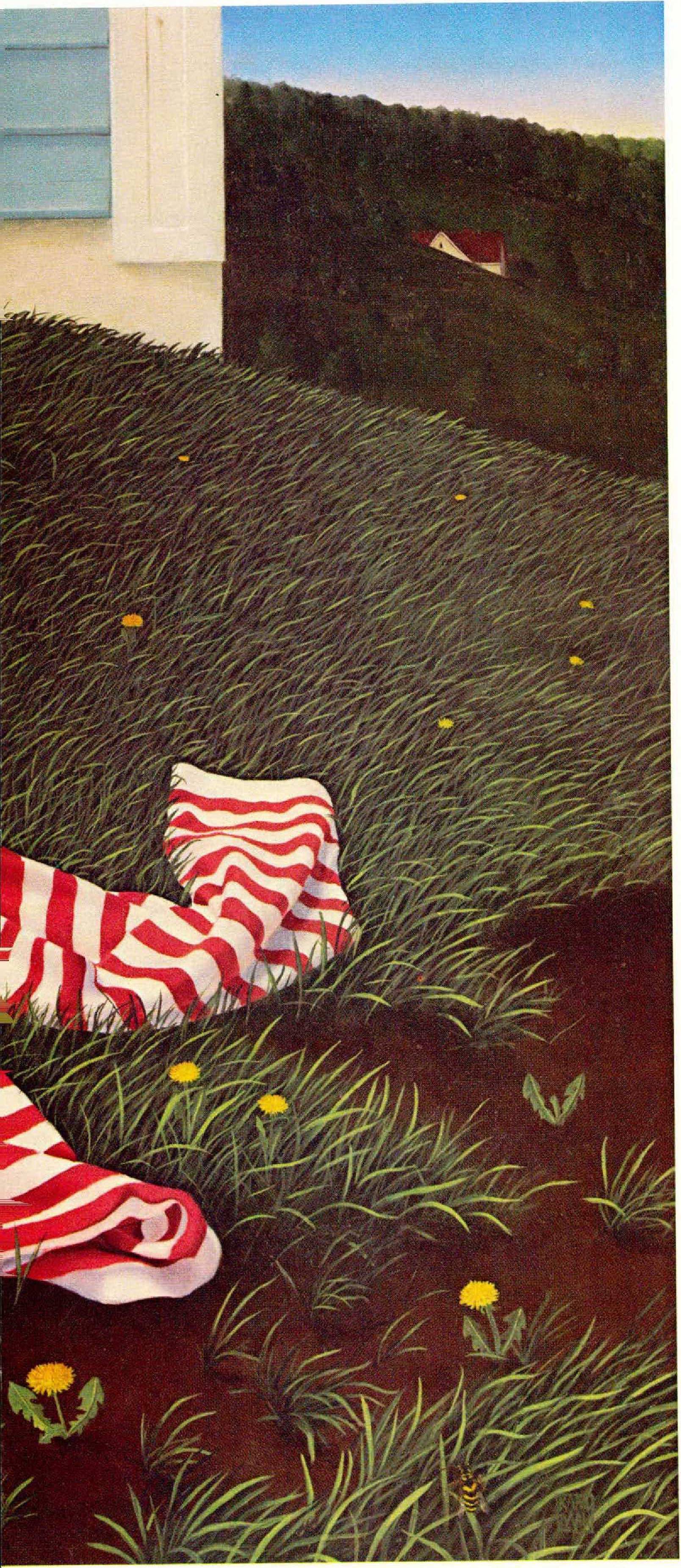
The land sloped so precipitously that the building inspector had said if we didn’t want a house full of waiter someday, I’d better lay up a stiff wall to divert storm runoff aside into the woods. Now, through clay and stony rubble that we envisioned would one day be a tapestry of plantings, a curving stair of railroad ties came down from the road, around the building inspector’s railroad-tie wall, to a terrace at the door. A more level right-of-way had been bulldozed across neighboring land to bring in the contractor’s equipment, but it was too rutty and rooty for the family car and the pickup. Hardening the road was a project for next spring. In the meantime we parked “upstairs,” on the county road, and Paula recited to herself what accidents to prepare against before she ventured to make the ascent with Ruth.
To hold a garden I chain-sawed logs from the trees that had been scalped from the hill and laid them randomly into the slope. Behind the logs I piled leaf rot and soil barrowed over from the side lots, and planted bayberry, rugosa roses, and young cedars from the shoreline, mosses from the woods, overgrown clumps from my father-in-law’s day-lily bed. Paula named the plants she wanted from the nursery and the catalogues: fire thorn, alyssum, artemisia, chrysanthemums, heather.
Straightening my back to rest from planting, I placed a foot on a boulder that had risen like an idol’s skull in the runoff of a heavy rain. I felt godlike myself, looking down the hillside to my wall and my redwood furniture on the terrace, my house weathering into the landscape. I breathed air of celestial purity. I thought I had been dealt a hand many others would have played worse.
There I was stung by a yellow-jacket wasp. I brushed it, felt the writhing fur justly impaled on its own anger.
Another buttoned on my ankle; another on my neck set off an internal alarm. I saw a dozen hover, guessed wildly that they must be in my hair, on my collar. I flailed as Lincoln’s apocryphal bee-fighting preacher might have, and slammed down the hill, insulting my father-inlaw’s lilies to their roots, took the wall at a jump, and brought a few with me into the house behind the banged door, hollering, “Get in a bedroom with the baby and don’t come out till I tell you!“ I slammed the bathroom door behind me and called out an explanation: “I may have brought some yellow jackets into the house. Stay put till I have a chance to check it out.“
I went into the shower with my clothes on, stripped, found two of them to squash, and threw my clothes out the window in case I’d missed a few. I opened the door carefully, put on a robe, and looked around.
“It’s okay to come out,” I said, feeling a little foolish, and chagrined that I had put my family in harm’s way. All that commotion for a couple of stings. “I wouldn’t have come in the house with them if I had thought.”
“Look at me,” Paula said. “Your face is swollen.”
“They didn’t sting me there. They got me on the arm and neck. And here.” I showed her rosettes on my ankle and arm, and where I supposed one was on my neck.
“Your face is swollen fat.”
I had been out in the sun ail afternoon. “It might be the sun.”
My fingers felt stuffed, my forehead stretched. I touched a finger to my now leathery forehead. I saw the tops of my cheeks. My eyes were heavy. I felt woozy.
“I think I’ll lie down,” I said.
“No, you won’t. You’ll get to Dr. Fettig as fast as you can, and if he isn’t in we’ll keep going to the MedCenter. Come on, Ruthy, we’re going for a ride with Daddy.”
In THAT WAY I LEARNED I WAS AMONG THE ELECTelect as are all who have peculiar vision, all who have extraordinary gifts not of their choosing: artists _and accountants, extrasensory perceivers, mystics, idiot savants, dowsers; elect as magnets are to find the poles and Spanish Bourbons to die from scratches. It I didn’t have handy the anti-venom kit Dr. fettig prescribed, I could be a goner.
I read up on yellow jackets. Their name is Vespula, species vulgaris, of the order Hymenoptera. They are, in a manner of speaking, carnivores, tempted by the dead meat of mice, insects, and, I feared, me. They are not without charm: inside their nests the young perk up like birds to get a malaxated ration. Best of all, they die within a year, all except the fertile queens.
They prefer ground nests, under logs, stones, and patches of moss, so I knew not to look for them in sultan hats hanging from branches or in mud flutes pasted under the eaves. Those housed hornets. I was wary of hornets, and took them out of play when I encountered them shopping in the flowers or walking on the windows, but the wasps that issued from the ground, illtempered, camouflaged in the low growth, were my mortal enemy.
Stalking their erratic flight at a cautious distance, I waited for one to disclose the home of many. They wandered the day like truant boys without purpose. One might walk around on a leaf, fly to a twig, and then bob awhile in the air, thinking of another idle way to kill time until he was expected home. They refused to show me where that home was.
I adjusted my habits to theirs. When I did my garden chores, I put on my Minute Man peaked cap, tucked my trousers into my shoes, and buttoned the sleeves and collar of my shirt. I reached into branchy places del-i-cately, kept an eye out when I used the hoe to scratch the roots of crabgrass or scarify the varnish of the drying rain. When they approached to look me over with carnivorous speculations, I stood quietly until their childish attention turned elsewhere.
Not until the summer was nearly over did I find them streaming in and out of a hole under a cap of moss. I had been at the spot a hundred times and not suspected the nest. I backed off. I got out the carpenter-bee elixir, saturated a rag, picked it up with the end of the hoe handle, and waited, holding the thready traffic in view until the sun settled and I judged they were bivouacked for the night.
I approached the arena with caution. I rammed the morbid flag into the hole. With the extended handle I prodded the cloth into a tighter bundle, rammed it again and again, and ran.
On the wall, ready to jump down and run into the house, I watched the rag through my binoculars. 1 had not got them all. A few latecomers, back from scaring eagles, puzzled at the barricade, muttered my name. In a frenzy the late ones tried to tear their way in to the others. It became too dark. I went inside.
In the morning no yellow jackets were around. I put a spade in the ground and turned up the nest. They lay in masses.
Next year they were back, born of other queens, not in the poisoned nest but never far. They entered ivy, did not reappear; left spoor in midair, dwindled into motes, vanished, reappeared on their truant rounds. I did not find a nest again. I became accustomed to living with them, although I was mindful of their imminence as I planted and weeded the slope into the tapestry the Garden Club asked to show on the Summer Caravan.
The terrace I defended as my own. When yellow jackets invited themselves to our barbecue to feast on roasted meat and pecan rolls, I swatted them with magazines, blasted them with aerosol, trapped them under pastry domes, in butterfly nets.
As time passed and I remained unstung, I treated them as familiars. Though I did not challenge them, I waved them off without concern; I named a fat one Mao Tse Sting and another for a cousin who sued his own sister.
The driveway on the right-of-way settled and hardened and arrived at a garage under a new wing of the house. It became a common lane for neighbors who ventured to build on the slope first assayed by me and my wife, Richard and Paula Sterko. An association was formed to pay for snowplowing and spring pothole-filling. Our neighbors’ dogs visited us. Richard Junior was born.
ONE SUMMER DAY RUTH, NOW VERGING ON BKing a young lady, in skinny jeans, mouth fenced with wires, ears strewn with ritual ornaments, as veiled as a begum behind hair astray, stepped out onto the terrace. She called something I did not hear clearly, and before I could ask, Come again? she decided to carry her question to me. As the stairs were too long around, she vaulted to a seat on top of the wall and came up the hill in a game of giant strides.
Stunned by the marvelous justice of her advance, which avoided every weed and seemed not to miss a catalogue number, I finally got out the word to make her watch where she put her feet. “No!”
“Mother isn’t home—” she said at the same time. She stopped. Daughters don’t come to fathers for nos.
I know Mother isn’t home. She went to the dentist and took Rick with her. Now, be careful where you walk. You’re standing on a heather.”
She saw my meaning and bent down to repair the damage—and they rose around her.
I saw them before she did. “Stay!” I ordered, as to a dog, while I got my wits together. I came down to within an arm’s reach and motioned for her not to move from her crouch. It might have been better to say Run! but I was committed to Stay! and I dreaded that I had made the wrong choice. She remained still, like statuary, and looked through a veil of hair for instruction. Fathers were for that.
I hollered, “Help! Help! Somebody! Help!” into the suburban universe and said quietly to her, “Don’t do anything to excite them. Breathe slowly. Move slowly. Try standing up very slowly. Fell me if you get a sting. It isn’t much—just a pinprick.” I hollered again, “Help! Help! Help!”
As she rose, pretending the stillness of landscape, they rose with her, issuing from the womb under the heather. I held out my hand to draw them, to be united with her where I had condemned her to stand. They veered from the current of my gesture.
“Sting,” she said. “Knee.”
“Hang in there. Let me know. If you get too many we’ll run for it. Try to wait them out.”
I called again for help. I had stood here on the head of a stone idol feeling like a god, and I knew now what a small thing it was to be one. Gods could do nothing about anything this energetic and immense. Gods decided that the game was Wasps & Girls and set both down on earth, but didn’t know any better than anyone else whether the play should be Stay! or Run!
I remembered with shame that I had not bothered to find out if Ruth had inherited my flawed chemistry. There was probably a test, and I hadn’t asked. I hadn’t gotten a new anti-venom kit when the date on the first one expired. I did not even know where it was—in the medicine cabinet? In the refrigerator? In the travel case from five years before, when we went to Williamsburg? I could reach out to her—to do nothing. I could not change places, mightily as I wished to. I offered my hand again to the wasps. They rejected me.
I thought that I had never loved anyone—not even Paula, not even this child—as I loved her at this moment.
I had given her life and put her in the way of death. I did not pray. I was not a praying man. I could imagine a God who had made the rules but not one who would change them: The game I knew to play was Patience.
“Leg,” she said. She sniffled and tossed her head to shake the veil of hair from her eye.
“Don’t move. Stick it out. Let them lose interest and scatter.” If they would be so accommodating.
My duty was plain enough: to run, to get to a phone and call the Rescue Squad, call the fire department— they knew how to inch boys out of chimneys, they must know about wasps. I knew I should call Dr. Fettig to bring the newest science. But I could not leave her. Heroes like me, of the second class, are called up by a neural recollection: admiration for some kinds of survivors is allayed. I hollered again.
“Hey, Sterko, what’s the problem?”
The voice came from behind, from the hilltop road. Nate Harris, who worked for the telephone company and had one of the new houses, had heard me. Nate couldn’t see anything wrong, just Sterko and his girl standing and looking at each other.
“Nate—get the Rescue Squad. We’re trapped by yellow jackets. We can’t move, Tell them we’re allergic. Bring wasp anti-venom. She has already been stung. It can be fatal if they don’t get here fast. Fast, Nate.“
“Roger. I’ll get right back to you.”The plaid shirt and the long face, a vase for the stiff shock of black hair, disappeared.
I reassured her. “Hang in there. They’ll be here soon.”
I put a number on it, as if I knew. “A couple of minutes.”
Wasps crawled on her. They sewed her in with insane needlework. I coached her. “You don’t want to excite them. Stay steady. I don’t know if you’re allergic. I don’t think you are. Your face isn’t swollen. It you were allergic your face would be swollen.”
She said, through unmoving lips, “You’re allergic. Get away. ”
“That’s okay. Be quiet.”
Vincent and Carole Rorrock came around the garage to the terrace. “Was that you calling for help?”
I told them what was happening. Vincent looked along the wall and went for the hose coiled on its drum at the faucet. “What if I turn a hose on them? It might drive them off.”
“I don’t know. It might excite them. I don’t want to excite them.”
“Just a light mist maybe.”
“Don’t you do anything with that hose,”Carole said. “You don’t know. If it was me, I’d turn it on as hard as I could if I wanted to drive them off.“
Heavy, light—it was vocabulary. Problems at a distance—war. peace, poverty, taxes, the sins of movie stars, the promises of legislators—yielded to the vocabulary of people standing around talking. My kind ot question was. Was George Washington a patriot or the tool of agrarian interests? Failures of vocabulary had no consequence, seldom even chagrin after error was detected. Ruth and wasps were in front of me. Error had consequences. “Let’s wait for the Rescue Squad,”I said to Rorrock; and to her, “How are you doing, kid?”
“Scared,” she said, and looked it. “Four stings.
“It’s okay to be scared. Hang in there. It won’t be long.”
“Right shoulder.”
I could expect her to take only so much. Then I would have to say Run for it! and get her into the house, no matter what. I low much was only so much?
A wild loopy signal burst in nearby and climbed the countv road, warning everybody who survived the heart attack to get out of the way. It was too soon for the skirl of the rescue ambulance; only on a still night could it be heard starting from the fire department, at the highway end of town. This would be a police cruiser that had been intercepted and told to get to lam Road and see what was going on.
Back on the top of the hill Harris had his arm up to semaphore the cruiser. “Here comes a cop car. Squad’s on the way.” The cruiser hunted along the berm for the best place to pull in. The officer, a young man I didn’t recognize, probably a summer man, got out with a leashed telephone in hand. He knew he was extremely important. Harris said, “They’re trapped by yellow jackets, officer. I phoned the Rescue Squad.”
The information was too trivial to be acknowledged. The officer spoke confidentially to headquarters. The other side responded in manic squawks torn from the speaker’s throat. When the conversation ended, the officer folded his arms, the phone still in his hand, crossed his legs, leaned against the car door, and looked at us without comment.
From the direction of Head of Bay came the first joyful noise of the Rescue Squad, and a second baritone siren.
I turned to say it would really be two minutes. Preposterously, she was grinning, showing her ornamented teeth. She blurted thinly, so as not to outrage the wasps, “All I wanted was to find out if you knew where I could find some stamps.”
Because the notion of stamps growing in the garden was so absurd, her grin expanded to laughter—not without tears, but at its core laughter, the shaking, unmanageable laughter of a child.
My face had no choice but to mimic hers mirthlessly.
THE AMBULANCE DREW UP BEHIND THE CRUISer. The pumper went on to the hydrant. The skirl wound down. In train were cars and pickups come for fire, blood, or battered metal wrapped around a telephone pole. All they found was a man and a girl down on the hillside looking at each other. Brice Cahill, lead man of the squad, rolled his stubby body out. He asked in his ordinary nasal whine of disbelief, “What have you got? Bees?”
“Yellow jackets. Have you got a venom kit?”
“We do. First we have to get you out of there. You allergic?”
“I am. I don’t know about her. She’s been stung. I haven’t.“ It was a reproach. “How do you handle these things?”
“Mahlon Neere’s coming with smoke if you can wait.” It set her off again. Smoke! She saw herself as Joan of Arc. She imprisoned laughter as best she could. Cahill saw that she shook.
You’ll be all right, little girl. We’re going to have you out of there in a cat’s wink.” Cat’s wink! Hilarious.
“The little girl’s been stung?”
“Five or six times.”
“How are you doing, little girl?”
“Fine.”
“What’s her name?”
“Ruth.”
“Ruthy, how would it be if we brought down a fire hose and blew the bees away while we helped vou get up to the ambulance?” Rorrock wasn’t dumb. Neither was hiswife. Only Dick Sterko was dumb. “Do you think you can handle that, Ruthy?”
“Yes.”
Cahill called down the road. “All right with the hose. Let’s have it here. Deevers“ —his aide—“you go down around the back of these good people so when the water hits, you can push them up. We don’t want to knock them down.”
Two firemen hauling a hose trashed the evergreen border and laid heavily booted feet in my garden. I winced but in the scale of events knew I should not guide them to a better stand. Cahill instructed them. “Open the spray up to about a three-foot circle and hit it right at them. You ready down there?”
They threw the water high till they got the diameter right, and then hit us with it in discrete fat bullets of salvation. I grabbed her arm as we were shoved from behind and pushed to the top, where other hands reached down to bring us the last yard. She laughed again and again as promptings of the bizarre struck her—these people rubbernecking, the cruiser’s sapphire eyes batting at her, the policeman’s stagy impassivity amid chaos, wasps rejecting her father’s offered hand, stamps growing in the garden. “There weren’t—there weren’t any in the desk.” It was too comical.
“It’ll sting a little bit,” Cahill said, as the medic pinched her arm for the needle.
Drenched, erect, shaking with laughter, she said, “Just what I need.” She fainted to the ground.
EVERY FAMILY HAS A STORY. A SMALL DEGREE this way, it’s an anecdote, a small degree another way and it may be recalled with profound sadness. I’m a lucky man to have only an anecdote.
Many times I’ve sat on the terrace and replayed the scene. It I had it to do again, I would like to know whether Stay! was better than Run! I am sure you know, because you weren’t there.
I think about her laughter. Yellow jackets are a fact of nature. Against them certain creative measures are taken, as an artist takes measures to work a stone. The object is carved or killed, according to the need. Laughter, on the other hand, predisposes nothing; and yet, in the end, for me it comes down to her laughter. At the moment my face benignly—vacuously, perhaps—mimics hers, I experience the purest joy.
Once when she brought the grandchildren to visit, we sat out here and she asked how I was getting along with the wasps. I have never been stung again. I said, “I don’t fool myself, though. They are my mortal enemy and mav get me yet. But at one level I have”—there is not always a suitable word—“a fondness for them. I don’t know whom or what but yellow jackets to thank for your laughter.” It wasn’t quite dry enough for my taste, and I never said it again, till now.