The Frank Review Interviews Interviews Hugh Frank [No Relation]
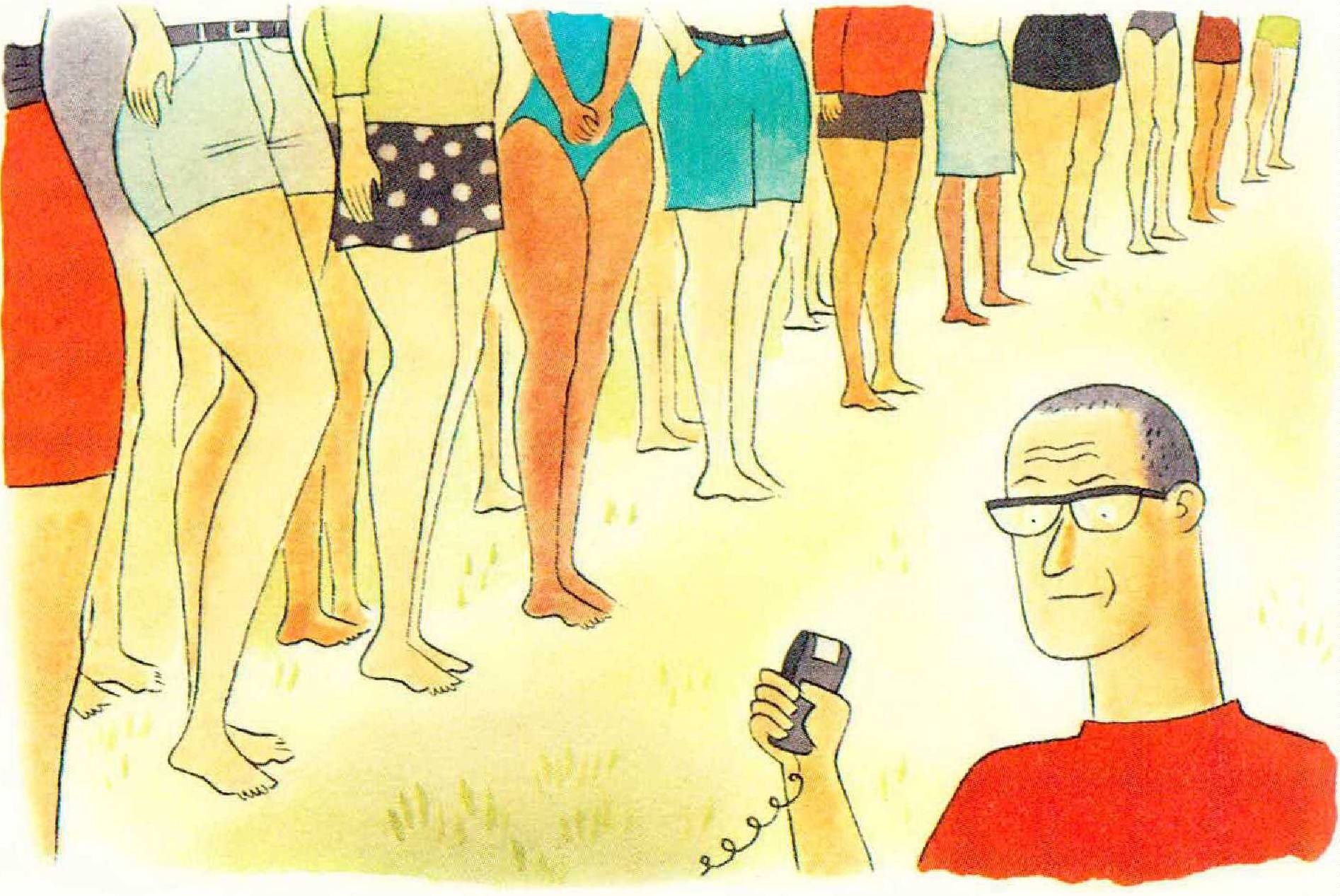
HUGH FRANK LIVES with his second wife outside Savannah, Georgia, in a remodeled Colonial. In their connecting living room and gallery is a massive metal sculpture by their friend Hughes Jimmy; opposite, tall windows open to rich magnolias. Asked if he placed his paintings leaning against the light-gray wall so that they might become three-dimensional objects, Frank says, “No; I haven’t bought hooks.” His studio is thirty minutes into the country. He likes the distance. He spoke more than expected. He considers himself unusual in this respect. “Sculptors,” he says, “are illiterate and unintelligible.” Hugh Frank is neither. His attempt to shave a square mile of women’s legs near Hankville, Utah, captured the nation’s attention, and while some may view it as overhyped media event or bad conceptual art, Frank disagrees: “I was able to tap into some deep-rooted problems in America.” Because Frank shuns tape recorders, two court reporters recorded our interview about what Time has called “the art spectacle of the decade.”
The Frank Review Interviews: What was the birth of the event?
Hugh Frank: One night I said to Peggy [Peggy Frank Peggy, the personality host and Frank’s first wife], “You should be careful shaving your armpits, which have more hairs and nerves per square inch than your legs.”And then, “Square inch. Square foot, yard. Acre. Square mile. A square mile of leg hair.” It struck me.
TFRI: And that was it?
HF: Pretty much.
TFRI: You have done welding on Hughes Jimmy’s Large Metal Objects of Art, yet you don’t do metal art yourself. Why?
HF: Both Hughes and I went to Virginia Commonwealth Sculpting School, but he could never weld, so he had to hire me. My own art involves epoxying junk, all textures, into slabs and then carving.
TFRI: Both adding and subtracting.
HF: Yes. The event also does that as I add women and subtract hair. Now all that hair is epoxied to thousands of boot heels.
TFRI: Interesting process. Did you consider waxing?
HF: No. I don’t care what they say, waxing is just too painful.
TFRI: Did you have difficulty selling the idea?
HF: Oh, no, not at all, no. I thought, “Corporate sponsorship. Shaving companies.”Furious bidding. I took Remington because Victor Kiam is just as patriotic as he seems on TV. It added up. The women were to be placed in an outline of the United States, and, of course, I’d start shaving at Plymouth. Later I thought of the Mole and Thomas photographs. Imagine, in 1918, twenty-five thousand soldiers forming The Human Liberty Bell at Camp Dix. No McDonald’s blimp, either.
TFRI: The networks made it quite a show, didn’t they?
HF: ZZ Top, the rock band, really put on a good show, even though they refused Schick and HBO’s million to shave those beautiful beards. Frank Beard, the band member without one, and I fought for a live audience, but all we got were PortaDressers for the models and a small village for the media.
TFRI: All this reminds me of Michael Heizer’s earth sculptures.
HF: Of course. As he bulldozes, he’s very into process. The locals aren’t as interested in his dirt as they are in my women.
TFRI: Your projects develop for film more than his.
HF: I find excitement in movement, in the dicker of film. I want the inherent danger of action, whirring blade to skin. No room for error. No lucky accidents.
TFRI: Your razor was electric. They couldn’t get cut.
HF: I’m speaking abstractly. And razor burn is always possible.
TFRI: That’s true. How’s your musical, Legs: A True Story, going?
HF: I love Broadway. It’s good to see Bob Goulet make such a comeback playing me. Mom’s a big fan, and it reminded her of Pop.
TFRI: I thought he was a doctor.
HF: He danced marathons before he was Hollywood’s chiropodist. His only regret was not working on Elmo Lincoln, the first Tarzan, in his prime. Legendary feet. The only film to do them justice was Griffith’s Intolerance. He played “The Mighty Man of Valor.”
TFRI: Interesting. Have you thought of writing a book?
HF: No, I only write about industrial machinery, and then I translate it into German. That clears my mind. If I write anything else, I start to talk too much, like my writer friends. We take them to operas or tennis. Even then I sometimes see their lips move. As Joan Didion says, writers are always selling somebody out.
TFRI: Are tape recorders? [Pause] Critics notice an art-versus-life dialectic in your work. Is that what you see?
HF: No. Different dialectics. First I see hair as spirit separate from flesh, but reversing Augustine. Then I echo Smithson in his “Science Fiction Fiction and the Art of the Absolute Nothing.”After he made Spiral Jetty, I hear he found spiral jetties everywhere: fish hooks, helicopter propellers . . .
TFRI: Van Gogh’s ear.
HF: Van Gogh’s ear, yes. That obsession appears in Warhol’s films: Bianca Jagger shaves her armpit. It’s posed, and yet, it doesn’t seem that posed. [Staring] There’s George Segal’s Woman Shaving Her Leg and Alice Listening to Her Poetry and Music . . .
TFRI: She listens to a tape recorder. We keep circling them.
HF: Okay, I’ll explain. If you record my voice, you take me, like the peoples who think cameras take souls. [His baritone hints of raspiness. He quit smoking last year.] Peggy had to speak to the press. That’s how she met that publicist Sam Peggy, whom she later married. Actually it worked out quite well. [Sam] Peggy and I were able to work out a deal with People to do a spread on our [Peggy and Hugh Frank’s] unhappy marriage, which was quite similar to the one they did on the happy marriage of Connie Chung and Maury Povich.
TFRI: I see. What function do drawings have in your art?
HF: They went on T-shirts. I needed a confidence-builder after the collapse.
TFRI: You didn’t expect that, did you? HF: No, I thought the shaving project would work like a Busby Berkeley film. Smooth. Instead OSHA threatened to shut me down, and then the women organized. I was on only the eighty-seventh woman, too, and I was so involved I didn’t notice that women were stealing buses . . .
TFRI: That truly is a great photograph on the cover of Newsweek, when you realized they were leaving. Your expression is hard to describe as anything but despair and disbelief.
HF: Despair and disbelief with a razor. Then Peggy ran off with Peggy. They got a good career out of it. didn’t they? Thank God for Stella.
TFRI: Stella Frank, your present wife, was the eighty-seventh woman, the last one you shaved.
HF: Yes. It must have been synchronicity. The problems started when we offered the Utah Jazz basketball team too much money. Even though Frank Layden, the team president and former coach, said no, the women—the grandmothers, the members of the tabernacle choir, the stock brokers—all became enraged. I tried to explain that those players had so much leg—Are you okay? [Steno 2 starts coughing. Frank gets her water.] Stella and I haven’t talked much about it, but in Interview she says the girls wanted to shave Mark Eaton.
TFRI: Your work seems to criticize the American dream.
HF: Well, I’m the type of guy, if I see Ernie Borgnine on TV holding a goat, I’ll watch the whole show. I don’t criticize. I point things out. I glorify useless rituals, like that woman who wears an evening gown made of thirty pounds of bologna. But then, one man has a grand theory connecting Playboys airbrushed pubic hair, the Life covers of my event and the bra’s hundredth anniversary, and Lyndon LaRouche. This guy, who happens to be a minister, poses as an agent for the hosiery companies, advertises for models, and then films them posing. He’s survived on that.
TFRI: And what about you? What now?
HF: I’m moving to Hawaii. There’s a place between the places owned by the poet Bill Merwin and Jim Nabors that I think I’ll enjoy.