The Man With All the Answers
The economist Lester Thurow, the dean of MIT’s Sloan School of Management, is on a crusade to rescue American capitalism from itself
BY CHARLES C. MANN
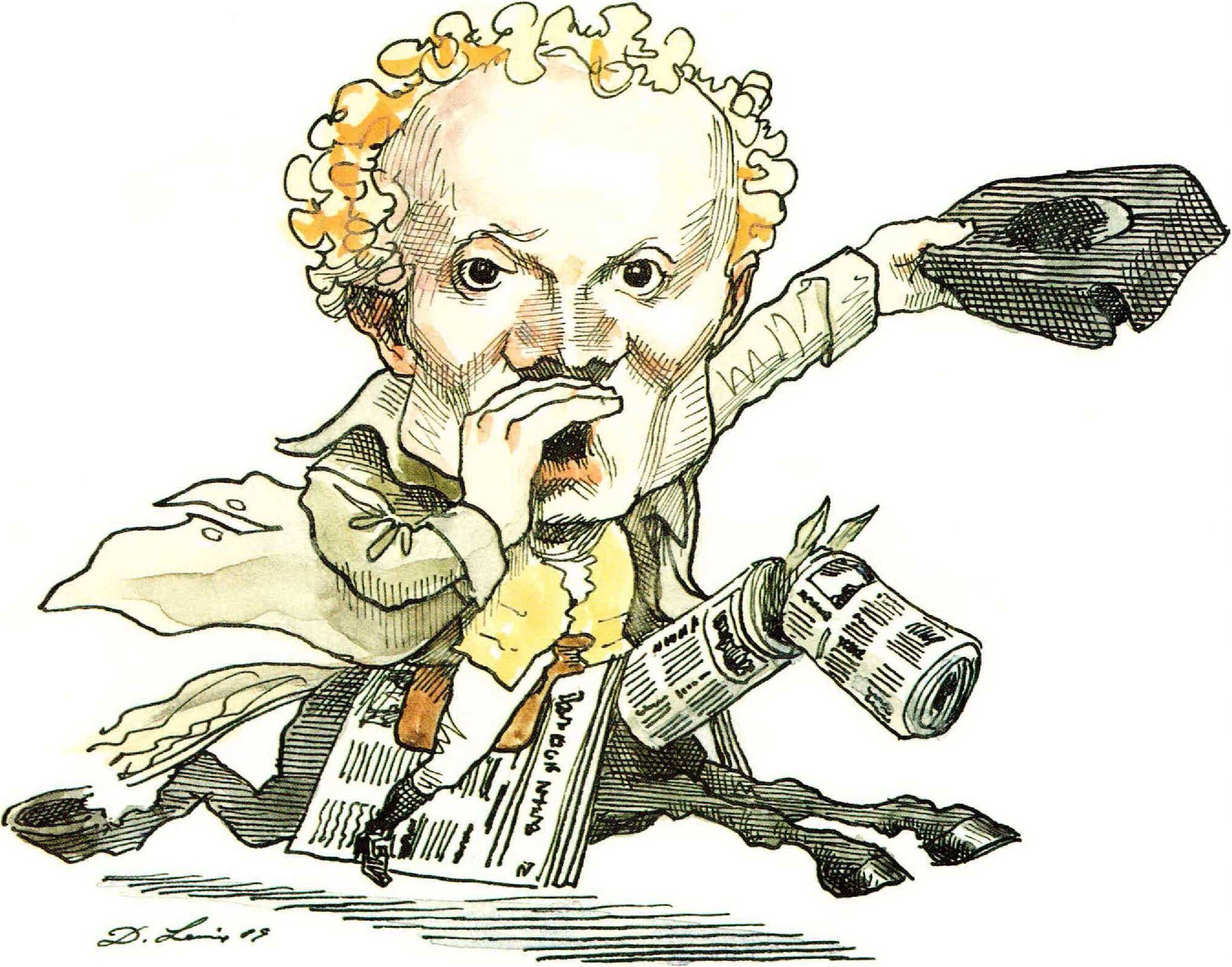
LESTER THUROW LIKES TO TELL A STORY about a big factory he saw a while ago in South Korea. The factory is owned by Daewoo, a Korean corporation that makes cars, ships, computers, and many other things. Most Americans, Thurow suspects, think that Korea looks like M*A*S*H: rickshaws and grass huts. The Daewoo factory did not look like M*A*S*H. Indeed, it didn’t look like the common conception of a factory. The most modern of its type in the world, the plant was not dirty, hot, or smelly; nor was it filled with grease monkeys in sweaty T-shirts. Instead, the floors gleamed like marble, the place was almost quiet, and the workers were educated folk in crisp laboratory coats—running Daewoo’s fleet of fancy robots is no job for unskilled workers.
At this point in his narration Thurow tells people that the Daewoo factory uses German and Japanese technology and is run entirely by Koreans. “The only American in the place that day,” he says, “was me, the tourist.”
Here he pauses. Inevitably somebody asks, “What did they make at this place?”
“Pontiac LeMans,”Thurow says. “Sedans.”
Establishment or Oligarchy?
IT IS EIGHT O’CLOCK IN THE EVENING AT AN OFFIcers’ club on a military base in northern Virginia. Outside it is raining buckets; inside, a crowd of damp MIT alumni is about to hear a man make an after-dinner speech. The speaker has wiry red hair, graying elegantly at the temples, and the pale, almost papery skin that often goes with red hair. His head is a bit large for his body; his eyes are the kind of blue that people use the word “icy” to describe. “Hello,” he says. “I’m Lester Thurow.”
Chances are pretty good that this introduction is unnecessary. Lester Thurow is probably the most famous economist in America who has not been the host of a PBS television series. In addition to visiting factories all over the world, Thurow has spent the past two decades sitting on blue-ribbon committees, giving interviews to electronic and print media, and writing twelve books (one of which, The Zero-Sum Society, was a best seller), scores of articles (a listing of which fills twenty-five single-spaced pages in his résumé), and hundreds of newspaper columns (he is featured regularly in newspapers from Los Angeles to Milan). Many of these newspaper columns, articles, books, interviews, blue-ribbon committees, and speeches have created a certain controversy, for Thurow has tried to use them to—well, to make America wake up and smell the coffee. Tonight’s speech to the MITalumni is part of the crusade.
Thurow begins, as he often does, with some numbers. The 1988 trade deficit was $127.2 billion, the budget deficit $145.8 billion; the world’s biggest debtor, Uncle Sam owes foreigners $532.5 billion—half a trillion dollars. The figures are gigantic, as unimaginable as the population of the earth or the distance to the sun; Thurow calls them out in a hushed, dramatic voice, and his audience reacts with fitting shock. At one table a woman actually gasps.
Although the sums make an impact, it seems fair to say that few people know exactly what these numbers mean, or what Thurow means by them. (In fact, the woman who gasped later whispers, “I never understand this stuff ” to her companion, who shrugs to indicate his own bafflement.) The trade and budget deficits today are what the price of oil was in the 1970s—an index of American anxiety. Newscasters compare the current deficits with those of last month, or last year, and people infer from the ups and downs how bad to feel at a given time. When the numbers are as big as Thurow makes them sound, you are supposed to know that the country has a million problems.
The evening is not, however, a session in breast-beating. Thurow is an optimist; America may have a million problems, but Thurow has a million answers. He smiles as they leap from his head—his hair seems to stand on end with them, and one’s hand aches from writing them down. Indeed, that night—and in the lectures, panel discussions, and interviews he will give over the next few months—Thurow suggests, with varying degrees of conviction, that people who own more than 20 percent of a company should be forced to give a day’s notice before selling their stock; that people should be paid to live near airports, waste dumps, and nuclear power plants; that antitrust laws should be eliminated, except for rules about price-gouging; that Brazil should charge the rest of the hemisphere for the oxygen made by its rain forest; that if the Common Market turns Europe into a single closed trade bloc in 1992, the United States may end up forming another one with Korea, Taiwan, and Singapore, leaving Japan in the cold; that stockholders should have full voting rights only after owning their shares for five years; that outlawing handguns is a waste of time; that Congress should prohibit home-equity loans; that Congress should pass a $1.50-a-gallon tax on gasoline; that Congress should set up a stiff national exam to determine which high school seniors will go to college, and that students who fail this exam should nor be allowed to go to college; that teachers and principals with many students who pass this exam should be rewarded with cash bonuses (“Hey, why not trips to Europe?”); that minimum payments on credit cards should be regulated upward; that banks should be encouraged to sit on the boards of the companies they lend money to (they can’t now); that the interest corporations pay on bonds should be taxed (it isn’t now); that insurance companies should manage the corporations in which they own stock (they don’t now).
He is addressing members of the Washington, D.C., alumni association of the Massachusetts Institute of Technology, he says that night, for two reasons: because they are from MIT, where he is dean of the Alfred P. Sloan School of Management, and because they are representative of the establishment—or, at least, he hopes they are. (That’s why they went to MIT, right?) “What do I mean by the establishment?” he asks. “An establishment is a bunch of people with a lot of money who know each other and who run the country. Now, an oligarchy is also a bunch of people with a lot of money who know each other and who run the country.”The difference, he says, is that an establishment recognizes that its long-term interests may require it now and then to take smaller profits in the present. The United States had an establishment in the immediately postwar era, when the nation’s leaders persuaded the reluctant American people to spend billions on the Marshall Plan. The United States had an oligarchy in the 1920s, when the ruling class in its exuberant greed let the economy spin out of control.
“The question is, do we have an establishment now, or do we have an oligarchy? Are you”—a challenging sweep of the hand to the well-dressed, still-damp Washington executives—“an establishment, or are you an oligarchy?
“If America is to prosper in the future, it has to change now. An establishment will help that change occur. An oligarchy will pull the country down with it.”
If the elite does not wake up, Thu row says, the longterm economic future of the country will be at risk. The United States, he believes, is in danger of changing from a relatively rich nation to a relatively poor one; we are on the road trod before us by England, and by Argentina. Disaster can be forestalled if the public is roused to action now, when the evidence of trouble is limited; if we wait a decade or two, the house will fall in, and the task of reconstruction will be wrenching. That is why he is ringing the bell tonight.
Pop Quiz No. 1: Is 1990 Like 1914?
ECONOMICS TEACHERS OFTEN PROCEED BY Giving hypothetical examples and asking students questions designed to elicit conclusions appropriate to the lessons the teachers want to impart. In this spirit, imagine a country that owes a sum equal to a fifth of its gross national product—a country that is the world’s biggest debtor, and has been for more than thirty years. A country with its chemical, communications, and transportation industries mostly in foreign hands. A country with a nagging trade deficit. A country with a rocky history of economic ups and downs. A country that foreigners with stronger currencies are buying up at an ever-increasing rate.
Question: Wi11 future generations regard that country as one in which the solid, old-fashioned virtues of thrift and sound investment prevailed?
Answer: Yes. The country described is the United States in 1914. That year the United States owed more than $7 billion to foreigners. The sum seems laughably small now, but in 1914 a billion dollars was a billion dollars, an eye-popping sum in a nation where the output of goods and services was only $36 billion.
Such debt provoked outrage, especially at the British, our biggest creditors, who some Americans thought were winning back through finance what they had lost in war. “It is to this brute of greed and cruelty, this merciless hog, this devilfish from over the sea, that we are surrendering our families,” cried one Kansas populist. “Forbid it, Heaven! Is there no voice, human or divine, that can awaken the American people to a sense of their danger?”
Question: Were these people wrong?
Answer: Apparently.
Question: Why were they wrong?
Answer: Because the simple existence of a foreign debt means nothing. Reduced to its basics, America’s total foreign debt is the difference between what foreigners owe Americans and what we owe foreigners. Germans buying U.S. Treasury bonds, Saudi Arabians depositing dollars in New York banks, Japanese buying ranches in Montana—all are dumped on the debt side of the ledger, because all involve a promise by people in this country to pay something in the future to people in other countries. The exact pathways of such transactions are often complicated, but they always end up with foreigners providing Americans with something of value—often money—and Americans giving foreigners IOUs in return. When Germans buy Treasury bonds, the U.S. government borrows their money, and promises to repay it with interest; when Saudis deposit money, American banks are borrowing it from them, and have to return that money with interest too. (Real estate counts as a debt for bookkeeping reasons—when the Japanese buy a ranch, they can’t take it home with them, and in some sense this country therefore still owes them the ranch.) Inevitably, such debts have to be repaid. A foreigner with a hundred-dollar IOU has a lien on a hundred dollars’ worth of something from the United States.
There is nothing wrong with such liens per se. As the economic historian Mira Wilkins has shown in her elaborately detailed History of Foreign Investment in the United States to 1914, most of what we borrowed from foreigners at the turn of the century was used to build the American railway system. This lowered the cost of transportation and gave American companies access to bigger markets. That in turn helped American industry grow, which increased the gross national product enough to make paying back the debt fairly painless. On balance, Wilkins argues, the United States was better off for getting into hock. We needed the money from foreign nations to build up our own country.
Question: Is 1990 like 1914? That is, have we accumulated a huge foreign debt because we needed money from foreign nations to make an investment in the future prosperity of the country?
To pose the question, as Thurow likes to say, is to answer it.
Montana Boy
LESTER THUROW WAS BORN ON MAY 7, 1938, IN LIvingston, Montana. Nowadays Livingston is mildly chic; actors and writers have moved to the Paradise Valley, south of town, bringing with them tourists, real-estate promoters, and trendspotting journalists. Livingston was a small Montana town at a time when the definition of a small Montana town was two bars within a mile of each other; a favorite local pastime was telling jokes about people from North Dakota. (Hear about the Montanan who moved to North Dakota? He raised the average IQ in both states.) Thurow’s father was a Methodist minister; his mother taught high school math. The Methodist church moved its ministers from parish to parish every few years, and so Thurow spent his childhood in a succession of rectories in rural Montana. “In that kind of Montana town,”he says, “the people who had gone to college tended to be the minister, the lawyer, the doctor, and the schoolteacher.” So Thurow’s family had two of the four.
Thurow, as the preacher’s kid, was a sissy until proved otherwise. He learned to be quick of foot and tongue. (Hear about the North Dakota coyote that got caught in a trap? It chewed off three of its legs before it got free.) He spent much of his time outdoors, hiking and fishing. As a teenager, he moved with his family to Anaconda, a small city almost wholly owned by the now defunct Anaconda Copper Mining Company. “The company was interested in having good science education,” Thurow says, “so that some of these people would go off and become mining engineers.” Thurow did not want to become a mining engineer, but Anaconda gave him an education anyway. As a result he was reasonably well prepared when he entered Williams College, in 1956.
People today describe the 1950s as a time when students minded their own business and did not wear complicated haircuts. Thurow, however, recalls his college days somewhat differently. The dorm rooms were thick with debate about civil rights, space, and the Soviet Union. “I don’t think it’s an old man’s memory, but I honestly don’t remember a single conversation at Williams about getting a good job to make a lot of money.”
He wanted to change the world for the better. He also wanted a profession that he could carry in his back pocket—that would let him be independent of institutions. One of the teachers at Williams that Thurow admired was Kermit Gordon, who later became the head of The Brookings Institution, an influential think tank. Wishing to help society improve the lot of the citizenry, Thurow quite naturally followed Gordon into economics. More precisely, he followed him into macroeconomics, the study of whole economic systems, as opposed to microeconomics, the study of small-scale economic behavior.
I hurow did well at Williams, becoming a Rhodes scholar; his Ph.D., from Harvard, was granted in 1964. His first job was as a staff economist for the Council of Economic Advisers, one of whose members was Gordon. Thurow had a pleasant image of himself yo-yoing up and down the Boston-Washington corridor, going from academia to government and from government to academia, gaining in prestige with every cycle.
In retrospect, it was a glorious time to be a macroeconomist. The United States had emerged from the Second World War with the strongest economy in the world. According to some estimates, as much as 40 percent of the world’s output was made between the Rio Grande and the Canadian border. The country simply had no competition; the rest of the developed world was still picking through the rubble. (“For thirty-five years we had effortless superiority,”Thurow says. “Graciously, we’d talk about allowing Japan to get a start in a particular industry.”) Yet despite these enormous advantages the nation spent much of the Eisenhower Administration staggering from one recession to another. To economists, the reason for this was obvious: Eisenhower didn’t believe in economists. In 1961 John Kennedy imported Walter Heller and a load of other smart Ph.D.s to Washington. In keeping with their advice, taxes were cut. The country went into boom mode, and Heller became a national hero.
The applause ended with Vietnam. Lyndon Johnson wanted to fight the war but believed the country would not be willing to pay for it with new taxes. Thurow says, “Gardner Ackley, who was chairman of the Council of Economic Advisers, actually went to the President and said, ‘Mr. President, you’re making a mistake.’ Basically, what Johnson evidently said was, ‘Well, you’re probably right. I’m making an economic mistake, but politically I’m not making a mistake.’” The President’s decision, Thurow believes, was catastrophic. “Fouling up the economy wasn’t done by accident,” he says. “It was done deliberately, with everybody’s eyes wide open.”
Volumes have been devoted to what happened to the country as a result of Johnson’s choice. After 1965 Republicans won five out of six presidential elections. Among the many consequences of this lock on the White House was the derailing of Thurow ‘s commuter train between the Beltway and the university. He became a professor at MIT in 1968 and has remained there ever since, churning out interviews, articles, and books, each and every one an attempt to move the world into a slightly better orbit.
Never a major contributor to refereed scholarly journals, Thurow’s flood of popular and semipopular writing has inevitably raised what he calls “the substance question.” (“Lester Thurow?” a prominent microeconomist asks. “You mean ‘Less Than Thorough’? He’s just proof that you don’t need a license to practice this profession.”) Perhaps in reaction, Thurow describes himself as an “economics educator”—a public intellectual who specializes in economics. A man of action rather than a doodler with equations, he rides on newspapers and magazines to America’s homes, yelling out his warning in orthodox Paul Revere fashion.
His audiences these days are receptive. No surprise: A distinctly contemporary American shiver arises from the sudden discovery that nothing on the shelves in a store bears a “Made in America” sticker. Or from learning that Japanese tourists are a preferred target for New York muggers, because they have more money than Americans—this in a city full of investment bankers! Or from hearing for the first time an automobile mechanic accustomed to BMWs growl, “Whaddya expect from a piece of Detroit junk?” Or from moving to Spain, as Thurow’s family did briefly three years ago (“My wife wants our kids to be bilingual”), and having teachers assume that his two children would be behind in mathematics because they went to American schools. Or from hearing that Rockefeller Center has been bought by Mitsubishi, although, truth to tell, Thurow and most economists believe that the “buy-out” of America has been greatly exaggerated. Foreigners may own a famous building or two, but the plain fact is that the vast majority of New York City is still owned by Americans.
“The Japanese aren’t buying America,” Thurow says. “We’re selling it! We’re consuming a hundred billion a year more than we produce. They have to buy some of America with the money—what else can they do with it all?”
Pop Quiz No. 2: What Is the Problem?
ECONOMICS TEACHERS OFTEN ASK STUDENTS TO test ideas by looking at real-world examples. In this spirit, examine the familiar notion that the United States is losing ground because its citizens have forgotten how to work. Is this true?
Consider the U.S. garment industry. Hats in hand, garment makers are always begging Congress for more tariffs and import quotas, which ineluctably force everyone else in America to shell out more for their clothes; otherwise, it is intimated, the industry will fall victim to the lower wages and weaker safety rules of Third World sweatshops. Indeed, some economists have argued that saving this industry is impossible, because American workers simply won’t do the job at a competitive price. It should be allowed to wither away naturally or, at most, be protected by temporary trade barriers while garment factories in the United States are closed and production moved offshore.
Question: Given the portrait painted above, can a garment industry flourish in an industrialized nation that has lower tariffs, tougher unions, longer vacations, and higher wages than the United States?
Answer: Yes. West Germany is one of the world’s major exporters of garments. It has fought tariffs and quotas harder than any other country in Western Europe yet by American standards is a union-buster’s nightmare. The German garment industry has higher wages, a guaranteed minimum of three weeks’ vacation, fancy healthcare packages, half again as many national holidays as the United States, and union regulations governing every aspect of production from layoffs to the organization of shift work. Despite or because of these things, the industry produces high-quality, high-fashion goods that cannot be made in poor nations; more important, the Germans sell them.
Question: If an overpaid, overprotected, overunionized work force is not the cause of the U.S. garment industry’s slide, what, then, is the cause?
Effing the Ineffable
INFLATION, UNEMPLOYMENT, OIL SHOCKS, TRADE deficits—the problems seem so multifarious that it is perversely comforting to learn that Thurow and many other economists think the difficulties America has experienced in the past two decades can be encapsulated in a single set of statistics. Computed with data from the Bureau of Labor Statistics of the Department of Labor and the Bureau of Economic Analysis of the Department of Commerce, the numbers refer to what practitioners of the dismal science call productivity.
Productivity statistics are a way of describing how much output comes from a given input. One of the simplest and most often used measures of productivity is “labor productivity,” which is the value created by a person’s work. This seems clear as a bell until you think about it. How, for example, would someone determine the productivity of a business-school dean? Ideally, one would try to measure the quanta of education provided by the dean, but how would anyone ever actually do that, let alone agree on a dollar value for education?
Recognizing how hard it is to eff the ineffable, the Bureau of Labor Statistics and the Bureau of Economic Analysis tend to work in broad terms, where individual differences disappear. The government has available to it measures of the gross national product; it also has ways of determining the number of hours people work. The BLS essentially divides one figure by the other, and the answer is the nation’s labor productivity. “We’ve been calculating output per hour since 1909,” says Larry Fulco, one of the BLS economists who does just that. “It’s all done on a very aggregate level, but the people who study productivity nonetheless feel that this single, abstract statistic explains a lot about what is happening to the country.”
All else being equal, economists say, high productivity means a high standard of living. Because the United States today has the highest labor productivity in the world, it enjoys the highest standard of living in the world. Our high productivity is a principal reason why Americans can afford to buy televisions from Japan, cameras from Germany, and water from France. However, our productivity is growing much more slowly than that of other developed countries, especially Japan—and that, economists say, means trouble.
A bit of arithmetic can make the implications clear. From 1948 to 1973 multifactor productivity grew at an average clip of something like two percent a year. ("Multifactor productivity" is a more sophisticated measure of productivity which tries to take into account both labor and capital; the “something like" is because economists who study productivity emphasize that the numbers are inexact.) At this growth rate American productivity would double in about thirty-five years, which is tantamount to saying that the American standard of living would double in that time. This, in turn, is roughly equivalent to saying that children would grow up to be about twice as well off as their parents—one way of stating the American dream.
Which makes it all the more distressing that multifactor productivity fell off a cliff in 1973. Almost no rise occurred for the next six years. After 1979 growth picked up—but only to perhaps 0.6 percent, about a quarter of what it had been before 1973. Under present conditions U.S. productivity will double in 120 years, and American children will not be significantly better off than their parents. “The slowdown is extremely worrisome,” says Edward F. Denison, a Brookings Institution senior fellow who was one of the first to call attention to the productivity decline. “If we’d kept up our pre-1973 growth rate, our per capita gross national product today would be a third more than it is. We’re not talking peanuts.”
The United States is by no means the only country with a slowdown. Productivity rose sluggishly around the globe after 1973, which suggests to economists that at least part of our slowdown might be due to transnational factors, such as the price of energy. In Japan, for example, productivity is now growing half as fast as it did in the 1960s. But the United States is more torpid still. “ Think of it this way,” Thurow says. “Even at the current rate, the Japanese standard of living will double in a generation. Meanwhile, we’ll be a little ahead of where we are now. We won’t have lost ground in an absolute sense—it’s just that the Germans and the Japanese will be able to afford things that we can’t.”Thurow believes that Americans won’t like that very much.
Denison and other economists have spent years searching for the reason that this country is moving so much more slowly than its friends in Europe and Asia. In the early 1970s, for example, many young people and women of all ages entered the work force. They got lowpaying jobs, which had a negative effect on the productivity figures. But, according to Denison, this kind of change in the composition of the work force had a very minor effect. “I’ve looked for years, and I’d have to say that a good part of the productivity slowdown can’t be explained by anything you can measure. There’s something going on now that was not going on prior to 1973.”
“There’s been mountains of work trying to explain the decline,” says Janet Yellen, an economist at the business school of the University of California at Berkeley. “Everything under the sun has been looked at, but I don’t think many people believe that the research has succeeded in figuring it out. Given that traditional economic factors have not accounted for it, it’s worthwhile looking at what Thurow and others are talking about, which is something often regarded as being outside the discipline of economics altogether.”
Man-u-fac-tur-ing
ON TUESDAY AND THURSDAY MORNINGS LAST tear Lester Thurow taught a course called Applied Macro and International Economics at the Sloan School of Management. Graduate business students being a different breed from, say, graduate students in electronic music, nobody came late; the corridor outside the lecture hall one morning was crowded fifteen minutes before class began. A visitor would not have been overwhelmed by the number of black and Hispanic students taking the course. As the future business leaders of America filed, tidy and prosperous-looking, into the auditorium, Thurow shuffled lecture notes at the podium. He wore a gras suit, black wingtip shoes. a softly patterned tie; the only trace of his upbringing in Big Sky country was the Indian design on his large silver belt buckle.
Thurow seemed a little tired that fine morning. In addition to writing, lecturing, and teaching, he is a full-time administrator. (Sample problem: Harvard undergraduates flood the accounting classes at MIT, yet Harvard refuses to hire its own undergraduate accounting faculty.) It makes for a lot of frequent-flyer miles. Last September, for example, he welcomed new M.B.A. students and faculty members to the campus; attended several receptions for visiting dignitaries; delivered warning speeches in Massachusetts, Missouri, New York, and Texas; wrote newspaper columns for the Boston Globe, Die Zeit, and Corrtere della sera; visited his family, who are again living in Spain; and met with Boris Yeltsin, the Soviet dissident parliamentarian, on the U.S. economy. He also spent some time, one presumes, musing on the possibility of becoming the next president of MIT (Thurow has been touted as a dark-horse candidate), a position that would allow him a greater scope for his efforts to change the world. Even Thurow’s hobbies are ferociously time-consuming; he spent months getting up at five in the morning for a punishing regimen of calisthenics and jogging, in preparation for a June ascent of Gasherbrum II, a mountain in Pakistan that is more than 26,000 feet high. Squeezed in was a birthday gift from his wife: sessions with a personal trainer. (In a series of interviews Thurow exhibits embarrassment only once, when he admits to having “my, ah, personal trainer.”)
Thurow became the head of a business school for the same reason that he went into economics: the job provided a small chance to change America. Having spent a lot of time telling executives that they were failing the nation, he was suddenly given the opportunity to show a generation of M.B.A.s the world according to Lester Thurow. “I got to put my money where my mouth is,” he says. It is typical of Thurow to say this without the slightest hint of ruefulness.
The Sloan School’s graduates tend to be placed on the fast track, and may have a chance to practice what Thurow preaches. Much of what he tells them can be reduced to three apothegms:
1) You will have to manufacture things to survive.
2) You will have to compete against other people doing the same thing.
3) Right now Americans are not doing enough of either.
Thurow is not alone in this view. Over the past few years many of America’s elite—in business, labor, academia, and government—have become convinced that the slippage in productivity is serious, even dangerous, and that both the problem and the solution lie largely in manufacturing. “Most economists would march shoulder to shoulder on the analysis of what has occurred,” says Edwin Mansfield, the director of the Center for Economics and Technology at the University of Pennsylvania. “Thurow’s a liberal, so conservatives would not agree with all his solutions—but nobody’s going to say that the dilemmas he’s talking about aren’t there.”
One way in which Thurow has stated his ideas about manufacturing can be found in a pamphlet that he and Louise Waldstein, a former student of his, put out last May for the Economic Policy Institute, a Washington think tank that he, along with several like-minded economists, founded in 1986. In it Thurow and Waldstein split the economy into two principal areas: industry and services. Industry includes manufacturing, mining, agriculture, and construction. Services is everything else. Almost all the 32.6 million fulland part-time jobs created in the United States since 1973 have been in services—one reason for the claim that we live in a “post-industrial society.”
Without undue violence to the data, the services category can be broken into three parts: health care, retail trade, and producer services. All three have boomed in recent years. There are more jobs in health care than there were in 1973 because more people have medical insurance, the population is older, and doctors keep coming up with new miracle cures. Retail employment has risen because, among other things, more women are working; that means more people eating in restaurants (Mom isn’t cooking dinner) and more stores that stay open late (Mom can’t shop while she’s working). Producer services includes financial services (investment banking, mutual funds, and so on), commercial real estate (offices, stores, and restaurants), professional services (accounting, law, and computer software), and labor subcontracting (temporary help). If you have seen the movie Working Girl (secretary uses brains, sex appeal, and computer spreadsheets to captivate investment banker, and ends up in a fancy office herself), it may not surprise you to learn that producer services, too, have grown enormously over the past fifteen years.
This list of categories comes up because the discussion in Professor Thurow’s applied-macro class somehow came round to the point where a young woman in a cardigan sweater asked if exports of services could help the trade deficit. (“Great,” muttered somebody in the first row. “Send Japan enough lawyers and their society is sure to collapse.”) Thurow said that the United States cannot look to its service sector for salvation. No country, he argues, has yet succeeded in exporting services; consequently, locking the country into services is equivalent to locking it into permanent trade deficits. In any case the service sector is not going to grow all that much.
“Why?” asked the woman in the cardigan sweater.
“Many of the service jobs of the past few years came from things like keeping stores open for longer hours,” Thurow said. “Once they’re open for twenty-four hours, you simply cannot keep them open for any longer.”Similarly, McDonald’s won’t be hiring as many new employees in the future. “They’re already in every town in the country,” he said. “Where else can they expand?” His manner was crisp and confident; Thurow always sounds more certain about nebulous economic concepts than most people feel about anything. The certainty sometimes annoys other, more cautious economists, but students seem to like it. The fact machine in his head unspooling numbers, he began jotting the constituents of the service sector on the blackboard in his scratchy handwriting. Restaurants and retail trade, he wrote. “No more Mcjobs.”Health care: Costs are already so high that everyone is trying to contain this part of the economy. “No matter what you think about the importance of health care,” he said, “Americans are not going to raise their standard of living by giving each other heart transplants. ” The quip came easily; it’s a line from his book The ZeroSum Solution. Laughter filled the classroom; Thurow continued, pleased at the reaction. (An idea encapsulated in a joke is an idea that students will remember.) The chalk squeaked. Financial services: The growth was a one-shot adjustment to the creation of a world economy. Commercial real estate: With the Baby Boom already absorbed into the labor force, fewer offices will be built. Professional services: “Suing each other is a lot of fun”—a nod to the student who detests lawyers—“but it is not productive. In any case the rest of the world will be too smart to import our legal system.”
“So,” Thurow said to his students, “what’s left? Mining and agriculture? Trust me, that’s not where you’ll see new jobs. Take everything else away, and what do you have left? Manufacturing. Manufacturing. MAN-U-FACTUR-ING. That’s all that’s left. You see? We’re going to have to make things to survive.”
Unfortunately, so will every other country. In the past, nations often tacitly ceded industries to one another. The United States ceded the trade in transistor radios to Japan; for a while Japan ceded machine tools to us. We gave the wine market to the French and the Italians; they left the soft drinks to us. Now no country wants to do that. Everyone wants a machine-tool industry and an electronics industry and a wine industry. Competition is head to head in most parts of the economy; American executives keep discovering that foreigners are suddenly standing in their favorite corners. It’s unpleasant.
Nobody but economists likes competition. When business people celebrate free enterprise, the freedom they are talking about is the freedom to make money. They are not talking about the freedom to compete. As the century’s gaudy history of cartels and price agreements and tariffs demonstrates, business people have exercised considerable ingenuity in avoiding unrestricted competition. Little wonder! Competition makes life turbulent and uncertain; competition almost always eats into profits. Worse, you can lose at competition.
Pop Quiz No. 3: The Market for Managers
ECONOMICS TEACHERS SOMETIMES TEACH LESsons by asking students to use economic principles to make predictions about human behavior. In this light, consider the modern corporation. Almost never do the owners of the corporation—that is, the stockholders—actually run it. Instead, the corporation is managed by a team of executives whose compensation comes from salaries, bonuses, stock options, and what have you. Thurow and most other economists teach that human beings are value-maximizers, which is to say that they will always try to make the best possible situation for themselves. If managers are value-maximizers, they will want to extract as much enjoyment from their jobs as possible. Sometimes this means a big bonus for getting that Korean account in shape; other times it means having a hefty expense account, box seats at the Super Bowl, and a trip by private corporate jet to the Maldives. The stockholders, also being value-maximizers, would love to have executives who work for nothing, because this would leave all the firm’s profits for the stockholders. Unfortunately, economics suggests that executives who work for nothing are worth what they are paid. Stockholders who want able chief executive officers to run their companies have to compete with other firms to get them, driving up managerial compensation. Thus, economists say, the free market restrains stockholders from starving their CEOs.
Question: What ensures that CEOs won’t starve their stockholders by chewing up the value of the firm in gala parties, self-aggrandizing promotional schemes, and acquisitions of expensive art?
Answer: According to economists, managers will be disciplined by what is called the market for corporate control. The market distinguishes good and bad sets of stockholders. Good ones strike a happy medium between wringing all possible profits out of a company and keeping their CEOs happy. Bad ones, through inattention or ineptitude, allow their executives to divert profits from dividends into fancy Bokhara rugs for their offices. These stockholders, the argument goes, won’t remain stockholders very long. Raiders will spot a flabby company, ripe for takeover, and buy it out from under them. In this way good managers will eventually replace bad managers, and everyone but the bad managers will be the better for it. There’s no need to worry about management, in short, because the market for corporate control will take care of it.
Question: Does the market for corporate control work?
Answer: It’s hard to prove that U.S. companies would have done better under alternative management. But the erosion of the American share of the market in automobiles, consumer electronics, machine tools, photocopiers, semiconductors, steel, and textiles suggests an answer. If this answer is correct—that the country’s managerial elite has been asleep at the wheel—then many economists would say that the current flood of mergers and takeovers and leveraged buyouts is a marvelous thing. It’s just the free market washing away those greedy and inefficient executives—and good riddance! Come on, good managers! It’s about time you showed up! Take your seats at the head of the table!
Question: What if the good managers we end up with are all Japanese?
The Macroeconomic Situation
THK PAST THREE PRESIDENTIAL ELECTIONS were won by candidates who proclaimed that the United States has few problems—indeed, the candidates derided their opponents as compulsive nay-savers. Although economics is hardly a profession dominated by wild-eyed left-wingers, it is not easy to find economists who wholeheartedly accept this sunny assessment. Whatever their views of the future of the world economy, mainstream economists tend to think that the United States needs to get its house in order. Most agree with Thurow that the macroeconomic situation, the education given to workers, and management practices are not what they need to be if America is to reverse its productivity slowdown and compete successfully in today’s global market. Where economists disagree, sometimes vehemently, is on the importance of each factor, and the remedies to be adopted. Not all accept Thurow’s argument that management is the center of the problem.
The “macroeconomic situation” means, chiefly, that it is not now easy for businesses to invest. If a company wants to modernize a factory, it almost always has to borrow money, usually by approaching a bank or by issuing bonds. In either case it must pay interest—sometimes quite a bit of interest. The higher the cost, the more difficult it is to justify the investment. Right now it is more expensive to invest in the United States than it is to invest in Europe or Japan. Exact figures are hard to come by. Dale Jorgenson, an economist at Harvard who has gained a reputation for his study of the question, thinks that the difference in the cost of capital in the United States and in Japan was as much as 25 percent in 1985 — such a huge difference that it alone is the single most important cause of America’s relative disadvantage, foreign banks will eventually catch on, he says, and invade the U.S. market.
Crudely speaking, money costs more in this country because there isn’t enough of it available to private investors. Americans save much less of their incomes than other peoples do; as a result, banks have less to lend. Last summer, Commerce Department figures show, the American personal-savings rate was 5.1 percent, meaning that the nation saved a nickel of every dollar of disposable income; in Japan the savings rate for 1988, the most recent figure available from the Organization for Economic Cooperation and Development, was 15.2 percent. With Americans not putting much in the bank, American banks have less money to lend.
Alas, Americans seem unconvinced of the connection between savings and investment. According to a study released last spring by the Public Agenda Foundation, a nonpartisan research organization with which Thurow is involved, Americans think that saving is bad for the economy, because they believe money in bank accounts just sits there. Indeed, much of the citizenry has picked up the erroneous notion that too much saving triggered the Great Depression. Even those who do believe that people should save more think of it as a means to avoid spending on foreign products. Such thinking gives little encouragement to hopes that the savings rate will increase.
Investment is also affected by that favored economic bugbear the federal deficit. A certain exasperation comes into Thurow’s voice when he talks of the deficits run up during the Reagan years. The chief trouble with the federal deficit, he says, is that it forces the government to raise money by issuing bonds. The bonds soak up much of the relatively small amount of available money, which leaves business fighting for the scraps. With everyone scrabbling for a slice of a pie that was small to begin with, the average interest rate—that is, the price of money— goes up, which means that somebody who wants to borrow money to build a new factory has to shell out a lot more in the United States than he would in a country with a smaller budget deficit.
Later Thurow says, “If there ever was a year to begin the process of balancing the federal budget, it was 1989, because 1990 is an election year, and 1991 and 1992 is the run-up to the next presidential election. If there was ever a year to do it, it was 1989—and we didn’t make an iota of progress.”According to some estimates, the 1989 deficit will be $161 billion, $89 billion over the Gramm-Rudman target, a big problem but not, in the context of the entire U.S. economy, a lot of money. A relatively small increase in savings could offset many of its harmful effects; a relatively small tax increase could eliminate the deficit altogether—without, Thurow believes, hurting the U.S. standard of living. “Here is a case,” Thurow says, “where the establishment has got to belly up and tell the American people why taxes need to go up or expenditures come down. I’m a Democrat, but even the most hard-nosed Republican would agree with that. Instead, you have the President absolutely abdicating his responsibility to educate the people. My God, if we can’t deal with the simple problems—and believe me, the deficit is a simple problem—what are we going to do about the hard ones, like education?”
How to Fix Our Schools
VERY FEW ECONOMISTS—AFTER ALL, ECONOmists tend to work in schools—would dispute that the educational system in this country is in a parlous condition; in an increasingly technological world, they would agree, a country with an underskilled, undereducated work force is at a significant disadvantage. In his many speeches and interviews Thurow likes to cite the advanced IBM computer-chip factory in Burlington, Vermont, which he says has two main parts: a chip-making facility and a school in which all 7,500 workers are taught the eighth-grade mathematics necessary to make the chips. “If IBM has to teach Algebra I and Algebra II,”he told ABC News, “then the price of IBM semiconductor chips has to include the cost of teaching Algebra I and Algebra II. If Hitachi makes the same chips and they don’t have to teach Algebra I and Algebra II, because the kids have already learned it in high school, then Hitachi chips are cheaper than IBM chips and IBM goes out of business.”
(As it happens, this story exemplifies a common complaint about Thurow—that he is willing to be sloppy about the facts in the pursuit of a good point. Few economists would disagree with the thrust of his argument, but Paul Bergevin, an IBM spokesman, says that the story just ain’t so. In all, less than a third of the plant’s employees attend the school. “If you’re dealing with advanced technology and your trigonometry is rusty,”he says, “it’s natural to want to brush up.” Thurow’s repeated exaggeration, he complains, “makes it sound like we hired unqualified people.” IBM worries about the decline in American education, Bergevin says, but Burlington is not an example of the problem.)
Thurow has given his answer to the question of How to Fix Our Schools often enough that it has acquired a high gloss and perhaps should be called a shtick. The shtick goes something like this:
Every country has problems that its inhabitants regard as intractable but that foreigners can’t believe it has trouble resolving. In Japan, for example, it’s housing. One of the richest countries in the world—but the people live in dumps! Expensive dumps! Even more incredible, despite this critical housing shortage, one tenth of Tokyo prefecture is still farmland! The problem is not Japan’s population density. Holland has a greater population density than Japan, but the Dutch live in beautiful houses! They’re small by our standards, but they’re verynice houses. You ask the Japanese what the problem is, and they’ll give you a big song and dance about the value of rice, small farmers, and so on—and then they throw up their hands. (Thurow demonstrates with a gesture.) Now, an American would go in there and say, This is crazy—sell the farms! After all, we don’t have farms in Manhattan anymore!
The same thing is true for education in the United States (Thurow continues). We have a 30 percent dropout rate. Nobody else in the developed world has anything like that many dropouts. But talk to people here about education, and they start talking about 15,000 local school boards, intractable unions, parental control—and they throw up their hands! You know what a Korean would do? He would come here and say: Shut down the schools for a week in February, during which you administer a very hard exam to every high school senior. Explain to the students that if they don’t pass they won’t get a chance to go to college. Because that’s what they do in Korea! Where the dropout rate is maybe half a percent!
Okay, how long (Thurow pops out his hands like long white asterisks on either side of his face) do you think it would take to improve those test scores if we did that? About twenty-seven microseconds! Bingo—I’ve just solved the school crisis!
Now, this solution is known in the trade as Holding a Gun to Their Heads. If nothing else, it proves that Thurow is an economist, because only an economist would suggest that a country filled with people who are convinced that the federal government is teaching their children vile things (evolution, sex, and religion, to name three) would advocate giving control over education to the federal government. Indeed, when pressed, Thurow will admit that a national exam is unlikely in the near future. What will have to happen, he thinks, is that private businesses will have to inform local governments that they will move unless the schools get better. (In Anaconda, one recalls, the copper company took an interest in Thurow’s high school.) But for companies to do that, he says, managers will have to take a broader view of their responsibilities than they now do. They will have to begin to act like capitalists.
Fear of Failing
ALFRED P. SLOAN, WHO FOUNDED THE BUSINESS school that Thurow now runs, did not want to produce a carbon copy of Harvard Business School, down the way. He wanted to endow a school that would not teach students the Harvard way. The education at Harvard, the leading business school, was and is based on something known as the case method: Faculty members search out the companies that are doing the best in their fields, and teach students what these firms are doing right. Because most of the students’ future employers will not be as well managed as the leaders, the students will probably be hired by firms that find these lessons important and useful.
The case method has obvious merit, but it is not without pitfalls. If, for example, every company in the United States is doing something wrong, the lessons will incorporate these systemic problems. Although Thurow would be the last to pick specifically on Harvard, his alma mater, clearly he thinks that many business schools need to reconsider their curricula. By concentrating on finance, these schools have bred a generation of experts in finance, where what is needed is a generation of experts in the practical application of technology. The American steel industry was undone twenty years ago by financial experts who took far too long to appreciate the value of innovative oxygen furnaces and continuous casting processes. Instead, the managers of the companies blanched at the expenditures necessary to retool factories. Ultimately, with the survival of the industry at stake, they had to do it anyway, but steel is still trying to recover. It is Thurow’s hope that the students he is bringing along at MIT will have the mysteries of production and technology drilled into them until these are second nature.
Just as important, he says, is steeping them in the hot brew of capitalism, and begetting a few old-style capitalists. Capitalists, in Thurow’s lexicon, are the empirebuilders who built up huge companies, and whose fates were inextricably tied to their creations. Locked in place, the Henry Fords and Thomas J.
Watsons of the past had to produce cheaper and better to stay in business. They couldn’t sell out, even if they wanted to; dumping their stock would simply depress its price. More important, they didn’t want to sell out. Their prestige was bound up with their corporations.
Many of them, Thurow concedes, had the singular rapacity of the self-made rich. But they built great institutions—they had to, if they were going to survive—and these institutions pushed the United States to global leadership.
Such capitalists still exist—Kenneth Olsen, of Digital Equipment Corporation, is one of Thurow’s favorite examples. But most companies today are owned by financial institutions like mutual funds. By law, such funds have to look out solely for the interests of their investors—they must always have the best return available for an immediate sale. By law, these institutions cannot approve of a manager’s betting the company on a new product, as Henry Ford did when he pushed the development of the Model A. By law, they must make money by watching the squiggles of the stock market.
As all the world knows by now, American managers have been forced to make the immediate return on investment their first priority, with the price of a share of stock second. (In contrast, one poll of Japanese executives found evidence that on a scale of concerns that ran from 0 to 10, share price was 0.1.) Reflecting these concerns, corporate pay often depends on current profits, not long-term performance. Everyone makes more money, but profits become disconnected from production. The age is increasingly characterized by the ascendance of the speculator. Whereas Fred Trump, the father of the renowned Donald, made his fortune in the 1950s and 1960s as an old-style-capitalist builder—he erected middle-class housing throughout Brooklyn and Queens—his son quickly discovered that there was more money to be made in the 1970s and 1980s with casino gambling and stock-market manipulations such as bidding for a company in order to drive up its stock price. To avoid losing ground in the market for corporate control—to avoid having the next generation of managers come exclusively from Europe and Japan—the country is going to have to do better than that.
Oddly, Thurow says, the business elite has been led astray by that old friend the profit motive. Profit-maximizing, as he puts it, has not led to output-maximizing. A host of regulatory changes—an antitrust laws; interest payments; Thurow will list them for you at the drop of a hat—could make it easier for managers to become capitalists. but none of this effort will mean much, he says, if the effort is not accompanied by a change of heart.
A Change of Heart?
LESTER THUROW HAS A NICE OFFICE THAT OVERlooks a reasonably scenic section of the Charles River. From his windows he can survey the tall, anonymous buildings in Boston’s downtown and Back Bay. Three floors below rushes a steady How of traffic on Memorial Drive. In Cambridge that traffic runs heavily to vintage Volvos and Volkswagen Beetles. A surprising number of these cars flash by with a bumper sticker that is one of Thu row’s pet peeves. The sticker says QUESTION AUTHORITY, and it irritates Thurow no end.
QUESTION AUTHORITY means don’t place your trust in experts and elected politicians. Thurow regards this as at best a recipe for quietism and at worst a kind of tyranny of the cretinous. In his view, an enlightened elite is essential to the functioning of a democracy. The citizenry is unlikely to know how best to deal with, say, the ozone hole over the Antarctic. It has to trust that its scientists and political leaders have sufficient devotion to the commonweal to choose a course of action that is fair and effective. QUESTION AUTHORITY says they won’t. One of the great problems of this nation, Thurow believes, is the disintegration of the elite occasioned by Vietnam, Watergate, and the variegated problems of the 1960s and 1970s, and the fact that for some time now people have been quite right to QUESTION AUTHORITY.
In the long run, he thinks, business leaders need to learn the difference between an oligarchy and an establishment. “Both,” he reminds his listener, “are groups of well-connected rich people who marry each other and run the country. The difference between an establishment and an oligarchy is that an establishment says, “I”m interested in the long-run success of my country, and I am personally confident that if my country succeeds, I will succeed.’ An oligarchy is intrinsically insecure and has got to have secret Swiss bank accounts, because they’re sure that the world is going to fall apart tomorrow and they won’t get their share, and therefore they’d better have their money in a Swiss bank account. Now, in some sense every country depends on having an establishment that can persuade the citizens of that country to do the things that are good for it in the long run, even though they may hurt a little bit in the short run.”
It is not like Thurow to pause—usually he speaks in a steady stream of orderly sentences that stops abruptly at a conclusion—but he pauses now. He has been asked how he hopes his students will be different from the run of business people today, and he is thinking about his answer. In the morning light it is possible to see that his hair is thinning a little up top. He looks a bit tired, as usual, though since his trip to Gasherbrum II (snowfall kept the expedition 600 feet below the summit) he has eased back on his training. Outside the window a persistent lunatic is actually trying to get in some October fishing.
Finally Thurow smiles, an engaging reflex, and says, “Some countries seem to consistently have an establishment, and others consistently have oligarchies. In the United States we bounce back and forth. The Founding Fathers were an establishment. The group of people after World War II that ran the country was an establishment. In the 1920s we had an oligarchy. And I think the historians are going to say in the 1980s we had an oligarchy. The question is, What are we going to have in the 1990s? In a place like this we would like to be training people who want to join an establishment as opposed to training people who want to join an oligarchy.” It is a measure of the times that creating an establishment can seem like a revolutionary goal.
In Thurow’s office is a small pile of newspapers, their financial pages crammed with the doings of the men (they are almost all men) Thurow might regard as this nation’s equivalent of Latin American oligarchs. All will let the boat run aground while they fight for the best seat—a course neither in their own best interests nor in anyone else’s. To select from a long list: Henry Kravis, whose firm, KKR, made the first leveraged buyout worth more than $100 million, transforming Houdaille Industries from a world-class machine-tool company into a basket case, at great profit to its executives; Donald Trump, who tried to buy American Airlines with the argument that management had cheated stockholders by aggressively modernizing its aging fleet of planes; Michael Milken, now indicted, whose self-serving high projections of companies’ potential earnings led to widespread financial hugger-mugger that now seems to be running sour, at terrible cost to almost everyone but Milken; politicians who trade on their respected names to make commercials for hotels or who allow themselves to be rented by Japanese combines; the hundreds of savings-and-loan managers who diverted depositors’ money into art collections, personal jets, and real-estate deals— the list is dispiriting to those who look to the nation’s elite for serious thinking about the challenges facing the United States.
“If you’d think about our chances for three seconds,” Thurow likes to say, “you’d realize the country doesn’t stand a chance. On the other hand . . .”He smiles, shrugs charmingly; a wordless confession of optimism. Thurow thinks things will come out for the better, not because he is a congenital optimist, although he is, but because he must. Any other attitude would foredoom the nation, at least in his mind, to failure. Any other attitude would close off the possibility of a change of heart.