Conventional Warfare
Third World conflicts and the lessons of vietnam are entering the curriculum of the Army War College, but the focus is still on Europe
THE MILITARY
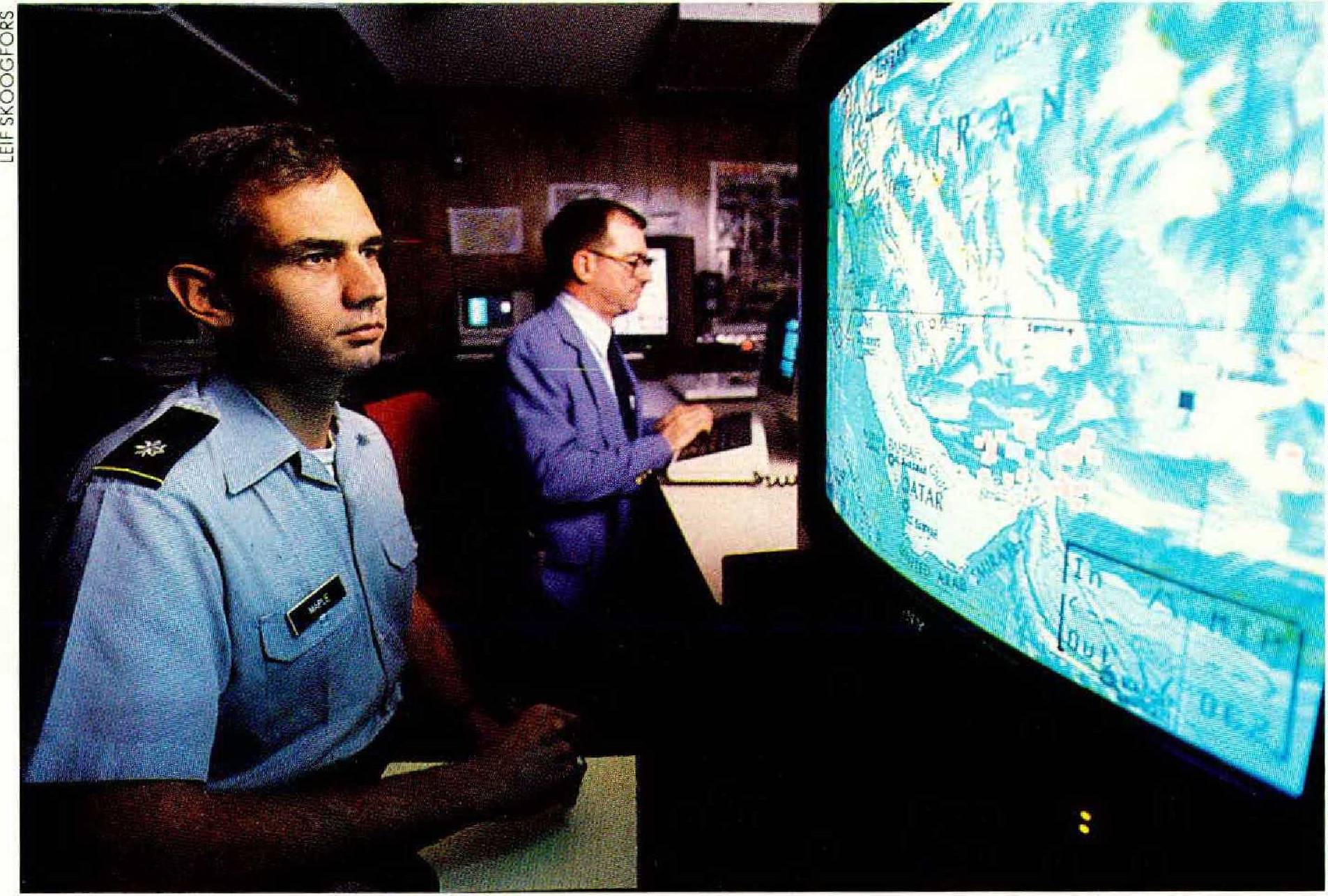
On an electronic display screen, a war game gets under way
THESE ARE unsettling times for the U.S. armed forces. The basic presumptions of the postwar period — the menace of the Soviet Union, the bifurcation of Europe, the nuclear deterrent, the role of NATO— have come under challenge. More and more, the military is being called on to perform unfamiliar tasks, from protecting Persian Gulf oil lanes and battling Colombian drug traffickers to subduing Qaddafi and helping remove Noriega. The military is on the brink of a new era, one that will be marked by declining budgets, reduced forces, and changing missions. How will the armed forces adapt?
To find out, I paid a visit to the Army War College, in Carlisle, Pennsylvania. The college serves as a sort of graduate school in war-making. Every year many of the army’s top men and women come to be groomed for senior leadership. Most of the students will go on to be full colonels; those who excel will rise to general. For several days I became a student at the war college. I attended lectures, pored over assigned readings, and participated in seminar discussions. I chatted with students in the hallways, joined them on the softball field, took breakfast with them in the morning, and downed beers with them at night. I stayed on campus, in a century-old guesthouse named after George Washington. The college officials asked only that I not quote any student by name.
The navy and the air force also have their own war colleges. Two other institutions, the National War College and the Industrial College of the Armed Forces, offer instruction to members of all the services. But the army is the largest branch of the armed forces, and the Army War College is worthy of special attention. Most of our top army generals, from Dwight Eisenhower and George Patton to Matthew Ridgway and Maxwell Taylor, attended the war college. What’s more, the college is in the midst of an ambitious five-year plan designed to prepare it for the twenty-first century.
There’s a problem, though. The war college, like the army as a whole, suffers from institutional inertia. As a result, efforts to update the school’s curriculum have flagged. In particular, the college is having difficulty anticipating the nature of future conflicts and absorbing the lessons of past ones—especially Vietnam.
CARLISLE BARRACKS, as the warcollege campus is called, does not look like a typical military post. The central academic building, Root Hall, is a squat, functional structure that recalls innumerable junior colleges across the country. (It’s named after Elihu Root, the former Secretary of War, who founded the college in 1901.) There are stately brick houses for faculty members and quaint matchbox houses for students and their families. Most impressive are the athletic facilities—several tennis courts, two softball fields, basketball and racquetball courts, even an eighteen-hole golf course. Oddly enough, the one statue I saw on campus was of Frederick the Great, a gift from Kaiser Wilhelm II.
Most students are lieutenant colonels in their early forties, and in their twentieth year of service. The experience that binds them is Vietnam—almost everyone served there. Otherwise, the class’s 288 members are a diverse group. In addition to army officers, there are representatives from the navy, Marines, air force, and Coast Guard, as part of a “jointness” effort to promote better coordination within the armed services; civilians from the CIA, the National Security Agency, the Foreign Service, and other government agencies; and thirty-four “international fellows,” from countries ranging from Tunisia to Thailand. Only eleven of the students, or 3.8 percent, are black, and six, or 2.1 percent, are women; 10.6 percent of army officers are black, and 11.1 percent are women. Three quarters of the students hold graduate degrees. In today’s army it’s hard to reach the senior ranks without one.
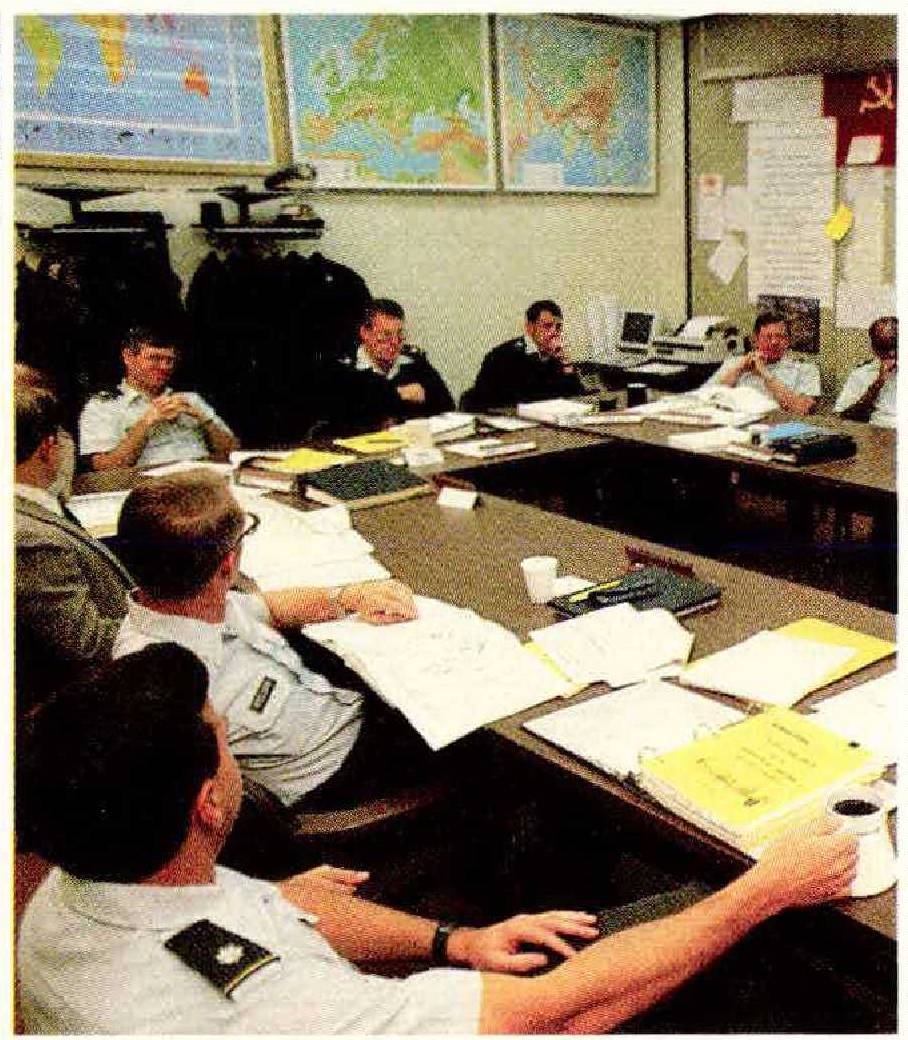
I was assigned to Seminar 10, one of the eighteen groups into which the student body is divided. We met in a windowless, brightly lit classroom whose walls were covered with maps. Dominating the room was a rectangular table around which sat the seminar’s sixteen members. They included an army infantryman, a navy pilot, an air force paratrooper, an employee of the Defense Intelligence Agency, a National Guardsman, an army nurse, a lieutenant colonel from Puerto Rico, and officers from Venezuela and Somalia. The instructor was Colonel Curt Esposito, who, despite tours at West Point, in Vietnam, and at NATO headquarters, managed to bring a boyish enthusiasm to his work.
The students tended to be tightlipped about the details of their pasts, but from occasional clues I could tell that these were not your everyday officers. Several had worked in Special Operations, the undercover unit that has been active in everything from fighting terrorism to training antiMarxist guerrillas. Some had been involved in the infamous Phoenix program in Vietnam, which liquidated thousands of Vietcong cadres. One student told me about his role in planning the invasion of Grenada, another about helping to fly Duvalier out of Haiti.
Clearly, these officers had the right stuff, and for this they had been selected to move up the chain of command. They were about to enter a world requiring a broader field of vision. Is it possible to fight a limited nuclear war? What is the Red Army’s strategy for fighting in Central Europe? How to distinguish among the various factions in the countries of the Middle East? This, then, was the primary mission of the college: to familiarize these soldiers with the larger issues associated with the military vocation.
The academic year at the war college is divided into six blocks, four of them a core program and the other two periods during which students can choose from a variety of courses. At the time of my visit students were examining the roles and responsibilities of “ The Senior Leader.” Discussion topics included “The Human Dimension in Combat,” “Professionalism and Ethics,” and “Challenges of Senior Command During War.” Students were assigned to read Samuel Huntington on the military mind, John Keegan on the face of battle, and essays on Rommel, “just” wars, and the loneliness of command. Each student was required to pick a famous general from history and write a 750-word essay on what made him great.
To my surprise, the students were subjected to a fair amount of psychobabble. Among the objectives listed in the course catalogue is to “clarify personal and professional goals through reassessment of personal values, strengths, and leadership competencies.” Students are required to take a battery of tests intended to detect their personality types and heighten their self-awareness. It took a while to get used to hearing these gruff officers talk about personal growth, self-discovery, and “structural judgmental” types.
I was equally struck by the school’s relaxed atmosphere. Students are not graded, and it’s almost impossible to flunk out. In contrast to the rigors of the Naval War College, where the work load compares to that of a graduate school, the required reading at Carlisle is kept to a minimum; I found I could complete each night’s assignment in less than an hour. Classes last only a few hours a day, and even that time is broken up with generous coffee breaks. All of this leaves students plenty of time to take advantage of the college’s athletic facilities. One afternoon I played outfield for Seminar 10’s softball team, part of a tune-up for the college’s fall league. With golf buffs lugging their clubs to get in a few holes before dark, the war college occasionally takes on the air of a country club.
“We don’t want to impose too heavy requirements on the students,” said Howard Graves, a Rhodes scholar, master parachutist, and rising military star who until last June was the commandant of the college; he is now the assistant to the chairman of the Joint Chiefs of Staff. For one thing, he said, the students need time with their families. “If an officer’s been leading a battalion in Germany and hasn’t talked to his wife in two years, we want to leave time for that.” More generally, he said, “we concentrate on the student as a total being—personal, professional, family man, and leader. This has to be a year of opportunity for renewal.”
White keeping the school’s pace relaxed, Graves and his successor. Major General Paul Cerjan, have sought to sharpen its curriculum. It is here that the war college faces its most important test. During the 1970s and early 1980s the curriculum became mired in all kinds of peripheral subjects. Budgeting, procurement, resource management, systems analysis—officers were being prepared less for commanding troops than for working a desk. Critics wondered what had become of the “war” in the war college.
But today the great emphasis at Carlisle is on “war-fighting.” Students read a lot of military history. They engage in frequent war games. They learn how to meld the various services under a joint command. And they delve deeply into the work of Clausewitz, the nineteenth-century Prussian strategist whose observations on the nature of war seem as relevant today as they were when he wrote them.
Students also learn about the “operational art” of war. The term, much in vogue at the war college these days, refers to the large-scale battlefield operations required in theater warfare. Becoming adept in this area requires mastery of all those elements associated with leading an army into battle—command structure, intelligence, technology, mobility, even climate and terrain. To help teach them, the college offers an advanced course on the great battles of the Second World War. Students learn how Douglas MacArthur islandhopped across the Pacific, how the Russians stopped Adolf Hitler’s tanks at Kursk, how the Allies repelled the Wehrmacht in the Ardennes.
CLEARLY, THE WAR college is preparing its students for another conflict like the Second World War. If Warsaw Pact troops come pouring through the Fulda Gap into West Germany, or if the Soviets send their armored divisions speeding toward Brussels, then our future generals will know how to respond. The college sees the world primarily in East-West terms. Europe is the main theater, NATO the chief ally, the Soviet Union the principal threat.
“The central focus at the war college is still on Europe—and with good reason,” says Rod Paschall, a colonel who recently retired as the director of the college’s Military History Institute, which houses more than 250,000 volumes. “Europe is the home of Western civilization. A war there can destroy that civilization.”Paschall, a graduate of West Point, George Washington, and Duke, says that if Gorbachev significantly reduced the size of the Soviet army, the war college could turn its attention to other matters. But he is not optimistic. “As long as the Warsaw Pact continues to mass a huge force in Europe,” Paschall says, “it’s important that we prepare our future leadership to deal with it. If we lose sight of that, we’re in deep trouble.”
Some, however, believe that the war college is preparing its students to fight the wrong war. One afternoon I met Colonel Harold Nelson for lunch at the college’s officers’ club. Wry and erudite— he holds a Ph.D. in Russian history—Nelson taught at the college for seven years before being named last summer as the army’s chief of military history, in Washington, D.C. “We take a lot of things as if they’re given—for instance, that there’s always going to be a Soviet threat,” Nelson says. “But experience teaches us that this is not so, not so at all.” He observes that there’s a lot of “healthy skepticism” about the school’s focus on Europe, especially now that superpower relations are warming up.
Nelson predicts that the army will shrink significantly in coming years, setting off a series of structural changes. Unfortunately, he says, the school seems uninterested in exploring the matter, despite the likelihood of large cuts in the military budget in the next few years. “The war college is not different from any other corporate body,” he says. “There’s a party line.” He adds, “We should be thinking about what the army is going to look like in the twenty-first century. If the Soviet threat does begin to fade, what are we going to teach in these damned schools?”
Unconventional warfare, perhaps. Over the past twenty-five years, while Europe has remained quiet, U.S. forces have been dispatched to Indochina, the Dominican Republic, Lebanon, Grenada, Honduras, and the Persian Gulf. From the contras in Nicaragua to the Khmer Rouge in Cambodia, from Angola’s UNITA to Peru’s Shining Path, war today is usually waged by peasant armies operating in remote jungles and mountains. “Low-intensity conflict,” the Pentagon calls it. In deference to this reality, the war college has added some faculty members with expertise in guerrilla warfare. Last year, for instance, a former head of the U.S. military group in El Salvador taught a course on revolution in Central America.
Beyond this, however, the college’s offerings on Third World insurgencies are slim. “The war college is not yet where it should be on low-intensity conflict,”General Graves told me.
“This has to be a major area of emphasis, because this kind of conflict has a much higher probability of occurring than any other. But we still have a long way to go.”Since we spoke, the college has increased course offerings on the subject.
Most telling, perhaps, is the school’s soft-pedaling of the political dimensions of military conflict. To be successful, contemporary officers must know not only about tank maneuvers and joint operations but also about agrarian reform and deforestation, human rights and international debt. Every year students travel to the United Nations, in New York, to talk with representatives from Third World nations, but this hardly familiarizes them with the intricate issues that they would likely face if posted to a distant land. Until senior officers understand the social roots of military conflict, they cannot hope to resolve it. This, in fact, is the primary lesson of Clausewitz, who wrote that war is an extension of political conflict. Apparently, this notion hasn’t yet pervaded the war college’s consciousness where the Third World is concerned.
THK REASON, I THINK, has much to do with Vietnam. For many years the school neglected that war. “There was a reluctance to look at Vietnam during the 1970s,” says Colonel Don Lunday, the director of academic affairs. It was simply too emotional an issue, he explains. Today officers are willing to look more analytically at the war, thanks in part to Colonel Harry Summers’s widely publicized book On Strategy (1982). Warning against the tendency to look for scapegoats, it notes our failure to recognize our true objectives in Vietnam and to devise a strategy for attaining them. The book, which was researched and written at the war college, has left an imprint. “Now we’re waking up to the fact that there are some lessons to be learned from Vietnam,” Lunday observes. Last year, for the first time, the school offered an elective course on Vietnam, and the core curriculum currently devotes two days to the war and its implications.
Still, this gives short shrift to the conflict. The Vietnam War would seem an ideal case study for examining the various dimensions of Third World conflict—guerrilla warfare, nationalism, radical ideology, class strife, revolution itself. Before we become involved in another peasant war, we need to understand why our many rural programs in Vietnam, from pacification to Phoenix, failed to win the hearts and minds of the local population.
During my stay at the war college, though, I found numerous indications that the army has yet to face up to its experience in Vietnam. One of the most revealing moments came during a classroom discussion of the My Lai massacre. I had been impressed to find the event in the college’s syllabus. My Lai is one of the blackest marks on the history of the American military, yet here was Seminar 10 spending an afternoon examining why it had occurred and how such events might be averted in the future.
Remarkably, the material was new to members of the class. The murder of old men, women, and children; the destruction of villages; the cover-up— most of the students seemed to be hearing the details for the first time. During the discussion an air force colonel told the class that he had become so engrossed in the army’s report on the incident that he had stayed up half the night reading it. “Until I read this,”he declared, “I believed that My Lai was a tactic used by liberal anti-war people to demean the people who fought in Vietnam. It was a real shock to pick this up.”All around the table officers nodded in agreement.
Near the end of the discussion I was asked to give my own impressions. I told the class how surprised I was to find that My Lai—an event that has been so exhaustively chronicled and debated—would come as a revelation to those veterans of the war. Esposito, who had served two and a half years in Vietnam, tried to explain; “When I came back from Vietnam, I just couldn’t focus on the war. When the media dealt with Vietnam, I tuned it out. My Lai? I didn’t want to be bothered with it. Only now am I getting to the point where I’m willing to go back and look more objectively at the war. I think that’s true for a lot of the people who were in Vietnam.”
On my last morning at the war college I attended a prayer breakfast at the campus chapel. About forty students showed up for eggs, cereal, and spiritual guidance. We sang “Happy Birthday" for one officer and prayed for the health of ailing friends and relatives. Then a uniformed colonel stepped up to the lectern to talk about ethics. In a soft voice he apologized for recounting a war story—something frowned on at the college—but said that he wanted to share an episode that had affected him deeply. In 1965 his commanding officer ordered him to inflate a body-count report. Though shocked, he complied. He falsified reports for the next three weeks, until he was wounded and evacuated from the country.
For many years, the colonel said, the event weighed on him. Wanting to make amends, he resolved never to repeat such an act nor to give similar orders to a subordinate. Nonetheless, “the burden stayed with me for years,”he said. Only when he turned to religion did he find a wav out: “I realized that I could get rid of this guilt only by taking it to the Lord and asking for forgiveness.”After reading two brief passages from the Book of Matthew, the colonel concluded, “We should not let loyalty to an individual supersede our loyalty to an institution based on the Lord’s law, and that’s the military.”
The room got very quiet. As the colonel returned to his seat, I sensed the relief he felt at finally getting this episode into the open. Expiation of his guilt had required more than talking to the Lord—it had required talking with his fellow officers. Similar candidness would probably help others at the college. Many are still haunted by painful memories of the war, memories pressing to be shared. In this critical area, however, the Army War College is not much help. The school, like the U.S. military generally, still finds Vietnam too traumatic to give it the attention it deserves. As the institution seeks to prepare our officers for the next century, Vietnam constitutes a missing link. Until our senior officers come to terms with the last war, they will not be prepared to fight the next one.
—Michael Massing