"Hey, Let Me Outta Here!"
Three days and three flights with eight hundred voices and four hundred people
BY CULLEN MURPHY
WHEN I FIRST MET OLLIE, HE WAS BESIDE himself, with his head lying alongside his torso in a wooden box. Jeff Dunham gently lifted the pieces out and helped Ollie pull himself together. When he was seated on Dunham’s knee, Ollie opened his eyes, looked at me, furrowed his brow, recoiled, and turned his head to the familiar face on his right.
“Who the heck is that?” he asked Dunham.
Dunham made the introduction, but Ollie would have none of it. “Do you have any idea what time it is?”
Ollie glowered, and his upper lip curled back in a menacing sneer. Dunham handed him to me and said, “Be careful.” I cradled Ollie on my lap and inserted my right hand into his thoracic cavity. The anatomy was unfamiliar, but I depressed one lever and then another and then a third. Ollie turned his head, dropped his jaw, and winked, A moment later his nose lit up bright red. His left eyebrow ascended. He sneered again. I handed Ollie back, and he seemed relieved.
“That was awful,” he said to Dunham. “Don’t ever let him near me again.”
Dunham soothed the little fellow and then returned him to his box. “I’m sorry about that,” he said to me. “Ollie be temperamental.”
In Ollie’s defense I should note that it was latearound midnight on the last day of the International Ventriloquist ConVENTion (the curious orthography derives from the term that “vents" use for one another), which is held every year at midsummer in Fort Mitchell, Kentucky, a suburb of Cincinnati, Ohio. Dunham, Ollie’s current owner and a rising young ventriloquist, was the chairman of the convention, and he hadn’t had much tree time. I had wanted to see and hold Ollie because he is one of the few figures (vents tend to prefer this term to “dummies,” but they use both) made by the McElroy brothers, Glenn and George, that remain on active duty.
In the 1930s the McElroys produced a series of perhaps a hundred mechanical characters, each of which in the world of ventriloquism enjoys the status of a Stradivarius. During the Second World War, when supplies became scarce, they took jobs at Ivory Soap’s Toilet Goods Model Shop, in Ivorydale, Ohio, and virtually stopped making figures for the rest of their careers (they are nowretired). The head of a typical McElroy figure was molded in plastic wood and painted with subtlety and skill. Features that had to be especially pliable—the eyelids, the retractable lips—were fashioned from leather or chamois and grafted imperceptibly onto the head. The mechanical works inside Ollie, which Jeff Dunham exposed by removing a plate in the cranium, resemble a heaping bowl of metallic pasta; they make possible some fourteen movements of the face and head. The wiring, fashioned largely from bicycle spokes, trails down the metal spine upon which the head is impaled to a set of levers that resemble typewriter keys, and it is essentially by typing that a ventriloquist manipulates a McElroy figure. A few days before I met Ollie face to face, I had seen how Dunham, in performance, made Ollie come alive. Every vent is at home with his own “headstick”; when I tried to manipulate Ollie myself, it was like driving a standard-transmission car with fourteen stick shifts. Ollie takes some getting used to,” Dunham said. “He’s more complex than all but a handful of figures. It is such a privilege to work with him.”
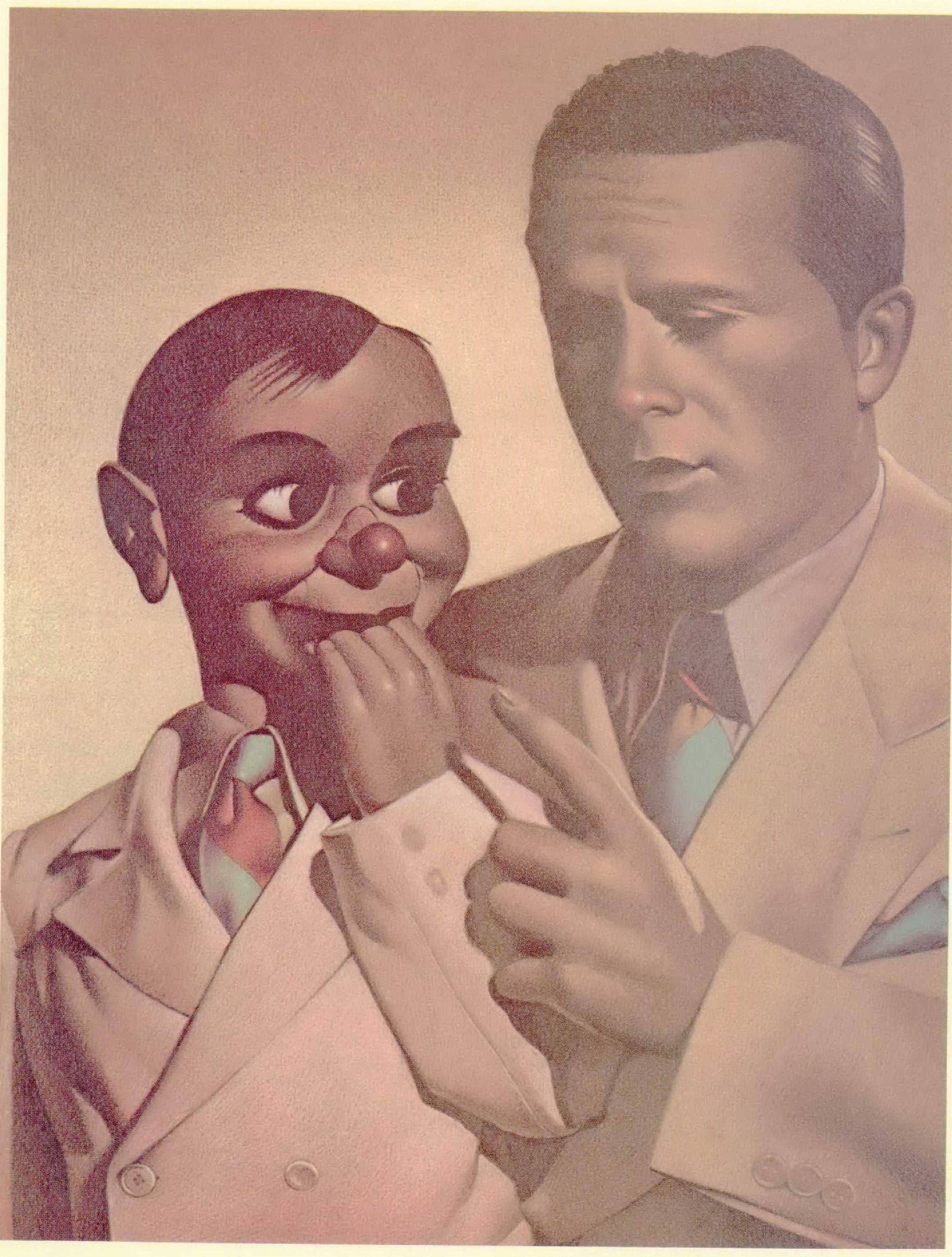
The world of which Dunham and Ollie are a part was foreign to me until I accepted an invitation to attend the fourteenth annual ventriloquists’ convention, last summer, and spent some time in the company of four hundred people who, in the words of one vent, “like to talk to themselves and play with dolls.” I was unaware before arriving that ventriloquism, like tap dancing and other vaudevillian arts, is enjoying a considerable popular revival. I had never given more than a passing thought to the vocal, manipulative, and engineering skills that the ventriloquist’s illusion requires. And I did not realize the extent to which ventriloquism, like puppetry in general, has swept through evangelical Christianity and become a mainstay of modern ministry.
Three days and nights in Fort Mitchell changed all that. I met a half dozen of the finest ventriloquists in the world. I saw several dozen performances. I spoke to people who make figures and learned some of the basics of their craft. I came home with the makings of a figure of my own, and with the desire to attend another convention when the memory of my initial immersion begins to dim. It hasn’t yet.
ANOTHER WORLD
ON THE NIGHT BEFORE THE OPENING OF THE convention there was a performance, which the public could attend for a dollar or two, by Ronn Lucas, one of the most innovative ventriloquists working today. Every seat in front of the stage at the Drawbridge Inn, in Fort Mitchell, where the convention is always held, seemed to be occupied by someone talking to someone else on his lap. In some cases both parties to a conversation were sentient beings, but from the rear of the hall it was hard to tell the children from the dummies.
When Ronn Lucas came out with the figure for which he is most widely known, Buffalo Billy, I realized that I had seen him once with Johnny Carson on The Tonight Show. Lucas is young, good-looking, and clean-cut in a midwestern sort of way. He had just gotten married, he told the audience, despite his fiancée’s concern that his lips wouldn’t move. Lucas eased gently into the kind of routine that is familiar to anyone who has ever seen a ventriloquist, in which the smart-alecky dummy takes on the increasingly bewildered vent. He demonstrated his command of the distant voice (the voice that seems to come from another part of the room, or over the telephone) and of the muffled voice (the voice that seems to come from inside a trunk or suitcase). Gradually Lucas added new dimensions to his act. In one routine he blew up a balloon while Buffalo Billy sang the ABC song. In another Billy held a figure in his lap and seemed himself to be a ventriloquist, creating an ever-shifting web of real and illusory relationships. Lucas then abandoned his figures and performed for a while with nothing but a sock that he wore on his hand. He discarded the sock and launched into a skit in which the microphone became his interlocutor, its voice tinny and electric and at times seemingly disturbed by interference. Before long the microphone, too, was abandoned, and Lucas performed what can only be described as a ballet, in which his bare hand danced to a strange music that the hand itself seemed to be producing. The music culminated in a high-pitched and steady whine, as if from a tuning fork, and it seemed to come from a spot Lucas pointed to on his palm. He turned the palm to the audience and the whine became louder. He turned the palm away and the whine became softer. He held his palm flat and the sound steadied for a moment, and then began slowly to fade. Before the sound could fade away completely, Lucas abruptly closed his hand, and there was silence. The people in the hall made no move to applaud for five or six seconds, as if applause were too blunt and bestial a response to what they had just seen. I clearly wasn’t the only one in the room whose rapture was tarnished by envy.
If a genie appeared and offered you three wishes, you probably wouldn’t use one to become a ventriloquist. But if you happened to wake up one day with a ventriloquist’s skills, you probably would admit that something wonderful had happened. Ventriloquism is a talent that almost no one would mind having. I remember advertisements in comic books for ventriloquism lessons which showed a big guy, maybe a sailor, carrying a trunk on his back, and from the trunk came the plaintive cry, “Hey, let me outta here!” A little kid with a devilish grin was shown standing nearby. I never clipped the coupon and sent in money, but the ad has always stuck in my mind, emblematic, perhaps, of a career path too early forsworn.
If I had followed that path, however, there would be a few things I could say about myself by now. I would probably be an alumnus of the Maher Ventriloquist Studios, which turns out as many as four hundred vents a year, and which, incredibly, conducts all its classes by mail. I would have invested $1,000 or more in the figures I now used, which I would carry around in a trunk. I would have publicity photographs on my person at all times, and they would show me mugging for the camera with my dummy, wearing the expression you see in every picture ot Willard Scott. I would be disliked by stand-up comics, who find distasteful the use of a “prop,” and who also frequently bomb when they have to follow vents. I would wear Hawaiian shirts on inappropriate occasions. And no matter what kind of ventriloquist I was, I would show up at the International Ventriloquist ConVENTion at least once every couple of years, because going there is good for art and good for business.
The International Ventriloquist ConVENTion is on one level a professional meeting like any other. There are lectures and workshops, a business meeting and an awards banquet, an exhibition hall and a hospitality suite. And there is a lot of shoptalk. Ventriloquism is a diverse endeavor with far-flung practitioners, and the convention is the one place where everyone can catch up with what’s happening in the profession. Nobody can do better than guess at how many people work as professional ventriloquists in the United States, but the number of people coming to the convention increases every year. Keeping vents supplied with dummies provides work for about fifteen small businesses in this country. And ventriloquism, which nearly died when vaudeville did, has moved into many new arenas.
Clinton Detweiler, who owns the Maher Ventriloquist Studios and is the editor of the newsletter Newsy Vents, and who seems to spend most of his spare time figuring out ways to incorporate mouths that can open and close into plastic fruit and neckties and watering cans and other items around the house, sat me down one afternoon at the convention and drew a pie chart. “I don’t know how many vents altogether are in this pie,” Detweiler said, “but if you had to divide them up percentagewise, it would look something like this. About five percent would be your stand-ups, working in places like Atlantic City, Chicago, and Las Vegas, or on cruise ships. Another twenty percent do mainly programs in schools—you know, for drug education and that sort of thing. And another twenty percent are part-time vents who do community-type shows and shows at parties. Maybe ten percent are teachers or doctors or lawyers or psychologists who use dummies in their work. And maybe five percent are people in business who’ll use a dummy for seminars and whatnot, and probably another five percent are vents in ways I haven’t thought of. We’ll call that ‘other.’ Another twenty percent are hobbyists. And then you have your gospel vents, who make up at least a quarter of the pie and probably more, and that share is growing.” Detweiler looked down at the pie. “So that comes to a hundred and ten percent. Well, there’s some overlap, I guess.”
A woman approached with a toy duck and asked Detweiler if he could find a way to give it a working mouth, and he said to leave it with him for a while and he’d see if he could rig one up, maybe with a clothespin. When the woman left, Detweiler said, “I spend a lot of time in grocery stores looking for things i can put mouths on. Generally the cereal aisles and the detergent aisles are the best, but in fact you’ll find things almost anywhere you look. That’s my problem.”
The dealers’ room is the heart of the convention, were most of the socializing occurs, and I walked around it one night for several hours. Dummies of all kinds, old and new, lay out on tables: drunks, dogs, and dons, grandmothers and goons, sailors, leprechauns, bullies. There was a Vietnam-veteran dummy in a wheelchair. The heads of many of the antique dummies were open to expose the works, and the cranial plates lay upturned beside the heads like ashtrays. Ventriloquists mingled among the stalls with their figures on their arms.
The figures tended to greet one another in the aisles. Behind my back someone said. “That’s the most beautiful ventriloquist’s figure I’ve ever seen.” Someone else said in reply, “Shari Lewis has the most beautiful ventriloquist’s figure I’ve ever seen.” Some dealers had small libraries for sale. The books bore titles like Something Punny and knock Em Dead and Conquering Stage Fright. At Clinton Detweiler’s table you could buy Shredded Wit, a book of jokes on cereal themes. One dealer showed me a collection of English music-hall routines. “If you really want a weird act, get one of these. It’s all ‘bloody’ this and ‘bloody that.” He was also selling Charlie McCarthy spoons from the 1930s and yellowing original scripts from The Paul Winchell Show. A dealer nearby was offering, for $200, a suit that had once been worn by Mortimer Snerd. Two seven-year-olds walked past me with dummies perched on their forearms. One of them said to the other, “So how long you been a vent?”

THB UNDKAD
THE INTERNATIONAL VENTRILOQUIST CONVENtion is held in Fort Mitchell because that is the home of the Vent Haven Museum, which houses the largest collection of ventriloquist’s figures in the world. The museum was opened to the public (by appointment) in 1973, after the death of William Shakespeare Berger, who was a president of the Cambridge Tile Company, in Cincinnati, an amateur ventriloquist, and a collector of ventriloquial materials: not only figures and puppets but also books, photographs, scripts, recordings, films, and wood-carving tools. The museum was initially confined to Berger’s redbrick Victorian home. (Berger had arranged his figures so that they looked out all the windows, until local residents complained.) By now the museum has spilled over into a refurbished garage and two other buildings. I was shown around Vent Haven one afternoon by Don Millure, who is a trustee, and his wife, Dorothy, who is the curator. Nine McElroy figures are on view, including one, named Kenny Talk, who can smoke a cigarette and blow the smoke out his ears. Harry (“The Great”) Lester’s Frank Byron, Jr., is there, and Valentine Vox’s Cecil Wagglenose. There is a replica of Edgar Bergen’s Charlie McCarthy, and of Paul Winchell’s Jerry Mahoney. Farfel, the dog figure that Jimmy Nelson used in his famous series of Nestlé’s Quik commercials, peers down from a shelf with heavy-lidded eyes; actually, this Farfel is the original Farfel’s stunt dog—the one that would get shot out of a cannon and do other dangerous deeds. In one room, on row after row of folding chairs, an audience of perhaps a hundred figures sits with open eyes and vacant smiles. The effect of this grouping is overpowering.
There is something surreal and ghastly about a ventriloquist’s dummy. In its life on stage it serves as a source of entertainment, but in its private life, we all know, it is an all-too-willing slave of dark forces—a characteristic displayed in movies like Dead of Night (1945) and Magic (1978), and in television programs like The Twilight Zone and Night Gallery. At the Vent Haven Museum there are some six hundred of these beings, clustered together in mobs of sixty to a hundred or more. Some of them have human hair or teeth. Virtually all their masters are long since dead, yet here sit the dummies, intact and immortal, though torn forever from their original voices. One dummy on display was found amid the rubble of a German house destroyed during the Second World War. Four others, from the turn of the century, were washed ashore after a shipwreck, the only survivors. On the walls arrangements of photographs show the great ventriloquists of yore getting older and frailer; the agelessness of their partners seems to mock them. A ventriloquist who came to the museum with me pointed out a certain figure and said, “The first time I saw him sitting there, I nearly broke down. He belonged to a friend who had just died in an accident.” A visitor to Vent Haven whose thoughts do not somehow touch on death is probably not human.
The association of ventriloquism and death has a historical basis. Some figures at Vent Haven go back 175 years, and the books there about ventriloquism go back even further, but the origins of the art itself lie deep in antiquity. Necromancers, who advertised themselves as the living vessels through which the spirits of the dead could speak, apparently were able to transmit apercus from the underworld without labial agency. There is archaeological evidence for this from Egypt and Palestine, and literary evidence from all over. (The biblical story of the Witch of Endor, in Samuel, is thought to involve a ventriloquist.) Up through the Middle Ages ventriloquism remained a tool of those with avowed ties to the supernatural. Elizabeth Barton, the so-called Holy Maid of Kent, professed such ties when, in a trance-like state and with no visible movement of her mouth, she suggested to Henry VIII that divorcing Catherine of Aragon would not be such a great idea. The suggestion was itself not such a great idea. Barton was hanged at Tyburn in 1534.

Not long afterward, of course, came that famous sea change in Western civilization when the realm of the spirit was invaded by scientists and entertainers. No one really knows who first established himself as a professional vent, but by the nineteenth century ventriloquists were fairly common. They usually didn’t use dummies, however, but entertained their audiences through exhibitions of the distant voice. This minimalist approach, whose effect can be dazzling, is one that some of the best modern ventriloquists take during portions of their acts. The use of mechanical figures was popularized in the late-nineteenth-century English music hall, where ventriloquists generally used not one figure but a whole family of them, often affixed to a bench: a blackamoor, a sailor, an old woman, a clown—the combinations varied.
The first man to become well known for using a single figure seated on his knee was Fred Russell, an English ventriloquist who flourished in the 1890s. A triumphal tour of the United States at the turn of the century by Arthur Prince, another English vent who used a single figure, made ventriloquism wildly popular in this country and shaped its contours for years to come. Harry Lester, who saw Prince perform, made his debut in 1902 and became the premier American vent of the vaudeville era. It was The Great Lester who taught Edgar Bergen (a $300 check from Bergen to Lester for lessons is on display at Vent Haven), and it was Bergen who led the way out of vaudeville and into broadcasting, inspiring Winchell, Nelson, and others. The example of Winchell and Nelson, in turn, helped draw in the generation that is now achieving prominence, on television (especially cable) and in clubs—people like Lucas, Dunham, Jay Johnson, Alan Semok, and Willie Tyler.
Whv, I asked Dorothy Millure, do so many ventriloquists’ figures tend to look alike? She said, “That’s a legacy from the old days too. There used to be a stock character in vaudeville, the wisecracking Irish kid, and ventriloquists, who worked vaudeville, realized early on that this was the perfect sort of foil. That’s why your typical figure has a black-Irish look and a name like Danny O’Day or Jerry Mahoney or Charlie McCarthy. Of course, that’s all changing. You’ve seen the dealers’ room. In thirty years the people in the museum”—I raised an eyebrow—“will be a lot more diverse.” One major trend is toward the use of soft figures, made of cloth or foam. The classic hard figure with a headstick will always be popular, but soft figures are within the financial reach of more people—especially young people—than hard figures are. They are also simpler to manipulate: you can use your hand directly to move the mouth and face, rather than having to negotiate a headstick. The advent of soft puppets is often cited as among the contributing factors in ventriloquism’s resurgence.
I had dinner after my tour of the Vent Haven Museum with a Chicago-based vent and figure-maker named John Arvites. Like a number of prominent vents, Arvites acquired his skills not through schooling but at the side of a “great man” (in this case, Frank Marshall). One of Arvites’s primary figures now is a hard dummy of a wizened black man named Little Charlie, who is supposed to be more than a hundred years old. Arvites is white. I brought up the subject of the ventriloquist’s dummy’s evolving form, and he said, “Some things have changed. Vents now tend to use mixed styles of puppets. There also are some things that don’t change. People will listen to a figure more readily and attentively than they will listen to a real person. The psychology is strange. You can say things through a puppet that the audience would never accept from you yourself. Whether I’m in a blues club on the South Side of Chicago with old Charlie, at a corporate banquet with Fred the Guy, or in a school with Terry—in any of these situations any of my characters can say things that the audience will think are delightfully funny, but if I had said them myself I’d get killed for it.
“Your characters are tools, instruments with which you communicate. The key is to create an illusion of life. It’s a game of make-believe in which you act as if the puppet actually had a life of his own. You’ll find yourself being surprised by things that the figure says—things you would never think of saying yourself.”
Ventriloquists don’t really regard their figures as beings with an independent existence, but watch a vent put his dummy down and you’ll see that he never just throws him on a table or into a trunk. He almost always sets him down gently, in a chair. I heard a story from Jimmy Nelson. He was taping a show for television, and the script involved Nelson, the dummy Dannv O’Day, the dummy Farfel, and Nelson’s wife. Everything went fine until it was Danny O’Day’s turn to speak. “I remember looking at him,”Nelson said, “and thinking, C’mon, the lines aren’t that hard. But he didn’t say a word. My wife had to kick me.”
A TECK OF TICKLED TETTERS
WHEN I SAID EARLIER THAT VENTRILOQUISM was a career path I had forsworn, I wasn’t quite telling the truth. Any time I have a puppet on my hand and a child on my knee, something compels me to become a not-so-great Lester. Anyone can be a successful vent when the audience consists of a single three-year-old and when the words to be said are easy ones, like “Hey, guys!" or “Are you a duck?” But when the situation calls for you to say something like “Shut up and listen, you bloody fool,” even a three-year-old will catch your lips moving. This is because p, b, and f, together with m, are the Scylla, Scylla, Scylla, and Charybdis of ventriloquism, and doom most passing lips.
I sat down for a cup of coffee one afternoon with Bob Isaacson, a ventriloquist who lives in Oak Park, Illinois, and asked how a ventriloquist makes the b sound. Isaacson said, “Well, some books will tell you to substitute a d sound, but I found when I was just learning that that doesn’t quite make it. ‘How adout a dottle of deer? Or some will say to use a v sound. ‘How avout a vottle of veer?’ When I first started, I remember thinking, This isn’t very good. This isn’t very good at all. I started thinking in my mind a combination of d and v. An exaggerated version would be, ‘How advout a dvottle of dveer?’ And I just kept trying it over and over again, trying to slide the sound out. And eventually it came to sound like ‘How about a bottle of beer?’ ‘How about some beer and some baked beans?’ See, that wasn’t bad. Of course, you get the b down and you still have the other hard ones to master. The most common substitution for p is a t. ‘Do you want to buy a tickle for a nickle?’ ‘Teter Titer ticked a teck of tickled tetters.’ Sometimes a th works better. ‘How about a thickle?' ‘How about a pickle?’ ‘A thickle. ‘A pickle.’ That’s not too bad. Again, it depends on how you slide that sound out. It’s almost a slurring kind of thing. Some people use an f. ‘A fickle.’ ‘A pickle.’ I’m kind of blowing the sound past my lips.”
Isaacson went through the other tough sounds. The extraordinary thing about our conversation was that during most of it Isaacson never moved his mouth. From three feet away I was aware of the expulsion of air, and of tense undulations in the muscles of Isaacson’s neck, but that was all. I went back to my room and began to practice what I had just learned, bearing in mind the exhortatory mantra in Paul Winchell’s Ventriloquism for Fun and Profit: “Don’t rush. Don’t get impatient. Don’t get discouraged. Don’t ever give up.”I gave it a good fifteen minutes. Then I got impatient and discouraged, and gave up. I went out and dought a dottle of deer.
People like me, who aren’t in the business, tend to think that making the hard sounds without “flapping ought to be just about enough to qualify you as a real ventriloquist, but in fact it only makes you eligible, much as being male makes you eligible but not qualified to be a Catholic priest. Vents do kid around about the oral tricks they resort to—I was introduced to the ventriloquist Colonel Bill Boley by a vent who called him Dill Doley— but they don’t pretend that letter substitutions, however skillfully voiced, are more than a small part of the illusion. One night I saw a boy with a gorilla dummy on his arm go up to one of the bigger names in ventriloquism. I heard the gorilla say, “Hi, friend, my name is Big Boy.”And the older vent said, “That’s pretty good, son. But how’s your distant voice? How’s your muffled voice?”
I sat in on a good many seminars at the convention— how to survive a kids’ show, constructing a foam-head puppet, putting mouths on things—and one of the most memorable, conducted by a vent named Nacho Estrada, was devoted to the distant voice. You are likely never to encounter Estrada unless you are in high school or grade school and live in the Southwest. He goes from one school district to another, cutting deals with superintendents here and there, and offering funny but serious programs about all the familiar touchy subjects. He limbers up his larynx while driving to shows by singing the famous refrain from “Witch Doctor”: “Ooh, Eee, Ooh-ah-ah, Ting-tang, Walla-walla Bing-bang.” Estrada is esteemed among his peers for his mastery of the distant voice.
He explained in his seminar that a voice from a distance was different from the regular “vent voice,” that the individual words had to be drawn out longer— “Heeeey, Joeeey”—and that the voice had to lose much of its body and texture, becoming forced and tiny. “You have to talk from your stomach,” he said. “Or like the way you would talk just after somebody punched you in the stomach.” (The word ventriloquism comes from the Latin for “talking from the stomach.”) But then Estrada went on to say that voice technique was never enough by itself, that voice can’t give itself a false source. He had performed a routine at the seminar in which his dummy was in a trunk whose lid he kept raising and lowering, and the dummy’s voice, which seemed to be coming from the trunk, was modulated accordingly in loudness, pitch, and sonority. Or so it seemed to me. Estrada said, “There’s no such thing as throwing your voice. Your voice has to come out of your mouth, because that’s where it comes out of. Fortunately for us, the ear isn’t a very reliable organ. It doesn’t always know where a sound is coming from. It will associate itself with any visual cue that happens to be around. If a sound suddenly sounds muffled when I’m closing the trunk, people think it’s happening because I’m closing the trunk. If I didn’t have a trunk, they’d probably think I was just lowering my voice.”
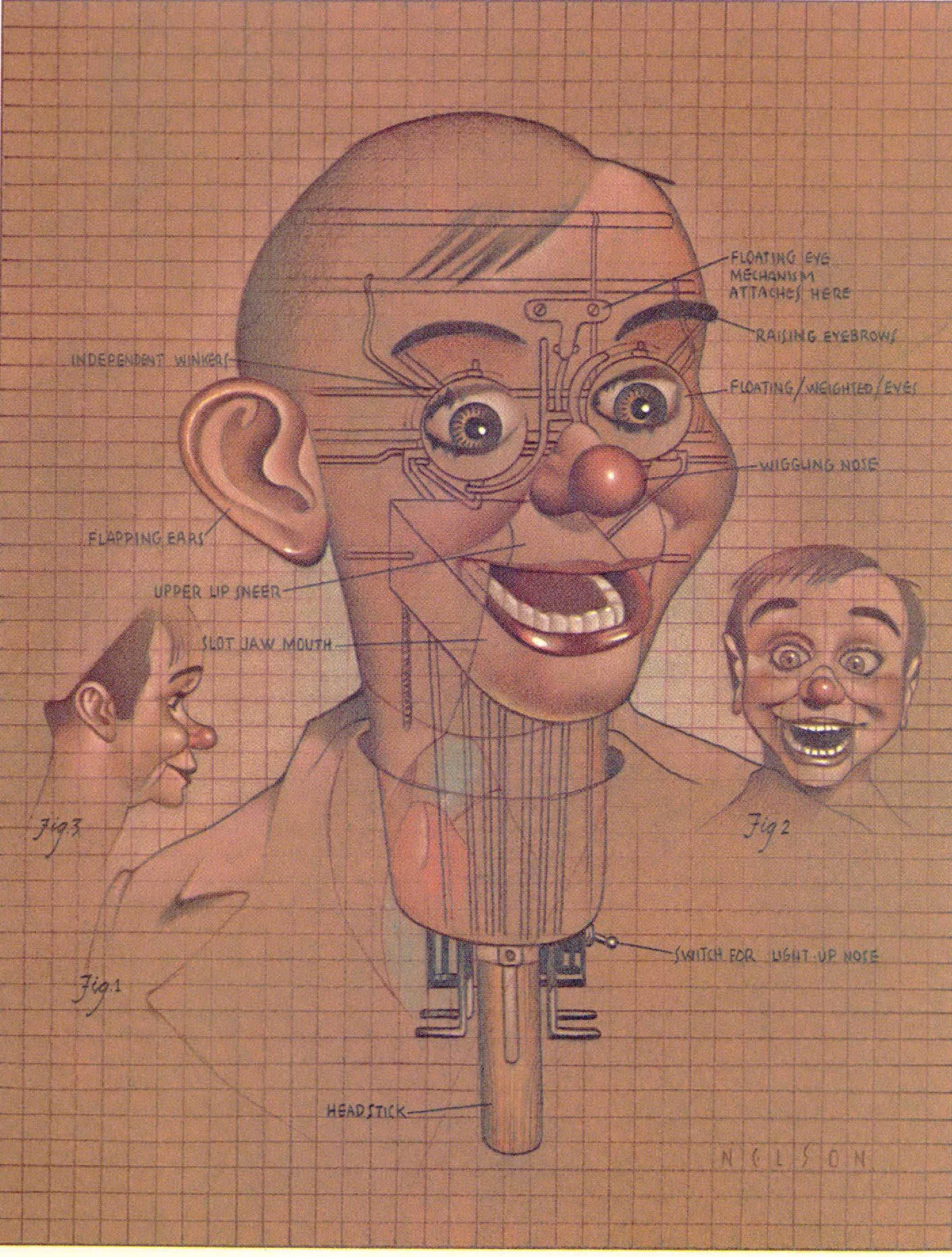
Any vent will tell you that manipulation and the figure’s personal character are as important as the vent’s voice in the success of an act. I had several conversations at the convention with Alan Semok, who is a figure-maker and actor, and a very successful vent. Semok’s first dummy was given to him when he was a child, to help him overcome his shyness, which is a story that not a few vents tell. (Another story vents sometimes tell is that they were given their first dummy for companionship during a serious childhood illness.) Semok had this to say about manipulation: “When you look at a lot of beginner vents you notice that their voice is fine but their figures are dead. Basically it’s just the mouth that’s moving. And the vent winds up having this magician problem, where the audience spends all its time looking at him, wondering if he’s going to slip up. The audience is supposed to be more interested in the dummy. Edgar Bergen had terrible lip control—actually, it was good at first but deteriorated after he worked in radio—and nobody cared, because Charlie McCarthy was just so real.”
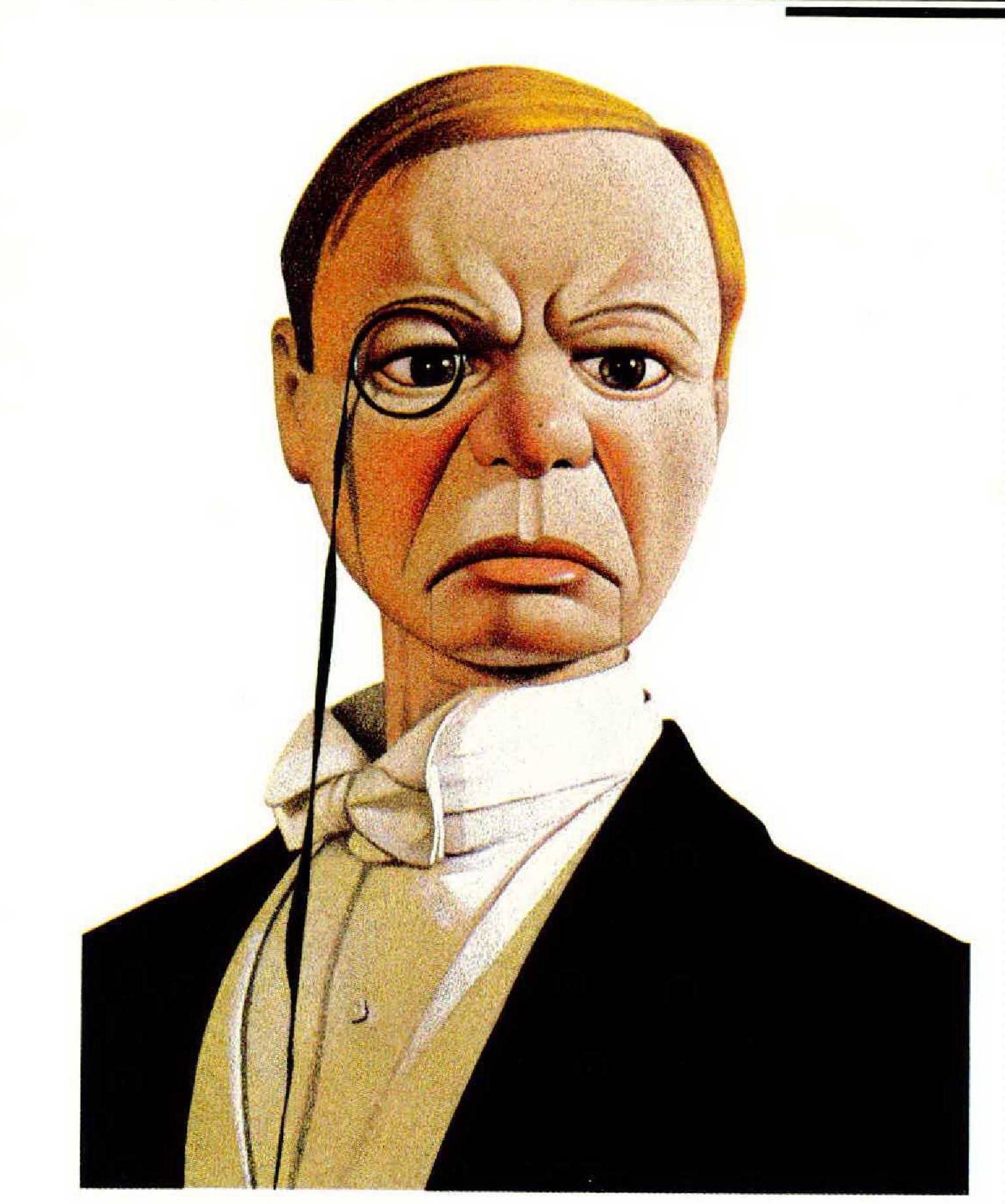
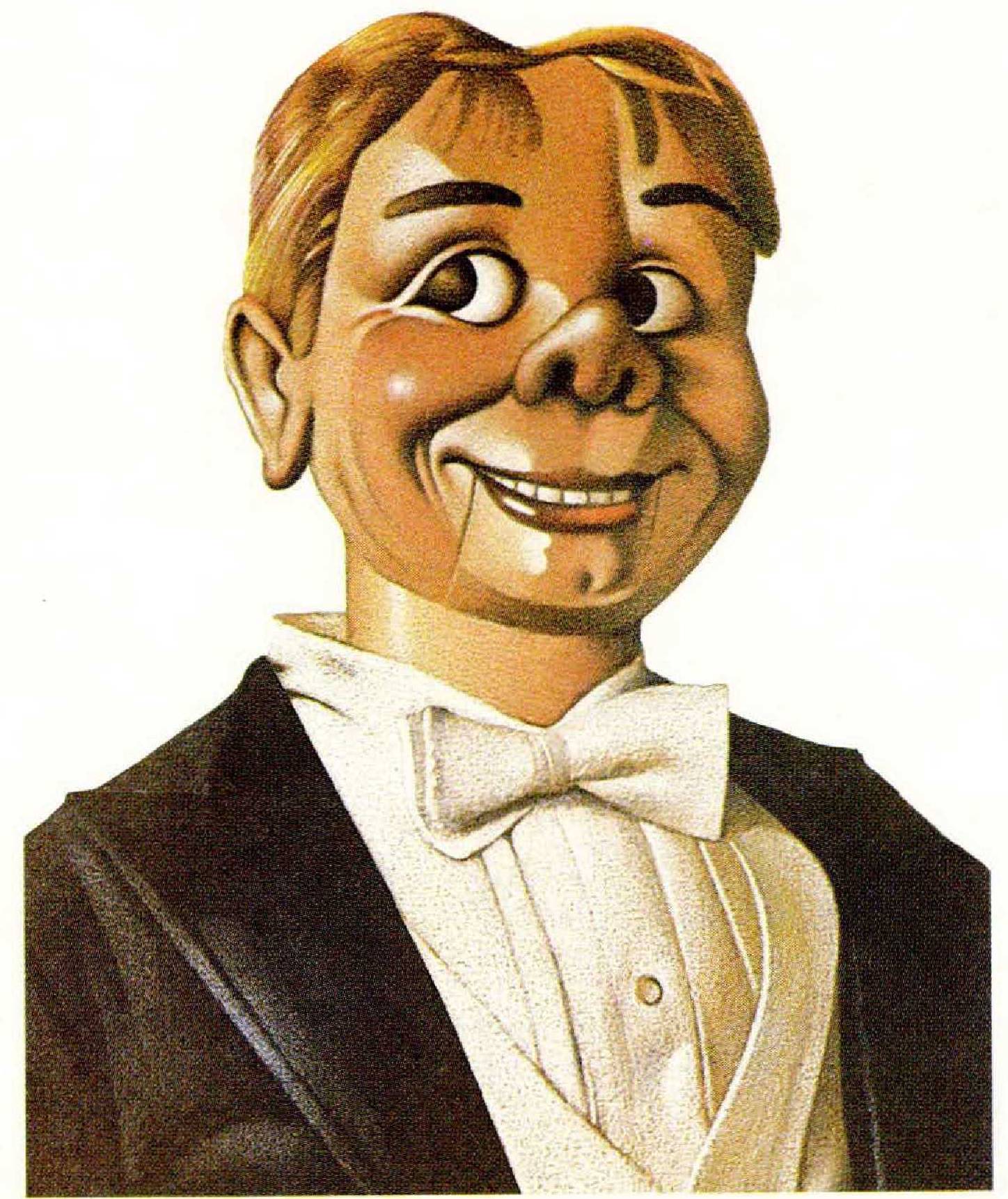
I have seen Semok’s point borne out twice. The first time was when I was a child, and saw Paul Winchell and Jerry Mahoney do a show that was a spoof of a Charlie Chaplin short, and had no spoken words. It must have been entrancing, because the memory is still vivid and I was only four or five. The second time was at the convention, when Jeff Dunham performed one night with a dummy of sour mien made by the figure-makers Bill Nelson and Chuck Jackson. (Nelson did the paintings that accompany this article.) Dunham’s manipulation, perfected on the daunting machine that is a McElroy, can be exquisite, and the dummy he was manipulating that night was unusually expressive to begin with. For fifteen minutes the dummy, which looked vaguely like François Mitterand, drew laughter with little more than an occasional grunt, a raised eyebrow, a disgusted turn of the head. “Something must be wrong,” Dunham said later, “when you can get by in an act without your figure having to talk.” He was being too modest.
ONWARD CHRISTIAN FIGURES
CONTESTS ARE HELD THROUGHOUT THE INTERnational Ventriloquist ConVENTion, for juniors and seniors, and prizes are awarded for distant voice, manipulation, and originality. One night I saw a boy of ten standing in the hallway, with a typical Irish-kid type of dummy on his arm and his mother bending over him. He was in tears, because he had arrived late and missed his chance to compete in the juniors. On the next night the convention officials interrupted the senior competition and gave the boy his turn.
He came out on stage dressed in immaculate white, and with the confident presence that very young people sometimes have, not being aware yet of all the good reasons for falling to pieces. His dummy, it seemed, had been lonely of late, didn’t have any friends. “You always have a friend,” the boy told him. “No, I don’t have any friends,” the dummy insisted. “Yes, you do,” the boy said. I didn’t have to wait long to find out where this routine was leading. A few moments later I heard the dummy say, “Jesus? I don’t know any Jesus.” And off it went. When the boy finished, he slid from his stool and sang, in a high, clear voice, without accompaniment, a hymn. About half the people in the audience rolled their eyes and clapped dutifully, and about half gave the boy an authentic ovation.
You don’t notice them at first, because the more pungent aspects of the art, such as dummies and disembodied voices, tend to make a more forceful initial impression at the convention, but gospel vents are a growing force in ventriloquism. Clinton Detweiler estimates that 50 to 70 percent of the people taking courses from the Maher Ventriloquist Studios intend to use their talents for church work. In the dealers’ room a good number of stalls offered a selection of materials of a plainly Christian provenance, such as a Treasury of Clean Teenage Jokes and Gospel Ad-Vent-ures. I was struck at the convention by how inoffensive the humor was in general, and eventually learned that this was the result of a tacit compromise between the gospel vents and the others. Some friction had been growing between the two groups as the presence of gospel vents at the convention became increasingly pronounced. Tensions were eased when the gospel vents began to do less “witnessing” on stage and to use the convention mostly to exhibit their secular material. (They can strut their gospel stuff at the annual convention of the Fellowship of Christian Puppeteers.) The other vents, in turn, tried to bear in mind that they weren’t in Las Vegas.
I had dinner with Dale and Liz VonSeggen, who direct the Puppet Ministry of the Denver First Church of the Nazarene, and after Liz had blessed our food, she said, “You don’t get much of an inkling at first that people like us are here. Several years ago there was an attempt to run two separate programs, one for club performers and one for Christian performers. A decision was reached after that to combine our efforts. A lot of the evangelicals now tend to pull back and cross over to mainstream vent routines. But we come because this is the greatest gathering of ventriloquists in the world, and it’s the only place you can go where everyone understands your artistic needs.”Dale VonSeggen said, “You probably think puppet ministry is a little strange, but puppetry has been associated with religion for a long, long time. The word marionette means ‘little Mary’ and comes from the Middle Ages, when Christmas plays would be performed with puppets. Then puppetry was thrown out of the church, and it stayed out for a long time.” It was accepted back by the Protestant churches in the nineteenth century and received a great impetus in the 1970s, with the popularity of Sesame Street. “We figured,” Dale said, “that if you could use figures to teach the ABCs you could use them to teach John 14:6.”An enterprise called Puppet Productions, in San Diego, sent teams around the country, mostly to fundamentalist churches, to set up puppet ministries for children. Demand grew rapidly, and Puppet Productions eventually branched into programs aimed at combating drug and alcohol abuse. The ability of a puppet or a dummy to command attention, compel confidence, and force a message through is difficult to counter. Puppeteers and ventriloquists are now routinely used to elicit testimony from children who have been beaten or sexually abused and who won’t talk to an adult. But church work is by far the largest nontheatrical outlet for ventriloquism. Liz VonSeggen received her first dummy, a Danny O’Day replica from a mail-order catalogue, in 1964. The VonSeggens now rule a small empire. When I spoke to them, they were about to embark on an eight-city cross-country tour with their evangelical troupe, called Victory in Puppetry. They conduct a week-long Children’s Ministries University every summer, attended by two hundred people.
Gospel ventriloquism has made at least one small inroad into an older faith. Jonathan Geffner, who was my pick to win the seniors competition (he came in second), started out as, in his words, “the Jewish equivalent, I guess, of the gospel vents.”Geffner, an intense young man, has a master’s degree in piano from the Manhattan School of Music. He turned to ventriloquism in part because he was having trouble making a living in the concert hall. He began using ventriloquism in classes he teaches in Hebrew school, and his Jewish-theme programs soon became popular in temples, community centers, and schools throughout the New York area. He now performs a wider range of material. I asked Geffner what he especially liked about being a ventriloquist. He thought for a minute and then said something I had been told in various ways by other vents: “Well, there’s the whole element of not having to rely on another human being.”
THE VENTRILOQUITIC OATH
“I DON’T KNOW-MAYBE IT’S THE ELEMENT OF miracles,” Ronn Lucas said when I asked him why there are so many evangelical ventriloquists. “Maybe they read about Moses talking to the burning bush and it gives them ideas. This is one of those unanswerable questions. Why are so many famous ventriloquists left-handed? Why do a disproportionate number seem to come from Texas? I don’t know the answer to those questions either.”
Lucas was relaxing in his suite, dressed in a jumpsuit. I asked Lucas if ventriloquists have a code they live by, and he laughed and said, “You mean a Ventriloquitic Oath?" He thought for a while. “There are some things that generally aren’t done,”he said. “The vent’s voice has to be his own and it has to be live or at least appear to be. And the figure on his knee is traditionally something he manipulates, not a real person. But there are always legitimate exceptions, and there’s room to stretch.
There’s a lot that can be done with electronics, for example, to change the character of your voice or enable you to manipulate a figure from afar. It’s inevitable that ventriloquism will branch out into holograms and liquid-crystal displays.
“But what will always remain the same is the schizophrenic aspect of ventriloquism, the tension between illusion and reality, that both attracts and repels.”
Lucas took Buffalo Billy down off a chair.
“I hate having to get up,” Billy said. “Reality is getting me down. Reality is so phony.”
“But, Billy,” Lucas said, “you’re not real.”
“Can I take that as a compliment?”