Not Log Cabins: Timber Framing Is an Innovative Alternative to Stud Framing
NOT LOG CABINS
BY PHILIP LANGDON
I RECENTLY SPENT three days in Elizabethtown, Pennsylvania, with some of the least-understood members of the custom-home industry— a group of craftsmen known as timber-frame builders. “What kind of log house do you build?” is the question most often asked of timber-framers, and it drives them crazy, because few timber-framers build houses with log walls. The distinctive feature of a timber-frame house is something entirely different— a woodenpegged framework of posts and beams six or more inches thick, which carries the weight of the building and gives the interior an atmosphere of sturdiness and warmth even when the walls between the posts are surfaced in ordinary gypsum board.
Twenty years ago there were hardly any timber-frame builders left in America except Amish farmers, whose distaste for modernity was inculcated by their religion. As far back as the nineteenth century, commercial homebuilders adopted quicker construction methods based on easy-to-carry, easy-to-fasten two-by-four sticks of lumber—stud framing. Traditional timber framing demanded too much labor and skill, both because of the bidkiness of the posts and beams and because the timber frame was put together without nails, bolts, or metal plates. Even today a timber-framer working in the traditional mode will cut the posts and beams so that a wooden tongue, or tenon, at the end of one timber fits precisely into a slot, or morrise, in another. Wooden joints in the mortise-and-tenon system require work of extraordinary exactness; a small mistake can render a large timber useless.
On the outside a timber-framed house looks much the same as a conventional stud-frame house. But on the inside the entire framework of posts and beams is exposed, making a dramatic, rugged outline against walls and ceilings. The rustic beauty of the framework, and its exceptional strength, have spurred a revival of the method since the early 1970s, bringing a seemingly obsolete craft back from the edge of extinction. By 1985 timber-framers had become numerous enough to form their own organization, the Timber Framers Guild of North America. I went to Elizabethtown, fifteen miles northwest of Lancaster, to join some three hundred and fifty timber-framers at their annual conference, on the tidy Elizabethtown College campus, with its orange-brick buildings. In talking with conference participants I discovered that a number of timberframers were part of the back-to-theland movement of the late 1960s and early 1970s—a few of the men still wore that era‘s ponytails and round wire-rim glasses, along with the standard plaid shirts and blue jeans.
Nonetheless, timber-framers have a symbiotic relationship with metropolitan areas. After doing the labor-intensive cutting and carving in their shops, which tend to be in low-wage rural areas, they often truck the finished posts and beams hundreds of miles and assemble the structure in a place where customers are willing to pay a higher price for a house. Some timber-framers build the entire house. Others erect only the frame, leaving it to the buyer or a contractor to bring the house to completion.
For a while, one of the toughest problems was insulation. The solution most timber-framers eventually settled on was to enclose the frame with “stress-skin panels”—factory-made sandwiches of building and insulating materials. The panel‘s first layer, facing the interior of the house, is a half inch or so of gypsum wallboard. The second layer is usually three-and-a-half or five-and-a-half inches of moisture-resistant rigid foam insulation. The third layer is a half inch of exterior sheathing—often orientedstrand board, which is wood chips glued together so that the fibers in each ply run in a different direction, giving the panel strength. The panels can be quickiv installed and then covered with whatever looks best—clapboard, brick, stucco, or another material.
By comparison, the insulation system in a conventionally constructed house is not well designed at all. Two-by-fours are nailed into place every sixteen inches, and fiber-glass batts are stuffed into the cavities between them. As anyone who has ever insulated an attic knows, fiber-glass batts are not easy to work with. The Pink Panther in the Owens-Corning TV commercials may be able to put the fiber glass in place with a flick of the wrist, but in real life the batts resist rolling out evenly and neatly, Workers installing the fiber glass may leave occasional gaps. Even the best installations are undercut by the wooden two-by-fours, which conduct cold or heat into the house. Polyurethane stress-skin panels are more expensive than fiber glass for the same amount of insulation, and their manufacture relies on freon, which is blamed for some of the depletion of the earth’s ozone shield. Some timber-framers use panels of expanded polystyrene, which do not require freon, but these are not quite as effective as insulation and are more vulnerable to fire. A search is on fora better alternative to polyurethane. Still, a stress-skin panel forming a continuous barrier is a superior insulator. It is this energy-efficient innovation that has made the ancient craft of timber-framing a desirable alternative to conventional building methods.
TIMBER-FRAMERS have made rapid progress in solving technical problems and expanding the aesthetic range of their houses. One of the foremost figures in both these efforts is Tedd Benson, a tall thirty-nine-year-old who has been building timber frames since 1974 in Alstead Center, New Hampshire. Benson was an anti-war activist and an organizer of “street academies” for poor minority youths during his college and immediately post-college years. He expected to end up a social worker, not a homebuilder. Yet timber framing is an expression of conviction, just as much as his political efforts once were. “Why is a house a hundred fifty years old and not torn down?” Benson asks. “I think buildings last because people love them. They love them because there’s an obvious aura of human presence.” In timberframe houses the feeling of human presence, of loving care, comes from the handcraftsmanship visible in the posts and beams. Benson, who is regarded as an authority on modern timber framing, collaborated with James Gruber to write Building the Timber Frame House (1980). Last March, Taunton Press published Benson’s second book, The Timber Frame Home, a gracefully written exploration of design.
Around the time of the conference I visited Benson’s shop, on a dirt road in the southwest New Hampshire hills, and saw evidence that Benson is interested in using modern technology, up to a point. In the center of the shop stands a ten-foot-long mortising machine, designed and built by one of his employees, Rees Acheson. It cuts slots in the timbers for mortise-and-tenon joints and thus reduces the human labor that has to be devoted to rough cutting and chiseling. The final stages of the work continue to be done as they were centuries ago, with mallet and chisel; the satisfaction of working with one’s hands, with tools, and with wood is much of what motivates people to become timber-framers.
In a white-walled office above Benson’s shop is a computer-equipped studio where staff designers plan most of the twelve to seventeen houses his twenty-four-person company builds each year. One of the company’s latest accomplishments is learning how to design the complicated mortise-and-tenon joints required by roofs with hips and valleys. “We put hundreds of hours into designing a frame for a hip-and-valley roof,” Benson told me. “After we’d done that, we produced a computer program to solve the difficult joiners, and now we can design one in an hour.” With aids like this, his firm also designs houses for other timber-framers.
In Greenwich, Connecticut, I visited a rambling 12,000-square-foot house— the largest house Benson has ever built, and one whose size and budget allowed him to demonstrate the versatility of timber framing. Because of the advances in hip-and-valley joinery, the family room of the Greenwich house has a vaulted ceiling that rises above the adjoining roof slopes. Inside the room the framing is composed of an unusual combination of woods. Most of the posts and beams arc northern red oak—oak being a favorite of timber-frame-home buyers because of its rugged, informal character. In a broad opening between the family room and the kitchen the framing is clear, smooth-textured Port Orford cedar. The contrast between the two woods is striking. Whereas oak dries out after installation and develops conspicuous but structurally acceptable surface cracks known as checking, the Port Orford, cedar is a West Coast species that arrives dry and remains free of such imperfections; the fine, smooth grain imparts an elegance to its surroundings.
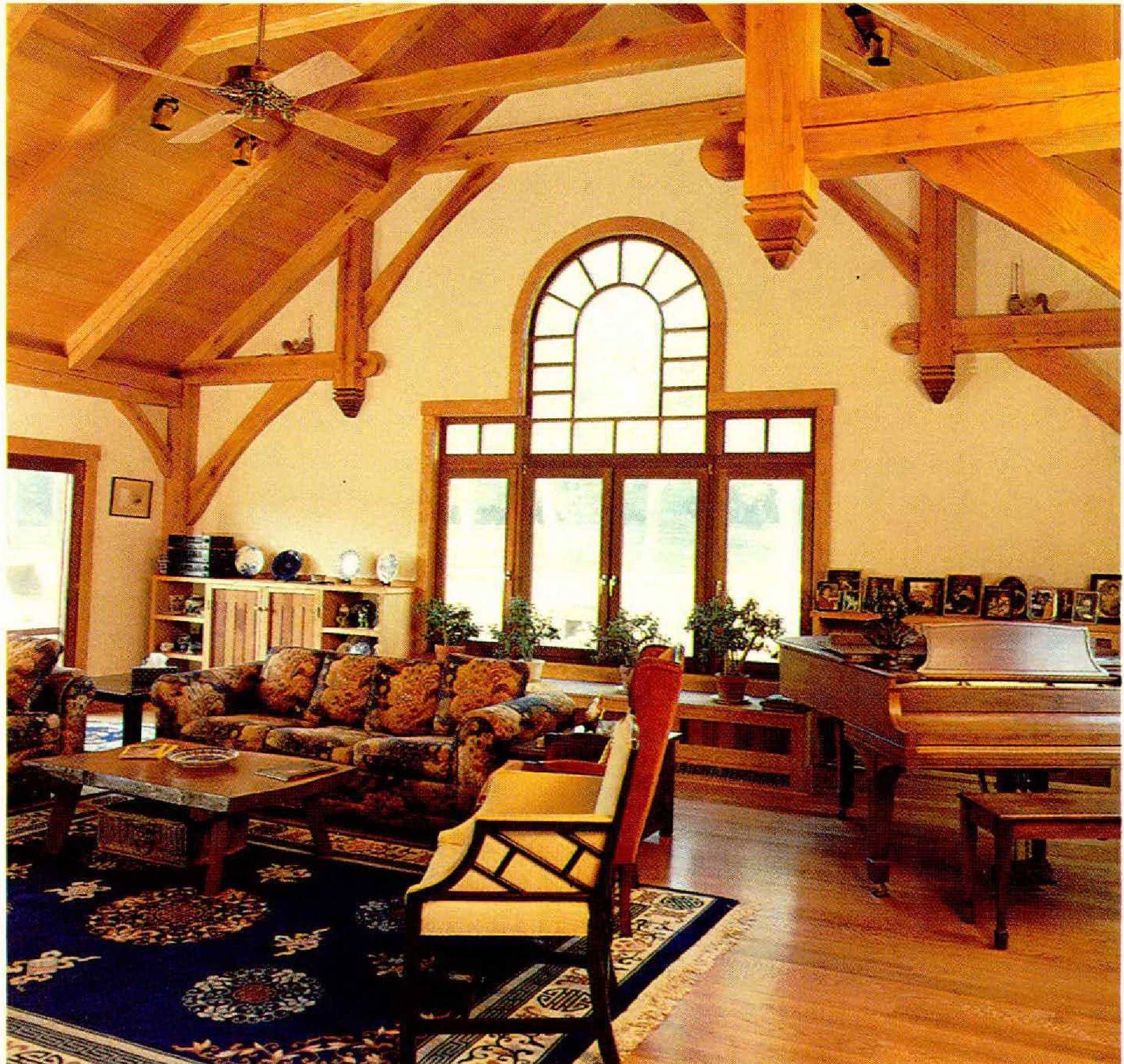
The Greenwich house employs different types of framing to establish a distinctive character in each of its major rooms. In the living room, oak timbers form two rows of “hammer-beam trusses” that reach down from a vaulted ceiling of clear Port Orford cedar to about nine feet above the oak floor. The intricately carved hammer beams and a massive stone fireplace wall are the room’s focal points—so robust and dominant that any other interior decoration is almost superfluous. By extending from the ceiling into the upper portions of the room, the timbers make a fairly large space—twenty-four by twenty-six feet, rising to twenty-four feet at its peak— feel comfortably proportioned.
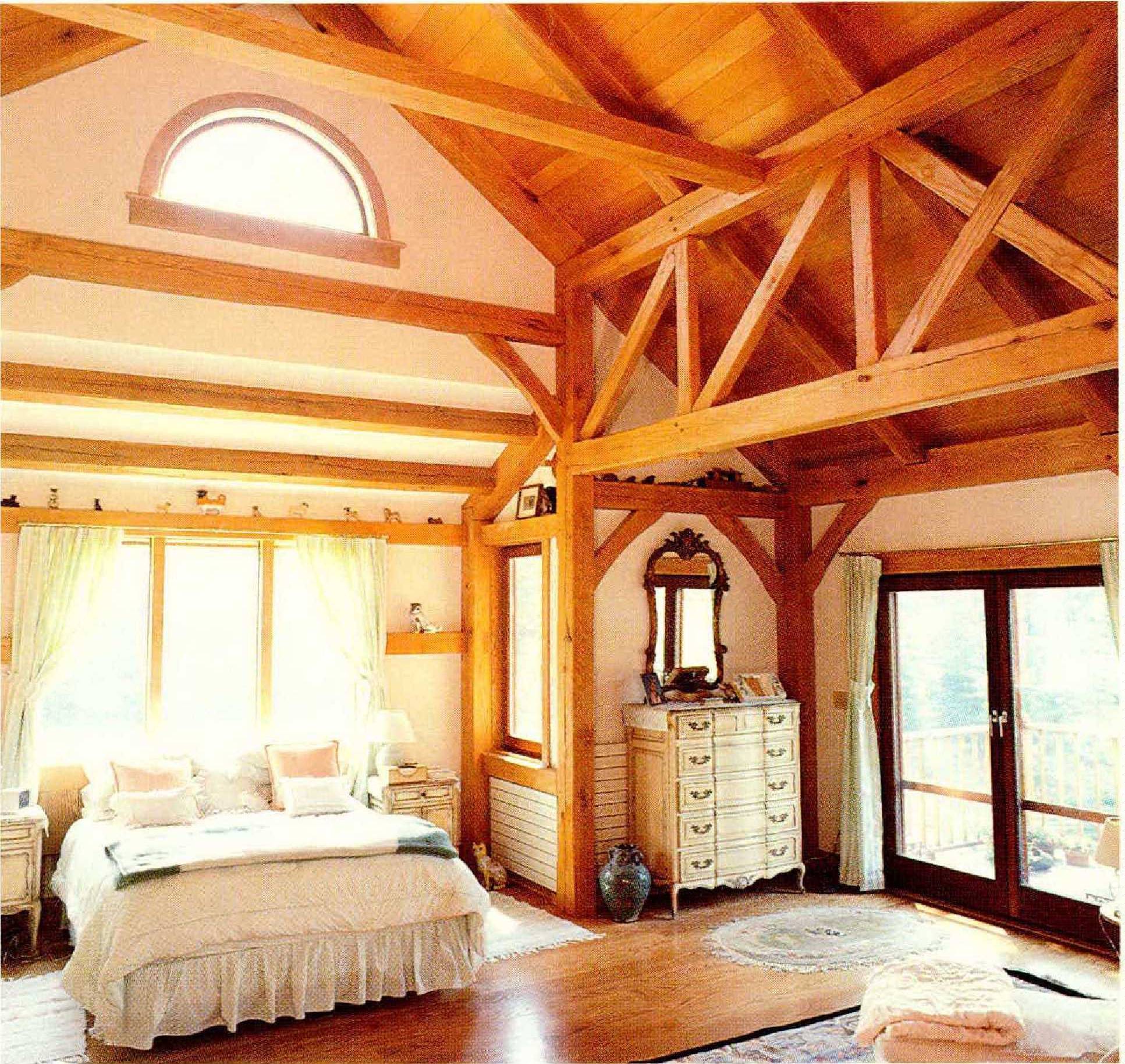
Much the same effect is achieved in the master bedroom, through another combination of framing. Oak beams extend across the sloping ceiling above the bed, breaking the expanse of gypsumboard into segments. Along two walls of the bedroom, bridge trusses—a combination of Xs and diagonal timbers like those in covered bridges—prevent the large room, which has a sitting area and a TV set at one end, from seeming to be a single, overly vast volume. I emphasize timber framing’s success in bringing human scale to large, tall interiors because this is one of the major unresolved problems in many of today’s “move-up” houses and even in some retirement houses, such as those I’ve seen in Sun City West, Arizona.
The cost of the house in Greenwich was $138 a square foot. Much of that can be attributed to luxurious features other than the timber framing and to the cost of everything in Connecticut’s premier suburb. The timber-framers I’ve spoken with say that a timber-frame house typically costs the same as a custom-designed stud-frame house of equivalent quality, or five to ten percent more. The price can be kept down by using a simple gable roof, an uncomplicated floor plan, and non-exotic woods—pine, for example—for the timbers.
Anyone contemplating having a timber-frame house built should be aware that such houses are more challenging to design than conventional ones. Stories are told, for instance, about timberframers who built a house with a laundry room in the core of the home and left no way to run an exhaust line to the exterior without either cutting through a beam or installing a duct that would protrude awkwardly beneath the ceiling. The locations of plumbing, heating, and electrical lines must be planned more rigorously than they would need to be in a stud-frame house, and after a timberframe house is built it is harder to add new lines to it.
The timber frame and the house itself must be planned in relationship to each other. The intervals from one load-bearing post to another and from one beam to another should be coordinated with room sizes and partition walls. In a welldesigned home the posts and beams help to define each area of the house. Since most timber-frame companies are small, with an average of a half-dozen employees, some have their customers work on the design with an independent architect or with the help of a more comprehensive timber-frame firm.
The most sophisticated firms, like Benson’s, may continue for a long time to serve a widely scattered clientele, but as timber-framers become better understood and more numerous, the trend will probably be toward their concentrating on customers within two hundred miles or so of their shops. This should produce improvements in cost efficiency that will benefit timber-framers and home buyers alike. Builders with national ambitions may be encouraged to operate more than one shop, in different parts of the country. Timberpeg, one of the most commercially successful of such companies, annually produces more than two hundred pre-cut timber-frame packages, in shops in both Claremont, New Hampshire, and Fletcher, North Carolina. Timberpeg uses fairly simple joinery, and its production process is relatively highly mechanized. A list of the approximately two hundred timber-frame companies for which the members of the Timber Framers Guild work can be obtained by writing to the guild at P.O. Box 1046, Keene, New Hampshire 03431.
The hope now among timber-framers is that their craft will avoid the fate of dome houses—that of being seen, in Benson’s words, as “just another interesting but out-of-the-mainstream building form.” Astute practitioners realize they will have to become known not only for fashioning rugged beauty but also for practical problem-solving.