The Return of the Shag: Languid, Sensual Steps to Rhythm and Blues Are Newly Popular
EACH YEAR DURING the second week after Labor Day thousands of people from all over the Southeast flock to North Myrtle Beach, a town on a stretch of the South Carolina coast called the Grand Strand. The event is a gathering of the Society of Stranders, and its principal function is to celebrate a dance called the shag, a staple of Carolina life. The shag is a slow, easy dance that developed in the late 1940s and early 1950s to early rhythm-and-blues music, but it has endured a lot of changes since then. After a hot summer’s day at work, or at the beach, many Carolinians think there is no greater pleasure than grabbing a few beers, heading for a local nightclub, and shagging the evening away. Small wonder that the shag is the state dance of South Carolina, that shag clubs exist in every major city and hundreds of smaller towns in both Carolinas, and that perhaps hundreds of thousands of people do it all over the South.
But few people outside the South have heard of the shag, and even fewer can do it. This may change soon, with the release this month of Shag, a film featuring the dance as choreographed by Kenny Ortega, who achieved national recognition as the choreographer of Dirty Dancing. Ortega first learned about the shag from some extras who worked on Dirty Dancing. “When I finally saw tapes of people shagging, I fell in love with it,” Ortega says. “The shag is stylish, it’s sexy, and all kinds of people of all ages do it. And what I hope we’ve captured in this movie is that the shag is a central part of the Carolina life-style.”
THAT ESPECIALLY AMERICAN confluence of black music and white kids, usually at hangouts frowned on by adults, gave birth to the shag in the 1940s on the Grand Strand, the fiftyfive-mile crescent-shaped beach running north from Georgetown, above Charleston, to the North Carolina border. At that time the Strand was the summer habitat of large numbers of college kids, from all social levels in North and South Carolina, who had become addicted to the free and unruly character of beach life. Away from the supervision of parents or campus authorities, these college kids tended, of course, to act like irresponsible good-for-nothings— beach bums—and were treated as such both by locals and by servicemen on leave from the many military bases in the area.
The college kids learned to make a virtue of necessity by accepting this community rejection and cultivating an aloof, “cool” demeanor. Cool meant, first, a look: for the boys, long, slickedback, peroxided hair with ducktail, Vnecked sweater with no shirt underneath, custom-tailored baggy pants; for the girls, short shorts, cut to reveal a sliver of panty. Cool footgear consisted of simply Weejuns or moccasins; socks were uncool. But cool also meant following a certain routine. Days were spent on the beach. Shortly after dusk the beach bums walked along the boardwalk to the numerous open-air pavilions that were the social centers of all the communities along the Grand Strand. Each had a refreshment stand, an arcade, and, most important, a wooden dance floor with a Wurlitzer jukebox. There the beach bums hung out until somebody came along who could afford to set the machine whirring: a nickel bought one song, a quarter bought five. Until the end of the war white teenagers heard only swing music and danced only the Lindy hop, better known as the jitterbug—a vigorous, jumpy dance that had swept the country in the 1930s. The cooler beach bums preferred hot black bands such as those of Lucky Millinder and Jimmie Lunceford, and the steps they danced to them were smoother and less frantic.
“Nobody started out to invent a new dance,” says Billy Jeffers, who first came to the Strand in the late 1930s and stayed through the mid-1940s. “We just didn’t think all those jerky jitterbug movements fit in with what life was like at the beach. So we began to dance the way we talked to girls—nice and easy, and real laid back.”
An accident of geography changed that slow, cool jitterbug into a distinctive dance all its own. Smack in the middle of the Strand was a single, utterly segregated black community called Atlantic Beach. To this day the beach road makes a detour inland to avoid the town. Atlantic Beach jukeboxes were then stocked with what the trade called “race music”— that is, records made by black musicians and marketed to a black audience. (Only in 1949 did Billboard magazine reclassify “race music” on its charts as “rhythm and blues.”) Around 1947 Jim Harris, a white man who owned and stocked most of the Strand jukeboxes, including those in Atlantic Beach, began to stick some race-music records, as a curiosity, into some of the Wurlitzers in the white pavilions. To his astonishment they were instant hits. Four years before the Cleveland disc jockey Alan Freed inaugurated the great “crossover,”by programming black music on white stations, Strand beach bums had already incorporated race music into their lives.
One avid race-music fan was Jo-Jo Putnam, a white South Carolina drummer who first landed on the Strand in 1947, at the age of thirteen. “We loved race music, but you couldn’t find it on the radio,”he says now. “You also couldn’t hear it anywhere else: the black groups couldn’t play in white clubs and were restricted to what was known as the ‘chitlin circuit.’ So the only place we white kids heard race music was at the beach.”
The dance now called the shag originated when Jo-Jo Putnam’s generation met Billy Jeffers’s generation—when the slow jitterbug perfected by the latter was adapted to the race music adored by the former. Putnam, for instance, never forgot the moment he first saw Billy Jeffers dancing at Robert’s Pavilion, in Ocean Drive Beach (now called North Myrtle Beach). “I couldn’t believe my eyes,”Putnam told me at a recent Society of Stranders party. “A whole realm of self-expression opened up to me. I thought I’d just been granted the opportunity to participate in a new art form. I almost broke down and wept.”
Robert’s and the other open-air pavilions with race music on their jukeboxes were the perfect environment for a group of white kids who were cocky and creative enough to invent their own forms of expression and competitive enough to goad one another on. The beach bums would meet nightly to improvise new steps and inspire one another, and to showcase what they did. A new dance had been born. It didn’t have a name, and was referred to as “beach dancing,”“nigger boogie,”“fas’ dancing,”and “dirty shag,” this last after an old Lindy step that vaguely resembled another Carolinian dance, the Charleston. “Shag" eventually stuck.
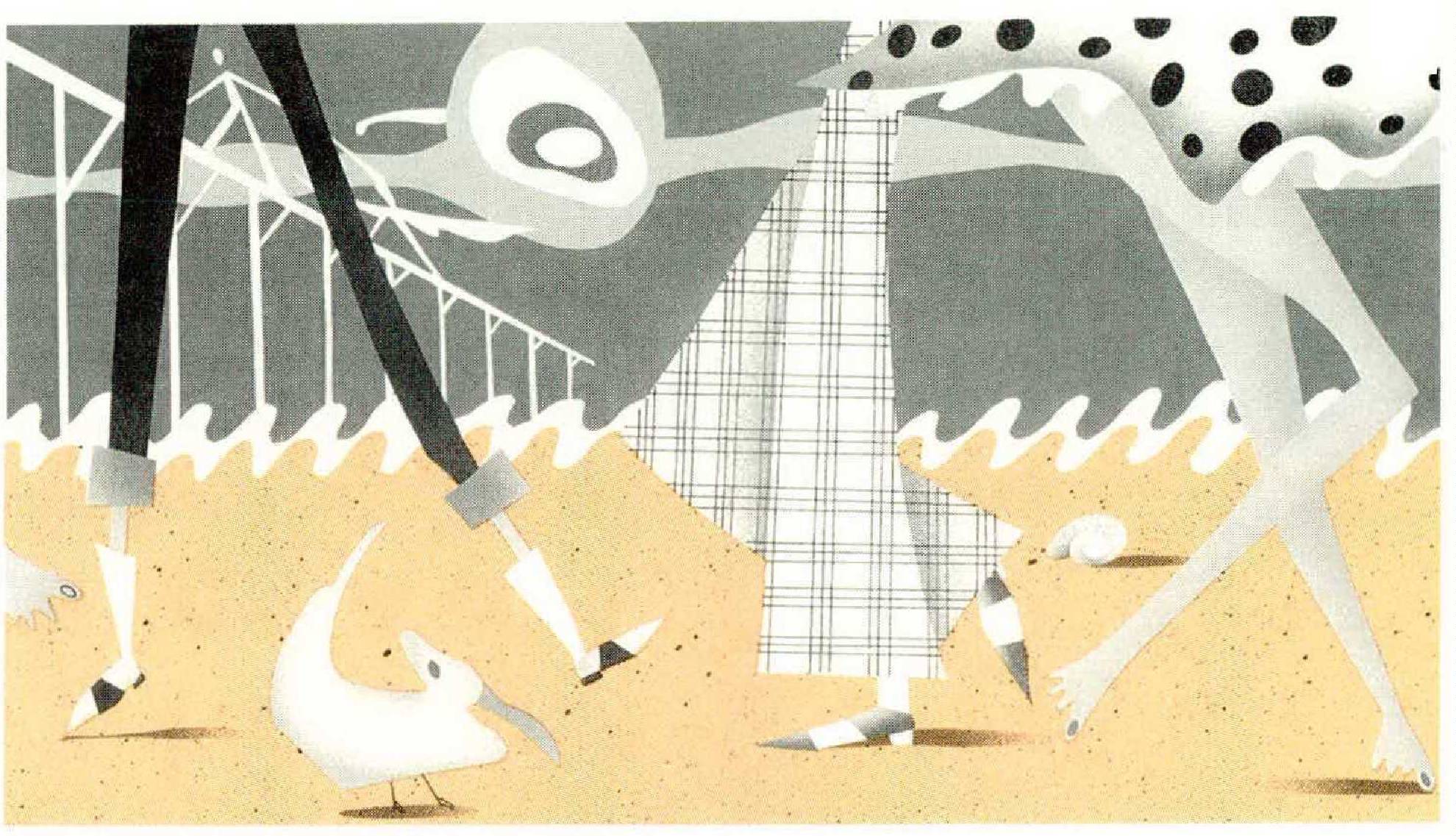
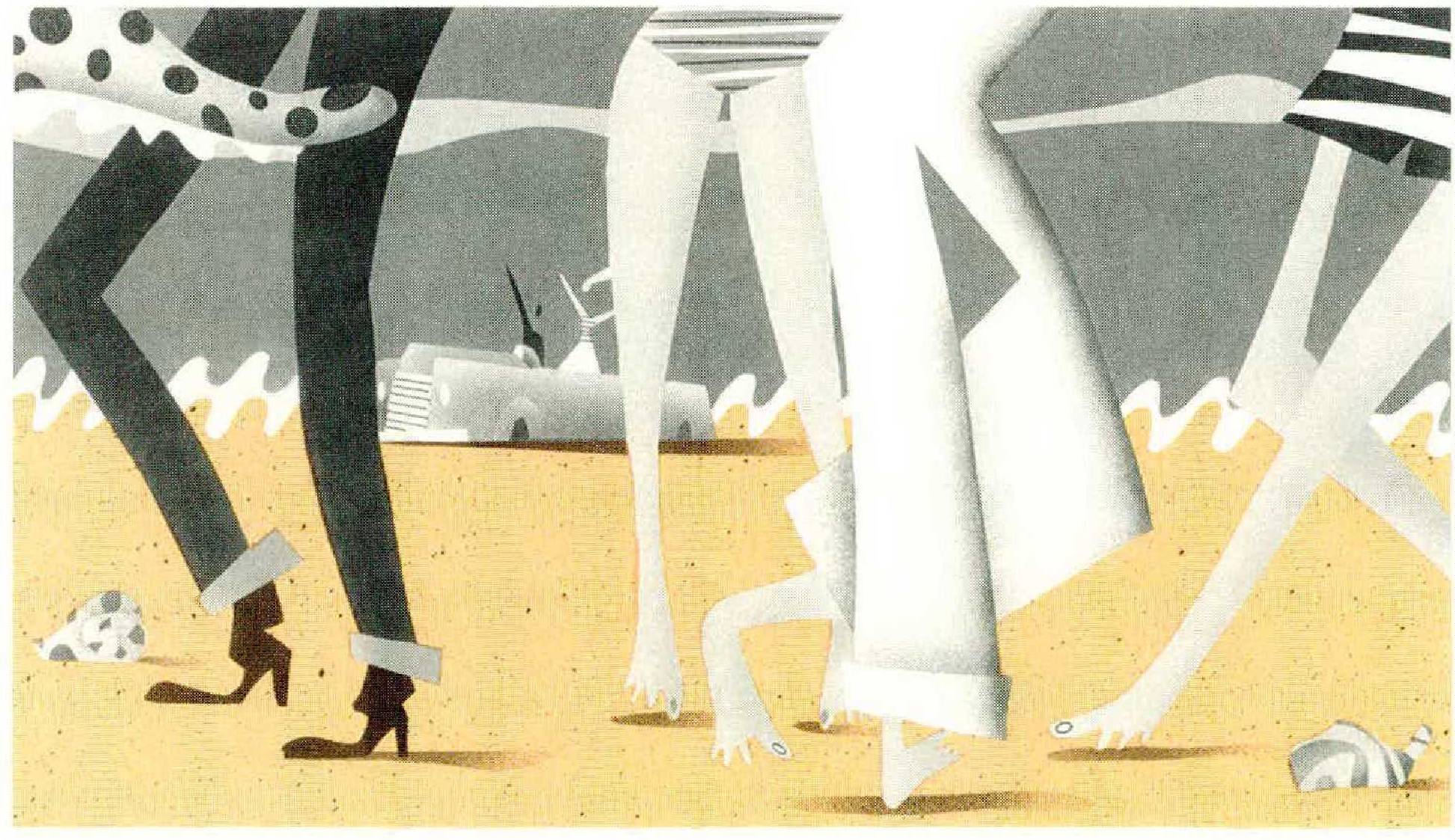
Some resemblances to the Lindy hop remained. Both are highly improvisational dances, and in both the partners mostly stay at arm’s length, rather than clutching each other ballroom-style. In both it’s mainly the male who shows off, whereas in ballroom dances his principal function is to show off the woman. But the differences between the Lindy and the shag are fundamental. While Lindy hoppers charge into their steps, shaggers stay aloof and detached. The shag is sexy, but it’s not the sweaty sexuality of the Lindy, with its wild animal energy, nor the explicit, aggressive sexuality of the tango, with its pantomimes of hunter and hunted. Instead the shag has a languid sensuality that involves slow, casual thigh and chest contact.
The beach bums put it simply: the shag, done right, is cool. Uncool is holding your partner with both hands, ringaround-the-rosy style. Uncool is picking up your feet more than six inches off the ground. Uncool is looking like you know how good you are. Cool is letting your right arm dangle carelessly by your side. Cool is making your feet act as if they are sliding on glass. Cool is looking away from your partner, or facing away from her as if she didn’t exist.
In 1951 a black group called the Dominoes released what quickly became the shaggers’ anthem of cool—“Sixty Minute Man.” The song combines a perfect rhythm-and-blues tempo, an aggressive masculine ethic, and sexual innuendo. It concerns the exploits of a certain Lovin’ Dan, who invites women attached to no-good men to drop by his place. Dan tells them what to expect:
then you’ll holler please don’t stop.
There’ll be fifteen minutes of teasin’,
fifteen minutes of pleasin’,
and fifteen minutes of blowing my top.
If your old man ain’t treating you right
Come up and see old Dan.
I’ll rock ‘em, roll ‘em, all night long
I’m your sixty minute man.1
IN OCTOBER OF 1954 Hurricane Hazel ravaged the Strand from top to bottom, and the Strand beach-bum culture was nearly annihilated. All the boardwalks and pavilions were torn to splinters, along with most of the mom-andpop cottages that beach bums inhabited during the summer. Few of the pavilions and cottages were rebuilt. Developers bought up beachfront property, and big motels began appearing along the coast. With the cottages gone, the college students stopped coming in the same numbers and stopped learning to shag. The older beach bums moved back inland, to acquire jobs and families.
Here and there small clubs opened up to keep shagging alive. The most notorious of these was The Pad, in Ocean Drive Beach, which opened in 1955, across the street from the remains of Robert’s Pavilion. The Pad was in the open carport of a beach house on stilts whose owner had decided to allow dancing and to sell beer. The owner was eventually forced by offended local citizens to build a wall around the dance floor, so that the shag dancing wouldn’t corrupt passers-by. At last community pressure prevailed, and in 1967 The Pad went the way of the earlier beach-bum hangouts.
Yet another serious blow to the shag was the sudden stardom, in 1956, of Elvis Presley, followed by Beatlemania. Although nominally inspired by rhythm and blues, Elvis and those who followed sped up the tempo and abandoned the original feeling. The shag had the flexibility to adapt to the considerable variations that rhythm-and-blues music underwent, but the new popular dances, such as the stroll (1957), the twist (1961), and the shake (1965), were essentially separate steps with no such flexibility. Predictably, these steps enjoyed some popularity for a time and then faded away.
The time between Hurricane Hazel and 1970 is known to local historians as the dark ages of shag. What followed is known, logically enough, as the shag renaissance. In 1970, when disco music was just coming into its own, a former beach bum named Bob Barnhill took over the management of an old bar, called Fat Jack’s, in Ocean Drive Beach. Barnhill began with the intention of turning Fat Jack’s into a disco. Halfway through the renovations he had a change of heart.
“I told myself I’d give it one more try,” Barnhill told me at the Society of Stranders gathering. “Shagging, and the music it was done to, was born here, and I thought it shouldn’t die here.” He stopped buying mirrors and colored light bulbs, got an old Wurlitzer, and stocked it with rhythm and blues. One of the songs, of course, was “Sixty Minute Man.” Barnhill says, “Fat Jack’s took off like wildfire. The old beach-bum crowd was ready to return to what they had done as teenagers.”
Other former beach bums began converting discos back to shag clubs. Even The Pad reopened. The shag renaissance at the Strand soon spread to Columbia, Charleston, and other places where former beach bums had gone to build careers. Most heartening of all, a few groups of musicians began recording what became known as beach music— not nostalgic rhythm and blues but music with a contemporary feel that was suitable for shagging. Young people began picking up the shag, and it became the dance of choice at college-fraternity beer blasts, proms, reunions, debutante balls, weddings, and all occasions where someone played a beach-music record. In the mid-1970s a North Carolinian from Greensboro named Shad Alberty began actively promoting shag clubs and shag competitions in that state, and in 1978 began offering commercial shag lessons. Shag clubs soon opened in Virginia, Georgia, and Florida, as well.
In the spring of 1980 Gene Laughter, who had been a Strand lifeguard in the early 1950s and is now an advertising executive in Richmond, Virginia, decided to try to stage a reunion of the old beachbum crowd, sometime the following September for a few days. The idea at first seemed hopeless; there was no way to track down even a handful of the old beach bums, since few of them had ever known one another’s last names. The North Myrtle Beach Chamber of Commerce wouldn’t help, and local merchants laughed at him, but Laughter decided to go ahead anyway. News spread by word of mouth and with the help of a few obliging local newspapers. About a hundred people were expected. Seven thousand materialized. “You have to realize,” Laughter says, “that none of us beach bums made the transition to rockand-roll. So when the reunion of the group—which we called the Society of Stranders, or SOS—was announced, a whole generation showed up.” Delighted by the success, Laughter has organized a similar gathering, open to the public, every year since then.
But even as the SOS gatherings bring together shaggers from all age groups, all classes, and all parts of the South (and some from beyond the South), they also bring to light great differences among shaggers. Old-timers complain that what they see on the dance floor isn’t genuine shagging: the shag is an individualized dance, and if you learn it in a school, as most newcomers have, you simply become a clone of the instructor. Newcomers, for their part, tend to view the oldtimers as fuddy-duddies and welcome the advent of a certain standardization in the dance, which makes contests possible. All the commotion about authenticity only testifies to how much shaggers care about the dance.
In the middle of a recent SOS gathering I ran across Laughter in a beach-music club just before dawn. I remarked, half jokingly, that since more and more people were doing the shag every year, perhaps the old Grand Strand beachbum fraternity should turn the situation into money—with books, posters, videos, official contests, T-shirts, trivia games, memberships, and assorted paraphernalia.
The vintage Wurlitzer was pulsing away, and Laughter was sitting on a railing above the dance floor, tapping his Weejuns to an old rhythm-andblues number about somebody’s mean momma. He was wearing cutoffs and his white hair was spilling out from underneath a pith helmet. A paper cup of beer occupied his right hand; he was propped up on the railing with his left.
“Naah,” Laughter said. “That wouldn’t be cool.”
- Lyrics by William Ward and Rose Marks, ©Fort Knox Music Co., Inc., and Trio Music Co., Inc., used with permission.↩