The Venerable Will
THE CENTENARY OF Will Durant’s birth falls on November 5, 1985. If celebrations are planned, I am not aware of them, but, in all decency, the executives of Simon and Schuster and the Book-of-the-Month Club ought to raise a glass to the memory of one whose Story of Civilization, in eleven fat volumes, has long sustained both establishments. The series has never been out of print. For a quarter of a century The Story of Civilization has served the Book-of-theMonth Club as a choice premium in newspaper and magazine advertisements: new members, taking advantage of an introductory offer, can buy all eleven volumes for $29.95, which works out to roughly one penny for every 1,500 words. Through the offices of the Bookof-the-Month Club alone, at least 500,000 complete editions of the work are extant in the land. Many occupy places of prominence in the nation’s living rooms and dens, where they are visible affirmations that civilization itself is no stranger to the neighborhood.
Has anyone actually read The Story of Civilization—gone the whole yard from Our Oriental Heritage (1935) to The Age of Napoleon (1973)? Has anyone, for that matter, even finished a single volume? The fraternity of such folk must be a very small one, which is a pity. The Story of Civilization repays careful study. Like Las Vegas, it is a truly monumental piece of work—so deficient in conception, so dreadful in execution, as to achieve a stunning grandeur.
Vowing to “gather up our heritage, and offer it to our children,” Will Durant set to work in 1927, the success of his Story of Philosophy—a finger exercise for what was to come—having afforded him a measure of financial independence. Durant was a Catholic ex-seminarian with a Ph.D. from Columbia, a sometime high school teacher in Manhattan, a vegetarian, and a frequent lecturer at laborite-leftist uplift gatherings. He took to wife one of his students, a girl of fifteen named Ida Appel Kaufman, and though he called her Puck for a spell, he finally settled on Ariel. Ariel Durant became Will’s researcher and collaborator. Six decades into their marriage the pair published a joint autobiography. It is an ingenuously revealing account, in which the authors wax in celebrity and ripen in love despite personal setbacks and unfriendly reviews.
In a way, the story of their marriage echoes the story (as the Durants tell it) of civilization: Bad things happen, but the human spirit is indomitable. Men are slaughtered, cities plundered, morals compromised, and yet, “among the ruins, men and women continued to write books.” Somehow the ascent of man inexorably proceeds, at a steady inclination of perhaps six degrees. The first amphibians creep out of the primal soup. Soon they are making tools. Then along comes Spinoza.
Reverses are momentary, obstacles fleeting. The Babylonians fade from the pages of history, but that’s all right, because “meanwhile, three hundred miles north of Babylon, another civilization had appeared.” Imperial China is wracked by political strife. No matter: “The life of the Chinese people flowed evenly on.” Despite poverty and oppression under the Raj, nineteenth-century India “continued to create science, literature, and art.”
Few events seem unexpected; everything is in its place. In an instant problems are solved. (“Caligula eased the situation by dying.”) In an instant problems are created. (“It seemed a propitious time to begin the Hundred Years’ War.”) History unfolds according to orderly rules, distilled into maxims. “A nation is born stoic and dies epicurean.” “The philosophy of one age is the literature of the next.”“Men lie most when they govern states.”
No human being is totally vile. “What sort of man was this ogre of a king?” Henry VIII, it turns out, was kind and generous to his friends, “jovially amiable, and capable of winning affection and devotion.” Louis XV was “sometimes cruel but more often humane.”Even Ivan the Terrible, who Durant frankly admits should never have been born, “had a sense of humor and could roar with Jovian laughter.”
Ariel’s name joined that of her husband on The Story’s later volumes, but Will was always the dominant partner. He perfected a glib, equable, didactic style of exposition that is virtually without peer in the modern hardcover trade. (Imagine Time magazine as a 2.000-page book.) Occasionally Durant confessed ignorance, but always wearily, as if what he couldn’t establish was in any case irrelevant. “We do not know which of the many roads to decay Crete chose,”he allowed; “perhaps she took them all.” He donned humility in a way that left all but himself decked in its raiments. “The past would be startled,” he w rote, “if it could see itself in the pages of historians.” From time to time he slyly asserted his authority by casting the reader abruptly overboard—“Recall the situation of Italy in 1494”—and then throwing him a life preserver.
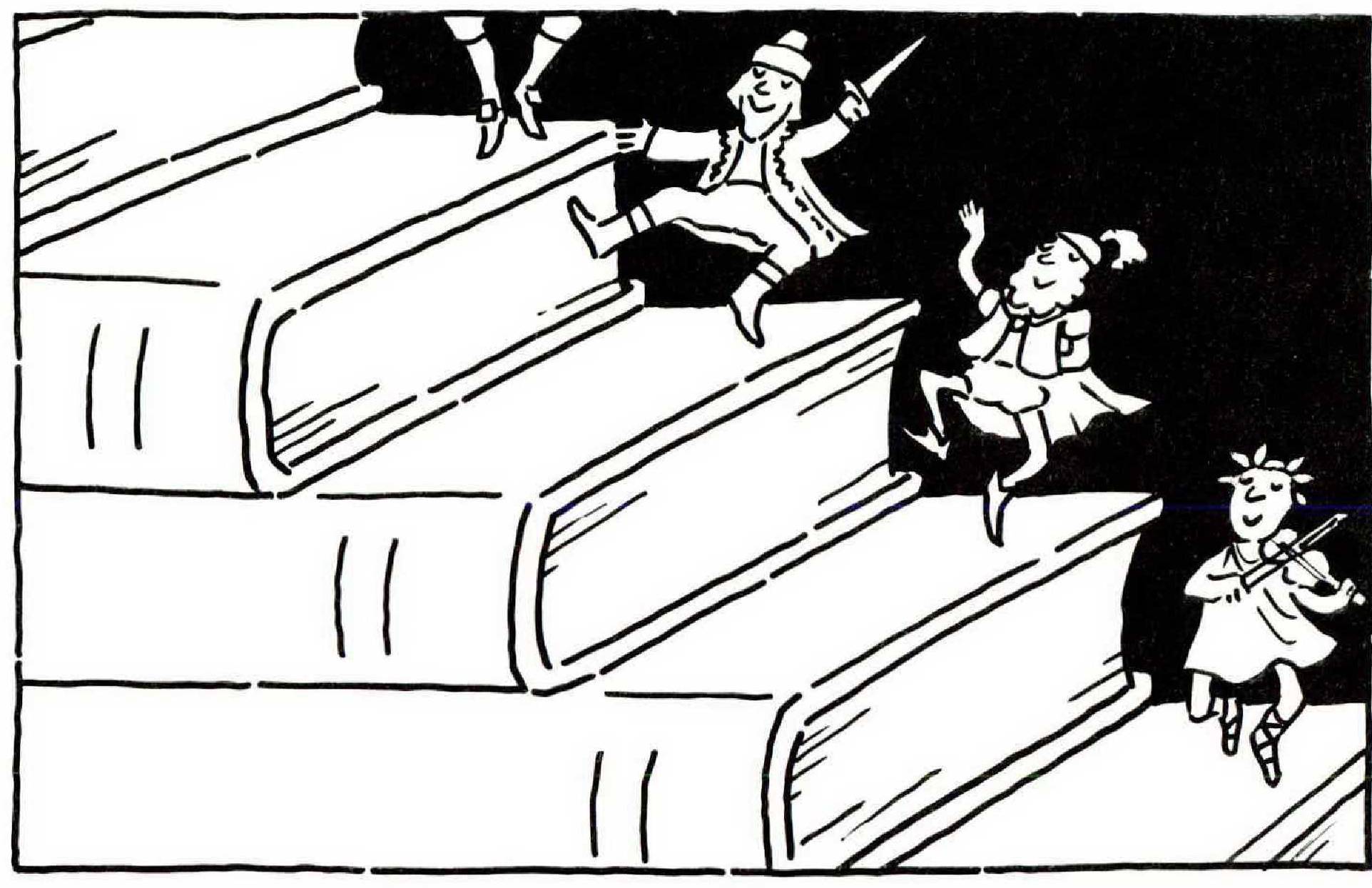
Durant flavored his prose with canned emotion. He was censorious, but never for long. He was sometimes tolerant of human folly, sometimes merely resigned to it. He grew impatient with men but remained a lover of mankind. And when the species came through for him, Durant waxed rhapsodic. “Has there ever been elsewhere such depth and intensity of Yea-saving life?” he wondered at the conclusion of The Renaissance (1953). “To this day we feel the lifting breath of that afflatus, and our museums overflow with the spared surplus of that inspired and frenzied age.” In the corpus of English literature these two sentences may have no rival.
EVERY YOU ME OF ’The Story of Civilization, within weeks of its appearance, was reviled by professional historians. Cambridge University’s j. H. Plumb greeted The Age of Louis XIV (1963) with a memorable blast in The New York Times Hook Review, likening its content to cheese spread: “good color, little taste, easy to use. boring in bulk, and infinitely remote from the true product.” The Durants, who presumed a certain kinship with their “colleagues” in academe, were devastated by such reviews. And yet, among the ruins, they continued to write books. One of these (Rousseau and Revolution, 1967) received a Pulitzer Prize. Gerald Ford in 1977 bestowed on the Durants a Presidential Medal of Freedom, the highest honor this country awards to civilians.
Will and Ariel Durant died in the fall of 1981, within two weeks of each other, shortly before their sixty-eighth wedding anniversary. They went to the grave confident that they had done mankind a service. Maybe they had. Will Durant criticized the chronicles of the Venerable Bede for being “innocently credulous” and “too heavy with miracles,”but he was grateful that they had survived. Chances are that The Story of Civilization, with its millions of volumes strewn from Bangor to Big Sur, will also survive. Once, on a term paper, a teacher scorned a reference of mine with the remark “Durant is hardly adequate.” Millennia hence Durant may be all we have, and scholars perforce will sift his chronicles for bias and meaning. As the Venerable Will once observed, “History is the greatest humorist.”
—Cullen Murphy