Public Health: Misfortune's Catalogue
“There shall no evil happen unto thee: neither shall any plague come nigh thy dwelling. ”
—The Book of Common Prayer
UNTIL RECENTLY, THOSE words were my belief and consolation, and I passed a placid three decades on the planet fearing not the pestilence that walketh in the darkness nor the sickness that destroyeth in the noonday.
To be sure, I endured my share of the usual maladies, and even an operation or two, but the afflictions always ran their course—“resolved,” as the medical journals would have it. I was not obsessed with the fecal-coliform count of my drinking water and never wondered whether the source of that water might be a spring surfacing within a fenced hog lot. I considered roughly nil my chances of contracting otitis from Pseudomonas aeruginosa in a mobile redwood hot tub. Pruritic rash and occasional urticaria associated with gypsy-moth caterpillars did not concern me, nor did Siamese-catborne tularemia, nor renal disease caused by the naphthalene in mothballs. I did not insist, as of course I do now, that foreign-exchange students be swabbed with Betadine and don antiseptic gauze masks should they wish to make my acquaintance.
I was shaken from complacency two years ago, by a little magazine called Morbidity and Mortality Weekly Report, which is published by the Centers for Disease Control, in Atlanta. For reasons I have been unable to establish, the publication began arriving at my office, addressed to me by name, on November 6, 1981. The etiology of the subscription matters little, however. The fact is, no other journal has so quickly commanded my attention and earned my respect.
This may come as a surprise to those who have only skimmed an issue or two at the county morgue, for the publication lacks the slick appeal of National Geographic, Country Life, and other standard waiting-room fare. A typical issue of MMWR, as the magazine is familiarly known, consists of sixteen pages—six inches by eight-and-one-half inches in size, the paper nonglossy, the type sans serif, the ink black. The editorial demeanor is brisk and businesslike, redolent of competence and devoid of levity. The gray text is enlivened only by tables and charts. These, however, are formidable instruments, and they tend to reinforce the average citizen’s reluctance to “become a statistic.” That, at least, is my experience.
There is always one table listing the number of deaths (by cause) in 121 U.S. cities during the previous reporting period. Another records the incidence of “specified notifiable diseases.” From my second issue I learned that in New York City alone there had been eight reported cases of leprosy during the first ten months of 1981. Nationwide, there had been nine reported cases of plague: all bubonic or septicemic and not, thank heavens, pneumonic, of which only one case has been diagnosed in this country since 1925 (that in 1980, however— chillingly close to the present). By the end of 1981, the total number of plague incidents had risen to thirteen. Six of the victims were Indians (five Navajo, one Hopi). The onset of the illness was attributed in one instance to the skinning of an infected bobcat.
By presenting such data in the same format week after week, for city after city, the editors betray their confidence that mankind’s most dreadful complaints (and, therefore, the magazine itself) are in for a long run.
THE REAL APPEAL OFMMWR to a layman like me—most of the journal’s 54,445 subscribers are physicians doing front-line duty—lies less in its admirable accretion of statistics than in its feature stories. Three or four of these appear in every number, bearing titles like “Niacin Intoxication from Pumpernickel Bagels—New York,” “Food-Borne Illness due to Inadvertent Consumption of Marijuana—California,” “An Outbreak of Pseudomonas Folliculitis Associated with a Waterslide—Utah,” and “Contamination of Potable Water by Phenol from a Solar Water Tank Liner— Georgia.” Because the editors avidly solicit “accounts of interesting cases, outbreaks, environmental hazards, or other public health problems” from their correspondents around the country, the menu is delectably varied.
A dentist in Charlottesville, Virginia, writes to report an alarming rate of tooth-enamel erosion among competitive swimmers in his care—the result, it is learned, of acid concentrations 100,000 times the recommended level in a local pool. Following a Colorado blizzard, Denver hospitals report fourteen snowblower-related amputations, the casualty in most instances being a single (male) finger, usually the middle digit. In Puerto Rico, Florida, Texas, and New York, doctors are surprised to find seventy-seven refugee Haitian males developing breasts, possibly owing to a hormone imbalance brought on by the victims’ suddenly improved diet. In California, public-health officials recount the aftermath of an attack by a single rabid dog in a Yuba County parking lot: seventy people received anti-rabies prophylaxis, 2,000 dogs were vaccinated, and 300 cats and dogs had to be destroyed. (I was sorry about the dogs.) The total cost came to $105,790.
The Weekly Report is quite high on rabies, and, I might add, rightly so. In a survey published in February of 1982, the journal noted that “documented rabies in animals [has] doubled in the last three years” and warned particularly of an increasing incidence of the disease among domestic dogs and cats. After a case of bovine rabies was diagnosed in Pennsylvania, the warning was extended to cows. (The animal, which had been infected by a bat, was “subsequently euthanized.”) By November, MMWR was calling attention to a rabies outbreak among wild raccoons in the midAtlantic region. The editors soon passed the word that the epidemic was radiating outward from its epicenter on the West Virginia border at an unusually fast clip: “approximately 25-50 miles per year.”
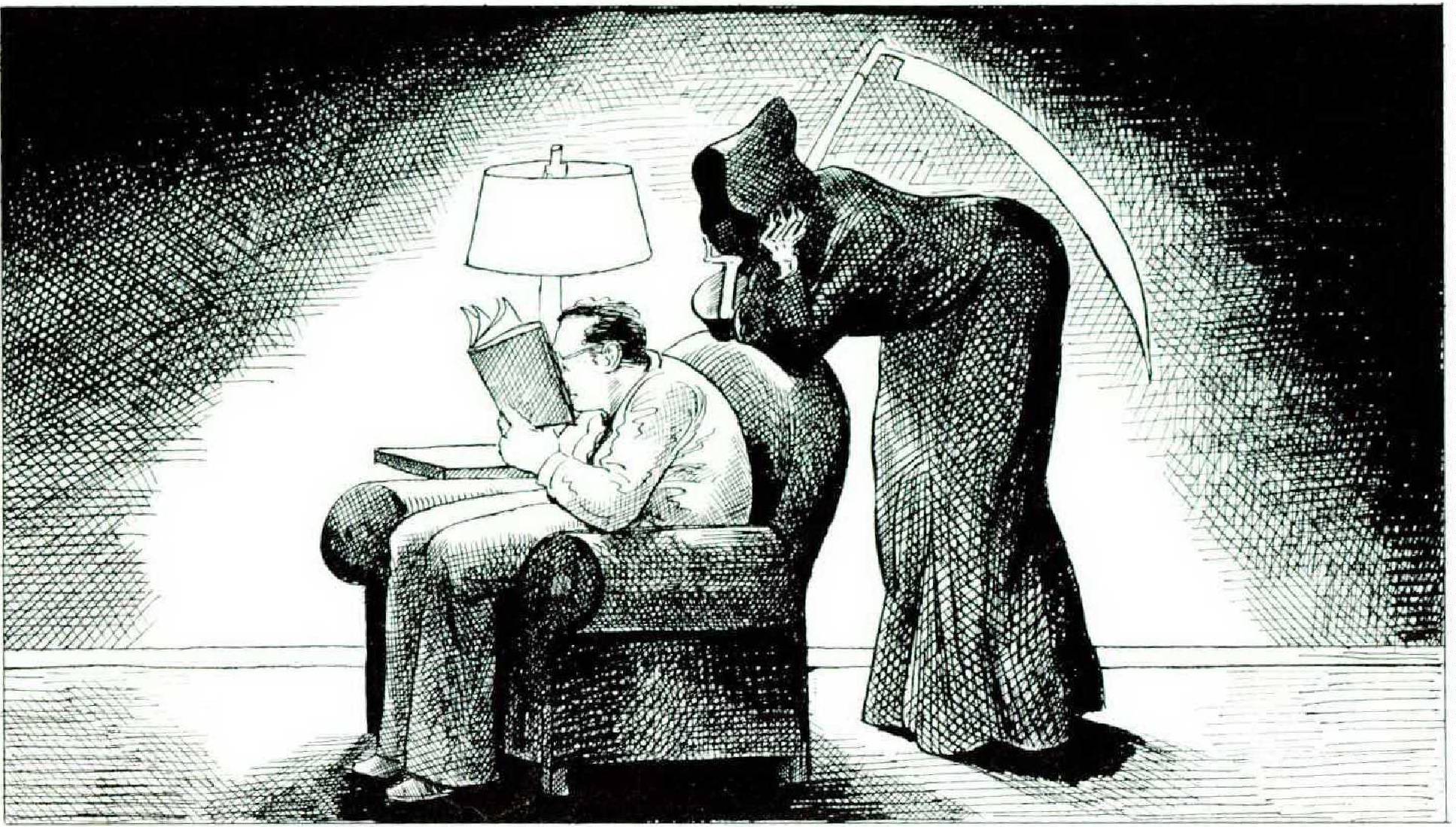
That rate, I reflected, would bring the frothing creatures to my doorstep in about six months. The prospect of hundreds of raccoons relentlessly trekking toward Washington, D.C., my home address no doubt fixed like a mantra in each corroding cortex, was enhanced a few weeks later by another report— “Epidemic Typhus Associated with Flying Squirrels”—and the subsequent realization that any ground attack would inevitably have air support.
ONE UNUSUAL characteristic of the writing in MMWR is its high caliber. The editors achieve a crisp, lucid, oddly vivid style suggestive of Hemingway as retold by Strunk and White. Each summary, like the affliction it describes, has a precisely defined beginning, middle, and end. Satisfied that the facts will carry the story, the editors do not play games. One article begins: “On April 28, 1981, a 35-year-old man was seen in a Modesto, California, hospital emergency room for nausea, vomiting, dark urine, and jaundice. He reported contact twothree weeks earlier with an ill friend who had ‘yellow eyes’.”
Given the nature of MMWR, where no news is good news and there is never no news, even the most innocent of topic sentences conveys an atmosphere of grim foreboding. “On June 27, 1981, a 17-year-old American arrived in Kenya as an exchange student. . . .”The veteran subscriber need read no further to envision the boy on a shimmering tarmac in Nairobi, suitcase in hand, a putrid haze of exotic pathogens misting his epidermis, the pores obligingly dilated by heat for easy penetration. Sure enough, the lad has a date with Chlorquine-resistant falciparum malaria (from which, after suitable agony, he recovers).
Judging from the frequency of the phrase’s appearance in MMWR, I have the impression that “something-resistant” is a kind of Bronze Star (with oakleaf cluster) that has been earned by all too many of the planet’s least law-abiding microzoa. During the past two years I have encountered multi-resistant Salmonella, Methicillin-resistant Staphylococcus aureus, Spectinomycin-resistant Neisseiria gonorrhoeas, Dapsone-resistant Mycobacterium leprae, and an abundance of other noisome pathogens that seem capable of resisting everything except a potential host (“host” being MMWR’s euphemism for me).
But there are many doors to let out life other than those held open by microscopic predators. Indeed, the journal’s periodic winter survey of hypothermia episodes and carbon-monoxide intoxication, as well as its occasional warmweather roundup of reports from selected local coroners (e.g., “Aquatic Deaths and Injuries—United States,” a regular summertime feature), provide a refreshing change of pace. From time to time, the Weekly Report will also pause to celebrate a medical landmark—the centennial of Robert Koch’s discovery of the tubercle bacillus, say—or to remark the progress of some worldwide clean-up effort, such as the Diarrheal Diseases Control Program. But the magazine’s editors are clearly happiest when they have a mugging to report: a case of assault by viral or bacterial agents, preferably abetted by chains of coincidence.
In a Texas home, a mouse is trapped and killed in the bathroom. Within days, five family members, infected by Rickettsia typhi in the feces of the rodent’s fleas, come down with murine typhus. In New Mexico, a thirty-one-year-old man awakens to discover his cat savoring a rabbit under the bed, is bitten as he attempts to deposit both outdoors, and four days later develops “fever, rigors, myalgia, non-productive cough, pleuritic pain, and vomiting.” In California, a fifty-six-year-old woman bakes a commercial beef pot pie, puts it aside on a kitchen shelf when her husband unexpectedly comes home with a bag of take-out hamburgers, returns to it after two and a half sweltering days, devours it on the spot, and contracts botulism.
To this last report MMWR appended an Editorial Note to the effect that heatresistant (needless to say) Clostridiumbotulinum is latent “in many fresh, frozen, and other food products.” The editors speculated that the initial baking had “killed competing organisms in the [pie] and eliminated much of the oxygen.” Left out at “incubator-like temperatures,” the spore-forming, anaerobic bacteria were able to germinate with abandon and secrete their lethal toxin.
THE SAD TRUTH is that eating accounts for about half of all episodes of illness or death featured in the Weekly Report. And to judge from the recent outbreak of psittacosis among turkey processors in Ohio (not to mention the asthma-like illness that winded crab processors in Alaska), even proximity to foodstuffs can be sufficient to bring on rash, fever, cutaneous vasodilation of the face and trunk, and sometimes death. Animal or vegetable, processed or fresh, cooked or raw, comestibles of every variety are best given a wide berth.
This is particularly advisable if the provender has been prepared by what MMWR (with ill-concealed contempt) calls a “food handler.” We are all, I expect, familiar with the type. Lie in wait outside a restaurant bathroom and you will often see him emerge, wiping his hands on a soiled apron, ready now to shred the iceberg lettuce or cough into the créme anglaise. “Suspected Hepatitis A in a Food Handler—California”: in the Weekly Report, items like this are commonplace; only the details vary.
Consider the case of one food handler, an unwitting carrier of Salmonella typhi, who in 1981 found gainful employment in a tortilla molino in San Antonio, Texas. Into his gloveless hands each morning came not only cornmeal to be shaped into tortillas but also barbacoa to be deboned. (The Weekly Report defines barbacoa as “salted, unspiced cow head cooked overnight under steam pressure.”) Over an eight-week period, this food handler spread typhoid fever to seventy-two of the molino’s patrons. According to MMWR, this was the largest “common-source” outbreak of typhoid fever since 1973, when more than 300 workers in a migrant-labor camp in Florida succumbed.
Yet, to be fair, food handlers are sometimes only convenient scapegoats. This was forcefully brought home to me by the 1982 MMWR report “Interstate Common-Source Outbreaks of Staphylococcal Food Poisoning.” According to the editors, picnic lunches supplied by a single catering establishment in Allegheny County, Pennsylvania, sidelined fourteen travelers on a bus in Iredell County, North Carolina (July 21); thirty-three people attending a picnic in Grove City, Pennsylvania (the next day); and fiftyone people on an Ohio River boat trip from Pittsburgh to Waterford Park, West Virginia (August 4). As it turned out, responsibility for the outbreaks lay not with the caterer but with a Brooklyn, New York, supplier of Cryovacpackaged hams whose “cold smoke” method of processing permitted “exposure to bacterial growth temperatures for over six hours.” The distributor ultimately repossessed 36,000 pounds of tainted gammon.
One expects this sort of thing from meat, of course, and I no longer touch it. But the prevalence of Yersinia entercolitica among vegetarians in Washington State suggests that a flesh-avoidance posture is but the first step toward an effective program of disease deterrence. In all, eighty-seven cases of gastroenteritis in Washington in 1981 were found to have been caused not by spoiled meat but by “a locally produced brand of tofu, an oriental soybean curd, packed in untreated spring water.” Seventeen people were hospitalized and one underwent a partial colectomy. Upon investigation, sanitary practices at the tofu plant, where the employees used an outdoor privy and observed “poor personal hygiene,” proved questionable.
THE WEAK OF WILL may be tempted to shrug off MMWR’s warnings about food (even though reading the journal during meals is a proven appetite suppressant). But only the foolhardy will ignore the evidence in the Weekly Report about other countries. To put it bluntly, foreign lands, along with their products and their peoples and probably their cultures, must be inherently malignant. The sensible person will eschew physical contact with all of the above, even if this requires, as I can attest it does, certain minimal life-style adjustments.
The evidence from MMWR on this matter is, unfortunately, conclusive. April, 1982: A Little League organization in a “southcentral Pennsylvania community” buys 2,928 seven-ounce bags of cashews imported from Mozambique, sells them in the stands, and then watches the bleachers empty as fans go home with “poison ivy-like dermatitis.” December, 1982: Black pepper imported from Brazil infects 126 people with Salmonella oranienburg, an infrequent visitor to the developed world. October, 1983: Forty-five people in Washington, D.C., are felled by gastro-intestinal illness after sampling Marcillat brie, made in France.
The journal is filled with reports of travelers acquiring Katayama syndrome (an acute form of schistosomiasis) after rafting on Ethiopia’s Omo River; of infants from Calcutta spreading Salmonella among their adoptive American families; of U.S. airmen, fresh from Korea, imparting new and puissant strains of Gonococcus to stateside affiliates; of dengue fever in a forty-one-year-old man returning from India and the same in a fiftyfour-year-old Hispanic male “with a history of travel to Puerto Rico.” In an Editorial Note on this last case, the editors attributed the recent increase in epidemic dengue activity in part to the growing frequency of air travel. Jet aircraft, they wrote, provide “an ideal mechanism for dengue virus movement between world population centers.”
Not surprisingly, what is good for dengue is also good for measles. During the spring of 1982, MMWR linked eightynine cases of measles in Ulster and Dutchess counties, New York, to a student who had recently traveled to the Soviet Union with his high school class. This lad’s feat was soon surpassed by that of a fourteen-year-old Dade County, Florida, youth who, while vacationing in Latin America, “had face-to-face contact with a cousin in Peru who had fever and a generalized maculopapular rash.” Upon the boy’s return to the United States, he exhaled with every breath a disease-laden effluvium that went on to infect 203 people in fifty-seven different schools, four day-care centers, one community college, and a military academy.
FOR ALL ITS merits, the Weekly Report seems to fail in one important respect: never does it give its readers any general advice about how, in the face of what is clearly an unrelenting assault, to protect life and limb. The editors do provide explicit solutions to specific problems: Avoid contact with dead rodents. Keep irrigation pipes away from electric power lines. Stay away from silos freshly filled with corn. Don’t use mothballs as an air freshener. Ventilate the indoor firing range. Other precautions can be inferred: Decline creamfilled pastries on cruise ships. Turn away door-to-door prostitutes. Wear a face mask when swimming in sewage. All such advice is well taken, I concede. But the editors have shrunk from distilling their thousands of sensible injunctions into a handful of life-saving tips.
Perhaps, upon reflection, that is as it should be, for any such tips would likely prove as reliable as those of a race-track tout. While the journal could reasonably counsel the health-conscious to avoid flora, fauna, and food, along with air, aliens, and anything aquatic, the determined few adhering to this regimen might yet be crushed in their sleep (cf. “Hospital Bed-Associated Deaths—Canada, United States”) or run over by a reaper (cf. “Farm-Tractor Associated Deaths—Georgia”). No, the editors of MMWR are not given to self-delusion. In their stoic refusal to promise panaceas, they acknowledge the proficiency of caprice and the feebleness of our deterrent.
—Cullen Murphy