Uneasy Rests Head Under Santa Hat

LAST CHRISTMAS SOMEONE asked if I would play Santa Claus for his children and their friends. Actually dress up in a full Santa suit that he would rent.
I said no.
He was taken aback. He couldn’t understand why I would pass up such a heartwarming opportunity. Kids regarding me with eyes of wonder. Eyes of “Wonder who put this total donut-hole up to this” is more like it, I said.
I remembered how my friend Dupree Culp felt when he portrayed Santa back in college, at a party our fraternity gave for local orphans. We needed a community-service credit to offset what happened when one of the brothers, Brince Ealey, regained consciousness unexpectedly one Sunday morning in the shrubbery outside Grace Boulevard Methodist Church. Unable to place himself at all, Brince perceived a world blotted out by a mass of tiny leaves except for a series of pastel-colored high-heeled shoes, which were crunching in the pea-gravel walkway past his face. In a kind of paroxysm, he ruined a lot of hedge, tore off one whole leg of his Bermuda shorts, and upended three prominent Methodist women.
This is by no means characteristic of Brince Ealey today. He is a congressman and outspoken foe of governmental action, who recently—after his eightyear-old daughter came home from school with the idea that Latin American people don’t believe in Uncle Sam—proposed that “reinforcement of American belief” be mandated through twelfth grade at least.
Dupree Culp had always associated Santa with the triggering of innocent ecstasy. In his childhood—thanks to his mother, who had been orphaned, first by an oil stove and then by a locomotive, just before the Depression—Christmas morning was something precisely commensurate with his capacity for wonder. “Even when I didn’t get the Erector Set I asked for one year,” he told me, “I figured if I didn’t get it, I must not have really wanted it.”
Dupree said his mother often told him that she treasured nothing in this world the way she treasured seeing the expression on his face every Christmas morning when he saw what lay under the tree. Plenty. From out of the blue.
And Dupree said he didn’t feel obliged to have a certain expression, either. He had it naturally. Every year, his mother would suggest how good of him it would be if he’d set aside one of his presents to give to some poor child through the church, and he always agreed and felt good about the idea, but she never actually made him do it.
So Dupree jumped at playing Santa Claus. The first jarring note came as he got into his suit. I was watching him. Everything in the costume worked except the hat.
WE TAKE A GREAT many things for granted in this country, until we find ourselves responsible for bringing them off. Santa Claus’s hat is a good example. Dupree wore his hair short, as was the fashion in 1961. and the hat wouldn’t sit up on his head. It flopped down over his eyes and onto his chin. The pompon bounced around on his face when he walked or tried a “Ho-ho-ho.”
When he moved the pompon to the back, the hat looked like a red skullcap. When he draped the pompon to one side, he appeared to be wearing the headdress of a fey Turkish pirate. Dupree was upset. He wanted to be convincing. At my suggestion, he gave the hat some body by stuffing it with cotton. “It looks like a sundae,” he complained. But after we pinned more cotton around the edges to represent snowy hair, the effect was pretty good. The hat-hair ensemble tended to stay in one place, which meant it changed position relative to his head when he made sudden movements, but he said he wouldn’t make any more sudden movements.
The doorbell rang, heralding the orphans. Dupree took his bag of gifts and crawled composedly up into the chimney.
Actually, there was no chimney. We had a false fireplace in the fraternity house. But it was a big one, and for some reason it extended upward, above the level of the mantle, into a dark pocket somewhat larger than Dupree. He climbed into this hidden space, with his bag on his shoulder, and hung there, completely out of sight.
In the entrance hall, the orphans were given lime sherbet melting in ginger ale. Then they were ushered into the large common room where the fireplace was. The orphans milled about. They sipped or spilled their punch. They looked around. Dupree was building suspense.
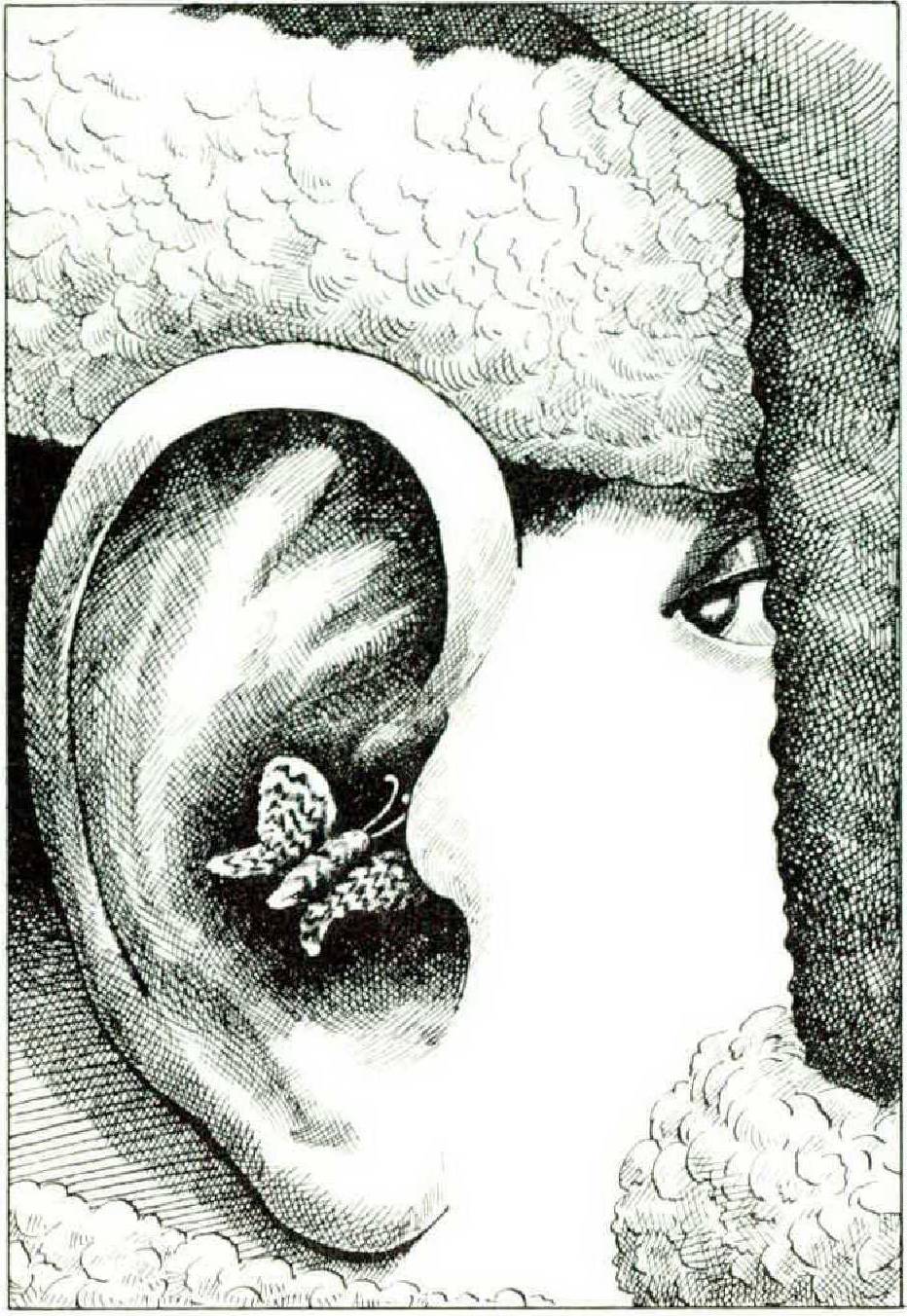
There was a soft plop. The orphans turned, as one orphan, toward the fireplace. There, like a small, dead, red-andwhite animal on a white nest, sat Dupree’s hat and snowy hair. Dupree explained later that he had felt deep in his ear something trying to fly. “It didn’t seem to want to come out,” he said. “It seemed to want to get further in.” For the orphans’ sake, Dupree had hung there stoically. But he had tried to nudge his ear with his shoulder, and in so doing had dislodged his headpiece. When the orphans saw it fall, they flocked to the hearth and peered up at him.
Dupree hung there, jouncing his head awkwardly and trying to think. The orphans said things like “Right. Sure.” He had lost the element of surprise.
There was no turning back. Dupree dropped into the children’s midst, reclaimed his hat and hair from one of them, jumped up and down on one foot like someone with water on the ear, and put his hat and hair back on. “Ho-ho-ho,” he said.
There is nothing quite so fiat as a “Hoho-ho” that has a distracted and also a resigned quality. By this time, the moth or whatever it was had left, but you know how you feel when something strange has just been in your ear. Dupree focused on the children’s faces, but their expressions were not what he had had in mind.
Perhaps he should have shown what today’s trend-setters call “attitude,” and said, “Okay. We all know there is no Santa Claus.” But what if one of the orphans had not known? How would that child have felt, finding out from Santa Claus himself?
As Dupree handed out presents, one of the orphans slipped past him to look up into the fireplace again. Dupree grabbed at him, but he got by.
“Hey,” the orphan said. “No hole in the top. How’d you get in? Hunh?” His “Hunh?” was hearty.
Then Brince Ealey woke up under a big sofa across the room and began sneezing and throwing up through his nose simultaneously, a terrible sound. As the children moved in that direction, Dupree took his empty bag and left.
He declined the role of Father Christmas the following year. That was when the orphans, having had four parties already that week and being due at another one in less than an hour, forced their way into the room where Santa —Brince Ealey—was getting into his suit.
The orphans found Brince in his beard, his red pants, and a fuzzy blue cardigan sweater. Most people in that situation would have felt like Venus observed while trying to find something under a chest of drawers, but in those days Brince could go with nearly anything, as long as, frankly, he hadn’t passed out yet. Brince yelled “Christmas is over! Easter time!” and led the orphans down to the kitchen, where they broke five dozen eggs. It was not until the fourth semester of his junior year that Brince did a complete 180: stopped raising hell, became a straight arrow, and ran for Honor Council.
Dupree felt strongly that Brince, in his partying days, was the wrong person to be Santa Claus. “I’m probably responsible,” he said, “for letting the orphans’ party fall off to the point where it would even occur to anyone that Brinee Ealey should play Santa.”
“But you meant well,” I told him. “You could have just strolled in through the door and been cool. You got in the chimney because you wanted to suspend disbelief. ”
“My mother did suspend it,” he said. He’s career-Army now, intelligence. The last time I saw him, he couldn’t tell me what he was doing, except that he was authorized to carry a pistol on commercial flights.
Let’s face it. In any period of history, being Santa Claus requires craft, timing, good breaks, and a specially constructed hat. Nobody wants a clown for a benefactor. (These days, nobody wants a benefactor at all. Everyone wants to feel that whatever he has he took.) Santa must be generosity personified, but also self-preserving. A fine line there.
Particularly today! Contemporary American children, if they are old enough to grasp the concept of Santa Claus by Thanksgiving, are able to see through it by December 15. In the movie Trading Places, which has found favor with the make-or-break youth audience, Dan Aykroyd eats a stolen smoked salmon through the beard of his Santa costume, on the bus, drunk. Beard and fish become horribly entwined. When I saw that scene, a child sitting near me exclaimed, “Ewwwww, yuck!” Her eyes were shining.
However, I don’t think we need to assume that the death of innocence is set in concrete. Things change. Brince Ealey changed. His daddy made him.