Watching the Russians
What are the Soviet Union‘s military manpower problems? What are its population trends? What is the state of its scientific training? When NATO and the Pentagon and the Commerce Department want answers to such questions, they turn to Murray Feshbach or one of his fellow scholars, who, working with sketchy data, are trying to describe the texture of Soviet life. We have never had a greater need for their efforts, but, because of severe budget cutbacks by government, foundations, and academe since the late 1960s, Soviet studies is a fragile enterprise.

ON MAY 24, 1972, PRESIDENT RICHARD M. NIXON AND Soviet Premier Aleksei N. Kosygin stood beneath the tinkle and glint of a two-story-high chandelier in the Kremlin’s St. Vladimir Hall for the signing of a formal accord on scientific and technical cooperation between the United States and the Soviet Union. The agreement went into effect at once. Two days later, American chefs using Russian kitchens served Leonid I. Brezhnev, the late Communist Party secretary, his first baked Alaska, at a celebratory banquet. Brezhnev publicly hailed what he called “hot ice cream” and expressed high regard for the “miraculous” Yankee ingenuity that had made it possible. Within six months, a U.S.-USSR joint commission on scientific and technical cooperation was set up to oversee exchanges of personnel and information. And within a year, Murray Feshbach, then forty-three, a scholar employed by the U.S. Bureau of the Census, was named a member of the American team on five working groups of the joint commission.
“He drove the Soviets bananas,” recalls William Carey, the executive officer of the American Association for the Advancement of Science. Feshbach served with Carey on three of the panels and traveled with him to Moscow on a half-dozen official visits. “Murray was regarded as fondly as a hair shirt, because he came fortified with a prodigious knowledge of the Soviet Union,” Carey says. “If a member of the Soviet delegation tried to slide by with an evasive or general reply, Murray wouldn’t let him get away with it. He would hang on like a terrier. He could always cite this or that article in some obscure Soviet publication, or he would refer to such-and-such a decision rendered recently in the depths of the Soviet bureaucracy. And he constantly interrupted the translator.”
Eventually, Carey says, the Soviets began to hint, though not in complete seriousness, that Feshbach was employed by a part of the U.S. government more sinister than the Census Bureau. (He was not.) As time went on, there would be unaccountable mix-ups in his hotel reservations, even as the rest of the American delegation proceeded without hitch or snarl to rooms in the elegant National Hotel (Feshbach’s favorite, and Rasputin‘s) or the massive Rossiya or the Art Deco Metropol. The Americans finally bought Feshbach a camping hammock. “For all that,” Carey adds, “the Soviets obviously respected Murray. They knew an expert when they saw one.”
MURRAY FESHBACH, ECONOMIST AND DEMOGRApher, would be well cast as the first victim in an espionage novel: the bespectacled, slightly awkward, utterly unsuspecting innocent killed because of something he found, something seemingly irrelevant. His graying hair, sparse above the tortoise-shell glasses, sprouts thickly at the sides, where long sideburns curve flatly against the jowls. His smaller-than-average frame carries more weight than it was meant to support. He concedes readily that he is too fat, that this is a mark of stupidity, that he is ashamed of it, and that the Exercycle is helping, “but the holidays always kill me.” He is continually dieting. “Yesterday I could have only skim milk and bananas,” he will explain; “today it’s only beef and tomatoes. Waiter, leave the pitcher, I can only have water.”
Feshbach’s manner and speech mark him indelibly as a New Yorker. One can imagine him hawking the Daily News at 42nd and Lexington, schlepping furs on 29th Street, or slicing Hebrew National salami behind a deli counter in the Pelham Parkway section of the Bronx, perspiration misting his brow. But because he is gregarious and energetic and because he enjoys a quirkily methodical, omnivorous turn of mind, Feshbach chose a different line of work.
Though little known beyond what one colleague calls an “invisible college of specialists,” Feshbach stands out among this small group as one of the more unusual and, in his way, indispensable students of the Soviet Union working in the United States. His approach to the country is not so much that of a social theorist, a political analyst, or a military strategist as it is that of an encyclopedist. He burrows in obscure and unlikely places, generating as a result large quantities of new information, preserving it all, and dispensing among his colleagues what he cannot use in his own studies of manpower, scientific training, health, mortality, population trends, ethnicity, the military, and industrial productivity. He burrows because knowledge of the USSR is not to be had for the asking, the Soviet government being secretive and camera-shy. Ultimately, Feshbach makes possible more research than he accomplishes himself, even as he produces much that is important in its own right.
Until accepting a senior appointment in 1981 at Georgetown University’s Center for Population Research, Feshbach worked out of a grimy building on 14th Street, in the middle of Washington’s red-light district, his seventh-floor window affording a view of the Olympic Baths and the Casino Royale Theater. This was long the home of the Foreign Demographic Analysis Division (FDAD—pronounced “efdad”), an anomalous and inconspicuous satrapy within the U.S. Census Bureau and Feshbach’s employer for a quarter of a century. At FDAD, beginning in 1957, Feshbach gathered string. Every bit of data he got his hands on regarding every conceivable aspect of Soviet life—wages, contraception, crime, disease, bureaucracy—was logged and cross-referenced daily.
Before long, he became a reliable first stop for other investigators. If one wanted to know anything about the Soviet Union—almost anything at all—Feshbach would at least know where to look or whom to see, and about half the time he would already have what one wanted in his files. If the answer existed only in his head, he might tell his visitor to pipe down—“Wait,” he would say, “let me talk to myself for a minute”—as he coaxed it forward like a balked sneeze.
Norton Dodge first turned to Feshbach nearly twenty years ago. Burly, affable, and thickly moustachioed, Dodge is a Sovietologist at St. Mary’s College of the Maryland state university system and owner-curator of the largest collection of contemporary Soviet unofficial art in the U.S. In 1965, Dodge was racing against a deadline for a report on Soviet women when his co-author was unexpectedly sidelined. He discovered that if he gave Feshbach a sheet of paper with items down the left side—women’s employment, average number of children, marital status, abortion, wages, whatever—and years across the top, Feshbach could fill it in faster than anybody else. For two weeks, Dodge worked Feshbach around the clock, depositing blank tables in his milkbox at midnight and retrieving the tables that had been completed since the previous visit. In partial payment, he underwrote Feshbach’s first trip to the Soviet Union (the first of twelve). “Murray is what the Russians call a tolkach—a pusher, a fixer,” Dodge says. “The tolkach—he’s the guy who deals in the semilegal aspects of production. You know, all the suppliers are out of nails but he can get them for you.”
Feshbach has found “nails” for the U.S. Departments of State, Commerce, the Treasury, and Defense; for the North Atlantic Treaty Organization and the Organization for Economic Cooperation and Development; for the foreign ministries of Sweden, Great Britain, France, Israel, and Japan; for Lazard Frères, Brown & Root, Tenneco, and Texas Eastern. The assignments vary. The Pentagon’s Office of Net Assessment, for example, has been using his work to gauge the future availability of Soviet conscripts. U.S. corporations hope to learn the etiquette of doing business in the USSR and to ascertain what their payroll might look like over there. The State Department is interested in the effect of the Soviet Union’s domestic tensions on the nation’s overall stability. Other clients have other concerns, but they insist on privacy. Feshbach is consulted because he has a knack for discerning relationships amid reams of data. Journalists, too, find the trait helpful. “Guys like this are diamonds,” explains Hedrick Smith, Washington reporter for The New York Times, a former Moscow correspondent, and a frequent lunch companion of Feshbach’s. “Reporters have learned that his feeling for the place is accurate, so they go back to him.”
Feshbach treats the Soviet Union the way James Joyce treated Dublin, as if he might be asked someday to put it all back together again, down to the signs of the zodiac on the clock at Moscow State University. Having read his entire body of published work, one would know, for example, that in 1950 the Soviet Union produced only half as much (52.6 percent) macaroni per man-hour as the United States did, and that a ZIL-155 bus held twenty-eight seats. In 1959, the USSR employed 13,582 female beekeepers. In 1964, 7.2 percent of all fifth graders stayed back. Some 2,000 Bulgarians were imported to chop wood in 1970.
But all this is trivia. Feshbach’s basic concerns run deeper. How is industry organized? How are political and business decisions made? How good is scientific training? What is happening to the birthrate? The mortality rate? Is the ethnic mix of the population changing? Is religion important? Is health care adequate? He wants to ken the shape of the society, the cut of its jib.
I MET FESHBACH IN 1980, AND AFTER AWHILE, WE BEgan to meet regularly for lunch, reconnoitering at noon beneath the dome of the Riggs National Bank at the corner of Wisconsin Avenue and M Street. (“Same time, same place,” he would say, telling me once that he arranged appointments with friends in Moscow the same way.) Feshbach has recently undertaken an ambitious assessment of the quality of life in the Soviet Union. “It‘s a difficult theoretical question,” he explained one afternoon not long ago at a restaurant in Georgetown. “What is the quality of life anyplace? What do you go by? How much do you count the fact that a country is not at war? How important is a low level of criminality? What about intellectual life and the arts? Personally, I think the exhibition of Russian avant-garde art as part of the Paris-Moscow show in 1981 is very relevant in evaluating the quality of life. These were paintings that the Soviets had never been allowed to see before. Of course, they were only shown in Moscow; this stuff wasn’t going out to Minsk and Omsk and Tomsk.”
He ticked off some of the other indicators of the quality of Soviet life that he had been looking at. “Nutrition,” he said. “For example, why are the Soviets still collecting data on rickets? We don’t even bother in this country.” Rickets is caused by a vitamin-D deficiency, which may result from a lack of sunshine, a lack of milk, a lack of many things. It is widespread among Soviet children, in part because the technique of manufacturing infant formula has not been mastered. One Soviet study of deceased infants that was conducted in large Russian cities during the mid-1970s found that 37.1 percent had suffered from aggravated rickets.
“Availability of housing,” he continued. “Even I. V. Arkhipov, the housing minister, has called this ‘one of the serious social problems,’ and when the Soviets use words like that in public it is strong language.” At least one out of every five urban families shares living space with another family. Usually that means sharing a corridor, kitchen, and bathroom, but there are still large numbers of working youths living in communal dormitories or substandard baraki. The Soviets are extremely reticent about discussing sanitation; almost no data are available. “It’s bad in hospitals, let alone restaurants,” Feshbach said. In 1972, only 60 percent of the families within the Novosibirsk district had indoor plumbing. Novosibirsk is the largest city in Siberia.
“Availability of education. This is another thing to look at. Only 20 percent of high school graduates are able to enroll full-time in a college of some kind. They have to compete against the men demobilized from the army every year, plus all of those seconded by their enterprises or collective farms, plus all of the disappointed high school graduates from previous years trying to get in.”
Then there is the mortality rate, which is as symptomatic to a demographer as the prime rate is to an economist. In the USSR, death rates have been rising steadily, from 6.9 deaths per 1,000 persons in 1964 to 10.3 in 1980. “This is unprecedented in a developed nation,” Feshbach explained. The expected longevity of newborn males has declined during the past fourteen years from sixty-six years to sixty-two, while that of females, after a period of gradual extension, has leveled off at seventy-four. The disparity between male and female life expectancy at birth in the Soviet Union—some 11.5 years—is exceeded in no other country.
“The area I‘ve done the most work on so far in this study is health,” Feshbach said. I was reminded that one of the first times I talked with him, he had just returned from the USSR and was telling colleagues about a cardiologist’s office at the top of a five-floor walk-up (“Anybody who got there was okay”). At its zenith, Soviet medicine can be quite good, and the USSR has greatly reduced the incidence of many lethal illnesses. In certain fields (e.g., some types of eye surgery), the Soviet Union leads the West. Yet in basic medicine for the populace, the picture is not so bright.
“At the twenty-sixth Party congress, in 1981, even Brezhnev brought up the ‘need to improve services to the population in this area,’” Feshbach said. “I appreciate what Soviet medicine has done and I know that medical services in the United States are not uniform. Still, some of the statistics are sobering. In 1979, there were 385,000 cases of measles in the USSR, as opposed to only 14,000 in the United States, and in that year the Soviets had 18,000 cases of typhoid, which works out to nearly twenty-nine times the U.S. rate per 100,000 population, and it‘s goingup. Why is it going up? I don’t know why, and it’s driving me insane.
“Then there’s the whole business of medical ethics—you know, hoarding medicines, the black market, bribery, stealing food from patients. How widespread this is I don’t know. I find evidence of it over time and over the whole country from Moscow to Odessa to Kiev to a beyond-belief situation in Azerbaijan, where eighty-one people in 1981 were brought up on criminal charges for unethical behavior relating to health care. Eighty-one is a lot of people. You know, the Soviets did away with the Hippocratic oath at the very beginning. They reinstated it around 1971, but reinstating it and having it applied are two different things.”
FESHBACH’S CONCERNS ARE NOT THE STUFF OF popular Kremlinology—who’s up, who’s down, and who’s standing where on the dais atop Lenin’s tomb on May Day—or of diplomatic globe-twirling, although both have clearly preoccupied Americans since the onset of the Cold War. Little regarded outside of Washington, and not eliciting much publicity even there, were the Soviet specialists who spent their time calmly running their fingers over the texture of Soviet life. They held their little conferences, published what they learned mostly in academic journals with tiny circulations, and made sure that the right people in Washington were kept informed.
All of this work accumulated imperceptibly until the point was quietly driven home that Soviet intentions and capabilities had to be assessed more thoroughly in light of certain domestic factors: a potential energy shortage, restless Moslem minority groups along the southern tier, serious health and labor problems, inefficiency and low productivity, and what Leonid Brezhnev, had he been a Romanov, might have called “malaise.” (In fact, Brezhnev once did acknowledge artfully that “it would be wrong to paint the picture of the present-day socialist world in exclusively radiant colors.”) In his budget message to Congress in 1978, Defense Secretary Harold Brown cited the USSR’s “major internal handicaps” as a key variable in the Pentagon’s evaluation of the overall strategic environment—something to be considered, in other words, alongside those comparative charts with their lines of little tanks, ships, missiles, and men.
The intention of the Soviet analysts responsible for this shift in perspective, Feshbach among them, was not to belittle the USSR’s capacity to make trouble but to emphasize that the very nature of Soviet society in some ways imposes constraints on the Kremlin‘s behavior, in some ways does the reverse. Predictably, the Soviets have followed all of this with interest.
Dr. Herbert Block, eighty, an elegantly mannered and accented ex-Berliner, was recruited by Abram Bergson to run the Soviet national-income-and-foreign-trade section of the Office of Strategic Services (OSS) during World War II. He has been a friend of Feshbach’s for decades. I asked him one day who made use of Feshbach’s work. “Certainly the Russians,” Block replied. Not until the twenty-fifth Party congress, in 1976, did the Soviet leadership warn publicly of an imminent labor shortage, but Feshbach had been calling attention to the problem since the mid-1960s. His more recent work on Moslem fecundity and the rapid ethnic “yellowing” of the Soviet population coincides with new directives from Moscow designed to spur the ethnic Russian birthrate—for example, new taxes on bachelors (a surcharge of up to 7 percent on income) and childless couples, along with a quadrupling of the subsidy for women who have illegitimate children. “They do a great thing,” one Soviet demographer has written of unwed mothers. “A citizen grows.”
It is not that the Russians do not appreciate their own problems, Block said; “they are not dumb.” But Feshbach’s work, he explained, like that of other Western scholars on other topics, often brings these ostryye voprosy, these “thorny issues,” out into the open. Thus, the Institute for Scientific Information in the Social Sciences (whose deputy director, Liparit Kiudzadzhan, is one of Feshbach’s Moscow acquaintances) regularly passes foreign research papers on to scholars inside the Soviet Union. “Here is another miserable product from the degenerate West,” the routing slip may imply, Block said, but such research often serves as an excuse for the Soviets to start writing about the subject. Or it could signal that there is no sense sweeping the problem under a rug any longer. Western research comes sometimes as an embarrassment, sometimes as a stimulus, and sometimes even as news to scholars in the USSR.
It was not always so, for Soviet studies is a young field. On V-E Day it scarcely existed in the U.S. as an academicspecialty, and that it exists today is owing to the efforts of a small number of people—historians, political scientists, economists (many of them veterans of the OSS), and a few experienced diplomats—who realized how little was known in the United States about our sometime ally and probable future rival. No one had more than a faint, filtered notion of what the USSR’s economy was like or what the quality of life was like; no one could do any more than guess about what the Great Patriotic War had done to the country, what the purges had done, or, even further back, what difference Stalin’s First Five-Year Plan had made. And Moscow wasn’t telling. For a people having no word in their language for “privacy,” the Soviets guarded theirs well.
At war’s end, the academic personnel in Soviet studies left a great deal to be desired. Most of the researchers were Russian immigrants. A few of these were first-rate scholars, such as the demographer Eugene Kulischer and the agricultural economist Naum Jasny. Their contributions were valued by their Western colleagues, despite inevitable disagreements. Jasny, for example, frequently complained that American economists paid too much attention to arcane problems of methodology in his work, overlooking, as a result, the larger points he was trying to make about the Soviet Union. One U.S. Sovietologist, an expert on the USSR’s military spending who was a graduate student at Harvard at the time, recalls Jasny’s outburst after just such a persnickety criticism: “I could run naked from my house in sneakers and all you would say is, ‘Your shoelaces are untied.’” Most of the expatriates were not of Jasny’s caliber, in any event. Many had ideological axes to grind. As for the U.S.-born or U.S.-trained scholars, with few exceptions they were clustered in Russian history or literature, not Soviet history or literature, let alone Soviet economics, sociology, political science, or philosophy.
The situation began to change soon after the end of World War II, when, with money from the Carnegie Corporation, the Ford Foundation, and other sources, Columbia University established its Russian Institute and Harvard University its Russian Research Center. Both welcomed graduate students from nearly all fields, with the stipulation that they learn Russian and apply thenskills to the study of the Soviet Union. The U.S. Air Force commissioned a good deal of the early research, providing money to send a platoon of Harvard staff and students to Germany to glean, from hundreds of questions put to thousands of displaced or captured Soviet citizens, whatever they could about life “back home.” The Air Force also channeled money, by way of the Rand Corporation, to Columbia, which established an ambitious economics project under the auspices of the Russian Institute. The head of the project, Abram Bergson, began to parcel out pieces of the Soviet economy to his students as dissertation projects.
Between them, Columbia and Harvard created and sustained the field of Soviet studies and trained the first small cohort of Sovietologists. Their efforts were supplemented from the outset by those of the Central Intelligence Agency (which was chartered in 1947) and within a few years by programs of Soviet studies at other universities, at the National Bureau of Economic Research (NBER), and at FDAD, which was established in 1951 with money from both the Defense Department and the Commerce Department (FDAD’s administrative overlord).
Spurred by the quickening of the Cold War, the outbreak of the Korean War, the detonation of the USSR’s first hydrogen bomb, in 1953, and, ultimately, by the Sputnik launch, in 1957, Soviet studies expanded rapidly. But it was not just the bountiful fellowships and the field’s intrinsic importance that attracted students. The Soviet Union’s obdurate bashfulness offered a young generation of scholars an irresistible opportunity: the chance not only to interpret the evidence but to find it—in effect, even to create it—and use it to enhance bits of knowledge already acquired. It was like a vast naval board game with a screen separating the two players, one of them charged with locating the other’s ships, the skilled opponent cannily keeping them hidden. At stake, however, were not ships but facts.
THE RULES OF THE GAME-IT HAS ALWAYS HAD the character of a game, no matter which Great Power tensions happen to intrude—have been simple from the beginning. The second player, the Soviet Union, has only one rule: Maintain control. At this the Kremlin is accomplished. It can variously publish no information about the USSR, incomplete information, contradictory information, wrong information, silly information, or, mischievously, correct information. Its power here is absolute and may be unabashedly exercised. A regime that would clumsily white out now-obnoxious names from the copy of a post-Revolution issue of Pravda that is on display in Leningrad’s Museum of the October Revolution does not, after all, fret over appearances. Cadres of censors are employed by the Chief Administration for the Preservation of Secrets in Press, Radio, and Television (GLAVLIT is the Russian acronym) and all printed materials bear a GLAVLIT number—UG 21421, say, or A 07775—designating the censor who approved it: “Inspected by No. 13.”
The first player—in the person of Feshbach, perhaps— has no rules at all, only a question: What lies on the other side of the screen? The ultimate objective is to assemble the answers into a portrait of the USSR, but the mere task of collection, let alone of assembly, is forbidding. One is dealing with a country of 270 million people spread across eleven time zones and 8.6 million square miles. There are 104 officially recognized nationalities within the USSR’s borders. One hundred and thirty languages are spoken; at last count, novels were printed in seventy-six of them, radio programs broadcast in sixty-seven, textbooks published in fifty-two, plays performed in forty-seven, and scholarly journals written in forty-two. There is not one economy but at least two—the centrally planned official one and the quasi-capitalistic “second” economy, the latter further subdivided into legal and illegal variants. Administratively, the nation is organized into fifteen republics (two with seats in the UN General Assembly, thereby giving the Soviet Union a total of three votes in that body), which in turn are fractured into smaller units: the krai, the oblast‘, the rayon. The Soviets themselves do not pretend that they fully understand how the USSR functions, or that running the country is an exact science. Too often, pushing in one place makes something pop out elsewhere. Enticing retirees into the work force to alleviate the current labor shortage, for example, has resulted in fewer babushki at home to care for grandchildren and, consequently, a sudden and enormous surge in demand for day-care services. Perhaps the chief myth about planned economies is that they are planned.
Since the late 1950s, when the first groups of Western scholars (and tourists) were granted regular access to the Soviet Union, contacts between “bourgeois falsifiers” and “party hacks” have expanded fitfully, although a kind of invisible placenta continues to regulate the flow of ideas and information between Sovietologists outside the USSR and economists and social scientists within it. Soviet scholars these days are at least willing (or allowed) to impart to some academic visitors laundered and limited data about the nation’s domestic affairs. As noted, however, they are far more interested in glimpsing the USSR’s reflection in Western research.
The image that Feshbach held up in his 1980 study of infant mortality in the Soviet Union was not, in official eyes, recognizable. The report, written with Christopher Davis, of the University of Birmingham, in England, showed that the infant-mortality rate in the USSR had abruptly increased by 36 percent since 1971, to at least thirty-one per thousand live births—an unprecedented rise— even as infant mortality declined almost everywhere else in the world. (The U.S. rate, which is higher than that of most Western countries, is now about twelve per thousand live births.) The increased mortality rate has been attributed variously to poor-quality health care, overcrowding, high rates of illegitimacy, and pollution—in short, to livingin the Soviet Union.
Moscow, which throughout the 1950s and early 1960s had held up its plummeting infant-mortality rate for all to see, knew that a grave problem existed. Indeed, the Soviets had expunged infant-mortality indices and a great deal of other medical data from statistical yearbooks beginningin 1975. But Feshbach and Davis noticed a peculiar correlation: in all the years up to 1975, the mortality rate for children from birth to age four always came to between 27 and 29 percent of the infant-mortality rate, never more nor less. And the mortality rate from birth to age four, inadvertently, was still being published. As a result , it was possible to derive estimated infant-mortality figures for the missing years, and then to check them for accuracy against scattered statistics available for specific locales.
When the report was released, the Ministry of Health called the U.S. Embassy immediately for a copy. As press accounts proliferated in the West, A. I. Smirnov, the deputy chief of social planning and population for Gosplan, held a rare news conference for Western reporters. Gosplan is the powerful State Planning Committee, charged with organizing the entire Soviet economy. Smirnov dismissed the infant-mortality-rate “rise” as a result of better reporting, an explanation that Feshbach regards as mostly, if not entirely, ochkovtiratel‘stvo. “Roughly speaking,” he says, “that means ‘eyewash.’” (Some demographers are inclined to agree with Smirnov’s explanation, however. They do not doubt that infant mortality is increasing, but they suspect that the rate of increase is slower than Feshbach found. Such disputes are common in a field in which so little can be proven.) Nevertheless, in December of 1980, B. V. Petrovsky, the longtime minister of health, was “relieved of his position in connection with other work.”
Curiously, the report seemed to have little effect on the Soviets’ relations with Feshbach himself. Vladimir Treml, an economist at Duke University, visited Moscow in the middle of it all, even as broadcasts from Moscow, monitored by the BBC, were denouncing “lurid reports” of deterioration in Soviet infant care. Treml is the scholar who first documented the extent of alcohol abuse in the USSR. He found that there were 51,000 deaths from alcohol poisoning alone in 1978 (the last year he has studied), which was more than one hundred times the number in the U.S. that year, and suggested that one reason why the Soviets have done little to curb alcoholism is that the tax on vodka generates revenues equivalent to the official defense budget. Invited to speak at the Institute of Economics of the Academy of Sciences of the USSR, Treml found himself cordially introduced as a “collaborator of Murray Feshbach.” When the session concluded, two Soviet economists approached him. They wanted more background on the infant-mortality report.
“I WISH THERE WERE A STORE LIKE THIS IN WASHington for books in English,” Feshbach said one afternoon, stepping out of his 1976 Plymouth Volare. Victor Kamkin, Inc., in Rockville, Maryland, resembles from the outside a Toys R Us store. Downstairs, a shop sells Russian suveniry: records, carvings, papiermâché palekit with scenes from folk tales painted on their lids. These elegant little boxes were moderately priced until a Canadian hockey team went to Moscow in 1972 and started buying them up. The Soviets, never squeamish about tapping new sources of hard currency, realized that they could make a killing in the West. Prices here now start at around $70.
A crude, hand-lettered sign above a door beyond the counter points upstairs: “Books,” it indicates. Three 90degree turns up four short flights of stairs bring one million volumes into view: art books, comic books, technical books, books on chess and computers, novels. Two million more sit in a warehouse nearby. All of them were published in the USSR. Kamkin’s is at least as good as Dom Knigi, the best bookstore in Moscow. “What makes this place different is that you can browse,” Feshbach explained. “In the Soviet Union, you usually can’t do that. I’m serious. On the counter there’s a little box filled with cards that tell you what books they have. When you find what you want, you tell the clerk and he goes and puts the book aside for you. Then you pay someone else. Then you bring the ticket back to the clerk, who gets the book for you and wraps it up.”
The atmosphere at Kamkin’s, by contrast, seemed to be almost familial. Russian clerks scurried about; “Poka,” “poka,” echoed from the mouths of friends bidding adieu. Feshbach expertly threaded his way among the tall metal shelves, selecting books on Soviet Moslems, education, religion, manpower, health, child allowances, and the population of Leningrad. The desk where he paid was cluttered with invoices for thousand-dollar shipments to Venezuela, Canada, and Britain. Kamkin’s is a magnet for Sovietologists, expatriates, and Soviet Embassy personnel, and Feshbach seemed to know all of the customers and staff. Near the oil-drilling textbooks, he ran into a former student of a friend. Near some Mickey Mouse comic books in Russian, he greeted a wizened expatriate of his acquaintance, a Radio Liberty retiree. Downstairs, he confronted Mrs. Kamkin herself, a stout, gray-haired woman of about sixty, wearing bright-red lipstick and smoking a cigarette; she made her way out of the Soviet Union via Manchuria after World War II. Mrs. Kamkin stood athwart our path of egress and bestowed a kiss. “Poka, Murray,” she said.
Murray Feshbach gets on well with Great Russians and has a warm regard for Russian culture. He speaks Russian well enough to make double entendres. He has an easy way with all classes of Soviets, from workers at a crowded lunch counter to members of the elite such as Valentin Berezhkov, the USA Institute’s man at the Soviet Embassy in Washington. (Berezhkov was Stalin’s translator at Yalta.) Feshbach knows how the Soviet system works—the universities, the institutes, the bureaucracies—and he knows how to get past the doormen (dvoniiki), a talent the Soviets both practice and respect. By 1979, he had thrice been allowed alone inside the offices of the Central Statistical Administration to interview officials, something only two other Westerners, a Briton and a Frenchman, had done since 1917. (The administration, a “strict institution,”is lodged in what might have become the League of Nations building in Geneva had Le Corbusier’s entry not been disqualified because he failed to employ India ink. The architect, furious, promptly sold the plans to the Soviets.)
Feshbach’s collection of Soviet calling cards is both extensive and functional, because there are no public telephone books in the USSR, where their existence no doubt would be regarded as an invitation to plots and cabals. (Indeed, to get an individual’s phone number from public assistance, one may be asked to provide not only his name and address but also his date of birth.) Most of the leadingeconomists and social scientists in Moscow know Feshbach well. Many have entertained him, introduced him to their husbands, wives, and families, and intentionally or not put their ambitions and rivalries on display. Feshbach keeps his friends in Moscow supplied with certain obscure American publications, and he expects, and gets, reciprocity. Despite the fine-mesh filter trapping most data generated inside the Soviet Union—a new law prohibits private citizens from sending books abroad without official approval—Feshbach can talk to Soviet scholars about their country in intimate detail on almost any topic; he prides himself on knowing the meaning of every Soviet acronym. He has given lectures on the Soviet economy at Moscow State University. The lengthy critiques of his work that he has received privately from specialists in the USSR have been constructive and devoid of rancor.
What may appeal most to the Russians is that Feshbach is always fair, even though, as Herbert Block says, “he exposes some very neuralgic points.” Several of Feshbach’s friends wonder how he maintains any objectivity, given the entrenched and palpable anti-Semitism of Russian society, something Feshbach has experienced and also heard about from his father, who lived through the pogroms of 1903-1906.
Feshbach’s network of economists, military analysts, demographers, diplomats, and emigres in the West is at least as carefully serviced and replenished as his network in the Soviet Union. A friend’s office burns down, and Feshbach replaces the books from his own surplus. A colleague needs some tricky computer projections done, and Feshbach has “just the man, down on 7th Street.” He was instrumental in building the Washington branch of the American Association for the Advancement of Slavic Studies into the thriving, 450-member organization it has become.
Communication is Feshbach’s compulsion. On his most recent trip to Moscow, he used the direct line to Washington at U.S. Ambassador Arthur A. Hartman’s residence to keep himself plugged in back home. According to John P. Hardt, the senior Soviet specialist for the Congressional Research Service of the Library of Congress, “If Murray finds something new, he immediately calls up his friends at Defense or State to see if they know about it. Or he drops a note to someone in Paris or London or Stockholm who might be interested. Or he makes a bunch of copies and shoots them around the country.”
Over the years, Feshbach has attracted or been sent dozens of graduate students, helped to train them, let them use his office to write their dissertations, placed them in jobs around town—in universities or on Capitol Hill or in the various executive-branch agencies with a need for Soviet analysts—when jobs were available. These days few are.
Rosemarie Crisostomo, twenty-six, is a specialist on Soviet Central Asia. “Everybody I run into says Murray helped them in the beginning,” she says. “He adopts people and he looks after his own.” Crisostomo is adept in French, Latin, Russian, Spanish, Turkmen, and Uzbek, although the latter suffers from an Afghani inflection, Afghan Uzbeks being the only ones available to give lessons (and even they are now at a premium). After a chance meeting, Feshbach brought her to FDAD from Indiana University to study the Turkmens, Uzbeks, Uigurs, Kazakhs, Tadzhiks, and other nationalities whose high birthrates and ethnic pride have been a source of much concern in Moscow.
At times, Feshbach concedes, he becomes so absorbed in some small problem at hand that he loses sight of what he is doing, what it will lead to. He handles such an enormous volume of information that he cannot help but miss the significance of much of it, and that is where his network in this country comes in—the scores of people he may contact on any given day. Strategically placed in government and academe, they have interests and talents of their own. Someone will have a use for what he finds.
DURING FESHBACH’S TWENTY-FIVE-YEAR TENURE at FDAD, he created one of the most valuable and accessible collections of Soviet materials in the country. The library alone contains 50,000 volumes (there were fifty when he arrived), including pre-revolutionary and pre-World War II publications that Feshbach saved from the discard shelves and bins at the Library of Congress, where they were being sold off by the foot. These are the incunabula of the trade—documents such as Latvia Annuaire Statistique, 1923—that are rarer than first folios. (“I show something like that to a visiting Soviet and he nearly dies,”says Feshbach.) Russians, Poles, Hungarians, Czechs, and hundreds of Americans and Europeans have all paid a visit to FDAD, some of the foreigners arriving in town with little more than a visa and Feshbach’s phone number. Among Soviet scholars, the agency is so well known that a recent English-Russian/Russian– English dictionary of economic terms published in Moscow followed the definition of “division” with the example “Foreign Demographic Analysis Division.”
FDAD recently moved out to a tawdry commercial strip in the Washington suburb of Marlow Heights, Maryland, where it shares a seven-story office building with Zenith Hearing Aids, Kwan Boo Park, D.D.S., Roane Construction, and other enterprises. I spent a morning there not long ago, accompanying Feshbach on one of his frequent sorties out of Washington. The penthouse floor is a “Census Restricted Area,” and some of the cabinets there are sealed with heavy bar locks and marked “Closed.” At the sound of Feshbach’s voice, people peered out of doorways. They put down their copies of the union paper Trud, their Siberian railway schedules, their foreign-trade price books, their transcriptions of Chinese broadcasts in Uigur across the border. Everybody within fifty feet of us could speak two or three languages and had one or two advanced degrees. “This is not your average government office,” Feshbach said. He disdains the popular stereotype of the federal bureaucrat, because it denies the professionalism that does exist.
FDAD has been monitoring foreign demographic and economic trends since 1951, and until Feshbach left the government, two years ago, he headed the division’s USSR Population, Employment, and Research and Development Branch. His acquisitions strategy was simple: Get at least one of everything—better yet, two: they might breed. Some 150 Soviet periodicals now come into the office, and about thirty-five newspapers, plus other materials, furnished by friends in Moscow, that are harder to classify: for instance, documents that have been “issued” to a limited audience in the Soviet Union but not actually published; small-circulation items, such as the Moscow government’s internal advisory Biulleten’; unsanitized journals meant for internal use only, as distinct from the versions of those same publications available abroad. There is also a publications-procurement officer at the U.S. Embassy (the Soviets have counterparts in the United States) who goes on carefully planned buying rounds in Moscow bookstores and periodically tours the hinterland in quest of curiosa—some real eye-opener published in Tashkent, say, one of only 500 copies. His job is important. Press runs in the USSR are typically small, and some specialized books disappear from the shelves almost at once.
The routine at FDAD is much the same now as it was when Feshbach worked there. Each morning, all the new Soviet materials are laid out on a big table. One of the staff will settle down with the Journal of the International Laboratory of Strong Magnetic Fields and Low Temperatures, perhaps, and then move on to the Journal of Baking and Macaroni and Yeast Production, and then pick up something else—The Whistle, a newspaper for railroad workers, say. He or she reads through everything quickly, marking passages to be copied. Then the material is passed on to someone else on the staff, who does the same. When everybody has finished, the pages are covered with marks.
The researchers’ reading is indiscriminate: scientific journals, children’s magazines, textbooks, driver-education manuals. They never know when they are going to find some trivial fact that in tandem with another trivial fact already known will produce a third fact never guessed before. One of them might read, for example, that the average Soviet doctor earns about 80 rubles a month, less than the average wage of a rabochi, or worker, and then, over coffee, the same person might hear from a recent visitor to Central Asia that a young woman in Tashkent nevertheless paid a 10,000-ruble bribe to get into medical school—that’s eight years’ pay at a state-run poliklinika—and suddenly the dimensions of the black market in health care become a bit clearer.
At FDAD, all work spaces are defined by makeshift walls of pulp, and no space is very big. Viewed from above, the floor plan would resemble the circuitry on a silicon chip. Scholars thrive in the interstices, shopping baskets full of files on their desks. The staff is diverse: quiet, middle-aged analysts, such as Louvan Nolting or Stephen Rapawy, both of whom have worked closely with Feshbach for years, their specialties Soviet research and development and the nationality aspects of military manpower; relative youngsters, such as Rosemarie Crisostomo; retired staff members, such as Sophie Pevsner, eighty-five, who used to work at FDAD as a librarian and who still comes in once a week to help with the overflow. Mrs. Pevsner married one of Alexander Kerensky’s diplomats in 1917, and when the short-lived Kerensky government fell to Lenin, she found work as a masseuse on an Italian ocean liner. “At sixty, she was a knockout,” Feshbach said. “When she was nineteen, she must have absolutely stopped traffic.”
Ludmilla Ivanovna Smith, an immigrant from Donetsk who years ago refurbished the basement of her Washington home to make a theater where her children could perform plays in Russian, is the guardian of the double-walled bank of gray metal cabinets around which life at the Soviet side of FDAD revolves. Every new fact for the centralized information-retrieval system brought to light by each scholar every day is typed verbatim in Russian by Ludmilla Smith on index cards and filed away according to a classification scheme invented by Feshbach in 1961 and later copied by other government agencies in the United States and France.
The cards are interlinked. O, for instance, denotes the Communist Party. K would be labor, with K07 the subcategory labor turnover. Q1O is war losses. QO5 is migration. If somebody came across the number of Party members who left their jobs in 1978 and found work in another republic, it would be filed under O, KO7, and Q05, and possibly under K16 (labor law and regulations) and POll (management). The card supplies the information, indicates who found it, where the original source is in the library, and under what other rubrics it was filed. Theoretically, you could start one day with WO2 (abortion) and follow a gnarled trail of cross references until, six months later, having wound your way through each of the 250,000 cards in the system, encountering many of them several times, you would find yourself back where you started.
“I just got tired of going to the Library of Congress,” Feshbach said. “I’d spend an hour driving to LC and finding a parking place, an hour looking through the card catalogue, an hour looking through the stacks and finding out the books were lost or stolen or being rebound, and an hour cursing on the way back to the office.” Strapped for cash, the Library of Congress began cutting back. Where once scholars had their own offices, soon they had only desks; then shelves. By that time, it didn’t matter. Feshbach had duplicates of all the Soviet economic and demographic materials (and then some) in his own office, and specialists could bypass the Library of Congress altogether.
“All of those just came in, Murray,” Ludmilla Smith said, pointing to a fresh delivery from Kamkin’s. Soviet publishers are not painstaking, Old World craftsmen. If they want to produce a truly fine book, something they can sell for hard currency—dollars or marks, not zlotys or quetzal—at one of the shops reserved to foreigners, they send it to the pros in Budapest or East Berlin or Helsinki. Scholarly works, on the other hand, are generally bound in chalky, poor-quality stock. Even the most evanescent memory of its texture sends a shiver up the spine. Three decades of handling such books has left Feshbach with a mild but apparently incurable form of eczema on his fingertips and lips.
Feshbach plunged into the new books recklessly. “Meat and milk industry, mechanization, computer systems, the metallurgical industry of the Ukraine, reprocessing slag and waste products of ferrous metals production, general military charter of the Soviet Armed Forces. Ha! Very interesting, the economics of Kirgizia.” He thumbed through the tables of contents, making a few mental notes. (Feshbach reads so quickly in English, French, and Russian that the Census Bureau refused to sponsor him for government-subsidized speed-reading courses.) “I used to admire the Soviets,” he said when he was finished. “They could write a book of 500 pages and not say a single thing, not one thing. It was beautifully done; you really had to admire it. How could they do it? Lo and behold, they did.”
As he made his way among the offices, Feshbach had the air of a popular commander come back to his troops. “You’re looking well, Murray,” someone said. He frowned. “I’m too fat.” Down a few more doors. “Murray, you still getting those Radio Liberty reports?” Down a hallway. “Well, look who’s here. We’re still holding all your mail.” Everyone was solicitous, probing with questions, concerned that he might be frustrated with ten miles separating his Georgetown University office from those 250,000 beloved index cards. The concern is justified. Feshbach misses the information-retrieval system—misses watching it grow—and he is drawn back frequently just to have a look.
MURRAY AND MURIEL SHREINER FESHBACH LIVE with the younger of their two sons in the Kemp Mill section of Silver Spring, Maryland. If pressed, Feshbach will deliver himself of a demographic treatise on the neighborhood, explaining that most of the residents are either Catholic or Jewish and that many of them are employed at the National Institutes of Health, Walter Reed Medical Center, the National Aeronautics and Space Administration, and the Naval Ordnance Lab. Kemp Mill was the first racially integrated subdivision in Montgomery County. It is otherwise unremarkable, and the Feshbach home is in most respects conventional. The only unusual thing that a visitor might find on the main floor—at least the only unusual thing I saw there when I joined the Feshbachs for supper one evening—is a shortwave radio, and if one turned it on between 11:00 P.M. and 1:00 A.M., one would hear Radio Moscow’s Moscow Mailbag. After dinner, Murray fixed some Russian tea, seventy kopeks the box, and led the way downstairs.
The basement is about the size of the average new apartment in the Soviet Union (50.2 square meters, or about 540 square feet). It is Feshbach’s clubhouse, his Monticello, his I Tatti. There are files on chairs and tables, on windowsills, on the floor. Labeled cartons lie about: “Moslems of the Soviet East”; “Soviet Uzbekistan Today”; “Religion (Moslems, Christians, Others) and Atheism (Jews and Judaism, see special box).” If data were dust, Miss Havisham might await her wedding here.
Winding above more paper in an adjoining room is 150 feet of railroad track on a chest-high platform, its 5,000 ties cut and laid by Feshbach under the direction of his son David. (The elder boy, Michael, is a graduate student at Brandeis.) Villages prosper along the junctions. Six drawers close by sag with calcites from Indiana, Spain, New Jersey, Romania: flower calcites, honey calcites, fluorescent and phosphorescent calcites. Elsewhere, under glass, are seashells: murexes, cones, cowries, pectens. The bookshelves hold arrangements of Russian souvenirs; glass bottles; antique cameras, some beyond repair. Feshbach’s photographs are either squeezed onto the walls, slim alleys of white between the frames, or stacked in cartons hither and yon. The picture that emerges from his several thousand snapshots of the USSR is of a country bereft of bridges, ships, airports, train stations, or anything military, since one is forbidden to photograph any of these things; statues of Karl Marx, on the other hand, abound. “This is the man who made my life possible, so to speak,” Feshbach said, holding a transparency up to the light.
Stamps have several cupboards to themselves. They fell out when Feshbach opened the doors and had to be stuffed back in when he closed them, with a prayer that the magnet would hold. One volume hitting the floor contained a Swdss collection nearly complete back to the turn of the century. The attraction of philately to someone like Feshbach is that not only can he collect stamps, but he can collect stamps of all the other things that he collects—stamps of railroads, stamps of books and writers, stamps from Russia, and stamps depicting seashells and minerals. And this, indeed, is what he does.
The latest addition to the clubhouse was an Apple II Plus computer. Now Feshbach is never far away from his favorite collection of all. Now if he wants to show someone what the Soviet Union’s demographic landscape looks like, for example, all he has to do is punch in a few codes and it comes right up:
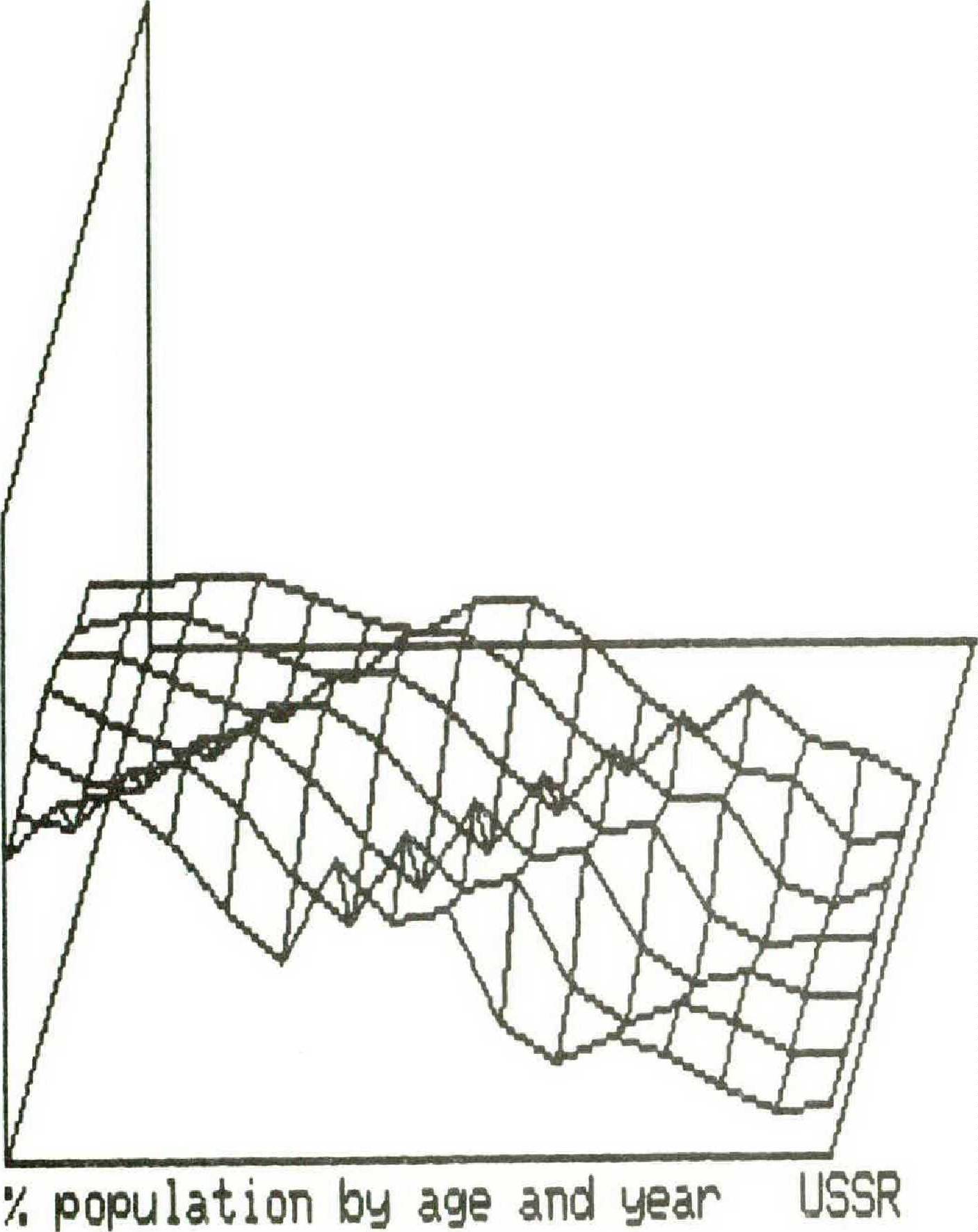
Feshbach shook his head. “When you think what the Soviet people have endured.” The series of horizontal lines from front to back represents 1970 through 2000 in fiveyear intervals. The distance above zero of each vertical line running from left to right is the proportion of population accounted for by a specific age group: the first line is birth to age four, the second ages five to nine, and so on. What the graph portrays, then, is a string of demographic setbacks. The dip at the beginning reflects the Soviet Union’s falling birthrate. The next big dip is an echo of World War II—all of the unborn children who would now be thirty-five or forty. The dip after that is their parents‘ generation, 20 to 30 million of whom perished in the Great Patriotic War. The final, tiny deflection is what remains of the trough opened up by World War I and the October Revolution. It is vanishing as the elderly survivors die off.
If he liked, Feshbach could have brought up a graph for Latvia or any of the fourteen other republics. Each graph would have been different. The Tadzhiks, Uzbeks, and Kazakhs have not fought many battles lately, and they value large families. Ethnic Russians, by contrast, are hardly bothering to replace themselves. They and the other Slavs also bore the brunt of war, purge, and revolution. Estonia, meanwhile, is slowly withering away. All in all, by Feshbach’s estimate, it will take 265 children from every 100 couples, assuming that the mortality rates remain constant, simply to keep the population in the USSR steady over the long term. The Soviets are already cutting it cose—fifty of those 100 couples are having only one child or having none—and without the 40 million Moslems along the southern tier, they would be looking at net deficits. Ethnic Russians evince a grudging admiration for Asian fecundity. The late Boris Urlanis, a Soviet demographer, wrote that Moslem women were pushing to its limits “the physiological potential of the female organism.”
The higher Moslem birthrate has the Russians greatly worried, however. They did not expand from the petty duchy of Muscovy in the thirteenth century to embrace a sixth of the planet’s land mass in the twentieth only to be overrun by people they refer to as chernye (blacks) in the end. Yet by the turn of the century, according to Feshbach’s projections, seventeen Moslems will be born for every twenty Russians, and the Great Russians by then will account for less than half of the USSR’s total population. Naturally, the Russians are jealous of their status as “elder brothers,” of their virtual monopoly on political power, and of the Russian language’s dominant position in the Soviet Union. When Leonid Brezhnev, at the twenty-fifth Party congress, in 1976, called for “an effective demographic policy,” everybody knew what he meant.
The Russians’ response has been two-pronged: trying to keep the lid on the Moslem population while “Sovietizing” the children they cannot forestall—giving them a “Communist upbringing,” instilling a “correct world outlook.” The means to both ends, as the strategy began to unfold, were to be education and urbanization. Everywhere else in the world, these are linked with low birthrates. Theoretically, both would encourage young Central Asians to learn Russian and to adopt a “socialist way of life.” The language issue, meanwhile, has been stressed over and over again. Russian, wrote the first secretary of the Uzbek Communist Party, Sharif Rashidov, “is a language as vivid as the rainbow after a spring shower, as true as an arrow, melodious and rich and gentle like a song carried over linen.” Since 1977, five new scholarly journals devoted to methodological questions relating to the teaching of Russian have begun publication—all of them outside the core Russian Republic. That, Feshbach said, is a good sign, it one is needed, that the Russians mean business. “I mean, do you know how hard it is to get an authorization for paper?”
Thus far, the only problem with the Kremlin’s approach is that it has not worked. Most of the Moslem children are being educated in their native tongues—indeed, one third of all Soviet children attend “nationality schools,” where Russian is a “foreign” language—and it is impossible to turn that practice around overnight. Simply adding more hours of Russian-language classes in Turkmenistan does as little good as mandatory French does in Yonkers. It might help if the Central Asians actually began moving to the cities, but finding an urban job in Central Asia usually requires knowledge of Russian to begin with, since a majority of those living in Frunze, Dushanbe, Tashkent, and the other capital cities of the Asian republics are ethnic Russians. Besides, housing is scarce in Soviet cities, especially for Moslem families with eight children. There is plenty of room in the countryside. (Kazakhstan alone is the size of Western Europe). Nor, it seems, has education greatly curbed fertility. Even though rural women in Uzbekistan, for example, now have more formal schooling than rural Russian women, according to one study, those who have higher education and who work still bear an average of five children.
Alexandre Bennigsen, a French scholar and a close friend of Feshbach’s, once observed that in Central Asia, “culture is not merely folklorics.” It is not merely Islam, either, nor is it merely literature, language, drama, music, or art. Instead, all these elements seem to function together as a kind of mass immunization against the whole “socialist way of life.” Indeed, there has been a resurgence of nationalism outside the Soviet heartland. Muammar Qaddafi’s fundamentalist Green Book is widely circulated in Moslem regions. Local scholars have begun a campaign to rid their languages of Russian loanwords. Cultural pride runs deep. The Uzbeks in 1980 celebrated with great pomp the one-thousandth anniversary of the birth of Avicenna, the Moslem poet and philosopher and a native son. When Avicenna screamed his first, the Russians were still pagan and illiterate.
Resistance to Russian preeminence exists outside the Moslem areas, as well—in the Transcaucasus, for example, where Armenians and Georgians successfully resisted the Cyrillic alphabet, and, to some extent, even in the Ukraine and in the Baltic republics. Living standards, values, aspirations, histories: all of these vary greatly from republic to republic within the Soviet Union. “Sometimes,” Feshbach said as he switched off the machine, “it makes more sense to think of them all as different countries.”
FESHBACH’S ROOTS GO BACK TO ONE OF THOSE DIFferent countries—to Bessarabia. “Give me a year and I’ll give you a place,” he says, when asked where, precisely, Bessarabia is. It went back and forth for centuries between Romania and Russia, and even now’ that Bessarabia is firmly Soviet, the Kremlin remains uneasy about this contentious bit of turf and looks kindly on efforts by Russian ethnologists to prove that the Wallachians, putative ancestors of the present-day Moldavians, were originally Slavs, thus cousins of the Russians. (Bessarabia is now divided between the Moldavian SSR and the Ukrainian SSR.) Whatever the technicalities, Bessarabia was part of Soviet Russia when Benjamin Feshbach, Murray’s father, abandoned it in 1919 at the age of sixteen and walked, rode, ran, and hid for a thousand miles from the shtetl to Hamburg, thence to New York. Benjamin’s ninety-two-year-old grandmother had begged to be taken along. Skeptical of her endurance, he refused. The old woman communicated her disappointment by post for another sixteen years.
A brother already worked in New York, and Benjamin went to work for him at what would become Feshbach & Ackerman, Furriers, 333 Seventh Avenue. He quickly moved up to foreman, supervising the fleshers and greasers, the matchers, nailers, finishers, and glazers. Much of the cutting he did himself, the skin dampened and stretched in front of him—“dropping” a short and broad mink pelt to make it long and narrow, or working two pelts into one without a trace. It took most cutters two and a half days to cut enough pelts for a Persian-lamb coat. Benjamin Feshbach could do it in eight hours. “When I saw him with a knife in his hand, I stood back in awe,” his son recalls.
Like 2,500 other furriers in New York, Feshbach & Ackerman did half of its work in June and July anticipating the August fur sales and the fall buying season. Murray worked during the summers as a delivery boy, dodging the crowds on 28th and 29th streets as he carried finished coats from place to place. He yearned for school to start. “Walking around in ninety-degree weather covered with mouton or mink was a good lesson in academic orientation,” he says. “They did that with our entire family. It was a very clever idea.” Many of the young Feshbach cousins decided education was a good thing, indeed. Herman Feshbach is chairman of the physics department at MIT, Seymour is chairman of the psychology department at UCLA, Sidney teaches English at the City College of New York, Paul is special assistant to Albert Shanker, president of the American Federation of Teachers. Murray’s sister, Charlotte, teaches mathematics in Rockland County, New York.
In Pelham Parkway, where the Feshbachs owned a small, red-brick, semi-detached house on Muliner Avenue, Murray hung around with Manny Bandel, Bill Kosloff, Herb Green, and a score of other bright children who joined the Boy Scouts together, skipped grades, went to college young, and are now doctors, lawyers, engineers, sociologists, and businessmen. They remain friends. Pelham Parkway—“Pawkway,” some pronounce the word— was a middle-class Jewish ghetto. The men worked in the city as jewelers, tailors, and furriers. Many of the boys attended Rabbi Meltzer’s Hebrew school five days a week, after six hours in public school. On Saturdays, Murray and “the crowd” would walk to the library, or take the subway into Manhattan and roam through a museum, or visit the bookstalls on lower Fourth Avenue. They might end up at Feshbach & Ackerman and come home with Murray’s father.
“Murray’s house was the hangout,” says Herbert Green, now a podiatrist in Yonkers. “Everybody else had, you know, three rooms—one bedroom, a living room, and a kitchen—but they had a dining room. And they had a porch. So you can imagine what happened. I mean, a bunch of gorillas came to his house every night.” Murray’s mother, Lilly, who had emigrated from Poland in 1923 and was married five years later, died on his fifteenth birthday. His stepmother, Sarah, put up with the boys gamely. “She was a saint,” Green recalls. “You’ve got to wonder where you find somebody like that to marry.”
Pelham Parkway was the kind of ideal ethnic community that one might think existed only in a civics textbook. Jack Cohen had his Scout troop at P.S. 105 and P.S. 105 was a good school; Miss Goodwin (the principal) and the parents insisted on it. Yankee Stadium was only a short ride away on the IRT. The first game Feshbach attended without his father was in 1936. Joe DiMaggio hit a triple and the Yankees beat Detroit 14-3. Feshbach began memorizing sports statistics, then moved up to bridge, then chess. He was good because he made it a point to be, and because he had a knack for remembering. He held every trick and every move in his head. He is the kind of person who today remembers not only the addresses and phone numbers of at least fifty friends and colleagues but also two or three previous addresses and phone numbers for each.
In fact, in that neighborhood, Feshbach was not all that unusual. As a young boy, for example, he often played chess with Arthur Bisguier, who lived a block away, on Matthews Avenue. Bisguier, who took chess seriously, soon left Feshbach behind and went on to win the U.S. Championship in 1954. In Pelham Parkway, roving bands of brainy, upwardly mobile youngsters were as plentiful as shad roe. “It was the old ethic, you know,” says Green. “You’ve got to go to school, you‘ve got to do better than your parents, that sort of thing. The parents didn’t realize that they did pretty well themselves. Who knows if we could have swung it if we had to do what they did?”
FESHBACH’S NEW OFFICE AT THE CENTER FOR POPUlation Research of the Kennedy Institute of Ethics is on the third floor of a red-brick Victorian building in Georgetown—the old trolley barn. It is set into a hill, so one can enter it from Prospect Street (to discover, in the elevator, that one is already on the fourth floor and must descend) or from M Street between a law office and a travel agency. Either way, one will probably smell the cordite and hear the echoing thud of weapons being fired on the premises of Anti-Aggression Systems, Inc., lodged in the same building. Feshbach’s window overlooks the Potomac and the approach to National Airport. Where there are no bookshelves, the walls are covered with Russian maps. On his desk, an eighteen-inch square is cleared for writing.
“Shifrin is a zealot about this,” Feshbach said one day, offering me a paperback for inspection. It was a beef-andtomatoes day, after a painful skim-milk-and-bananas day, and he had returned happily to his office, fortified for a long afternoon of conversation. A book had arrived from West Germany, edited by Avram Shifrin, a Russian expatriate, and forwarded forthwith by a former student of Feshbach’s. It was A Guide to Labor Camps and Prisons in the Soviet Union, archly designed to mimic Fodor’s: how to get there, what to see, where to stay. (“Psychiatric Hospital No. 5 [is] located on the train route to Kursk.”) Shifrin angrily describes one patient’s being committed to a mental institution merely for walking in front of the Bolshoi Theater with a sign reading “I want to leave the USSR.” The official diagnosis, however—“misjudgment of the surrounding reality”—seems hard to dispute.
Books like this are the kitsch of Soviet studies. They give everyone a kick, and sometimes there are even a few nuggets to mine. No one else in Washington had seen a copy yet, and Feshbach reached for the phone. Within a few minutes, he had routed the book all over town. “That is the big difference between Murray and me,” Herbert Block says. “I am an introvert. I stay in my library. But Murray knows everybody. He gets his hands on all sorts of outlandish literature. And he is generous in a field where many people hold their cards close to their chests.”
It is also a field, Feshbach explained between frequent interruptions, that he had not intended to enter. He graduated from Syracuse University, in 1950, and then, a year later, received an M.A. in European diplomatic history from Columbia; he wrote his master’s thesis on the Franco-German war scare of 1875. That autumn he was drafted. Feshbaeh realized in the Army that he was far more interested in the Cold War and the Soviet Union than he was in obscure war scares. Winston Churchill gave his famous Fulton, Missouri, speech in 1946, and Feshbach recalled and liked the part about the Soviet Union being “a riddle wrapped in a mystery inside an enigma.” Furthermore— and this was not to be discounted lightly—it was going to be important to the United States to have people who understood the Soviet Union. There would be jobs available for such people; there would be foundations and government agencies willing to support them while they learned.
He heard about the U.S. Army Language School in Monterey, California, applied for the Russian program, and was selected—the only successful candidate from the entire Second Army. It was an intensive, year-long course: 1,320 hours; equivalent, Feshbach notes, to two and a half years at Georgetown. (He habitually depicts one thing in terms of another, the way chronic dieters instinctively intuit the parity of three-quarters of a cup of milk and an ounce of chocolate.) Inexplicably, after bothering to instill fluency in Russian, the Army sent Feshbach to do personnel work in France.
He got out of the Army in 1955 and found work at once as a junior clerk with the Soviet-economy project of the NBER. It was the last year of famine in Soviet studies, the last truly bleak year. Moscow had published virtually nothing about the country since 1936. A slim propaganda pamphlet had appeared in 1938. A handful of education statistics were published in 1940. In 1941, Stalin prepared a secret plan for the Soviet economy; the Germans captured it from the Russians, and, in 1944, the Americans captured it from the Germans. That was all there was.
For a long time, Feshbach said, no one knew how the few statistics that were released had been gathered or how reliable they were. Someone might discover that annual soap tonnage had suddenly increased and run around the office excitedly with the news that more bars of soap were being produced. But then another researcher might say, “What’s the fat content? If the fat content has been reduced they’d probably substitute something heavier; there could be just as many bars, maybe fewer.” There was a joke about a collective farm that had raised three pigs one year. The farm director told the Gosplan agent for this particular rayon that it had raised five. The agent told his superior at the oblast‘ level that the total was eight. He in turn pronounced the figure ten and passed it on to Moscow, which sent word back to the collective: “Good work, comrades. We’ll take only three of your pigs, and you can keep the rest.”
Fluency in Russian was essential but not enough; one also had to pick up the jargon. Euphemisms were often opaque. “Enterprises and Organizations on a Special List,” for example, meant the military. A dictionary defined a rabotnik as a “worker,” implying a laborer, but the Russians used it to include the salaried staff of a factory—even the clerical help, the guards, and the engineers—and if one didn’t know this, one’s employment estimates would be off by about 20 percent. The word instruktor for years was taken as referring to a junior official of some kind. Then it turned out that ministers took orders from these instruktori, that “instructors of the Central Committee of the Communist Party of the Soviet Union” were very senior indeed. “Now when I see something signed by an instruktor I look twice,” Feshbach said. “I look more than twice.”
To the pioneers of Soviet studies, little triumphs were important—coming across an occupational category no one had ever heard of before, figuring out how much farm produce was hauled by barge. One fellow spent weeks trying to determine the population of a Soviet “secret city,” which was a center for nuclear research. No luck, until he realized that figures existed for every other city in that republic, and that a “total urban” figure had also been published. It all seems rather inconsequential in retrospect, and that is the point. Matters of little or no consequence were at least as hard to settle as the large and crucial questions, such as how many people lived in the Soviet Union, or how big the army was.
Feshbach spent his first nine months at the NBER trying to determine the caloric equivalents of Soviet coal, moving beyond the gross tonnage figures to estimate its real value—what share was lignite and what was bituminous—and what the Soviets could really do with what they mined: how many factories they could run on it; how many homes they could heat. He had no sooner finished his study than the Soviets rendered it superfluous.
IN MAY OF 1956, THREE YEARS AFTER JOSEF STALIN’S death, and only a few months after Khrushchev’s secret speech denouncing Stalin at the twentieth Party congress, Moscow published the first of its annual statistical handbooks, The National Economy of the USSR. Only then did scholars begin to appreciate what had happened to the country during the twenty-year blackout. The population was virtually the same at the beginning of 1956 as it had been in 1936. A living generation had been decimated in the field, an unborn one shrunk by the dearth of new parents. There were fifty-five women in the Soviet Union for every forty-five men. (By the year 2000, the sex ratio is expected to be ninety-one males for every hundred females—less skewed than it was, but still abnormal.) The economic damage the nation had sustained was staggering. Industry lay in ruins; the fertile Black Earth Zone had been a battlefield for four years. The U.S. Civil War had not bled the South so white nor set it back so far.
The Soviet handbook was hardly flawless; it was incomplete, contradictory, sometimes duplicitous (although it did seem to corroborate the estimates in Feshbach’s coal study). It was also mum about the blackout years. A great deal of information had apparently been “lost during the war,” the standard and still quite serviceable evasion. Scholars continue to fill in the 1936—1956 period rather like a crossword puzzle. Information turns up unexpectedly. Feshbach once found a table on the Soviet population in 1948 and 1949 buried in an article on the Soviet watch industry.
Subsequent volumes of the Soviet handbook did not always represent an improvement. The 1960 edition—the last one to give any military data at all—put the number of women in the armed services at 632, which was ludicrous on its face. Feshbach eventually figured out that as many as 800,000 military personnel (including doctors, nurses, and construction troops) were being statistically “hidden” within the civilian economy. Misleading data were an occupational hazard, but the silver lining was that if the Soviets had scrupulously followed the guidelines of Stalin’s 1947 secrecy act, they would not have divulged anything at all. “The 1950s were a time for stockpiling,” Feshbach said. “It was the training period. The job was simply to get a basis for understanding. Only when we had this could we go on to other questions.”
The evolution of Soviet studies since then is reflected in the titles of Feshbach’s published work, written alone or with collaborators. The early nuts-and-bolts studies, such as The Role of Trucks, Buses, and Aircraft (1958) and The Soviet Statistical System (1960), gave way to more ambitious efforts, such as Women in Soviet Agriculture (1966), which in turn took a back seat, once enough pieces of the puzzle were in place, to broad evaluations of pressing policy issues in the USSR: Prospects for Outmigration from Central Asia During the Next Decade (1977), Soviet Population Trends and Military Manpower (1978), and the forthcoming survey of the quality of life in the Soviet Union. These days, enough information is in hand about most aspects of life in the USSR to imply the basic picture. Even when some crucial piece of evidence is missing, people like Feshbach often can find ways to reconstruct it. The abbreviated 1979 census (publication stopped in mid-1981 without explanation and then resumed haphazardly in 1982) provides ample opportunity to do so.
One of the many items deliberately left out of the few census pages published so far in Vestnik statistiki is population by age, and Feshbach was keen on knowing how many children there are under the age of ten. He spent a night combing through the journal until he came across a couple of entries under education. One was “population with higher education.” Another was “number per thousand aged ten or older with higher education.” Simple arithmetic produced the desired result. Feshbach divided the first figure by the second, multiplied by 1,000, subtracted the product from the total USSR population, and thereby estimated the number of children under ten at 44 million. Then he broke it down by republic. “Of course,” he said, “I was assuming that not many kids under ten had higher education, but that was pretty safe; I mean, Norbert Wieners there aren’t too many.”
The interesting thing about the number of children under ten, of course, is how widely it varies from place to place, in the six Moslem republics, which are rural and where the cradles are perpetually full, one of every three people is younger than ten. In the urbanized Slavic and Baltic republics, where the divorce rate is high, where most women have to work, where families often must double up in apartments, and where “militant bachelorism” is a favorite complaint in social commentary, there are millions fewer children than there were ten years ago, and three times as many people over the age of sixty-five as there are in Central Asia.
“Here’s the whole story,” Feshbach said, grabbing a Soviet decree from his desk. He likes to punctuate his conversation by producing documentary exhibits and, surprisingly, given the chaos, he can lay his hands instantly on whatever he wants. “This is from the weekly Report of the Supreme Soviet of the USSR, announcing the latest recipients of the Mother-Heroine medal, which is given to mothers who have borne and raised ten or more children,” Feshbach continued. “‘The Presidium of the USSR Supreme Soviet . . . confers the title Mother-Heroine on 66 multichild mothers living in the Russian Republic, 55 in the Ukrainian SSR, 690 in the Uzbek SSR, 382 in the Kazakh SSR, 19 in the Moldavian SSR, 138 in the Turkmen SSR, and 1 in the Estonian SSR.’ I really think Estonia is going out of business.”
The irony is that all of the “pro-natalist” policies that the Soviet Union has adopted to get the Slavs to breed—the hundred-ruble bonus for a second child, the monthly payments to families with more than three children, the fines that witnesses to marriages in Moscow must sometimes pay when the newlyweds divorce within three months— have proved useless in the Russian Republic while working all too well where they were not needed: along the southern tier. A. I. Smirnov, the Gosplan spokesman, compared the enterprise with “irrigating a field during a rainstorm.” A new batch of inducements was promulgated in 1981, and this time the Russians are taking no chances: the incentives go into effect at different times for different regions, with Central Asia, Kazakhstan, and the Transcaucasus bringing up the rear, a full year behind the Slavs and Balts.
THE FERTILITY DIFFERENTIAL IS NOT JUST A CURIOSity, Feshbach explained; it has enormous consequences. For one thing, there could be 22 million more Moslems by the year 2000, while the total population of the country, thanks to the sluggish Slavs, is likely to be between 40 million and 50 million less than the 350 million that was estimated by the Soviets only a few years ago. As late as 1976, the USSR’s passenger-transportation experts were basing all their plans on projections that suddenly shrank by 15 percent. A serious labor shortage is already apparent (there were 2 million job vacancies in Soviet factories last year), especially in the industrial north, which is the source of 60 percent of the Soviet gross industrial product. During the 1980s, the labor situation will only worsen, with the population in the “able-bodied ages” (sixteen to fifty-nine for men, sixteen to fifty-four for women) growing every year at one fifth the rate it did during the 1970s, and almost all of that increment coming from the south.
The Moslems are not inclined to make up the deficit, however. They believe their land to be the cradle of civilization; to leave it is regarded as a sin against the Ulus, the community. The Russians have been trying with little success to put southerners to work on the Baikal-Amur railway, on the huge Non-Black Earth Zone agricultural project (a costly attempt to enlarge the Soviet Union’s inadequate breadbasket), and at many new industrial sites in Sayansk, Ust-Ilimsk, and elsewhere. Apparently, you can send a Tadzhik to work at a factory in Sverdlovsk, double his pay, give him a twelve-room apartment for his growing family, and buy him a subscription to a Tadzhik newspaper, but six weeks later he will want to go home.
Reluctantly, the Kremlin has started relocating its industrial plant—moving highly labor-intensive enterprises, for example, into Central Asia. There is still the problem of getting the Moslems off the farm, however. Meanwhile, the Soviets are pulling in thousands of “guest workers” from fraternal socialist neighbors: Bulgarian lumberjacks, North Korean coal miners, Vietnamese laborers. (Hanoi is reportedly paying off its $3 billion war debt to Moscow with people.)
The labor crunch poses a special dilemma for the army. Moscow does not publish many details, but Feshbach estimates that the Soviet military needs to draft some 1.7 million eighteen-year-old males every year to sustain its 4.5 million-man armed forces. In 1987, only 2,012,000 young men will be of draft age. Given the rate of exemptions and deferments (once around 30 percent, although steps are being taken to reduce this proportion), that means a shortfall for the army even if the needs of the civilian economy are ignored. There are obvious solutions to the problem, of course—limiting deferments and extending the length of service beyond the present two years. The hard part is setting priorities: making the tradeoffs between the Red Army and everything else.
“The military in the past largely got what the military wanted, but the present is not necessarily the past,” Feshbach said. “A whole generation of young Soviets has not suffered the deprivations their parents and grandparents did. Their knowledge of what life is like in Eastern Europe–much better than it is in Russia, and many Soviets have seen this with their own eyes—and in the West is far more complete than it ever used to be.”
Jokes about the lack of consumer goods have a hard edge to them. There is the story of a woman who left Russia as a child and returned fifty years later to a class reunion at her grade school. An official asked her if she could pick out her old boyfriend, and she did so at once. “How could you tell?” he asked, surprised. “Oh,” she replied, “I recognized his overcoat.” Shortages of basic commodities—food and clothing, primarily—mean long lines, a form of inflation in a society where prices are set by the state and do not rise with demand. “Time-budget” studies (based on interviews with immigrants from the USSR) reveal that Soviet women on the average spend 20 percent of their leisure time queueing up.
The fecund nationalities promise further woes for the military. Every year a growing proportion of all newborn children is going to be Moslem. Problems of language, education, and culture already plague the increasingly “yellow” Red Army. Even during the darkest days of World War II, when Stalin desperately needed more men, the Russians rarely deployed Central Asians as front-line troops (90 percent of all riflemen, for example, were Slavs). Today, Moslem draftees, lacking both the skills and the fluency in Russian required by a modern Soviet army (the driver-education course for new recruits now takes up to a year), are frequently assigned to construction details. They are virtually barred from any of the elite units, such as the strategic-rocket forces.
Recent experiments have changed few minds. While it has been Soviet policy since 1938 not to send reserve troops into adjacent territory, in December of 1979, Moscow sent two Central Asian regiments into contiguous Afghanistan along with regular army units. Those regiments have since been withdrawn. “There was a question not only about their fighting ability but also about what was happening to them as they were exposed to contemporary Moslem practice,” Feshbach said.
HOLDING A CONVERSATION WITH FESHBACHmore accurately, letting him hold one with you—is like watching three television programs at once. At college, Feshbach’s friends joked that he could hold a conversation while listening to a basketball game on the radio, and, somehow, when the game was finished, and the conversation was finished, all of Feshbach’s homework would also be finished. As we talked that afternoon in his office, the phone was in use much of the time, incoming calls occurring randomly, outgoing ones apparently scheduled (“I have to make a call at 2:17”). He asked a Moscowbound colleague to convey condolences to the widow of a friend. He talked to someone else about resettling a Russian-Jewish immigrant. He read aloud from an acerbic review of Gorky Park in the weekly Literaturnaia Gazeta (“a piece of ridiculous trash” designed to “discredit détente”). As he talked on the phone, he made little notes to himself and gestured to visitors. The computer down the hall had generated some graphs illustrating another dimension of the population problems, and Feshbach spread them out for me while he spoke to someone in Chicago.
They showed a population being eaten away from two directions: not only by the enormous increase in infant mortality but also by premature deaths among twentyto forty-four-year-old males. The men are in bad shape. Unlike the situation that has prevailed in the rest of the industrialized world since the 1950s, more women in the USSR become heads of household because their husbands have died than because of divorce. Moscow stopped publishing age-specific mortality data in 1975-1976, but Feshbach has re-created the missing statistics for the years since. If anything, his infant-mortality estimate may be too low, since the Soviets do not consider as having been born any child of less than twenty-eight weeks gestation, less than 1,000 grams in weight, or less than 35 centimeters in length who dies within seven days of birth.
“Infant mortality is a very good social barometer,” Feshbach said—a point the Soviets used to emphasize, in very nearly the same words. “There has clearly been a serious deterioration in health. The Soviets have some very bad habits. They smoke and drink too much, even the women. They don’t eat properly, especially the pregnant women. The environment is very bad. Plus the health-care system has serious problems. They‘re short of x-ray film and surgical instruments and even aspirin. They have none of the throwaway technology—the plastic syringes, the paper bedding, and so on. A lot we don’t know, because the information was dropped from the yearbook.”
Feshbach has been in a Soviet hospital only once—Botkin Hospital, the leading institution for those who lack access to the closed system reserved for the elite. He had twisted his ankle in a pothole while avoiding an onrushing car. A doctor at the British Embassy immobilized his foot with an elastic bandage and then the State Committee on Science and Technology ordered Feshbach to Botkin for an x-ray. He waited three hours. Finally his turn came. It was not the wait that has stuck most vividly in Feshbach’s mind. It was not the paucity of lead shields in the radiology lab. It was the radiologist saying to her assistant as she removed the elastic bandage, “I’ve heard of these.”
When it comes to bad health, the Soviets seem to stack the odds against themselves. Because no other means of contraception is made readily available (the result, perhaps, of the state’s wish to increase population rather than to help limit it), the Soviets rely on abortions. Some 10 million or more are performed every year, between two and three for every live birth. The average Soviet woman will have four to five abortions in her lifetime, compared with 0.75 for U.S. women. The more abortions a woman has, the greater the chances of premature delivery when she chooses to bear a child, and the greater the chances then that the child will die. This problem is exacerbated by the abortion procedure employed by physicians in the USSR: frequently dilation and curettage rather than the far less traumatic (for the mother, anyway) vacuum aspiration. Because most mothers must work, moreover, millions of infants are left in day-care centers. When a virus sweeps across the country, day-care centers take it on the jaw.
“You can understand why the Soviets have been holding back on the census,” Feshbach said. “The results are so implicitly negative for the Russian leadership. As the problems of their economy and society get worse, they cut back on information. Since the signing of the Helsinki accords, in 1974, about thirty major items have disappeared from the statistical yearbook—this is in addition to things that never used to appear. The number of doctors by specialty has disappeared, together with some national income data and employment by industry. When I see something disappear, I get even more curious than I was.”
NORTON DODGE HAD INVITED A SMALL GROUP OF Soviet scholars to Cremona, his nineteenth-century farmhouse on the Patuxent River in southern Maryland, for oysters on the half shell, oyster stew, crab casserole, cornbread, and chicken. The pilings offshore wore caps of osprey nests against the late-autumn wind. Feshbach was talking about Eurocurrency speculation by Moscow’s Bank Narodny in London when owlish Alexandre Bennigsen—an Orson Welles grown old, not fat— swept in from Paris. He embraced Feshbach; they kissed, Russian-style. Bennigsen is an authority on Soviet Moslems, who, he likes to say, had a thriving culture “when the Russians were still in the forest.” He ducked out for a radio interview and returned proudly to Feshbach a halfhour later. “I defended the Turks,” he declared. “You have a very broad definition of Turk,” Feshbach said, smiling. “He did very well,” Dodge said. “The interviewer always asked him the same question, but fortunately Alec came prepared with different answers.” It occurred to me that Feshbach himself has been doing just that for twenty-five years—coming up with different answers to a single question: What lies on the other side of the screen?
This is what all Sovietologists ask themselves, and a good place to hear them do it is at the Kennan Institute for Advanced Russian Studies. (The institute is named not for George F. Kennan, the historian and former ambassador to Moscow, but for his grandfather’s first cousin of the same name, who was an explorer of Siberia and the author of the book Siberia and the Exile System.) I have stuck my head in there at least once a day for about five years. There is always some scholar around just aching to share a humorous morsel gleaned moments before from Pravda; or to display an article by Art Buchwald that Literatrnaia Gazeta has reprinted as straight news on page one; or to explain for no reason in particular that when the Russians want to refer to the “big cheese,” they say instead the “big pine cone.” It is the lot of one staff member there to ascertain periodically the proficiency of the American translators on the Washington-Moscow hot line.
The Kennan Institute, an arm of the Woodrow Wilson International Center for Scholars, where I work, is lodged in the upper floors and towers of the old red-brick Smithsonian castle, on the Mall, and it was at the institute that I first observed Feshbach, a Kennan Fellow for a year. At meetings and conferences, under the rose window and Renaissance tapestry of the Wilson Center’s library, he carefully worked the crowds, not flitting from group to group—Feshbach never flits—but making his way by a kind of peristalsis. “He’s like a Jewish Lyndon Johnson,” someone once remarked from the sidelines, watching Feshbach throw himself into a reception.
After I was introduced to Feshbach, we would linger long over lunch in the fellows’ dining commons, Feshbach diagramming points on napkins, explaining three unfavorable projections of Soviet GNP in the year 2000, and wondering if the Soviets would this time muddle through as they always had before or if the burden of military spending on a sluggish, low-growth, low-investment economy would ultimately force a major change in policy. “There are ‘muddle-through’ believers in this town,” he would say, “and there are ‘burden’ believers. I happen to be a burden believer, and I think the people in Moscow are going to modify the practice of giving the military a blank check. Even though I believe this, they still haven’t done it. It isn’t logical that they still haven’t done it, but, nevertheless, they haven’t.”
The better one gets to know Feshbach and his colleagues, the more one appreciates the fragility of Soviet studies as an enterprise. Its practitioners are spread thin, as if to ensure that there will always be someone to hear the tree falling in the woods. Its sources are brittle, its methods often improvised. It is undermanned and largely at the mercy of external circumstance: the Korean War and Sputnik sent its fortunes soaring, while détente and recession have acted as a drogue parachute. Owing to budget cutbacks in both government and academe, jobs for younger specialists today are scarce. College students are going into other fields. The number of Ph.D.s granted annually in Soviet studies has sunk to pre-1965 levels, and enrollments in Russian-language courses at American universities have declined by more than a third during the past decade. Latin is now more popular on campuses. The depletion in the ranks is so serious that Congress is considering a bill to create a $50 million “Soviet Bloc Research and Training Fund.” Last October, W. Averell Harriman and his family gave $11.5 million to Columbia University’s Russian Institute (which, as a result of the gift, was renamed in Harriman’s honor), in order to help revive Soviet studies in this country. Meanwhile the first generation of Sovietologists is fading into retirement. Hedrick Smith says, “There won’t be many Murray Fbshbachs around a decade from now, and we will pay dearly for that.”
Over the desk in Feshbach’s office is a photograph, taken at a conference, of most of the men and women in Feshbach’s field, and he will be sitting underneath it for the next ten years or so, as many of those faces drop out of active research. That disturbs him. But for the time being he has other fish to fry. He has a class to teach every semester, dissertations to supervise, and a half-dozen projects of his own to finish. Possibly the Soviets will release the rest of their 1979 census results for Feshbach to go to work on, though he is not optimistic, remembering that most of the data from the 1959 census are still under lock and key.
“When are you going to publish some more?” Feshbach once asked Petr Pod”yachikh, director of the USSR’s Census Administration, about the 1959 data. Pod’yachikh smiled, went to his safe, and pulled out a bulky mimeographed document. “We have it all,” he said, “down to the county level.” Feshbach asked, “Can I have a copy?” Oh no, the answer came, it doesn’t pay to make just one copy. “All right, I’ll take three, I’ll take five.” But Pod”yachikh coolly returned the papers to the safe and spun the dial. “No, Murray,” he said.
Peering from behind his bifocals, sifting among the drifts of paper on his desk, Feshbach stifles the memory of that playful act of cruelty. “They’re trying to keep me from understanding,” he explains, “and I’m not going to let them.” □