Rendezvous With Romania
(with apologies to Graham Greene)
IT IS THE EARLY days of this century, the parlour of an English country house. A young man wants to be a writer. Why? Why not remain well-to-do and “safe,”like so many men of his generation? Of course, he knows that death is the desirable end, the end to “all this.”Then why authorship, that futile packing and unpacking of the smuggled guns of memory? I cannot answer now, a quarter of a century later, any more than I could then, in the early days of this century. Yet I had to write. It was as necessary to me as the smile of a beautiful woman you have come to love. This is the story of that young man, the books he was to write, and a certain journey he was to take, just before the outbreak of war.
I do not see much promise in those early novels—each one of which came out of the author as a baby comes out of his mother’s womb. Papers in Order and Bags Packed was a total failure, as I knew it would be from the time I was seven years old. But Ronald Peetie—he was later to shoot himself—had been urging me to publish for some time. Over too many gins one night in Brazil, I agreed. He was a young man, this writer, and bewildered, perhaps, by the rats that were running all over his feet, squealing revolution. He did not know what I now know—though age brings its own innocence—that rats have no attention span and frequently don’t know what they are saying, and that “political” revolution means nothing: for a man must first hunt himself like a beast, and catch himself, and beat himself up.
That first novel was a nightmare of technical worries,1 as I struggled with nausea and mosquitos on a tiny boat, while a surly Estonian “boat boy" offered me sex and drugs for money. It was then that I smelled for the first time a sweet, heavy odor I was to recognise repeatedly in later years—in Quemoy and Matsu, in Kenya during the Mau Mau rebellion, in Paris at the first performance of The Rite of Spring. It was the odor of outraged innocence, the sweet, heavy smell of corruption.
In later years, I have dared re-read that novel only two or three dozen times. There is nothing of value in it really, except possibly the character of old Smith, the Jesuit armaments dealer with his cherished seventeenth-century mouse in the bottle he would not put down, even when his wife fell off that Liberian steam packet and drowned while he watched, sinking under the load of pity that was never to desert him. Or, perhaps, the character of Dottie, the nun-faced prostitute, who demanded to be paid in chocolates, and whose past was a mystery even to her creator. But I was to have some consolation lateion, when an American President, Harry Truman (the former haberdasher), was to say that reading it made him understand political life for the first time.
Yet there must have been something to those early novels, because in 1932, I was approached by a secret agent disguised as a beggarman, as I was strolling near my home.
“I hear you’re a young novelist looking for trouble,” he began.
I walked on and made no sign of having heard, carrying caution in my hands like a bag of explosives.
“Care for a fag? Or prefer opium?” he continued, sizing me up.
“Whatever you say.”
“Interested in spying for us?” He drew out an expensive cigarette case. “Help yourself.”
“Not till I know where I’m going and if there’s any trouble there.”
“Okay, okay.”
We walked a short way in silence, the young novelist and the beggarman. He was not what he seemed. Was I?
“How’s Bucharest sound?”
I made up my mind quickly. “Count me in.”
We discussed the situation over akvavit in the nearby cosy. Apparently, the Romanians were engaged in a mobilization that looked very ugly indeed. (“Ugly”—why did I ever popularize that word?) I was to visit Bucharest incognito—a shepherdess costume was provided—and just circulate, trying to overhear war secrets and, if possible, steal money. Other than that, I was free to do as I pleased. I had my rendezvous with Romania.
It meant saying good-bye to my wife, Niçoise, and to my children. I had a rendezvous with Romania. Naturally, I didn’t like leaving them—I had to take all the money with me—but they had plenty of live goats. I boarded the Romanian train that night at Victoria Station, knowing I would never return.
As we thundered across the Channel, I read Cardinal Newman’s “Apologia Christi,” or “Apology for Christ.” Was it there, in that clattering pre-war compartment with its naive photos of the Midlands, that the spy thriller was born? I think not. And yet . . .
I was not the only passenger reading Newman that night. The respectable man opposite was reading it too. Was he a shade too respectable? I covered my face with both hands and peered out through them, in perfect security. Then, by squeezing my eyes almost shut, I was able to read his tiny lapel pin: KGB. I shuddered, like the young boy who smokes too many opium pipes to impress the hot, sticky girls in the “plaza.” I fell asleep and dreamed: a large cathedral, organ music. Monks intone Latin. I feel an almost unbearable tenderness. Then, in the corner, I see the Pietà, surrounded by a sort of halo. Mary’s eyes turned down in compassion on—me!
I woke up. The KGB agent was sitting at my side.
“Believe me,” he whispered, in heavily accented English, “I have read all your books, and I love them. And I love you!”
Nothing more was said. Slowly, I drew out my wallet.
“No! No!” cried the Soviet. “Never, from the author of The Dried-Up Policeman!” Strangely enough, I was to see him again when I walked across Asia, many years later. He seemed to admire me as much as ever, but had fallen pathetically under the spell of Somerset Maugham.
Dieppe was gay in those days before Occupation—but it was the gaiety of the fan dancer who has just begun to notice big veins coming out on her legs. One night, I was sitting up late in my hotel, drinking with a Polish novelist and talking with caution. There was a knock. We froze. My companion shouted something in Polish. A small dwarf entered, bearing a telegramme for me from De Gaulle. How did he know I was here?
FORGET BUCHAREST STOP JOIN THE RESISTANCE FRANCAISE STOP DONT TELL ANYBODY STOPFIRSTGET YOUR SELF SOME NEW CLOTHES STOP DE GAULLE
I threw it down and smoked some opium. Over the open flame, the soft bubble of brown wax slowly changed its shape until it formed a perfect question mark. Is there a God who makes our plans for us, and shapes our lives? Or a sneering clown?
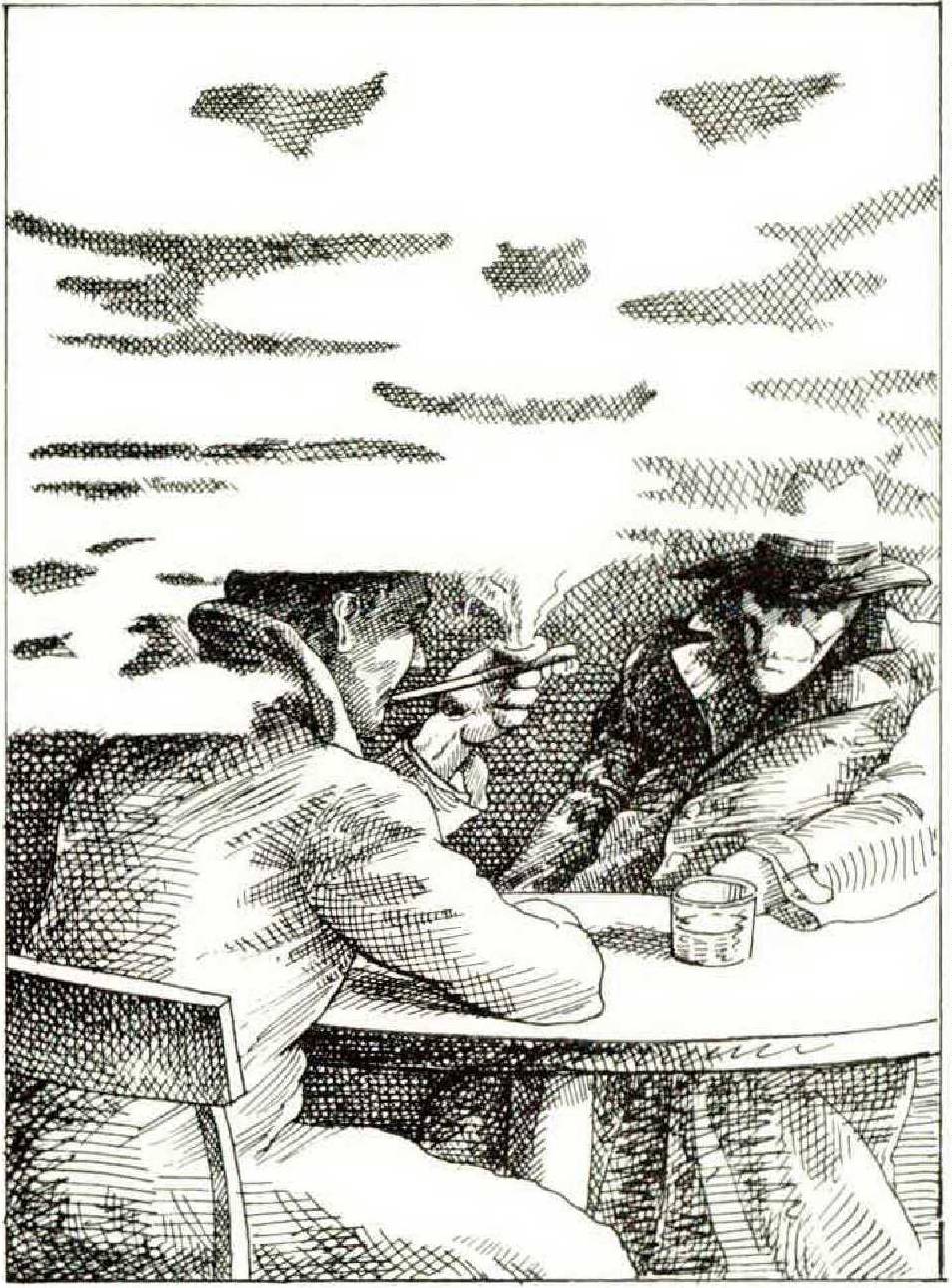
The Polish novelist explained the political situation. The Estonians, most of whom had never seen a white man, were massing on the bolder, along with twenty-five angry divisions from the Far East. Of course, I had heard something of the same thing from Sir Buddy Johnson. In short, all that I had loved in France—its irreplaceable civilisation, as forgiving and grateful as a fading society beauty, its thriving brothels where, for a bag of Hershey’s Kisses, slender girls will “make you feel at home”—all this was threatened now. The Polish novelist begged me to stay. “You know codes,” he said. Could I turn my back on “La belle France”? I had to. I had a rendezvous.
Bucharest. Toddlers in gutters, gnawing with empty eyes on the Top Secret despatches of a government they did not know had fallen. This was the garbage of war. Bucharest-Troy. Bucharest-Espionage. Bucharest-Fear. These are inextricably linked in my mind now, two quarters of a century later, just as they were then, when, still a young man, I was feeling my way to a difficult destiny.
I saw Vslivyk and Mrovichki. I saw Blücher—already old and dying of herpes simplex. Nothing was said. Already my true feelings were beginning to emerge. I felt sympathy for the Romanians. But I felt sympathy for the Estonians, too. But most of all, I felt sorry for Blücher. He was old, and the Romanians didn’t need him. His kind of war was just a memory now—made obsolete by his own incredible victories at Wagram and Waterloo. On my last day in Bucharest, riding by in Lady Blumberg’s Daimler, I saw Blücher—still harboring that grudge against the Corsican Devil—sitting miserably alone at a tiny table at the Metropole, while shopgirls walked by in their summer dresses, laughing heartlessly. He was reading that “literary lady” Madame de Staël (a woman of the mannish type I cannot bear). Years later, as I was lunching in Malaya, a furtive red-haired man rushed in to tell me of Blücher’s death. He then keeled over, a knife in his back.
Spy in My Arms, the novel I wrote on my return, was not a success with the public. However, it was the inspiration for the following poem, which T. S. Eliot sent me:
A Spy in my Arms!
Whoops! I
think you’re swell.
I alone am responsible for the failure of the book, as it has very little of merit in it — except, perhaps, my description of the Duchess of Riga’s bitter laugh as she ascended the Grand Staircase of Bucharest. For the president of Romania had just thrown her over, in favor of a Chinese taxi girl. Through some misfortune, Averell Harriman had been present during the entire interview. Perhaps that had some bearing on her later suicide.
In any case, who was I? A no one. A young and restless novelist, standing on the sidelines of history, spreading despair, and where that was not possible, looking up brothels or hopelessly buying akvavits for spies who were paid to betray me.
THIS HAS BEEN the story of a certain part of a life. The books I wrote, a certain journey I took. I have received much praise, and much blame. I make no apologies. I will say, simply, that the heroes of my books are men with a rendezvous, struggling to meet it, but prevented by the malicious operations of Fate on the innocent, and by the repulsiveness of foreigners. In spite of these things, Fate compels them to travel—always looking for trouble yet never averting their eyes from the grinning death’s-head within. They are men who know how to get their hands on the last can of beer in a falling capital; men who can get a band of savage Gurkhas to smile tenderly and hand over their Spam. They are men who have known, almost since before they were born, that there is no limit to human folly—at the mere mention of which, waves of compassionate pity overtake their weary hearts.
- How, I wondered, could I tell a story without letting the reader’s attention wander from myself?↩