Chickens
I THINK THERE IS more to the chicken than it gets credit for. We hear much about the dignity, mystery, and vulnerability of more alien, not to say less upfront, animals and aspects of nature. Chickens we chew on or chuckle over. Some people probably hold the belief, whether they articulate it or not, that either a chicken sandwich or a rubber chicken is a purer representation of what it is to be a chicken, essentially, than a living chicken is.
Yet the chicken is as close to man and as savory as the apple, as full of itself as the lynx or the rose. A hen’s feathers feel downy but organized when you lift her up. She has a peck like a catcher’s snap-throw to first. A chicken never makes eye contact with a person. Who is to say why they cross the road?
A good thing to read is The Chicken Book, by Page Smith and Charles Daniel, published by Little, Brown a few years ago. This book undertakes to see the chicken from all angles and to see it whole; to treat the chicken as an entity, multifarious: the chicken in literature, in history, in its own inner and outer workings, in the pharmacopoeia, in orangewine sauce, A fine idea, an estimable work, a rare advance in integrated thinking.
Then again, perhaps it is not the book (which required two authors, aided by a class of their students) that is integrated so much as the animal. Beyond the volume stands the fowl: a few feathers floating in the air, but far from exhausted. The chicken warrants further pursuit. It is hard, however, to discuss the chicken seriously. It is possible to talk about even the sheep seriously, or the badger; but you cannot reflect for sixty seconds, even to yourself, upon “the chicken” without something in the back of your head going “Booo-uk buk buk,” and dipping its head suddenly and picking a bug. So I will not try to develop any thesis. I will just set down one person’s Chicken Notes.
WHICH FIRST, CHICKEN OR EGG?
On this point, The Chicken Book’s authors, without admitting it, throw up their hands: “Even when the chick is in the egg there are eggs within the chick, microscopically small but full of potential.” And so on. That is like going through a daisy saying, “Even if she loves me, she might not. Even if she loves me not, she might.” The chicken/ egg is one of those questions like:
• Do the same tastes really taste the same to different people, and if so, in what sense?
• If you watched an area of your skin steadily for several hours while coming down with the chicken pox, could you discern the moment when a given pock appeared? And if not, why not?
• If you could get inside another person’s head, would you know it, or would you think you were the other person?
One of those questions, I mean, that people have, with mounting irritation, been wanting an answer to since early childhood.
Okay. No one is going to be able to track down an eyewitness account of the moment when one or the other, chicken or egg, first emerged. Lacking that best evidence, it is up to each of us to make his own best determination. I say, the chicken. If an egg were first, the chances are that Adam, Eve, one of the beasts of the field, even one of the beasts of the air, whatever was around then, would have broken and/or eaten (I mean eaten and/or broken) it. We have no way of knowing how many projected species were nipped off because they made the mistake of starting out as eggs. I assume that the chicken was first, and that it evaded destruction long enough to lay several dozen eggs. This is just elementary Darwinism. Also, if the egg came first, then what fertilized it? In point of fact, the egg must have come third.
At any rate, talking about chickens gets us back to first principles.
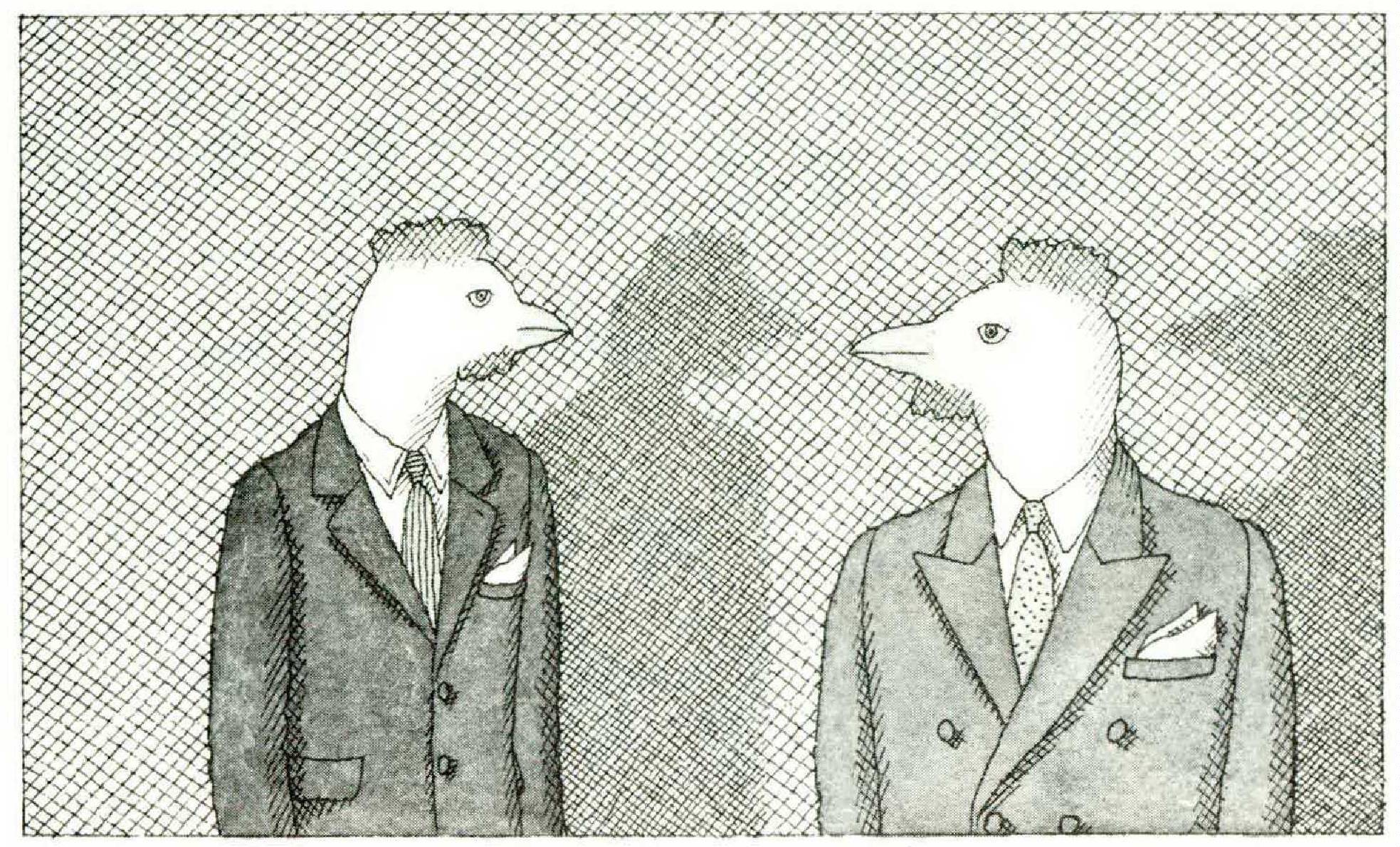
CHICKENS IN QUOTATIONS
• “I’ve always figured that, when the time come I couldn’t farm a crop of cotton and a crop of corn and keep one woman faithful, I’d get me a tin bill and pick bugs with the chickens.”—from Walls Rise Up, a novel by George Sessions Perry
• “When I warned [the French] that Britain would fight on alone whatever they did, their generals told their prime minister and his divided cabinet, ‘In three weeks England will have her neck wrung like a chicken.’ Some chicken; some neck.”—Winston Churchill
• “How come a chicken can eat all the time and never get fat in the face?”
—Roger Miller
ON FRIED CHICKEN: GOODNESS, EATING
My mother’s (rolled in flour and dropped in hot shortening in a hot, heavy iron skillet, at just the right time, for just the right length of time) is not only the best fried chicken but it still represents to me the highest form of eating. It is crisp without seeming encrusted. In the best fried chicken, you can’t tell where the crust leaves off and the chicken begins.
In the comic books they talked about caviar and pheasant under glass. I accepted these things as literary conventions. But in my thoughts they did not crunch, give, tear, bloom brownly. The richest brown—or sometimes auburn— in the synesthesial spectrum is well-fried chicken.
Which is not to say that the crackle is all. I once heard Blaze Starr ask an audience whether they would like her to uncover entirely her (larger than life) breasts. When the audience cried out yes, yes, ma’am, they certainly would, she froze, rolled her eyes, and replied, with great, pungent reserve, “I reckon you would like some fried chicken.”
The sweetest chicken pieces, though, are not the fleshiest. The wishbone—destroyed in most commercial cutting— and the “little drumstick,” which is the meatiest section of the wing, are both delicacies. So is the heart. But when chicken is fried right, the tastiest meat of all—delicate, chewy, elusive—is between the small bones of the breast; chicken rib meat. I have never heard anyone mention this meat, and I have never spoken of it myself, even privately, until now. Fried chicken is a personal experience, like the woods out beside your house. But look for the rib meat. It’s worth the trouble.
Another thing I recommend is to go off alone with the largely de-meated carcass of a roasted whole chicken and explore all its minor crisps and gristles for tidbits. You get to know a chicken that way. I’m not sure that tenderness and bustiness are the absolute virtues that Frank Perdue assumes them to be. I like chicken meat that offers some resistance. Meat should be earned, at each end.
Chickens themselves, given the chance, are rangy, resourceful eaters. Remember, in the comic strip Smilin’ Jack, the overweight sidekick character who was followed around by a chicken that ate his shirt buttons as they popped off?
CHICKENS IN THE NEWS
• I have lost the clipping on this, but it appeared in the Cape Cod Standard Times a few summers ago. Chicken growers, disgruntled at low chicken prices, had parachuted great numbers of ready-for-market chickens onto a town in Rhodesia. (It was either Rhodesia or Rumania, and it wouldn’t have been Rumania.) The clipping said the original plan had been for live chickens to be dropped, but that project had been abandoned as inhumane. It would be nice to think that there was a local character named Sky Little who ran around shouting, “The chickens is falling! The chickens is falling!”
• On June 5, 1975, The New York Times, in a rare acknowledgment by it of this sort of thing, reported that on June 5, 1904, it had reported that “a Pochuck, N.J., man found a woodchuck that was raising four chickens.” Even assuming that the woodchuck was raising them not for profit but out of maternal instinct, and even rejecting the possible inference that neither chicken nor egg came first but rather the woodchuck, this is quite a little story. So why doesn’t the modernday Times give its readers such news? When a chicken lays an egg in the shape of a heart, as sometimes happens, you never read about it in the Times. You will never come upon an individual chicken in the Times. Poultry raising, to be sure, and therefore chickens in the mass. But never one chicken singled out, nor one chicken’s egg.
• In the Batesville (Miss.) Panolian, there appeared several years ago a photograph of a woman displaying an egg and a sweet potato, both extremely elongated. The caption read: “NEVER AT A LOSS FOR natural phenomena is Mrs. Cordie Henderson of the Mt. Olivet community. Last week, Mrs. Henderson visited the Panolian with an extra large hen egg, which later proved to have two yolks; and an unusually long sweet potato.” The Times is sometimes at a loss for natural phenomena.
• (Also to be filed under Most Surprising Thing a High-Ranking American Official Ever Tried to Do with a Rubber Chicken.) According to People magazine, after Nelson Rockefeller delivered a graduation-day address at the U.S. Naval Academy, “outgoing midshipmen presented Rocky with ... a rubber chicken (which the Veep vainly attempted to inflate).”Rockefellers! There is no telling what the late Rocky would have tried to do with a live chicken. I can tell you what a live chicken would have let him do: not very much.
KEEPING CHICKENS— A PERSONAL ACCOUNT
When I was about thirteen, I got for Easter a baby chick that had been dyed pink. I now deplore the practice of dying chicks and ducklings, but this chick thrived and made a good pet. Some people don’t believe this, but before all the pink had grown out of it this chicken was already running around the yard after me like a puppy. I used to carry it around in my shirt or in my bicycle basket. (I am not going to say what its name was. You can’t win, telling what you named a chicken. The reader’s reaction will be either “That’s not a funny name for a chicken” or “He had a chicken with a funny name. Rig deal.”) I didn’t really love it the way you love a dog or cat, but I really liked it, and it liked me. We were talking about that chicken the other day. “I would think that would be embarrassing, being followed by a chicken,”said my brother-in-law Gerald.
“No,” said my sister Susan. “That chicken liked him.”
But the chick grew into a pullet. It didn’t look right, and it might have been illegal to have a chicken in our neighborhood; and we didn’t have the facilities for it, because at our previous house we had kept chickens in quantity (six), in and around a chicken house, and my father was softhearted about wringing their necks (that is, he would try to wring their necks in a softhearted way). Or that is my recollection. When I asked my mother for details, she wrote:
“The chicken house was there complete with rather sad-looking and unproductive chickens when we bought the house. There was a rooster and five supposedly hens.
“The people we bought the house from had them because of the war and food shortage. I was sorry they were there, Daddy was glad. You were delighted with them. It also smelled and I hated cleaning it—so did Daddy and we tried to outwait each other. You can guess who won most often. We finally decided two eggs a week were not worth it. The chickens didn’t look too healthy, then too they were all named and after one try we decided we couldn’t eat them and gave them to a colored man.
“The one try was by Daddy. He assured me he could kill a chicken. His mother always wrung their necks etc. and he had watched. He violently wrung the neck (you were not told)—real hard—and threw the chicken to the ground. It lay stunned and then wobbled drunkenly off to the chicken house. We spent the rest of the week nursing it back to health.”
When the chickens were gone, the chicken house remained. It was made of scrap lumber and tarpaper. I used it as a fort, a left-center-field pavilion, and a clubhouse for a while, but by the time I was eleven or twelve I had gotten off into other things, was playing Little League ball, and had peroxided the front of my hair. And my mother hated the chicken house. She said it ruined our back yard.
She said she burned it down by accident. One afternoon she was raking leaves and burning them, and the fire spread to the chicken house. When Mrs. Hamright, across the street, out watering her bushes, smelled smoke and heard the sirens coming, her reflex was to yell, “Oh, dear Lord” and squirt the hose through the window of her house onto her husband, Gordy, who was inside reading the paper. We eventually had to give him our copy of that evening’s paper. Even though we were the ones who’d had the fire.
Mr. Lovejohn, the old man who lived with his middle-aged daughter next door to the Hamrights, and whom we ordinarily never saw except when he was sitting in his daughter’s DeSoto early on Sunday morning waiting for her to get dressed and drive him to church, came over in his dark-brown suit at about the same time the firemen started thrashing around with the hoses. He said he wanted to “counsel with” us. He said fire was the wages of smoking in bed.
“Now, Mr. Lovejohn,” my mother said. “No one in our family smokes, anywhere. And there aren’t any beds in the chicken house.”
By the time the firemen got there, the chicken house was about gone, but they stretched hoses all over the back and side yards, trampled a dogwood tree, and eyed our house as if they would love a chance to break some windows. We didn’t have many fires in our area at that time, for some reason, and the fire department was accustomed to igniting abandoned structures—chicken coops, often, in fact—on purpose and putting them out for practice, playing them along for maximum exercise.
Mrs. Hamright kept trying to get one of the firemen to tell her whether the fire was under control. I think he hated to admit that it was. Finally, he turned around and asked her, “Whud they have in there?”
“Chickens,” she said.
His eyes lit up. “Hit them rascals with the hose,” he said. “They’d take off.”
My parents didn’t want to go through all that again, so we gave my pet chicken to Louisiana, who came every Wednesday to iron and clean and yell “You better not bleev ‘at man, child” at the female characters in the soap operas, and who received a lot of things that we didn’t know what to do with. The chicken was getting too big, I could see that. Having a grown chicken as a pet would have been a strange thing.
“How is the chicken?” Susan and I would ask Louisiana on subsequent Wednesdays.
“He wa. . . He’s fine,” Louisiana would say. Finally, when we said we wanted to visit it, she said she had let it go see her granddaughter, who lived eighty miles away. “Does she play with it lots?” we asked.
She said she did.