MILDRED HAD JUST COME INTO THE KITCHEN AND was looking at the clock, which said five to two. She had thought it might be at least half-past. Wilfred came in from the back, through the utility room, and said, “Hadn’t you ought to be out there keeping them company?”
His brother Albert’s wife, Grace, and her sister, Vera, were sitting out in the shade of the carport making lace tablecloths. Albert was out at the back of the house, sitting beside the patch of garden where Wilfred grew beans, tomatoes, and cucumbers. Every half-hour Wilfred checked to see which tomatoes were ripe enough to pick. He picked them half-ripe and spread them out on the kitchen windowsill, so the bugs wouldn’t get them.
“I was,” said Mildred. She ran a glass of water. “I maybe might take them for a drive,” she said when she had finished drinking it.
“That’s a good idea.”
“How is Albert?”
Albert had spent most of the day before, the first full day of the visit, lying down.
“I can’t figure out.”
“Well, surely if he felt sick he’d say so.”
“That’s just it,” said Wilfred. “That’s just what he wouldn’t.”
This was the first time Wilfred had seen his brother in more than thirty years.
Wilfred and Mildred were retired. Their house was small and they weren’t, but they got along fine in the space. They had a kitchen not much wider than a hallway, a bathroom about the usual size, two bedrooms that were pretty well filled up when you got a double bed and a dresser into them, a living room where a large sofa sat five feet in front of a large television set, with a low table about the size of a coffin in between, and a small glassed-in porch.
Mildred had set up a table on the porch to serve meals on. Ordinarily, she and Wilfred ate at the table under the kitchen window. If one of them was up and moving around, the other always stayed sitting down. There was no way five people could have managed there, even when three of them were as skinny as these visitors were.
Fortunately there was a daybed on the porch, and Vera, the sister-in-law, slept on that. The sister-in-law had been a surprise to Mildred and Wilfred. Wilfred had done the talking on the phone (nobody in his family, he said, had ever written a letter); according to him, no sister-in-law had been mentioned, just Albert and his wife. Mildred thought Wilfred might not have heard, because he was so excited. Talking to Albert on the phone, from Logan, Ontario, to Elder, Saskatchewan, taking in the news that his brother proposed to visit him, Wilfred had been in a dither of hospitality, reassurances, amazement.
“You come right ahead,” he yelled over the phone to Saskatchewan. “We can put you up as long as you want to stay. We got plenty of room. We’ll be glad to. Never mind your return tickets. You get on down here and enjoy the summer.” It might have been while he was going on like this that Albert was explaining about the sister-in-law.
“How do you tell them apart?” said Wilfred on first meeting Grace and Vera. “Or do you always bother?” He meant it for a joke.
“They’re not twins,” said Albert, without a glance at either of them. Albert was a short, thin man in dark clothes, who looked as if he might weigh heavy, like dense wood. He wore a string tie and a westerner’s hat, but these did not give him a jaunty appearance. His pale cheeks hung down on either side of his chin.
“You look like sisters, though,” said Mildred genially to the two dried-out, brown-spotted, gray-haired women. Look what the prairie did to a woman’s skin, she was thinking. Mildred was vain of her own skin; it was her compensation for being fat. Also, she put an ash-gold rinse on her hair and wore coordinated pastel pants and tops. Grace and Vera wore dresses with loose pleats over their flat chests, and cardigans in summer. “You look a lot more like sisters than those two look like brothers.”
It was true. Wilfred had a big head as well as a big stomach, and an anxious, eager, changeable face. He looked like a man who put a high value on joking and chatting, and so he did.
“It’s lucky there’s none of you too fleshy,” Wilfred said. “You can all fit into the one bed. Naturally Albert gets the middle.”
“Don’t pay attention to him,” said Mildred. “There’s a good daybed if you don’t mind sleeping on the porch,” she said to Vera. “It’s got blinds on the windows and it gets the best breeze of anywhere.”
“That’ll be fine,” said Albert.
With Albert and Grace sleeping in the spare room, which was where Mildred usually slept, Mildred and Wilfred had to share a double bed. They weren’t used to it. In the night, Wilfred had one of his wild dreams, which were the reason Mildred had moved to the spare room in the first place.
“Grab ahold!” yelled Wilfred, in terror. Was he on a lake boat, trying to pull somebody out of the water?
“Wilfred, wake up! Stop hollering and scaring everybody to death.”
“I am awake,” said Wilfred. “I wasn’t hollering.”
“Then I’m Her Majesty the Queen.”
They were lying on their backs. They both heaved, and turned to face the outside. Each kept a courteous but firm hold on the blankets.
“Is it whales that can’t turn over when they get up on the beach?” Mildred said.
“I can still turn over,” said Wilfred. They aligned backsides. “Maybe you think that’s the only thing I can do.”
“Keep still, now, you’ve got them all listening.”
In the morning she said, “Did Wilfred wake you up? He’s a terrible hollerer in his sleep.”
“I hadn’t got to sleep anyway,” Albert said.
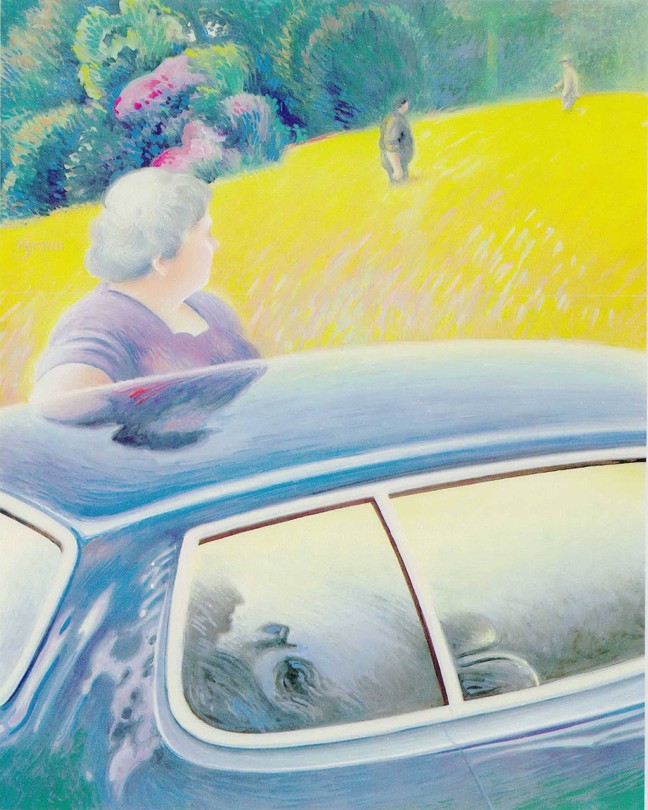
SHE WENT OUT AND GOT THE TWO LADIES INTO THE car. “We’ll take a little drive and raise a breeze to cool us off,” she said. They sat in the back, because there wasn’t really room left over in the front, even for two such skinnies.
“I’m the chauffeur!” said Mildred merrily. “Where to, your ladyships?”
“Just anyplace you’d like,” said one of them. When she wasn’t looking at them Mildred couldn’t be sure which was talking.
She drove them around Winter Court and Chelsea Drive to look at the new houses with their landscaping and swimming pools. Then she took them to the Fish and Game Club, where they saw the ornamental fowl, the family of deer, the raccoons, and the caged bobcat. She felt as tired as if she had driven to Toronto, and in need of refreshment, so she headed out to the place on the highway to buy icecream cones. They both asked for a small vanilla. Mildred had a mixed double: rum-raisin and praline cream. They sat at a picnic table licking their ice-cream cones and looking at a field of corn.
“They grow a lot of corn around here,” Mildred said. Albert had been the manager of a grain elevator before he retired, so she supposed they might be interested in crops. “Do they grow a lot of corn out west?”
They thought about it. Grace said, “Well. Some.”
Vera said, “I was wondering.”
“Wondering what?” said Mildred cheerfully.
“You wouldn’t have a Pentecostal Church here in Logan?”
They set out in the car again, and after some blundering, Mildred found the Pentecostal Church. It was not one of the handsomer churches in town. It was a plain building, of cement blocks, with the doors and the window-trim painted orange. A sign told the minister’s name and the times of service. There was no shade tree near it and no bushes or flowers, just a dry yard. Maybe that would remind them of Saskatchewan.
“Pentecostal Church,” said Mildred, reading the sign. “Is that the church you people go to?”
“Yes.”
“Wilfred and I are not regular churchgoers. If we went, I guess we would go to the United. Do you want to get out and see if it’s unlocked?”
“Oh, no.”
“If it was locked, we could try and locate the minister. I don’t know him, but there’s a lot of Logan people I don’t know yet. I know the ones that bowl and the ones that play euchre at the Legion. Otherwise, I don’t know many. Would you like to call on him?”
They said no. Mildred was thinking about the Pentecostal Church, and it seemed to her that it was the one where people spoke in tongues. She thought she might as well get something out of the afternoon, so she went ahead and asked them: was that true?
“Yes, it’s true.”
“But what are tongues?”
A pause. One said, with difficulty, “It’s the voice of God.”
“Heavens,” said Mildred. She wanted to ask more—did they speak in tongues themselves?—but they made her nervous. It was clear that she made them nervous, too. She let them look a few minutes more, then asked if they had seen enough. They said they had, and thanked her.
IF SHE HAD MARRIED WILFRED YOUNG, MILDRED thought, she would have known something about his family and what to expect of them. Mildred and Wilfred had married in late middle age, after a courtship of only six weeks. Neither of them had been married before. Wilfred had moved around too much, or so he said. He had worked on the lake boats and in lumber camps, he had helped build houses and had pumped gas and had pruned trees; he had worked from California to the Yukon and from the east coast to the west. Mildred had spent most of her life in the town of McGaw, twenty miles from Logan, where she now lived. She had been an only child, and had been given tap-dancing lessons and then sent to business school. From business school she went into the office of the Toll Shoe Factory, in McGaw, and shortly became the sweetheart of Mr. Toll, who owned it. There she stayed.
It was during the last days of Mr. Toll’s life that she met Wilfred. Mr. Toll was in the psychiatric hospital overlooking Lake Huron. Wilfred was working there as a groundsman and guard. Mr. Toll was eighty-two years old and didn’t know who Mildred was, but she visited him anyway. He called her Sadie, that being the name of his wife. His wife was dead now but she had been alive all the time Mr. Toll and Mildred were taking their little trips together, staying at hotels together, staying in the cottage Mr. Toll had bought for Mildred at Amberley Beach. In all the time she had known him, Mildred had never heard him speak of his wife except in a dry, impatient way. Now she had to listen to him tell Sadie he loved her, ask Sadie’s forgiveness. Pretending she was Sadie, Mildred said she forgave him. She dreaded some confession regarding a brassy-headed floozy named Mildred. Nevertheless, she kept on visiting. She hadn’t the heart to deprive him. That had been her trouble all along. But when the sons or daughters or Sadie’s sisters showed up, she had to make herself scarce. Once, taken by surprise, she had to get Wilfred to let her out a back way. She sat down on a cement wall by the back door and had a cigarette, and Wilfred asked her if anything was the matter. Being upset, and having nobody in McGaw to talk to, she told him what was going on, even about the letter she had received from a lawyer telling her she had to get out of the Amberley cottage. She had thought all along it was in her name, but it wasn’t.
Wilfred took her side. He went in and spied on the visiting family, and reported that they were sitting staring at the poor old man like crows on a fence. He didn’t point out to Mildred what she already knew: that she should have seen the writing on the wall. She herself said it.
“I should’ve gotten out while I still had something going for me.”
“You must’ve been fond of him,” said Wilfred reasonably.
“It was never love,” said Mildred sadly. Wilfred scowled with deep embarrassment. Mildred had the sense not to go on, and couldn’t have explained, anyway, how she had been transfixed by Mr. Toll in his more vigorous days, when his need for her was so desperate she thought he would turn himself inside out.
Mr. Toll died in the middle of the night. Wilfred phoned Mildred at seven in the morning.
“I didn’t want to wake you up,” he said. “But I wanted to make sure you knew before you heard it out in public.”
Then he asked her to have supper with him in a restaurant. Being used to Mr. Toll, she was surprised at Wilfred’s table manners. He was nervous, she decided. He got upset because the waitress hadn’t brought their glasses of water. Mildred told him that she was going to quit her job, she wanted to get clear of McGaw, and she might end up out west.
“Why not end up in Logan?” Wilfred said. “I’ve got a house there. It’s not so big a house, but it’ll take two.”
So it dawned on her. His nervousness, his bad temper with the waitress, his sloppiness, must all relate to her. She asked if he had ever been married before, and if not, why not?
He said he had always been on the go, and besides, it wasn’t often you met a goodhearted woman. She was about to make sure he had things straight, by pointing out that she expected nothing from Mr. Toll’s will (nothing was what she got), but she saw in the nick of time that Wilfred was the kind of man who would be insulted.
Instead, she said, “You know I’m secondhand goods?”
“None of that,” he said. “We won’t have any of that kind of talk around the house. Is it settled?”
Mildred said yes. She was glad to see an immediate improvement in his behavior to the waitress. In fact, he went overboard, apologizing for his impatience earlier, telling her he had worked in a restaurant himself. He told her where the restaurant was, up on the Alaska Highway. The girl had trouble getting away to serve coffee at the other tables.
No such improvement took place in Wilfred’s table manners. She guessed that was one of his bachelor ways she would just have to learn to live with.
“You better tell me a bit about where you were born, and so on,” Mildred said.
He told her he had been born on a farm in Hullett Township, but left there when he was three days old.
“Itchy feet,” he said, and laughed. Then he sobered, and told her that his mother had died within a few hours of his birth, and his aunt had taken him. His aunt was married to a man who worked on the railway. They moved around, and when he was twelve his aunt died. Then the man she was married to looked at Wilfred and said, “You’re a big boy. What size shoe do you wear?”
“Number nine,” said Wilfred.
“Then you’re big enough to earn your own living.”
“Him and my aunt had eight kids of their own,” said Wilfred. “So I don’t blame him.”
“Did you have any brothers and sisters in your real family?” Mildred thought cozily of her own life long ago: her mother fixing her curls in the morning, the kitten, named Pansy, that she used to dress up in doll’s clothes and wheel round the block in the doll buggy.
“I had two older sisters, married. Both dead now. And one brother. He went out to Saskatchewan. He has a job managing a grain elevator. I don’t know what he gets paid but I imagine it’s pretty good. He went to business college, like yourself. He’s a different person than me, way different.”
THE DAY THAT ALBERT HAD STAYED IN BED, HE wanted the curtains shut. He didn’t want a doctor. Wilfred couldn’t get out of him what was wrong, Albert said he was just tired.
“Then maybe he is tired,” said Mildred. “Let him rest.”
But Wilfred was in and out of the spare room all day. He was talking, smoking, asking Albert how he felt. He told Albert he had cured himself of migraine headaches by eating fresh leeks from the garden in the spring. Albert said he didn’t have a migraine headache, even if he did want the curtains closed. He said he had never had a bad headache in his life. Wilfred explained that you could have migraine headaches without knowing it—that is, without having the actual ache—so that could be what Albert had. Albert said he didn’t see how that was possible.
Early that afternoon Mildred heard Wilfred crashing around in the clothes closet. He emerged calling her name.
“Mildred! Mildred! Where is the Texas mickey?”
“In the buffet,” said Mildred, and she got it out for him so he wouldn’t be rummaging around in there in her mother’s china. It was in a tall box, gold-embossed, with the Legion crest on it. Wilfred bore it into the bedroom and set it on the dresser for Albert to see.
“What do you think that is and how do you think I come by it?”
It was a bottle of whiskey, a gallon bottle of whiskey, 110-proof, that Wilfred had won playing darts at the tournament in Owen Sound. The tournament had taken place in February three years before. Wilfred described the terrible drive from Logan to Owen Sound, himself driving, the other members of the dart team urging him to stop in every town they reached, and not to try to get farther. A blizzard blew off Lake Huron, they were enveloped in whiteouts, trucks and buses loomed up in front of their eyes out of the wall of snow, there was no room to maneuver because the road was walled with drifts ten feet high. Wilfred kept driving; driving blind, driving through skids and drifts across the road. At last, on Highway No. 6, a blue light appeared ahead of him, a twirling blue light, a beacon, a rescue-light. It was the snowplow, traveling ahead of them. The road was filling in almost as fast as the snowplow cleared it, but by keeping close behind the plow they were guided safe into Owen Sound. There they played in the tournament, and were victorious.
“Do you ever play darts yourself?” Mildred heard Wilfred ask his brother.
“As a rule they play darts in places that serve liquor,” Albert said. “As a rule I don’t go into those places.”
“Well, this here is liquor I would never consider drinking. I keep it for the honor of it.”
THEIR SITTING TOOK ON A REGULAR PATTERN. IN the afternoon Grace and Vera sat in the driveway crocheting their tablecloths. Mildred sat with them off and on. Albert and Wilfred sat at the back of the house, by the vegetables. After supper they all sat together, moving their chairs to the lawn in front of the flower beds, which was then in the shade. Grace and Vera went on crocheting as long as they could see.
Wilfred admired the crocheting.
“How much would you get for one of those things?”
“Hundreds of dollars,” Albert said.
“It’s sold for the church,” said Grace.
“Blanche Black,” said Wilfred, “was the greatest crocheter, knitter, sewer, what-all, and cook of any girl I ever knew.”
“What a name,” said Mildred.
“She lived in the state of Michigan. It was when I got fed up with working on the boats and I had a job over there working on a farm. She could make quilts or anything. And bake bread, fancy cake, anything. But not very good-looking. In fact, she was about as good-looking as a turnip, and about the shape.”
Now came a story that Mildred had heard before. It was told when the subject of pretty girls and homely girls came up, or baking, or box socials, or pride. Wilfred told how he and a friend went to a box social, where at an intermission in the dancing you bid on a box, and the box contained a lunch, and you ate lunch with the girl whose box you had bought. Blanche Black brought a box lunch and so did a pretty girl, a Miss Buchanan, and Wilfred and his friends got into the back room and switched all the wrappings around on these two boxes. So when it came time to bid, a fellow named Jack Fleck, who had a very good opinion of himself and a case on Miss Buchanan, bid for the box he thought was hers, and Wilfred and his friend bid for the box that everybody thought was Blanche Black’s. The boxes were given out, and to his consternation Jack Fleck was compelled to sit down with Blanche Black. Wilfred and his friend were set up with Miss Buchanan. Then Wilfred looked in the box and saw there was nothing but sandwiches with a kind of pink paste on them.
“So over I go to Jack Fleck and I say, ‘Trade you the lunch and the girl.’ I didn’t do it entirely on account of the food but because I saw how he was going to treat that poor creature. He agreed like a shot and we sat down. We ate fried chicken. Home-cured ham and biscuits. Date pie. Never fed better in my life. And tucked down at the bottom of the box she had a mickey of whiskey. So I sat eating and drinking and looking at him over there with his paste sandwiches.”
Wilfred must have started that story as a tribute to ladies whose crocheting or baking or whatever put them away ahead of ladies who had better looks to offer, but Mildred didn’t think even Grace and Vera would be pleased to be put in the category of Blanche Black, who looked like a turnip. And mentioning the mickey of whiskey was a mistake. It was a mistake as far as she was concerned, too. She thought of how much she would like a drink at this moment. She thought of Old Fashioneds, Brown Cows, Pink Ladies, every fancy drink you could imagine.
“I better go and see if I can fix that air-conditioner,” Wilfred said. “We’ll roast tonight if I don’t.’
Mildred sat on. Over in the next block there was a blue light that sizzled loudly, catching bugs.
“I guess those things make a difference with the flies,” she said.
“Fries them,” said Albert.
“I don’t like the noise, though.”
She thought he wasn’t going to answer but he finally said, “If it doesn’t make a noise it can’t destroy the bugs.”
When she went into the house to put on some coffee (a good thing Pentecostals had no ban on that), Mildred could hear the air-conditioner humming away. She looked into the bedroom and saw Wilfred stretched out asleep. Worn out.
“Wilfred?”
He jumped. “I wasn’t asleep.”
“They’re still sitting out front. I thought I’d make us some coffee.” Then she couldn’t resist adding, sweetly,
“I’m glad it isn’t anything too serious the matter with the air-conditioner.”
ON THE NEXT-TO-LAST DAY OF THE VISIT, THEY decided to drive forty-five miles over to Hullett Township to see the place where Wilfred and Albert were born. This was Mildred’s idea. She had thought Albert might suggest it, and she was waiting for that, because she didn’t want to push Albert into doing anything he was too tired to do. But at last she mentioned it. She said she had been trying for a long time to get Wilfred to take her, but he said he wouldn’t know where to go, since he had never been back after being taken away as a baby. The buildings were all gone, the farms were gone; that whole part of the township had become a conservation area.
Grace and Vera brought along their tablecloths. Mildred wondered why they didn’t get sick, working with their heads down in a moving car. She sat between them in the back seat, feeling squashed, although she knew that she was the one doing the squashing. Wilfred drove and Albert sat beside him.
Wilfred always got into an argumentative mood when driving.
“Now what is so wrong with taking a bet?” he said. “I don’t mean gambling. I don’t mean you go down to Las Vegas and you throw all your money away on those games and machines. With betting you can sometimes be lucky. I once had a free winter in Port Arthur on a bet.”
“Thunder Bay, it is now,” Albert said.
“Port Arthur is what it was then. Or half of it was. I was off the Lethbridge, I was in for the winter. The old Lethbridge, that was a terrible boat. One night in the bar they were listening to the hockey game on the radio. Before television. Playing Ottawa. Ottawa four, Port Arthur nothing.”
“We’re getting to where we turn off the highway,” Albert said.
Mildred said, “Watch for the turn, Wilfred.”
“I am watching.”
Albert said, “Not this one but the next one.”
“I was helping them out in there, I was slinging beer for tips because I didn’t have a union card, and a grouchy fellow was cursing at Port Arthur. They might come out of it yet, I said, Port Arthur might beat them yet.”
“Right here,” said Albert.
Wilfred made a sharp turn. “Put your money where your mouth is! Put your money where your mouth is! That’s what he said to me. Ten to one. I didn’t have the money, but the fellow that owned the hotel was a good fellow, and I was helping him out, so he says, take the bet, Wilfred! He says, you go ahead and take the bet!”
“The Hullett Conservation Area,” Mildred read from a sign. They drove along the edge of a dark swamp.
“Heavens, it’s gloomy in there!” she said. “And water standing, at this time of the year.”
“The Hullett Swamp,” said Albert. “It goes for miles.”
They came out of the swamp and on either side was wasteland, churned-up black earth, ditches, uprooted trees. The road was very rough.
“I’ll back you, he says. So I went ahead and took the bet.”
Mildred read the crossroad signs: “Dead end. No winter maintenance beyond this point.”
Albert said, “Now we’ll want to turn south.”
“South?” said Wilfred. “South. I took it and you know what happened? Port Arthur came through and beat Ottawa seven to four!”
There was a large pond and a lookout stand, and a sign saying “Wildfowl Observation Point,”
“Wildfowl,” said Mildred. “I wonder what there is to see?”
Wilfred was not in the mood to stop. “You wouldn’t know a crow from a hawk, Mildred! Port Arthur beat Ottawa seven to four and I had my bet. That fellow sneaked out when I was busy but the manager knew where he lived and next day I had a hundred dollars. When I got called to go back on the Lethbridge I had exactly to the penny the amount of money I had when I got off before Christmas. I had the winter free in Port Arthur.”
“This looks like it,” Albert said.
“Where?” asked Wilfred.
“Here.”
“Here? I had the winter free, all from one little bet.”
They turned off the road into a rough sort of lane, where there were wooden arrows on a post. “Hawthorn Trail. Sugar Bush Trail. Tamarack Trail. No motor vehicles beyond this point.”Wilfred stopped the car and he and Albert got out. Grace got out to let Mildred out and then got back in. The arrows were all pointing in the same direction. Mildred thought some children had probably tampered with them. She didn’t see any trails at all. They had climbed out of the low swampland and were among rough little hills.
“This where your farm was?” she asked Albert.
“The house was up there,” said Albert, pointing uphill. “The lane ran up there. The barn was behind.”
There was a brown wooden box on the post under the arrows. She opened it up and took out a handful of brightly colored pamphlets. She looked through them.
“These tell about the different trails.”
“Maybe they’d like something to read if they aren’t going to get out,” said Wilfred, nodding toward the women in the car. “Maybe you should go and ask them.”
“They’re busy,” Mildred said. She thought she should go and tell Grace and Vera to roll down the windows so they wouldn’t suffocate, but she decided to let them figure that out for themselves. Albert was setting off up the hill and she and Wilfred followed him, plowing through goldenrod, which, to her surprise, was easier than grass to walk in. It didn’t tangle you so, and felt silky. Goldenrod she knew, and wild carrot, but what were these little white flowers on a low bush, and this blue one with coarse petals, and this feathery purple? You always heard about the spring flowers, buttercups and trilliums and marsh marigolds, but here were just as many, names unknown, at the end of summer. There were also little frogs leaping from underfoot, and small white butterflies, and hundreds of bugs she couldn’t see that nibbled at and stung her bare arms.
Albert walked up and down in the grass. He made a turn, he stopped and looked around and started again. He was trying to get the outline of the house. Wilfred frowned at the grass, and said, “They don’t leave you much.”
“Who?” said Mildred faintly. She fanned herself with goldenrod.
“Conservation people. They don’t leave one stone of the foundation, or the cellar hole, or one brick or beam. They dig it all out and fill it all in and haul it all away.”
“Well, they couldn’t leave a pile of rubble, I guess, for people to fall over.”
“You sure this is where it would have been? Wilfred said.
“Right about here,” said Albert, “facing south. Here would’ve been the front door.”
“You could be standing on the step, Albert,”said Mildred, with as much interest as she had energy for.
But Albert said, “We never had a step at the front door. We only opened it once that I can remember, and that for Mother’s coffin. We put some chunks of wood down then, to make a temporary step.”
“That’s a lilac,” said Mildred, noticing a bush near where he was standing. “Was that there then? It must have been there then.”
“I think it was.”
“Is it a white one or a purple?”
“I can’t say.”
That was the difference between him and Wilfred, she thought. Wilfred would have said. Whether he remembered or not, he would have said, and then believed himself. Brothers and sisters were a mystery to her. There were Grace and Vera, speaking like two mouths out of the same head, and Wilfred and Albert without a thread of connection between them.
THEY ATE LUNCH IN A CAFÉ DOWN THE ROAD, IT wasn’t licensed, or Mildred would have ordered beer, never mind how she shocked Grace and Vera or how Wilfred glared at her. She was hot enough. Albert’s face was a bright pink and his eyes had a fierce, concentrating look. Wilfred looked cantankerous.
“It used to be a lot bigger swamp,” Albert said. “They’ve drained it.”
“That’s so people can get in and walk and see different things,” said Mildred. She still had the red and green and yellow pamphlets in her hand, and she smoothed them out and looked at them.
“Squawks, calls, screeches, and cries echo throughout this bush,” she read. “Do you recognize any of them? Most are made by birds,” What else would they be made by? she wondered.
“A man went into the Hullett Swamp and remained there,” Albert said.
Wilfred made a mess of his ketchup and gravy, then dipped his french fries into it with his fingers.
“For how long?” he said.
“Forever.”
“You going to eat them?” said Wilfred, indicating Mildred’s french fries.
“Forever?” said Mildred, dividing them and sliding half onto Wilfred’s plate. “Did you know him, Albert?”
“No. It was too long ago.”
“Did you know his name?”
“Lloyd Sallows.”
“Who?” said Wilfred.
“Lloyd Sallows,” said Albert. “He worked on a farm.”
“I never heard of him,” Wilfred said.
“How do you mean, he went into the swamp?” said Mildred.
“They found his clothes on the railway tracks and that’s what they said, he went into the swamp.”
“Why would he go in there without his clothes on?”
Albert thought for a few minutes and said, “He could have wanted to go wild.”
“Did he leave his shoes, too?”
“I would think so.”
“He might have committed suicide,” Mildred said briskly. “Did they look for a body?”
“They did look.”
“Or might have been murdered. Did he have any enemies? Was he in trouble? Maybe he was in debt or in trouble about a girl.”
“No,” said Albert.
“So they never found a trace of him?”
“No.”
“Was there any suspicious sort of person around at the time?”
“No.”
“Well, there must be some explanation,” said Mildred. “A person, if they’re not dead, they go on living somewhere.”
Albert forked the hamburger patty out of his bun onto his plate, where he proceeded to cut it up into little pieces. He had not yet eaten anything.
“He was thought to be living in the swamp.”
“They should’ve looked in the swamp, then,” Wilfred said.
“They went in at both ends and said they’d meet in the middle but they didn’t.”
“Why not?” said Mildred.
“You can’t just walk your way through that swamp. You couldn’t then.”
“So they thought he was in there?” Wilfred persisted. “Is that what they thought?”
“Most did,” said Albert, rather grudgingly. Wilfred snorted.
“What was he living on?”
Albert put down his knife and fork and said somberly, “Flesh.”
All of a sudden, after being so hot, Mildred’s arms came out in goose bumps.
“Did anybody ever see him?” she asked, in a more subdued and thoughtful voice than before.
“Two said so.”
“Who were they?”
“One was a lady that when I knew her, she was in her fifties. She had been a little girl at the time. She saw him when she was sent back to get the cows. She saw a long white person running behind the trees.”
“Near enough that she could tell if it was a boy or a girl?” said Wilfred.
Albert took the question seriously.
“I don’t know how near.”
“That was one person,” Mildred said. “Who was the other?”
“It was a boy fishing. This was years later. He looked up and saw a white fellow watching him from the other bank. He thought he’d seen a ghost.”
“Is that all?” said Wilfred. “They never found out what happened?”
“No.”
“I guess he’d be dead by now anyway,” Mildred said.
“Dead long ago,” said Albert.
If Wilfred had been telling that story, Mildred thought, it would have gone someplace, there would have been some kind of ending to it. Lloyd Sallows might reappear stark naked to collect on a bet, or he would come back dressed as a millionaire, maybe having tricked some gangsters who had robbed him. In Wilfred’s stories you could always be sure that the gloomy parts would give way to something better, and if somebody behaved in a peculiar way there was an explanation for it. If Wilfred figured in his own stories, as he usually did, there was always a stroke of luck for him somewhere, a good meal or a bottle of whiskey or some money. Neither luck nor money played a part in this story. She wondered why Albert had told it, what it meant to him.
“How did you happen to remember that story, Albert?”
As soon as she said that, she knew she shouldn’t have spoken. It was none of her business.
“I see they have apple or raisin pie,” she said.
“No apple or raisin pie in the Hullett Swamp!” said Wilfred raucously. “I’m having apple.”
Albert picked up a cold piece of hamburger and put it down and said, “It’s not a story. It’s something that happened.”
MILDRED HAD STRIPPED THE BED THE VISITORS had slept in, and hadn’t got it made up again, so she lay down beside Wilfred, on their first night by themselves.
Before she went to sleep she said to Wilfred, “Nobody in their right mind would go and live in a swamp.”
“If you did want to live someplace like that,” said Wilfred, “the place to live would be the bush, where you wouldn’t have so much trouble making a fire if you wanted one.”
He seemed restored to good humor. But in the night she was wakened by his crying. She was not badly startled, because she had known him to cry before, usually at night. It was hard to tell how she knew. He wasn’t making any noise and he wasn’t moving. Maybe that in itself was the unusual thing. She knew that he was lying beside her on his back with tears welling up in his eyes and wetting his face.
“Wilfred?”
Any time before, when he had consented to tell her why he was crying, the reason had seemed to her very queer, something thought up on the spur of the moment, or only distantly connected with the real reason. But maybe it was as close as he could get.
“Wilfred.”
“Albert and I will probably never see each other again,” said Wilfred in a loud voice with no trace of tears, or any clear indication of either satisfaction or regret.
“Unless we did go to Saskatchewan,” said Mildred. An invitation had been extended, and she had thought at the time she would be as likely to visit Siberia.
“Eventually,” she added.
“Eventually, maybe,” Wilfred said. He gave a prolonged, noisy sniff that seemed to signal content. “Not next week.” □