The Future of the Photovoltaic Cell
Can solar power ever play an important role in solving our energy problems? The answer depends in large part on the perfection of the ingenious device that turns sunlight into electricity.
Every source of energy seems to have become a political issue. Tell me whether you think the path to a happy future lies with solar heating or with nuclear furnaces, tell me how you feel about oil shale and coal and corn-fed gasohol, and I’ll tell you where you stand on welfare reform, environmental policy, vegetarianism, busing, backpacking, and abortion. Sometimes it seems almost that simple. But there is one source of energy that attracts a diverse following: photovoltaics, the art of converting sunlight directly into electricity.
Photovoltaic devices—called solar batteries or solar cells—have a natural appeal for industrialists as well as for enemies of nuclear power. Some enthusiasts think of solar cells as a means of wresting control of energy from cruel oligopolists—“pulling the plug on the utilities” is a favorite term for this vision, in which houses and neighborhoods possess their own little power stations. Meanwhile, some of those selfsame oligopolists, including most of the big oil companies and several other large corporations, have invested in photovoltaics. Is big business plotting to retard the development of solar cells? The more likely motive for investment in photovoltaics is simple profit.
Although opinions vary on the importance of electricity in the future, demand for power seems unlikely to decline. Today, electricity accounts for about one third of all the energy that America uses. It consumes roughly one fifth of all privately invested capital. Many different markets for power exist. The largest are residential and industrial, and some entrepreneurs imagine photovoltaics finally breaking into these, whereupon the technology would become a truly significant partial solution to the nation’s problems with energy.
That time is not at hand. Bill Murray, an analyst with Strategies Unlimited, spends most of his time studying the young industry in solar cells. He estimates that as of 1979 private investors had put up somewhat more than $100 million. The federal government had spent a total of about $400 million. Modest investments when one considers that a conventional power plant today costs as much as the entire amount spent on solar cells so far. As for the industry’s performance, in 1978 American manufacturers shipped about $12.5 million worth of photovoltaic cells. Wired together and placed in the sun at high noon, this equipment would generate about one megawatt—or about 1000 times less power than one large coal-fired plant can produce. In 1978, however, the industry was only four years old, and in those four years the cost of the average photovoltaic device had been reduced more than 1000 percent.
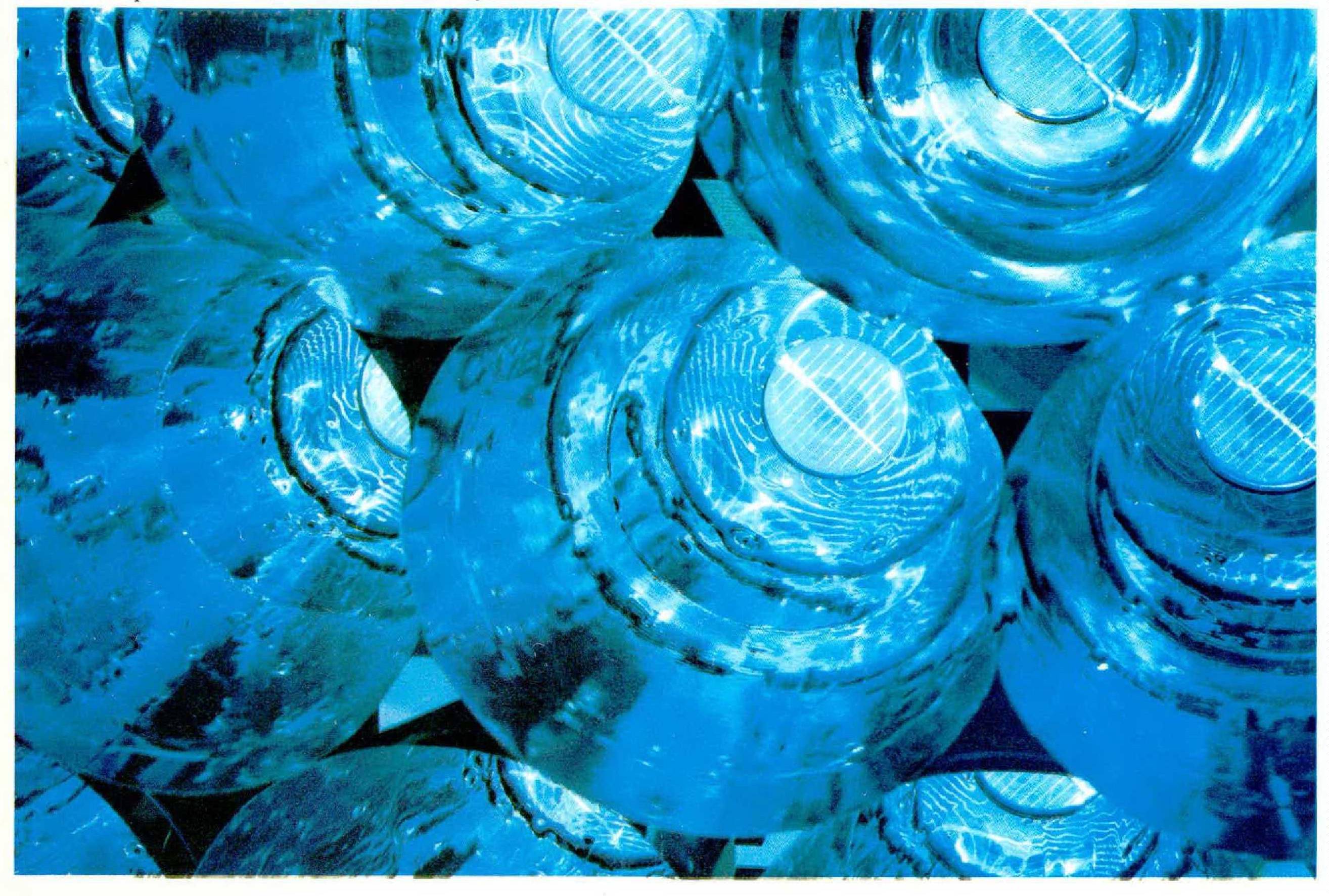
In the fall of 1979, rumors of fresh progress and activity abounded. Cheaper techniques and processes were said to lie just around the corner. In foreboding tones, I was informed that the Japanese were building a photovoltaic industry too. And for the first time some American firms were gearing up for large-scale, automated production. I recently visited one of these corporations, a small company called Solarex, which has 225 employees and ranks as the world’s largest producer of solar cells. The owners had just sold 40 percent of the company to Standard Oil of Indiana and to two large European corporations. Solarex was going to use the money to build a new factory. They were planning, a vice president told me with a cocky grin, to become very big and profitable. Phones were ringing everywhere. Engineers strode through the lobby. Doors closed on secret labs.
Elegant
Some people like photovoltaics mainly for aesthetic reasons. It is an elegant technology. Henry Ehrenreich, a solid-state physicist from Harvard who was chairman of a panel that studied photovoltaics at the request of the President’s science adviser, explained it this way: Sunlight is a very well-ordered energy; heat is quite disorderly, energy on the way to dissipation. Converting sunlight directly to heat, as in a system for solar space heating, trades energy of high quality for low. Converting sunshine directly into electricity is a more pleasing transformation, because, like sunlight, electricity stands fairly high on the scale of energy quality and can be converted into light, mechanical power, and chemical energy as well as into heat. “Photovoltaic cells make use of sunlight in something like the way plants do,”Ehrenreich continued. “To me, this is one of the great attractions of photovoltaics.”
Ehrenreich also said, in praise of solar cells, “They don’t leak.” Several administrators at the Department of Energy predicted to me that solar cells would be much easier to market than solar heating systems have been so far. Ultimate success lay in the nature of the device, one young bureaucrat explained. “Photovoltaic cells are solid state, man.”
Shortly after World War II decades of investigation into the internal workings of the solids yielded an important piece of hardware: the transistor. For its invention, three scientists employed by Bell Laboratories won the Nobel Prize. Transistors, a family of devices, alter and control the flow of electricity in circuits (one standard rough analogy compares their action to that of faucets controlling the flow of water in pipes). Other devices can do the same jobs, but transistors are solid. They have no cogs and wheels, no separate pieces to be soldered together; it’s as if they were stones performing useful work. They can be made microscopic, and partly for that reason they are cheap to produce. They are also durable, take almost no time to start working, and don’t consume much power.
A multibillion-dollar industry—the semiconductor industry, which is named for the class of solid that transistors are made from—grew up around the new devices and developed them, producing the tiny integrated circuits that have made spaceships possible and computers, TV’s, radios, and stereos ubiquitous. Meanwhile, marketing executives in all corners of the electronics industry transformed the phrase “solid state” into a synonym for technological virtue. Some of the luster has worn off, but the term still suggests machines of quality that are, in the words of a computer engineer I know, “small, advanced, and sexy.”
The invention of the transistor led directly to the development, in 1954, again at Bell Labs, of the first functional solar cell. It closely resembled one sort of transistor. For the solar battery, however, applications have come slowly. Solar cells performed their earliest important work in space, providing power for instruments with great reliability. Later, they were used on buoys at sea, and on remote archipelagos and mountaintops. For most other applications, the device was and still remains impractical, but an impractical marvel: a great generator without visible moving parts, which can produce electricity for years without making a sound or using any fuel except sunlight, and which can be fabricated essentially from sand.
How does it work?
In solid-state physics lies a fundamental surprise, like the rabbit inside a magician’s top hat. This is the recognition that the apparently quiescent, lumpish things of nature may be veritable carnivals of change and motion on the inside. Most solar cells on the market today are made of silicon, which along with oxygen is found in ordinary sand and is the second most abundant element on earth. A few complex, expensive processes tear the silicon away from the oxygen and convert it into a very thin wafer of crystal. Sunlight penetrating such a crystalline wafer will transfer some of its energy to some of the atomic particles inside—specifically, to the little bits of matter called electrons. (As high school courses in physics teach, electrons are what make electricity; a flow of electrons is an electrical current.) In effect, the light that enters the wafer of silicon will knock some electrons away from their atoms and set them free.
But to manage this small internal ferment, to make the electrons move in an orderly, useful fashion, the manufacturer must turn the silicon wafer into a sandwich. Imagine two slightly different slices of material fused together face to face. In a sense, a very rough and incomplete one, this sandwich is a battery, one slice representing the positive pole, the other the negative; an external wire connects the two open faces. Put this contraption out in the sun. The light passes through one slice of the sandwich and, reaching the area where the two slices meet, breaks chemical bonds, releasing electrons. If the wafer were not a sandwich but all of a piece, the freed electrons would quickly return where they came from, and that would be the end of it. But by giving the wafer two sides, imbued with opposite electrical properties, the manufacturer has created an internal pressure which forces the loosened electrons to one side of the sandwich and the broken bonds to the other. The broken bonds and electrons are of opposite charges. They are attracted to each other. But they cannot flow back the way they came: the pressure is one-way. So the electrons take the path of least resistance, and flow outward to the open face on their side of the wafer and into the external wire. Attach to this wire a small bulb and it should light up.
It works. Today, one can buy packages containing two or three dozen wafers, all wired together and encased under a tough, clear, plastic-like substance, the upward-pointing faces of the cells covered with a mesh of tiny wires and often colored a lustrous blue. Contemplate such photovoltaic arrays, each about the size of a suitcase, and the question naturally arises, Why aren’t they on every rooftop? But at today’s prices, a photovoltaic system large enough to power a home would cost a great deal more than a home.
It may seem strange that such an apparently simple machine should cost so much. But certain properties of sunlight limit the theoretical efficiency of solar cells, and actual performance generally falls far below the ideal. Most cells sold today convert to electricity only between 10 and 12 percent of the energy that the sun delivers to their surfaces, so it takes a lot of cells to get a fairly small amount of power. Another crucial set of problems is of a different nature and perhaps more tractable. The raw material of solar cells goes through about a dozen processes before it becomes a generator. Each step of the way, the techniques that most manufacturers presently use waste material, energy, and labor. The arrays also have to be mounted, hooked up, kept clean, and on occasion repaired. And because solar cells produce direct current and not the alternating current that runs virtually every appliance made in America, a converter has to be installed. Until recently, almost no effort had gone into reducing these “balance of system” costs.
There are other problems. If decentralized residential power—neighborhood power stations or houses that stand disconnected from the local utility’s lines—— represents an ultimate goal, then provision must be made for nighttime or cloudy days. This means, for one thing, purchasing enough arrays to carry the system through the longest possible period of sunlessness, and thus buying equipment that will be used only part of the time. Moreover, the self-sufficient system would need a way of storing power, and given the present state of storage technology that would probably mean for an average house some twenty-four expensive, relatively short-lived, and potentially explosive lead-calcium batteries.
For the time being, storage may not stand in the way of residential photovoltaics. Many experts have pointed out that the national electrical grid contains a great deal of storage capacity, which would probably not be overtaxed until solar cells were providing somewhere between 5 and 20 percent of a region’s power. According to the scheme usually advanced, the local photovoltaic stations or solar-powered houses in a given region would hook themselves up to the power company’s lines, sell their excess electricity at half price to the power company during sunny days (to sweeten the deal for the utilities), and buy electricity from the power company at full price when the sun wasn’t shining. Because demand for electricity tends to run highest during the daytime, when air-conditioners are operating, utilities might benefit from such an arrangement. A few have already announced that they like the idea.
A variety of other barriers exist. These include the improper orientation of roofs and the fact that though virtually indestructible in theory, solar cells fall prey to corrosion and may not last even for twenty years. Further, in buying solar cells, one would be purchasing much of one’s electricity for years to come and laying out a lot of cash at the start, but not many Americans live in one place for twenty years and financing may prove difficult. And there is the question of sun rights: what to do if your neighbor’s trees mature to cast shadows on your solar cells?
The most interesting question, however, is not what is wrong with solar cells but how to fix them—a question, mainly, of how to make them cheap.
The solar streetlight debate
Barry Commoner is one of the influential solar advocates. A professor of environmental sciences at Washington University in St. Louis, with a Ph.D. in biology from Harvard, he has credentials; as if to emphasize this point fans of his usually refer to him as “Dr. Commoner.” In The Polities of Energy, Commoner touts a plan devised by the now defunct Federal Energy Administration (FEA) for the development of photovoltaics. Over five years the Department of Defense would purchase about $.5 billion worth of photovoltaic equipment, which it would use to replace some of the military’s gasoline-powered generators. These generators produce very expensive electricity. The strategy would be to create a substantial market in an area where photovoltaics would quickly become competitive in price. The newly created, guaranteed market would in turn encourage manufacturers to invest in the equipment needed for efficient mass production. Mass production would reduce the cost of arrays and each important reduction in cost would in turn open up new markets. The process, Commoner writes, would become “automatic.”
This strategy, as Commoner points out, resembles one that the government employed with great success in the early development of the semiconductor industry. Commoner maintains that it would work just as well for photovoltaics; at the end of the five years the price of solar cells would have fallen by a factor of 20 and the technology would be ready to begin competing in the residential market. Such a decline in prices would not be “particularly remarkable,” Commoner writes, because the semiconductor industry achieved something comparable and semiconductor technology is after all “closely related” to photovoltaics.
Commoner’s argument has a familiar ring. Semiconductor technology, having placed the central works of powerful computers in thumbnail-sized packages, among other astonishing feats, has replaced the ModelT as the ultimate argument for surefire new enterprises of all sorts. In fact, photovoltaics and the technology of transistors are intimately related in conception, but they serve different ends. The semiconductor industry has succeeded largely by compressing more and more circuitry into very small packages; photovoltaics must find economical ways to cover vast areas with solar cells. Thus, for instance, the price of raw materials such as silicon is a relatively small factor in the cost of semiconductors, but an absolutely crucial element in the price of solar cells.
Commoner does not pin all his hopes for this technology on the history of a different one. He writes: “One of the astonishing features of the FEA plan is that the technological improvements that are required to achieve these sharp reductions in cost are almost ludicrously simple.” He cites the problem of cutting silicon wafers. Under standard procedure, silicon is transformed into a round ingot of crystal, like a bologna, and thin round wafers are sliced from it, but the process is expensive—thick saws that cut fast leave a lot of costly sawdust behind; thin saws cut too slowly to be economical. A possible solution is saws with many thin blades. Commoner writes that manufacturers are thinking of making five-bladed saws. He adds, “Some measure of the novelty of this ‘breakthrough’ can be gauged from the fact that a similar technique has been used in the Italian marble industry for years.”
It’s an unfortunate statement. As Commoner himself notes, crystalline silicon is “extremely hard.” It is not as easy to cut as marble (in this respect it resembles diamond) and the sawing must be done with great precision, to tolerances of a few microns (that is, with virtually no room for error). Nor are manufacturers contemplating five-bladed saws. Varian Corporation already boasts of a saw with 300 blades, and the general feeling is that the way to real savings lies with saws of 1000 blades. Developing such a saw is far from simple.
As it happens, techniques that require saws may soon become obsolete. Other approaches are being developed, and at least one of them will probably have to become workable if solar cells are to fall in price by a factor of 20. I talked to a number of people with a professional interest in photovoltaics, to the analyst Bill Murray, to an investment banker who sometimes acts as a spokesman for the young solar cell industry, to representatives of several firms in the business, to a number of administrators at the Department of Energy, and to two scientists at national laboratories. All had a stake in boosting the technology, and all agreed that for solar cells to break into the big residential market, many improvements were needed. These include not only the sort of advances that mass production would be likely to bring, but also changes in materials and design. The people l talked to agreed that the technology as practiced today won’t be the one that will lead to solar cells on rooftops, although some manufacturers fell that they had found and would soon exploit the technology that will. Photovoltaics doesn’t need a breakthrough for success, not if by “breakthrough” one means some completely new understanding of natural law. What the technology needs is a great deal of good research and clever, difficult engineering.
Throughout his book Commoner suggests that many solar technologies are already ripe. In his opinion, the main impediment to their ubiquity lies with those who set national policy toward energy. If only they would take the steps that he proposes, then all would be well. That seems to be the message. Ultimately, it is comforting: misguided officials can always be replaced or re-educated, but an imperfect technology may never turn out right no matter what steps are taken. The attitude constitutes almost a religious faith, I think, admitting no blasphemy of the virtues of certain solar technologies. Of course, other technologies have their priests too. In the arguments among them technical details often get confused.
One of the fiercest critics of the solar movement is Samuel McCracken, who could also be described as an advocate of nuclear power. In a Commentary article titled “Solar Energy: A False Hope,” McCracken attempts to show that Commoner’s arguments rest on blind faith, for his technical arguments are bankrupt. As an example, McCracken discusses Commoner’s suggestion that photovoltaics might soon become a practical means of powering streetlights. Commoner estimates that a panel of about ninety square feet connected to some batteries could power a streetlight of 1000 watts. McCracken reports that in fact about 1000 square feet of solar arrays would be necessary. The size of the thing revised according to his own estimate, McCracken proceeds to imagine an example of what he calls “the Commoner Patent Streetlight.” It would be a tower 300 feet high, monstrous-looking, very expensive, with guy wires running, no doubt, through the living rooms of nearby houses.
As McCracken points out, photovoltaic streetlights aren’t a very good idea. (Just for the sake of the exercise, though, I asked an engineer with Solarex to give me a rough estimate of how large such a streetlight would have to be. The engineer warned that the size would vary according to a host of variables, such as geographical location, but he figured that a reasonable size for the arrays would certainly be more than 90 square feet and a great deal less than 1000.)
Another view of photovoltaics and what to do for the technology comes from the team of scientists led by Ehrenreich, the physicist from Harvard. Working at the government’s request, with public financing, and under the aegis of the American Physical Society, the scientists produced a study in 1979. It prophesies that photovoltaics will someday supply an important part of the nation’s electricity, but probably no more than one to 3 percent of it by the year 2000. Attempting to make precise estimates of what photovoltaic systems would have to cost to compete with coal-fired power, the scientists imagined photovoltaic power plants and didn’t attempt to assess the economics of solar cells on rooftops.
Not surprisingly, Commoner and the solar lobby denounced the study. Commoner writes that central power stations represent a wrong and needlessly expensive application of photovoltaics; sunlight is distributed, so the means of capturing it ought to be too. For that reason, according to Commoner, the scientists’ estimates are inaccurate. Maybe they are, but that isn’t the real issue. The report demonstrates once again that today’s systems cost many times too much to thrive in the residential market, whether they’re put on rooftops or assembled in power stations.
The most important thing about the study is the general advice it renders—that the government delay programs for commercializing photovoltaics and spend its money on research. The scientists reason that because no clear choice exists among the various possible approaches to cheap solar cells, a program such as the FEA’s might stimulate the development of a wrong approach, might “lock us into an overly costly technology.” In conversation, Ehrenreich allowed that large intermediate markets for solar cells do exist and that a less than perfect technology might succeed in them. But since money is limited, he feels that “the emphasis at this point ought to be on research and technological development rather than deployment.”
A bureaucrat at the Department of Energy, who must remain unnamed, suggested that a recommendation for further research is what one would expect from a team of scientists who do research. And conversely, he said, one would expect manufacturers with production facilities to favor large federal purchases of their products. In the end, if photovoltaics are to become truly important, the government will probably have to follow both approaches. The argument boils down to how soon a program for commercialization should be undertaken. As Ehrenreich’s panel points out in fine detail, developing an industry capable of meeting just one percent of total demand for electricity would be no mean feat. It would take a long time, even in the best circumstances. So why not begin now? Companies in the industry are pursuing a host of different approaches. This suggests that the industry isn’t likely to get locked into a wrong approach. And it is at least arguable that research conducted in a competitive atmosphere, with a number of companies contending for a share of a large new market, would be more likely to yield progress in the photovoltaic art than research without immediate and tangible commercial ends. As for the cost of a program such as the FEA’s, the sum envisioned is modest compared to what is being spent on other unproven technologies including breeder reactors and fusion. Commoner may be right in touting the FEA’s plan. It might be wise, however, to abandon all notions that God watches over solar technologies, that photovoltaics comes with a guarantee of success.
Washington: In the dark
In the fall of 1979 I went to Washington, D.C., hoping to find out what the government was doing to advance photovoltaics. In an austere office high in the Forrestal Building, an employee (in his late thirties, I guessed) of the Department of Energy conjured up a vision of roofs glimmering with solar cells all across the Republic. He talked with apparent enthusiasm but he kept glancing at the thin partition that separated his desk from a neighboring administrator’s. Speaking in a voice so soft I had to strain to hear it, he insisted that I keep everything he told me “off the record.” Another at the DOE who was working in photovoltaics made the same demand, and for a time I entertained suspicions that something dark and dangerous was afoot in the world of the solar cell. In fact, I think the young bureaucrats were merely confused; they didn’t know what new shape official policy was going to assume. For the DOE was being reorganized again.
The federal approach to energy has been a saga. Within recent memory, the Atomic Energy Commission became the Energy Research and Development Administration, which in turn joined up with the FEA to become the DOE. The managers of the DOE organized the federal program for solar energy in a most confusing way, placing the various efforts on behalf of technologies such as photovoltaics under different secretariats. Recently, a new administration decided to put the pieces of the program back together. Many months went by. Finally, by March of this year, the change, as one staffer put it, was “sort of done.”
What can account for this confusion and delay? Many solar advocates believe that the government harbors deep hostility toward the solar arts. Evidence for this was much stronger, though, in the middle 1970s, when the government first began to spend money on solar technologies. Since then expenditures on all solar technologies have grown steadily, from absolutely nothing to about $1 billion in 1980, which may not be enough to suit enthusiasts but which is a great deal more than any other country is spending to develop solar energy. In only about half a decade a vast apparatus has been created, consisting—to name a few parts—of a large Solar Energy Research Institute in Colorado, national centers for appropriate technology, regional solar energy centers, a Solar Energy Information Data Bank. Many universities have graduate students working on some sort of solar research; many national laboratories and some private industrial ones are involved. A number of state governments have launched their own programs, and of course there is no end to the stream of official pamphlets extolling and sometimes explaining solar technologies.
So far the nation doesn’t have much to show for all this activity, beyond the various demonstration projects. You see these from a highway or an airplane on occasion—a big windmill on a hill, a school with solar panels on its roof. They are intended as harbingers.
Stated plans and goals tend toward high ambition. These have been the DOE’s stated goals for photovoltaics: by 1986, systems cheap enough to begin to penetrate the residential market, and by the early 1990s, solar arrays so cheap that everyone will want some. Congress has not adopted the FEA’s scheme, but it has set out to provide some cash to reach these optimistic goals. In 1978 it passed two laws: one would provide $98 million over three years for federal purchases of photovoltaic systems, and the other promised $1.5 billion, which would be spent over a decade, both for research and for gradually increasing federal purchases. Actual appropriations, however, have fallen short of those sums, and most of the money has been ticketed for research.
Although Ehrenreich’s panel found some faults with them, the programs for research seemed to be proceeding fairly well. The Solar Energy Research Institute was administering the advanced research and the Jet Propulsion Lab in Pasadena was handling the program to develop economical approaches quickly. Both received fairly high marks from the people I talked to in the industry. There was every reason to believe that the managers of the programs for research took the DOE’s goals seriously. There was some doubt, however, that the DOE did. Whether or not the goals are overly ambitious, as Ehrenreich contends, experts in the field agree that they can’t even be approached without a program for stimulating new markets. I visited Elaine Smith, one of the employees of the DOE who dared to speak her name. I had heard she was involved in the administration of the effort to commercialize the solar cell. I asked her to describe that program. She replied, “I’m it.”
What was the government going to do? Late in 1979, the Air Force announced that it might buy a vast amount of photovoltaic equipment to power some of the many stations of its proposed MX missile system. Henry Eaton, a staffer for the House Committee on Science and Technology, insisted that the Air Force’s proposal could turn out to be “a real shot in the arm” for the technology. He also suggested that the mere fact that the proposal has been made indicated a new enthusiasm for photovoltaics among those who set national policy toward energy. Eaton reasoned that this might be “the only way” to get the Carter Administration to pursue vigorously the commercialization of solar cells.
There is no reason that programs to develop photovoltaics should be tied to the outcome of the lively debate about the nation’s nuclear weaponry. In early 1980, in any case, the issue became moot. In the administration’s desperate attempt to cut the budget, the MX-photovoltaic scheme was scrapped. At the same time, the administration attempted further to reduce expenditures for commercialization of solar cells in 1981. It appeared that at least some members of Congress were preparing to fight over this issue.
So all in all, it was extremely hard to tell what course the government would take. For the moment, Washington still seemed to be pursuing two policies toward this technology: one stated and one real.
Safer than most
Two promising raw materials for solar cells incorporate cadmium, a deadly substance, and the famously lethal arsenic. Solar cells containing these substances and spread across the countryside could have unpleasant side effects. The prospect, albeit an unlikely one, of several million houses, each containing two dozen leadcalcium batteries in its basement to store the power from a photovoltaic roof, ought to worry environmentalists.
Today’s techniques of purifying silicon and turning it into solar cells require both a great deal of energy and the use of several toxic chemicals. A boom in photovoltaics would put a burden on the nation’s resources. Large amounts of metals, plastics, and glass would be consumed. And if cadmium should become the raw material of choice, there might not be enough of it to go around. The earth doesn’t lack for silicon, but by late 1979 a shortage of adequately purified silicon loomed over the entire electronics industry, and the price was going up. As for capital, Ehrenreich’s careful panel figures it would take $20 billion just to provide something on the order of one percent of electricity with solar cells by the year 2000, and more if the time were shortened.
But when it is viewed beside the other likely ways of making power in the future, photovoltaics appears to offer some striking advantages. The environmental risks it carries are far less severe in their fundamental nature than those that come with uranium and coal. Solar cells don’t require fuel except in their manufacture, and, at least in theory, photovoltaic systems could drive plants that manufacture solar cells: Solarex claims that it will soon begin constructing such a photovoltaic breeder. Photovoltaics is a desirable technology, something worth pursuing. What are its real prospects?
There is no way of answering the question without knowing much that can’t be known—the pace at which the cost of electricity is going to rise, for instance, or the future course of federal policy. Solar cells may never be more than a source of power for remote places. Lots of inventions don’t measure up to expectations. But it’s clear that photovoltaics could play some truly important role, if the price of systems falls a great deal.
Some scientists and engineers are developing techniques of automated mass production, to eliminate wiring and packaging by hand. They are also aiming to increase the efficiency of photovoltaic devices. This is a promising approach to the problem of cost, since, as Ehrenreich points out, the cost of energy from a photovoltaic system decreases 40 percent if efficiency increases from 10 to 20 percent, provided that other costs remain stable; maybe concentrators that focus sunlight on high-efficiency cells is an answer. Many believe that the way to success lies with very cheap cells of perhaps 15 percent efficiency, and a number of companies and entrepreneurs are experimenting with ways of laying down thin films of crystalline substances onto cheap substrates. Mobil-Tyco is developing a process for growing silicon crystals in thin ribbons instead of round ingots; the ribbons can simply be scribed and cut, hence no 1000-bladed saws and no sawdust—this is also one way to produce rectangular cells, which can be packaged more economically than round ones. Texas Instruments is testing a cell that consists in part of an electrolyte fluid; this kind of solar cell converts sunlight directly into hydrogen, which is a fuel of high quality. My favorite scheme, one that General Electric and others are trying out, is photovoltaic shingles. Ehrenreich, like many other scientists before him, wonders if research in photovoltaics might not lead someday to techniques for assisting nature with photosynthesis.
A scientist of impeccable credentials, whom I visited early in 1980, told me that friends of his at one of the national laboratories had found a new way to purify silicon, a process far cheaper than any yet devised. Because of certain considerations having to do with patents, he said, the government was keeping this process a secret for the time being. It’s the sort of story one often hears in the land of photovoltaics these days. Hardly a week goes by without news of some new “breakthrough.” Veteran observers have learned to curb their enthusiasm. “No miraculum has appeared yet,” said Elaine Smith in March. But the technology is very young and there are so many good ideas for its development that some of them, you have to feel, will work. □