Washington: Capital Punishment
Reports of the President’s political demise are probably not exaggerated. But are the obituaries fair to the man? And is there a successor in view with better policies or ideas?
WASHINGTON
The Washington Post, ran the news beneath a banner headline: “Kennedy Confirms He Is Considering Race.” Had the coverage been more restrained, it would have underestimated the local impact of the news. In the excitement of the moment, mainstream thinkers in Washington rushed to pronounce the Carter Administration dead and gone. “By almost every measure,” Hugh Sidey wrote a few days later, “Jimmy Carter’s influence has ended.” In conversation, people began referring to the Administration in the past tense. There were speculations about how many of his advisers the President would pull down with him, and how many would survive, Robert Strauss-like, to serve yet other masters. After the initial flurry of excitement, people began to cover their bets. The prudent noted that Gerald Ford had trailed Carter by thirty points in August of 1976 but had made up all but a point or two by Election Day, and that Richard Nixon had run behind Edmund Muskie in the polls throughout 1971. The campaign trail experts said that in the long, slow slog of three dozen primaries, just about anything could happen. But while many in Washington admitted that Carter might yet survive, very few outside his immediate staff felt that he deserved another try. Hugh Sidey concluded that although “there remains the slim chance” of Carter’s re-election, “he would, under those circumstances, be a lame duck for five years rather than one. The measure of Carter has been taken. The decision is in. That is what Ted Kennedy is all about.”
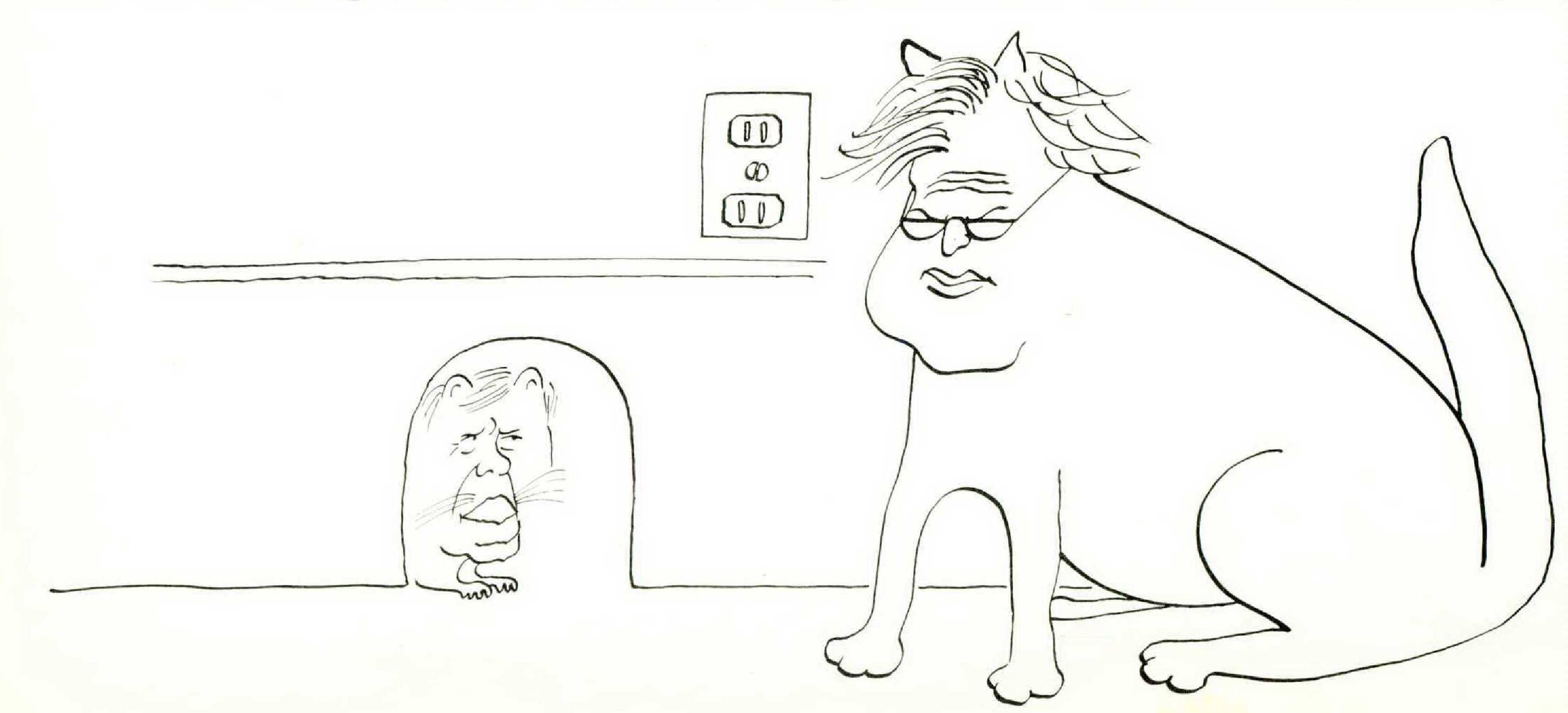
In the rest of the country, dissatisfaction with the President seems to arise from real, tangible troubles: heating oil at a dollar a gallon, mortgage rates and property taxes chasing each other up and up, the re-emergence of atavistic economic fears. In Washington, these often seem less important in themselves than as further evidence of the Administration’s incompetence. In a town made of experts in the working of the political-governmental-journalistic machine, there is little patience for those who are always getting their limbs and clothing caught in the moving gears. Most of the complaints in Washington about “lack of leadership” boil down to the assessment that Carter is not, and never will be, a pro.
One anecdote, from a New York Times story by Martin Tolchin, told it all. In 1962, when Frank Church was a young senator running his first race for re-election, he stumped through Idaho supporting John F. Kennedy’s denials that the Soviet Union had missiles based in Cuba. When evidence of the missiles did turn up, according to the Times story, “President Kennedy not only was on the telephone immediately, but also sent a military plane to Boise to return the junior Senator to Washington to confer on the problem. The gesture of sending the aircraft, with much fanfare, took some of the discomfort out of Senator Church’s awkward position.”
“This summer,” the story continues, “Senator Church was again campaigning for re-election, this time supporting the administration’s denial of reports of a Soviet combat brigade in Cuba. When those reports were confirmed, however, not only was there no military plane to bring him back to Washington, but President Carter also waited a week before returning his urgent phone calls. This time, Mr. Church was no longer a junior Senator, but Chairman of the Foreign Relations Committee.”
The problem of bungling is real, as are the economic perils; as a practical matter, I think the reports of the President’s political demise are also correct. Without the kind of lucky break that Carter no longer seems capable of getting, it is hard to imagine what could turn his fortunes around. But I still think that Jimmy Carter has a stronger case to make for himself than many people now admit.
I have a personal stake in these questions, and a possible bias. Six months ago, The Atlantic published the first of my two articles on the Administration, based on two and a half years’ experience working for Jimmy Carter. Those articles, at some length, went into the reasons the President has fallen short of early expectations and the areas where it seemed most crucial for him to change. Nothing I have seen in the intervening six months suggests that the problems are different in nature or degree from what 1 thought at the time. What we have seen in nearly three years of the Carter Administration is what we would be likely to get in another five.
But I concluded those articles by saying that, on balance, President Carter might well deserve support for re-election. At the time, many people considered that a perfunctory attempt to sugarcoat my “disloyalty” to the Administration. Others read it as the naive triumph of hope over experience. To me, it was a recognition that politics is a matter of comparative rather than absolute virtues, and that to disagree with or criticize a man should not be the same thing as repudiating him altogether.
By the same test of comparative merit, what can Jimmy Carter say for himself? To begin with, he can say there is no reason to believe that Edward Kennedy would do much better in handling the problems that have the country most worried—inflation, a possible recession, the thousand miseries associated with foreign oil. It is conceivable that a man with Edward Kennedy’s demonstrated skills would make marginally better headway in these areas than Carter has. As an orator and a “leader,” he might whip up more support for his administration’s proposals. As a veteran of seventeen years of getting and going along in Congress, he would presumably suffer fewer total legislative breakdowns.
But how much real difference will any of this make? Will it bring down the inflation rate? Will it reduce pressures for wage and price controls—or make controls easier to manage if they are imposed? Will it extract more oil from the Middle East, or lower the price?
Except on the question of busing, Senator Kennedy has never had to represent a profoundly divided constituency. He has been an advocate, not a broker, on most economic issues. He said in September that the real issue in the campaign would be “leadership,” not a specific economic program. Will “leadership” bring the gas producers of Oklahoma and the consumers of New Jersey any closer to agreement on the price of natural gas? Will it make the environmentalists any happier if a new refinery is built on the Chesapeake—or reduce the lines at gas stations if it is not? Will “leadership” tell us where to build nuclear power plants and how to make them acceptable to their opponents—or where to get the energy if we don’t? Kennedy was quoted on September 12 as saying that he was most concerned about “the shortage of home heating oil, the continuing inflation, the danger of recession—all problems not of my making.” Just whose making does he think they are of? What, specifically, does he propose to do about them? An air of leadership might buoy Kennedy’s popularity if, like Carter before him, he failed to master these problems. But how is “leadership” without a program going to do us any more good than the “competence and compassion” without a program that Jimmy Carter offered in 1976?
In other areas, Carter can point to achievements no rival is likely to surpass or even match. The nation has been at peace during Carter’s years. For the first time in a generation, we have not been engaged in a foreign war. Is it so important, he might ask, to get a little more “professionalism” and give up a record of peace?
Sophisticated Washington tends to look down on this claim, hinting that Carter’s accomplishment is tainted by an appearance of weakness. Yes, it is said, we haven’t been fighting hot wars, but does Jimmy Carter really have the stomach for a test of will? Granted that there is such a thing as a “test of will,” and that in many of these tests the Soviet Union must be resisted. If those 3000 Soviet troops had been shipped into Cuba last month, all would view it as a “test” of this administration’s willingness to resist. But if the troops have been there six or seven years without our noticing, we may have more cause to worry about our aerial reconnaissance than about the current state of our “will.” Just how are we being tested by our recent discovery of their presence? Exactly what do we think they will do? Even if there is good reason to find their presence undesirable and to bargain hard with the Russians to get them out, the circumstances are not those of a crisis. Yet the conventional wisdom in Washington was that the President had to put up or shut up, had to show he was a man. Judy Woodruff ended one NBC newscast saying it was an open question whether Jimmy Carter was tough enough for this challenge; the oracles on the Agronsky and Company talk show uttered dour warnings. This is not even to mention the fulminations of Senators Church and Stone about the peril ninety miles from our shore.
Few prospects are more threatening to a President, especially an unpopular one, than being called “weak” or “soft.” Dwight Eisenhower is the last President in memory who could not be taunted into Mayaguez-style demonstrations of fortitude when such suspicions were in the air. Yet Jimmy Carter can claim to have acted with the restraint the situation demanded, asking reasonable, detailed questions about the dimensions of the threat and the consequences of all likely responses.
Carter may have looked “weak" in this dealing, and in handling the uprisings in Nicaragua and Iran. But he might ask his opponents what, specifically, a “stronger” President would have done. Could we really have maintained Somoza or the shah in power? Would it have been in our long-run interest even to try? When not whipped into panic about “weakness,” most people would, I suspect, agree with Carter that the answer to both questions is No. If Carter’s opponents disagree, he might press for detailed explanation of just how far they would be willing to go, what military and political commitments they would make, toward the end of looking strong. One of the great contradictions of the presidency is that the element of pizzazz that helps build public support is not always compatible with the calm rationality so desirable when the President’s finger is poised over the proverbial nuclear button. Calmness in those moments can matter a great deal, and Carter is as good as we will get on this count.
Jimmy Carter was never more popular during the 1976 campaign than when he talked about the failings of big government. He did so not in a George Wallace fashion, but in a way that revealed his understanding that the execution of government programs was at least as important as their intent. He has not done nearly enough to carry out his promises, but he has done something. Edward Kennedy lists airline deregulation as part of his platform, but there are few hints in his public utterances of an awareness that there is a problem with big government.
While Kennedy might tap the part of the American spirit that wants to “get this country moving again,” Carter has performed a spiritual ministry of at least equal worth. While he spoke in his sermonlike way in the 1976 campaign, most audiences were rapt. Carter talked about American values, about the divisions among racial and economic and professional groups, about the standards of American society and the selfishness of American life. His listeners knew he was talking about something real. As President, Carter has not been the preacher and teacher many people expected, but he has continued to try. The inside-Washington appraisal of his televised speech on July 15 is that the premise was all wrong, that Carter should have stuck to his energy bill and his inflation plan and not gone into the national “malaise.” Yet those who have seen the mail that poured into the White House after that speech say that it exceeds in volume everything except the response to the pardon of Richard Nixon, and that in thoughtfulness it is unlike anything ever seen before. In the day or two between that speech and his Cabinet shake-up, Jimmy Carter had made contact again. If his luck improved, he could conceivably do it once more.
These are qualified endorsements, but qualified success is the stuff of the real world. To imagine anything else is to set ourselves up for yet another heartbreak when the next hero fails. That is what I find so sad about the political obituaries being written for Carter. Not that they are unfair to Carter, for politicians have no right to expect fair treatment, but rather that there is so little willingness to recognize that the alternatives too are flawed men. All our problems will disappear, everyone seems to want to say, once we send these clowns packing to Georgia. Our choices will be easy, once we get a leader. Happy days will be here again. Maybe Kennedy will turn out to have the answers to our problems and prayers. At the moment, he has courted the girl, won the parents’ blessing, and done all but consummate the marriage before producing a shred of evidence about his plans. Meanwhile, Carter, the unglamorous, solid-citizen suitor, stands by, his dime-store candies rejected, his modest nest egg and dependable demeanor no match for his girl’s craving for some excitement in her life.
—JAMES FALLOWS