Six Novels in Search of a Novelist
Flap copy for John Barth’s seventh work of fiction, LETTERS (Putnam’s, $16.95), reminds readers that the author is “the man the New York Times called ‘the best writer of fiction we have in America at present, and one of the best we have ever had.’” Those about to pit themselves against the book’s 772 oversized, tightly printed pages should probably also be reminded—in the interest of easing the self-contempt that can arise from failed efforts at mastering “best writers”—that agreement with this judgment isn’t universal. More than once Barth has been stung, in print, as an author whose works are literary events rather than books—objects that sensible readers approach warily. And there’s a fairly solid, if cowed, core of people in publishing who are convinced that, were it not for English professors (and allied willful obfuscators), Barth might have small reputation or none.
Nothing mysterious here. Barth is an English professor—currently at Johns Hopkins, formerly at SUNY/Buffalo, and before that at Penn State. Unlike many writer-professors, moreover, he behaves as though unashamed of his university ties: is known to attend department meetings, to deliver papers at professional conferences, and so on. (The program for next month’s Modern Language Association sessions, for instance, lists Barth as a symposiast.) And, from the beginning of his career, he has shown a softness for paleface preoccupations. The first two novels, The Floating Opera (1956) and The End of the Road (1958), are compactly fashioned narratives about, respectively, a suicidal lawyer in small-town Maryland and a neurotically immobilized thirty-year-old whose therapist advises him to take a job teaching remedial English in a community college. Both books develop absurdist themes and neither qualifies, in book trade jargon, as a page-turner. Next came two outsized ventures into parody and allegory, each reflecting intensely literary concerns. The Sot-Weed Factor (1960, 806 pages), a picaresque about a mythentrapped scholar-pedant in seventeenth-century England and America, intermittently spoofs historical fiction and comparative mythology. Giles Goat-Boy (1966, 710 pages), about the world as a university split into two campuses, East and West, both tyrannized by a computer, intermittently spoofs science fiction.
More recently Barth has experimented, in Lost in the Funhouse (1968), with short, interrelated pieces “written for print, tape and live voice.” And in Chimera (1972)—arguably his most entertaining book — he undertook to modernize some stories of ancient heroes and heroines (Perseus, Bellerophon, others), employing a voice that blends Robert Graves, S. J. Perelman, Lenny Bruce, and (so says my ear) certain members of the school of literary analysis known as Russian formalism.
In a lecture included in Chimera, Barth discoursed on the trouble he was having with a work in progress—“a novel called Letters [which] seemed anyway to have become a vast morass of plans, notes, false starts . . . I grew more mired [in it] with every attempt to extricate myself.” With the book now in hand, one can see why he had a hard time. One can also see that the public response to this work is likely to repeat past responses to Barth —more salutes to “the greatest writer” on the one hand, more mutterings about academicism, professors’ darlings, and the like on the other.
Letters begins straightforwardly, focusing on its heroine, Germaine Pitt, who seems at first glance a thoroughly conventional novelistic figure—a university administrator caught in a power struggle. The year is 1969, late in the age of academic expansionism, halfway through the nightmare of campus unrest. The place is “Marshyhope State University College,” located on a spit of Maryland’s Eastern Shore. The power struggle is about the future shape and direction of the institution, which is in transition from independence to membership in the state higher education system. Marshyhope’s just-deposed president envisioned the place as a university center—“not a replica of the state university’s vast campus on the mainland, but a smaller, well-funded research centre for outstanding undergraduate and postgraduate students . . . academically rigorous, but loosely structured and cross-disciplinary.” His successor, however, a cigar-smoking hustler named John Schott, has other ideas. He’s pushing for a plant featuring a skyscraping “Tower of Truth” and a student body of, say, 50,000—a pitiful helpless giant, maybe, but also a scene that, properly hyped, can win a Hayakawa-style president national visibility.
Riding the right-wing wave, exploiting local boosterism, suppressing student demonstrations, Schott looks invulnerable—but Acting Provost Pitt hangs tough. When her leader, who treats honorary degrees as a form of patronage, proposes that the college award a Litt. D. to the execrable “Maryland Laureate” —an arch Tory and statehouse political fixer who, we learn later, is a closet revolutionary—she sees her chance to make trouble. Bringing the issue straight to the Honorary Degree Committee, which is under her control, she launches a campaign to reserve literary honors for somebody else—a counter-candidate who is not simply a native Marylander but a writer of literary rather than political talent.
Stages in the battle thus joined —it’s one of a dozen versions of the literature versus life conflict treated in Letters—are dutifully chronicled in the book, and, while the author turns away frequently from academic scenes, he invariably returns. Much of the action occurs on campus. Many principals in the tale are, or have been, teachers. Sounds of radical student protest echo and re-echo through the pages, and a major narrative crisis coincides with an explosion reminiscent of sixties demonstrations and strikes. But if Letters thereby qualifies as, in some sense, a college novel, it qualifies as a half-dozen other kinds of book as well —and the overall experience offered is, finally, remote from an orthodox romp through academic groves.
Provost Pitt herself is partly responsible for this. Like few academic executives one has known, she is instantly recognizable as a person of wit, charm, and candor; she is also splendidly and unembarrassedly appetitive sexually, and blessed with a piquant background. English-born, an unmarried mother in her youth (the father of her mysteriously disappearing son was a mysteriously disappearing French Canadian), later the wife of Lord Jeffrey Amherst (descendant of the famous soldier of the king), she has been “the great and good friend of sundry distinguished writers,” including H. G. Wells and James Joyce, Hermann Hesse and Aldous Huxley. She herself is a writer, having published in her youth several nonacademic biographical studies, most notably of her namesake and ancestor Mme. de Staël. (It’s this “bibliography” that helps her when, as an impoverished but titled widow—Lady Amherst—she applies for work at MSUC.)
As a deeply bookish person, Provost Pitt is sympathetic enough with the cause of literary experiment to be willing to serve it actively when summoned. And her summons comes swiftly. The native Marylander whom she settles upon as a Litt. D. counter-candidate is John Barth, novelist. When she writes to him explaining the Marshyhope situation and asking help in her effort to thwart the politicization of academic honors, Barth declines for good reason—but he then goes on to suggest that she consider becoming a character in his novel in progress, supplying him (through correspondence) with the story of her life, and allowing him “to make use of my imagination of you.”
It appears that certain facts about herself which Germaine Pitt set down in her letter inviting Barth to become a degree candidate put the writer in mind, coincidentally, of a character he once sketched in a journal. It further appears that Barth has recently decided that, having “long since turned his professional back on literary realism in favor of the fabulous irreal,” he ought to shift course and try to work out “a détente with the realistic tradition.” Pursuing this goal, he has written letters (similar to the one he addresses to Germaine Pitt) to the originals or proxies of characters who have appeared in his earlier books. (“If I’m going to break another lance with Realism, I mean to go the whole way.”) And in one fashion or another, friendly or hostile, these parties have signified readiness to cooperate. (Each of the seven sections of Letters contains one or more letters from “seven fictitious drolls & dreamers, each of which imagines himself actual”; various tricky numerological and alphabetical schemes also figure in the book’s organization.)
Germaine Pitt more than cooperates. She becomes the most voluble of Barth’s correspondents, and the result is that, among the life stories of Barthian originals interwoven in Letters, her life past and present—including her testing at Marshyhope—becomes central. The interweaving isn’t, to be sure, uniformly tight. There is a close connection between Germaine and Ambrose M., a youngster who serves as the locus of consciousness in the short pieces assembled as Lost in the Funhouse; in Letters, Ambrose M[ensch], fully grown, is a faculty colleague of Germaine’s and her lover.
Equally close is the connection between Germaine and A. B. Cook, proxy for the seventeenth-century hero of The Sot-Weed Factor and source of hundreds of pages of historical rumination in Letters about Napoleon, the French and Indian Wars, the sellout of the American Revolution, and other matters. Cook is the Maryland Laureate (and closet terrorist) whose Litt. D. Germaine is blocking, and he is later intimated to be the vanished father of her vanished child. But with the others—Todd Andrews, a bachelor lawyer whose day of intended suicide is recounted in The Floating Opera, Jake Horner, the immobilized neurotic from The End of the Road, and Jerome Bonaparte Bray, the computer specialist in mathematical fiction from Chimera and elsewhere—the ties are slack.
Nevertheless, the author does manage to keep a sober promise he makes early on, namely that “the several narratives will become one.” He brings it off by framing the individual narratives in a film production, an attempt by a moviemaker to create a screen version not of one of his books but of all of them, including those still unwritten.
The theme of this film—a “visual orchestration of the author’s Weltanschauung”—is the destruction of the universe of language. During its shooting, the author, scriptwriter, and director scrap hilariously for aesthetic control. Part of the action portrays antiverbalist cabals led by persons from Barth’s books waging war on each other to determine who is to dominate the nonverbal arts of the future. And the impresario at the helm—a ferociously word-hating monster named Reg Prinz—ranks with Barth’s most extraordinary comic inventions. Prinz, in his late twenties, is:
lean, slight, light-skinned, freckled, pale-eyed, sharp-faced. He wears round wire-rimmed spectacles like Bertolt Brecht’s and a bush of red hair teased out as if in ongoing electrocution. His chin and lips are hairless. No hippie he, his clothes are rumpled but clean, plain, even severe: . . . he dresses like a minor member of the North Korean U.N. delegation, or a longterm convict just released with the warden’s good wishes and a new suit of street clothes. . . . It is said that he comes from a wealthy Long Island Jewish family and was educated at Groton and Yale. It is said that he “trips” regularly on lysergic acid diethylamide and other pharmaceuticals, but deplores the ascription to them of mystic insight or creative vision in their users. It is said that he is a brilliant actor and director; that he has absorbed and put behind him all the ideology of contemporary filmmaking, along with radical politics . . . and literature, which he is reputed to have called “a mildly interesting historical phenomenon of no present importance.” One hears that he is scornful of esoteric, high-art cinema as unfaithful to the medium’s popular roots, which however bore him. Political revolutions, he is said to have said, are passé, “like marriage, divorce, families, professions, novels, cash, existential Angst.”
For the climax of his film, Prinz, who speaks only in “ellipses, shrugs, nods, fragments, hums, non sequiturs, dashes, and suspension points,” chooses an event nowhere represented in Barth’s books: the sack of Washington in the War of 1812. The reason for that choice is that what he “truly wants to record the destruction of is not any historical city, but the venerable metropolis of letters.” Wild indeed is the account of the staging and filming of this event—the burning of the Library of Congress and the National Archives— and also rich in allusion. (Barth somehow works into the slapstick-ridden action thumbnail histories of the alphabet, printing, other related subjects.) The culminating deed of mayhem is committed by the director upon his scriptwriter (too wordy for Prinz’s taste) and his own cameramen:
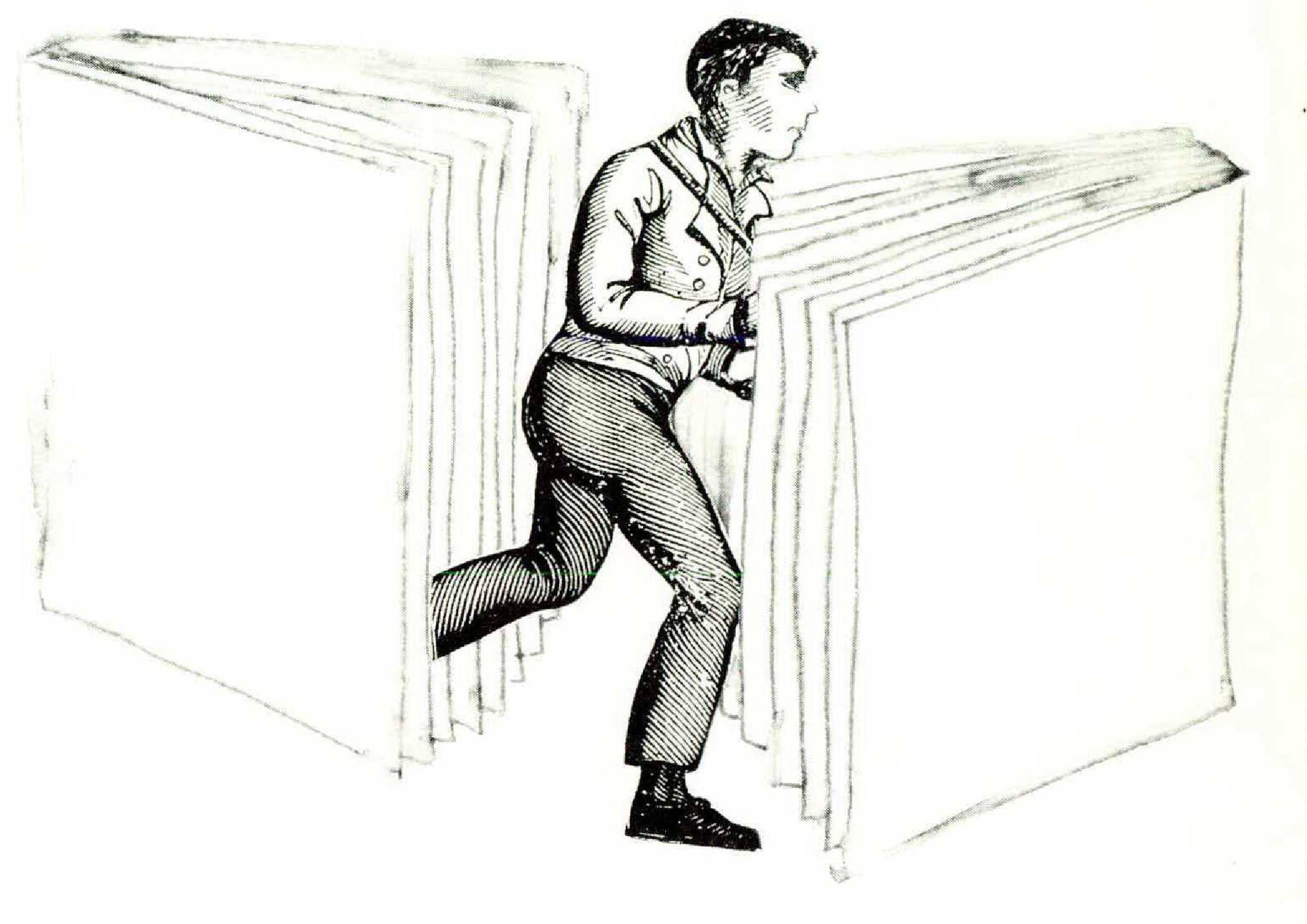
. . . Reg P. . . . has been waiting his moment, and when we move now, in a pause in the downpour, behind the burning flat to a row of dripping bookshelves representing the Congressional Library, he breaks away . . . suddenly an eight-foot case of “books” (actually painted rows of spines, but the case itself is a heavy wooden thing) comes tumbling upon [scriptwriter and cameraman], pushed by [Prinz], from an angle such that to avoid it they must spring toward the flames!
Midway in Letters, Barth reproduces a patch of his own correspondence in which he asserts that the book “will not be obscure, difficult, or dense in the Modernist fashion.” And he adds that, while “it will hazard the resurrection of characters from my previous fiction . . . as well as extending the fictions themselves, [it] will not presume, on the reader’s part, familiarity with those fictions, which I cannot myself remember in detail.” I’m sorry to report that there’s some self-deception in these observations. Ambiguities of identity in the chief characters, the irrelevance of whole chapters of historical matter to what the nonspecialist reader must regard as the narrative main line, the author’s near obsession with historical and linguistic correspondences, doublings, and layerings— these combine to produce extreme difficulty. And if it is true that Barth doesn’t expect his reader to know his previous books, it is no less true that readers ignorant of them are bound to be mystified often, especially by the letters from the master of the mathematical novel. (“Giles our prix buck passed on! Les nans reduced to browsing on LILYVAC’s language circuits!”) There’s a character in this book with a forty-hour-a-week job who discloses she is reading Barth’s complete works, at the rate of a volume per month. Anybody gainfully employed who means to conquer Letters in a month should go on part time.
Is it really worth bothering? Yes and no, leaning yesward. Besides Germaine Pitt, much Rabelaisian humor, and the high-camp theatrics of the filming episodes, Letters contains at least two extended and admirable sections of narrative—a carefully detailed history of a family of Eastern Shore stonemasons, and a farewell cruise around the Chesapeake on a skipjack whose captain has a movingly precise appreciation of the joys of pure physicality. In addition, the author’s speculative intelligence is rarely out of sight, whether his focus is the nature of a political liberal, or the early impact of the American idea on European intellectuals, or how to chisel letters on a tombstone, or how to set canvas for a sweetheart run downwind, wing-and-wing. And while Barth’s fascination with the technology of narrative is often wearing, it does stimulate brooding on the meaning, for contemporary life, of the decline of the storytelling craft. The scholar-critic Frederic Jameson recently observed that in the West, “literary construction itself seems to have joined a long list of extinct or vanishing handicrafts or other skills.” John Barth’s bemused teasing out and exhibition of the story elements of his fable comes to seem, well before the end, a mode of decent piety— a last touching attempt, in the twilight of yarn-spinning in words, to evoke and objectify the beauty and mystery of the spinner’s skills.
More important than any of this is the scrupulousness with which the book’s basic theme—call it the fiction of fiction—is explored. Other writers besides Barth—the best of the type is surely Thomas Pynchon—create figures whose lives, like Germaine Pitt’s, are dominated by fictional forces or myths beyond their understanding. Few writers work as patiently or as ingeniously as Barth at explaining the derivation of such figures—why they have cropped out all at once in our fiction, what their roots are in contemporary intellection. Time and again in Letters the author invites his reader to ponder the present status of the idea of the real and the unreal, present thinking about the arbitrariness of signs, present critiques of naive realisms, scientific and otherwise. Time and again his narrative becomes an instrument for renewing comprehension of the universal human enclosure in fictions novelists never made—the truth, that is, “that our concepts, categories, and classifications are ours, not the World’s. . . .”
Whether the novel as hitherto constituted is the proper setting for such instruction can be debated. So too can the wisdom of promoting complex epistemological fiction in a manner suggesting that a swell evening’s read lies ahead. And there is something in this late-twentieth-century embrace of the theme of reality as mirage that hints at enfeebled responsiveness—inability to awaken any sense of pain and injustice except that which deals abstractly with them as “clichés.” Yet despite all this, Letters remains worth wrestling with. It is by turns a brain-buster, a marathon, an exasperation, a frustration, a provocation to earnest thought. Barth is preaching, wittily but with total conviction, on the limits of our kind, on the sanity of doubting that we know where, in our lives, fiction stops. His book intimates that things as they are—the myths of the West, of free enterprise, of the scientific method, of the energy crisis, all those orderings of life shaped in the nightly news—may hold less of a key to the truth of our being than the dream some neighbor is dreaming as we turn the page. A piece of me believes this; therefore I think Letters has a future.