Getting Serious About the Occult
Scientists have long discounted “psychic" phenomena, but recent experiments have persuaded some skeptical researchers to take yet another look. Is there such a force as “psychokinesis”? Can some people (as the experiments suggest) actually affect the workings of electronic machinery by the power of thought? O brave new world, that has such people in’t! . . .
In the ninety-odd years since the occult entered makeshift laboratories, a cadre of scientists and would-be scientists—often called parapsychologists—has attempted to prove that man’s mind possesses hidden powers of transcendence, its own élan vital. Until recently, most of these efforts were aimed at indisputably documenting extrasensory perception, or ESP. All of them failed.
Subjects believed to be psychic, when asked to guess what card had been chosen from a shuffled deck, or to reproduce an image drawn by another person away from normal view, occasionally exhibited what looked to be striking success at thought transfer or clairvoyance. But the research failed to convince rigorous empiricists. Albert Einstein once reviewed contemporary research and concluded that the evidence suggested nothing more than a “nonrecognized source of systematic errors.” Traditionally, official science has been even less charitable. ESP eluded repeatable, objective testing, and so was denied scientific acceptance.
For those reasons, “guess tests" have fallen out of favor with psychic researchers. Parapsychologists today are less interested in ESP than in another phenomenon: “psychokinesis,” or PK. It is related to ESP, parapsychologists claim, yet very different. Whereas telepathy and clairvoyance produce information, psychokinesis produces (or is said to produce) results; it purportedly affects tangible matter.
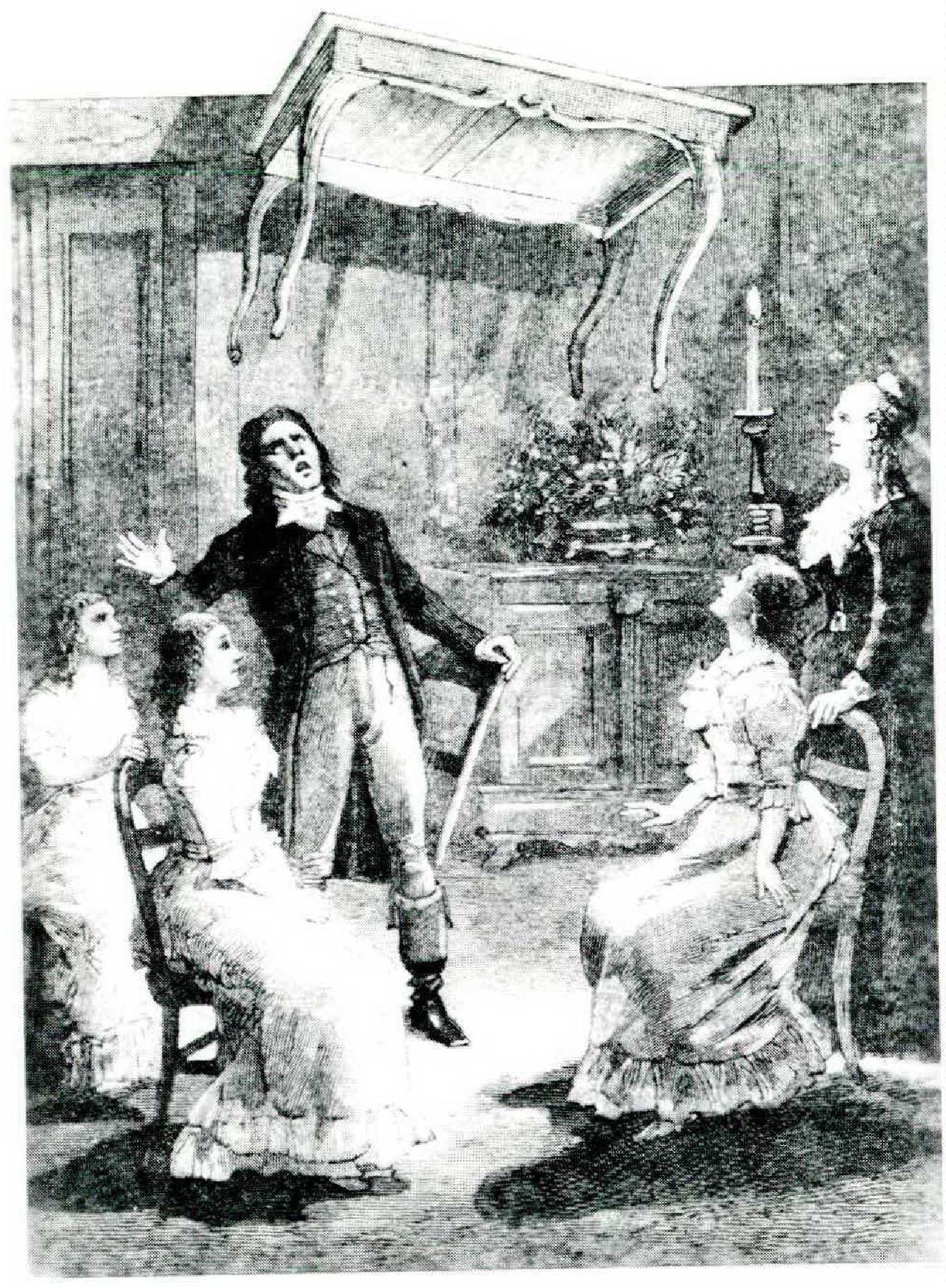
In the days of Victorian seances, it was known as “telekinesis,” for the most part expressing itself as living-room furniture that eerily levitated at the behest of an entranced spirit medium. Scores of European researchers fruitlessly endeavored to study PK in the late nineteenth century, referring to it as “physical phenomena.” Experimental procedure involved little more than tying a medium to a chair, to guard against surreptitious use of limbs, and lying in wait for the outlandish marvels. The favorite subject was a waifish Italian girl from Bari, Eusapia Palladino. Curtains billowed in her presence. Bottles moved as if bewitched. Either bound to a seat or firmly held by the hands of the curious, Eusapia attracted to her articles of furniture, made them rise, held them suspended like Muhammad’s coffin, and allowed them to descend only in undulatory movements, at her will. Pierre and Marie Curie saw it; so did Charles Richet and Lord Rayleigh. Psychic scientists were shocked when, later in her career, Miss Palladino admitted to using some simple trickery at times.
Only the obstinate stayed with physical phenomena after that. The most serious attempt to resurrect telekinesis was initiated by the psychologist J. B. Rhine, whose Duke University laboratory had been the center of the first loud ESP debate. In 1943, he quietly published a monograph announcing that people could, by dint of mental effort, affect the roll of dice, not merely guess the outcome. Years before, a cocky young gambler had wandered into his office claiming to have a Midas touch with dice. After a short session, Dr. Rhine concluded that the cubes probably were falling, against the odds, in the direction of the gambler’s desires. He set out to have hundreds of others try it, and found that scores of his subjects seemed equally able to influence the roll of the dice.
Rhine’s experimental anomalies were not given a respectful hearing by a science world preoccupied with the advent of quantum physics. A clear and supposedly comprehensive picture of the physical world was emerging, with no room for spiritlike powers causing mysterious physical effects. ESP was tolerated as an idle fancy, but PK directly conflicted with the laws of physical cause for physical effect.
That didn’t bother parapsychologists. As far as they were concerned, something was still going bump in the night. Once in a while, the media heard the sounds too. Newspapers carried periodic reports of wall-knocking poltergeists and psychics who mysteriously caused small objects to move or who bent silverware. Physicists, meanwhile, were radicalizing their view of reality, submitting for consideration subatomic particles that moved faster than light, stars that collapsed into time-warping black holes, and anti-matter. The American Association for the Advancement of Science decided that if it was going to allow those new eccentricities, it would be only fair to include parapsychology, even if it was a cottage science. In 1969, following an impassioned plea by anthropologist Margaret Mead, the Parapsychology Association was voted in as an official member, but its phenomena were still regarded as unproven and alien.
Once electronics and microscopic technology became available to them, parapsychologists proceeded with their first major experimental run at PK. The effort was so expansive that it was without precedent. Scientists—and pseudoscientists—dabbled in the possible influence of the psyche on magnetic fields, protein enzymes, paramecia, nuclear cloud chambers, sensitive thermistors, exotic metal alloys, fungi, and other unusual targets. Current literature in the field has become dominated by reports of PK, which offers a far greater variety of subject matter than telepathy ever could. Most perplexing is a mechanism known as the random event generator.
In terms of evidential credibility and replication, the random event generator is the most substantial test procedure researchers in parapsychology have ever devised. Universities and other assorted think-tanks around the world, many never before interested in the occult, are taking the device seriously. Most of them are getting the same results. And parapsychological (psi) scientists are finally producing defensible statistics that seem to suggest the existence of psychic energy with unknown potential.
In the June 24, 1971, issue of the discerning New Scientist and Science Journal, a technical article appeared, entitled “Mental Influence on Random Events,” with an abstract underneath: “Two subjects have been found with the apparent ability to influence physical events by psychokinesis. The odds against obtaining the large difference between their scores by chance are more than 10 million to one.”
Helmut Schmidt, the author, is a German theoretical physicist. He stands six-feet-two and is a thin man with receding blond hair. He works out of a large, bright-paneled office with thick gold shag rug at the Mind Science Foundation, twelve miles from downtown San Antonio.
One day in 1967, while he was employed in Seattle as a senior plasma researcher for the Boeing Company, Schmidt began to ponder the ESP experiments he had read about in the work of Rhine and S. G. Soal, a London mathematics lecturer. He was troubled by their laboratory procedures, though intrigued by the results. Dr. Soal, once a standard-bearing skeptic of parapsychology, had been taken aback by some positive results from his own ESP experiments. He found, among other puzzlements, that some people seemed to be able to predict which card the experimenter would choose from the stack, a prophetic talent known as precognition. Rhine had found the same. He had used “Zener cards” for his precognition tests, a pack of twenty-five in which each displays either a cross, a square, a circle, a five-point star, or three wavy parallel lines. Subjects were required to have a “vision" of the card haphazardly chosen from the rest. The problem, as Schmidt saw it, was that parapsychologists had no foolproof way of insuring that the cards had not simply fallen into a coincidental pattern, been fraudulently prearranged, or been covertly peeked at. With Rhine’s tumbling dice, no one could be certain the cubes were not lopsided, worn, or otherwise biased. Schmidt knew that what was needed was “a system indisputably random.”
One such process is the radioactive decay of atomic nuclei. While we can roughly guess how many atoms will decay in radioactive substances over a certain period of time, we can’t possibly predict the exact moment an atom will deteriorate, firing out a high-speed electron. If, somehow, a person were able to tell when radioactive particles were about to be released, he would be doing so through ESP, Schmidt concluded, since not even the most sensitive electron microscope can precisely warn of an impending atomic fade-out. The perfect test, then, would involve radioactivity as the source of randomness.
Schmidt invented the “quantum mechanical random generator” on precisely this principle. It was a gray metal box with switches and counting displays, not much larger than a hard-cover unabridged dictionary, but inside was a labyrinth of microcircuitry, silicon chips, and transistors and electronic triggers, the most sophisticated tool in the history of parapsychology. Once turned on, it would automatically proceed to a series of stop-and-go patterns among target positions. It acted as a complex roulette wheel, and the atomic decays, in the role of the “marble,” determined when and where the “wheel” would instantaneously stop. The subject’s objective, naturally, was to “guess’ intuitively the general pattern of the machine.
For radioactivity, Schmidt used a piece of strontium 90. Electrons fired from the strontium, which was of weakened strength, at an average rate of ten events a second. Each one was registered on a nearby Geiger tube. Meanwhile, a high-speed counter, the “roulette wheel,” passed the four possible targets at a rate of a million times a second. Every time a strontium particle registered, the counter stopped wherever it was at the exact millisecond. There was thus a perfect 25 percent chance of a given target being hit.
The targets were connected to four corresponding lamps, blue, yellow, red, and green, arranged on a display board. Next to each lamp was a button. When the subject wanted to make a guess, he pressed the button of whichever lamp he thought would illuminate. As long as the subject took no action, the display remained unlit, despite the fact that inside, the strontium was proceeding with its constant selections. When a button was pressed, the machine was activated to light the lamp that was connected to the target position the counter would next stop at. If his chosen bulb lit, a hit. The score was kept by two electromechanical counters and an independent punch-tape that would be checked by a computer later to make sure the scoreboard had not been manipulated. Anyone who guessed right more than a quarter of the time was beating the odds.
The first exploratory test, conducted on 100 people, produced mainly chance scores. For the next operation, Schmidt recruited three new subjects who claimed to have a history of psychic experiences and who belonged to spiritualist or “psychic development" groups. They were told to play it by hunch. “I told them to relax, and make the guesses however they felt would be best,” Schmidt says. “Everything was very, very normal, yes.”
Except the results. The three scored an average of only four or five extra hits per hundred attempts. However, after 63,066 trials, that figures to odds of one against hundreds of millions. In a confirmatory test, the subjects were given the option of aiming for either a large or a small number of hits. II they chose the latter, the task would be to push a button next to a light that would not illuminate next. Twenty thousand trials later, a computer evaluated the high-aim success rate at 26.8 percent. When the subjects were intending low, the chosen light glowed only 22.7 percent of the time. Says Schmidt: “The odds against obtaining this or better score by chance is more than ten billion to one.” The results were far higher than any other psi researcher had tabulated up to that point. They were also a fascinating distance above the twenty-to-one ratio accepted as the significance level in other disciplines.
Unless Schmidt was fabricating the data, something inexplicable was happening. Run through millions of control trials, in which the machine was left on in the absence of humans, the generator’s results were neatly in accordance with the laws of probability. But were the subjects really predicting what the generator would do? Or were they exerting subconscious PK and influencing the machine to correspond with their guesses?
To isolate any possible psychokinetie effect, Schmidt changed the display panel and simplified the generator so that it had just two target positions, symbolized this time as +1 (“heads”) and — 1 (“tails”). The display was restructured so that there were nine lightbulbs arranged in a circle and no more buttons. Switched on, the electronic “coin-flipper" lit a bulb at the top of the circle. When the strontium picked up a + 1, the electrical current lit a bulb immediately to the right of the top light and would proceed to flash in a clockwise direction if the following numbers continued coming up heads. Conversely, — 1’s caused the current to flow counterclockwise. At a typical rate of one step a second, the light performed an erratic walk among the nine lamps, half of the time jumping clockwise, and vice versa. Seated directly in front of the display, subjects were asked consciously to attempt to make the lights go in one direction more often than the other. Schmidt felt he could be sure the results were PK instead of ESP because he was not asking them to guess what the generator would choose, but instead was trying to see if they could deviate a long run of random machine choices. In the end, if subjects had been simply guessing the results, the machine theoretically would still have chosen each target 50 percent of the time. PK, on the other hand, would unbalance the two columns of total machine choices, and in fact this is just what happened. Preliminary tests bore out his idea that a mental force was influencing the machine, he says, and in years of follow-up experimentation, that conclusion grew stronger. Something to do with consciousness appeared to be affecting cold hardware.
Martin Gardner, the most erudite critic of parapsychology, is a serious, tense-appearing man with a relaxed voice. His bushy white eyebrows are partly concealed by thick horn-rimmed glasses. To date, says Gardner, “there is still not a solid shred of evidence for psychic miracles.” As far back as 1952, Gardner wrote a book entitled Fads and Fallacies in the Name of Science. In it he criticized the work of Rhine and others for slovenly experimentation and myopic observation. Today, he serves on the executive council of the Committee for the Scientific Investigation of Claims of the Paranormal, an organization of magicians, philosophers, scientists, and writers who debunk each new psi claim as quickly as it appears. They are professional disbelievers, well-heeled with prestige: astronomer Carl Sagan, psychologist B. F. Skinner, and writer Isaac Asimov serve as associate members. Gardner is the committee’s sentinel.
When dealing with psychic experimentation, Gardner has a simple philosophy: If the slightest room for trickery, error, or fraud exists, the test is invalid. Scientists, he says, are “the easiest people to fool.” “In the few cases where tests have been closely scrutinized, large loopholes in controls have come to light.” The most publicized ESP tests of the decade have taken place at Stanford Research Institute in Menlo Park, California. Along with other members of CSICP, Gardner seriously questions Stanford’s statistical practices and overall objectivity. Recent SRI experimentation dealt with what its scientists refer to as “remoteviewing,” the alleged clairvoyant talent for envisioning distant objects and places. That potential capability was enough to interest the CIA in sponsoring an experiment, “Project Scanate,” in which two psychics tried to project their ESP to classified sites, but though success was reported in that venture, a Department of Defense intelligence squad had earlier reviewed some of SRI’s psi work and deemed it informally executed. Says psychologist Ray Hyman, who served as a consultant to defense investigators, “In a visit to SRI on December 8, 1972, I saw little to increase my confidence in their ability to conduct psychic investigations.”SRI parapsychologists are now investigating random generators, perhaps partly because they have noticed that only one large-scale endeavor in psi has not yet been found to have serious flaws: the work of Helmut Schmidt.
Schmidt’s experimentation is rarely discussed in the press, presumably because of its complexities and subtleties. Yet while television and magazines regularly focus on SRI as an example of scientific inquiry into the paranormal, the most frequently cited experimentation in the top echelons of parapsychology is that with random generators. The machines are as pervasive as card-guessing was decades ago, and rapidly spreading. As yet, Gardner says, he knows of no thoroughgoing critique on Schmidt.
Still, Schmidt’s work cannot be accepted on faith. No accurate evaluation has been attempted by an independent and skeptical statistician, a task that, according to Gardner, would require months of investigation and at least $50,000 in fees. “One would have to analyze any raw data still available, interview all the participants, and so on,” he says.
Whenever humans are involved in an experiment, even if it is merely to switch on machines or yank out punch-tapes, the possibility of subterfuge remains. “I suppose,”observes Gardner, “that as more and more sophisticated randomizing techniques are used by parapsychologists, more clever ways of biasing them may be found by the very small minority that consciously fudge their results. Just as the rise of modern computers in banks has been accompanied by a rise in sophisticated computer frauds. It may appear incontrovertible on paper, but the fact is no skeptical observer was standing over Schmidt when he was garnering his fantastic statistics.”
In the spring of 1974, J. B. Rhine revealed to the press that parapsychologist Walter J. Levy had been nabbed falsifying psychokinetic data—random generator work. Dr. Levy was, at the time, director of Rhine’s Institute of Parapsychology in Durham, North Carolina, a post once held by Schmidt. As it happened, two alert colleagues suspicious of Levy’s extrachance results found that he was manipulating the recording device. Spying on Levy in the laboratory, one of the investigators watched the director biasing the results by pulling a plug at strategic intervals in a way that registered an unrepresentative number of hits. He was forced into resignation, his nine years of research null and void.
The most publicized person claiming the ability of directly observable PK, Uri Geller, has left the limelight because he could not prove he can actually bend and otherwise contort forks and spoons via mind alone. Some scientists claimed he affected exotic metals, causing strange lowor high-temperature atomic effects as he bent them, but virtually all the Geller studies had serious protocol faults, and his resistance to full-time laboratory work has prevented a conclusive study. A number of respected experimentalists, however, including scientists at SRI, believe Geller can indeed cause metal to bend or break simply through a light rubbing motion of the fingers.
Any time only one laboratory reports new effects, the results are suspect. So there was at least one major element left for the generator work: replication. Nearly every ESP and PK experiment had lacked that vital ingredient. One scientist’s psychic finding was another’s chance results. Only when they could be reproduced and amplified would Schmidt’s claim be a serious candidate for validity. Which brings us to the present . . .
Deepest Brooklyn, the end of 1977. In a windowless basement laboratory at Maimonides Medical Center, a stout, bespectacled researcher, Charles Honorton, stands at the foot of a small mountain of electronics. He is watching red block digits on an electronics counter rapidly registering hits for a complex random generator he named “PSIFI.” The machine produces up to a thousand trials a second, operating on the same principle as Schmidt’s but employing thermal noise as the source of randomness. The subject is twelve feet and two double-steel walls away, nearly asleep on a vinyl recliner in a red-lit isolation room. Electrodes are pasted to his scalp and right ear. A constant cacophony of odd tones—beeps, bass, a static buzzing—comes through a pair of headphones. The subject, passively attentive, tries to “think” the feedback noise toward the low end of the spectrum, gently wishing it to remain there. When it does, the possibility exists that PSIFI is being psychokinetically affected. This happens frequently, Honorton says.
An intense fellow in his early thirties, with a somber stare and constant pipe, Honorton calls his laboratory the Division of Parapsychology and Psychophysics. Years ago it was the Dream Laboratory, drawing national publicity for some pioneering experiments in telepathy and precognition. During the last two years the laboratory has switched its emphasis to PK, confirming and extending Schmidt’s work.
PSIFI is unique because of its many options: an EEG to monitor brainwaves, a myograph for muscle activity, an autogenic system of feedback to orient psychokinetic trials. This way, Honorton can find the psychological and physiological conditions most fertile to PK. The atmosphere is cordial (“Experimenters who made an effort to help their subjects feel comfortable and relaxed were more successful than those who got right down to business,” he notes), with Honorton softly speaking directions over an intercom to the subject in the other room, which is shielded from sound, radio waves, and static. As in the Schmidt studies, the subject aims at the feedback, only indirectly trying to affect the generator.
In theory, psychokinetic feedback is similar to biofeedback, in which a person learns to control bodily functions not normally subject to conscious will. The most famous biofeedback technique was developed at the Menninger Clinic in the 1960s. By attaching to their hands a sensitive thermistor that monitored heat, subjects were taught to increase their skin temperature at will. Connected to a gauge needle, the thermistor converted the reading to a readily visible display, so the subject could follow what was going on inside him. Watching the needle movements, people gained control over autonomic functions.
Honorton hypothesized that perhaps PK functioned similarly, that everyone had psychic talents but had no way of knowing how to externalize them. He arranged the audio feedback so subjects could actively search for the mental state conducive to significant PSIFI scoring, and it apparently worked. Maimonides and other laboratories employing this technique have reported significant results in replication experiments. In 1976, Honorton and nuclear physicist Dr. Edwin May issued a formal statement declaring that PSIFI was picking up “an as yet anomalous human capability to interact with remote physical systems.”
Since the days of Rhine, parapsychologists have said that psi energies are constantly at work, unnoticed, within the human organism. The exteriorization of such “energy,”they say, rather than the existence of the force itself, is abnormal. Despite a scarcity of evidence, some scientists suggest that certain functions of the nervous system, for example, are directed by an internal brand of PK. Supporting that notion is the recent discovery that, through biofeedback, a single nerve cell can be consciously controlled. Once, when asked what one practical application of PK might be, J. B. Rhine said: “Healing.”
Hundreds of people claim to be “psychokinetic agents,”what most people know as psychic healers. So many exist that Martin Gardner’s committee of skeptics formed a special branch to deal with questionable cures. If any one area of parapsychology is potentially dangerous to the public, it is the dependence of ailing people on faith healers who have no real knowledge of medicine. The most ardent supporters of psi would not claim that paranormal “healing" should be relied upon by the ailing, but in fact the credulous and uninformed are bound to do exactly that. While healing is questionable itself, however, researchers declare it to be the major parapsychological goal, in an obvious attempt to emphasize the positive applicability and to dissuade their listeners from preoccupation with possible harmful uses, such as psychic warfare. An unwritten rule holds that efforts should be aimed in the healing direction, and most new experimentation is oriented to the human body.
Dean Kraft is the most famous of the growing number of psi medicine men and also the most professional in this highly dubious realm. Patients are referred to him by some two hundred doctors, he claims, and must, before he attends them, fill out a case form pledging to continue seeing more conventional practitioners. No fees are charged. Instead, patients make donations. And, as a result, Kraft, a street-wise twenty-eight-year-old who never attended a day of medical school, lives a comfortable upper-middleincome life with a plush “doctor’s office” on Manhattan’s East Side.
Before 1972, Kraft never heard the term “psychokinesis.” But that year strange things began happening. He claims that small objects near him seemed to move of their own volition. He learned to concentrate, hands outstretched and trembling, and cause pens and plastic-wrapped candy to skip, hop, and jump for short distances. Reporters watched him do what he swears is no trick. So did John Lennon and Yoko Ono. And scientists. At Stanford Research Institute, Kraft deflected a motionless pendulum sealed in a glass case and monitored by a laser beam. The next time he tried, he knocked the shaft off its treadle. Dakin Laboratories in San Francisco issued a report saying that he affected electrical fields and the growth of rye grass. In another experiment, Dakin researchers asked him to attempt to lower the blood pressure of a chronically hypertensive rat. In the presence of two scientists, Kraft tried to cure the rat for thirty minutes without touching it, and without disguising his personal dislike for the animal. Immediately afterward, the vermin was found dead, for reasons unknown.
Kraft likes people better. In the last several years he has seen more than 3000 of them. He claims 70 percent of them have benefited in some way from his enchanted hands. He says he has successfully treated herpes, kidney stones, cancerous tumors, multiple sclerosis, and depression. A New York City family court judge told the Village Voice about “an incurable arthritic condition in my knee and back. Dean came over to see me, and sure enough, the pain left me. And I haven’t had any problems since.” A physician, Dr. Gerald Jampolsky of Tiburon, California, said he watched Kraft treat a man with a cyst on his knee. “Normally, it would have needed surgical removal,” he told the press. “It would not disappear by itself. Today, after a healing by Kraft, the cyst has shrunk in size by 95 percent, based on x-rays taken before and after.”
In this domain, so rife with charlatans, I found it surprising to talk with John Kmetz of the Science Unlimited Research Foundation in Texas. Dr. Kmetz, in one experiment, gave the psychic a flask that contained a culture of HeLa cells, more commonly known as pelvic cancer. When alive, the cells cling to the glass with such an intensity that you could slam the container against a wall and still not loosen their grip. Kraft held the flask between his palms. Later, a microscope revealed that a startling number of cells had detached and were floating freely. That meant they had died. “No way he didn’t do something to them,” Kmetz says. “It’s one of the most exciting things I’ve ever seen.”Kraft is exhilarated about it too. “I was really cooking down there.”
“The likelihood of negative application frightens me greatly,” Charles Honorton says. His worry is that work with random generators will eventually pave the way, unwittingly, to the use of psychic energy for purposes that are not as lofty as, say, healing. “Given the right level of funding, it would be possible to make the necessary progress for practical application. That would be a real Pandora’s box. If PK is distance-independent, as it seems to be [Schmidt found subjects could affect his equipment from across town], the possibility of jamming computers or erasing program cards is there. And remember, Kulagina was reported to have caused a frog heart kept functioning in saline solution to stop beating.”
Ninel Sergeyevna Kulagina is a plump, fifty-twoyear-old Russian housewife. A top line of Soviet scientists have filmed her causing, through purported PK, compass needles to spin, unexposed camera film to fog, wood matches to drag along tabletops even when protected under Plexiglas, and numerous other small objects to budge paranormally. During a typical session, Kulagina sits in a straight chair in front of a table, after being x-rayed or otherwise checked for trick devices, at first appearing relaxed as she takes several breaths. Then she holds one or both hands near an object supplied by an observer. It matters not if it is organic or inorganic, magnetic or nonmagnetic. The sessions last anywhere from a minute to two hours. The objects begin squirming eerily as she intently stares on, her brainwaves increasing in voltage and her pulse racing up to 240 beats a minute. Westerners have observed her in independent circumstances which they feel precluded fraud or the possibility that she is governmental propaganda. Afterward she is in bodily pain and utterly exhausted, suffering lack of coordination, dizziness, and insomnia. Moscow University’s chairman of theoretical physics, Dr. Y. A. Terletsky, once told Pravda that Kulagina “displays a new and unknown form of energy.”
The Defense Intelligence Agency recently issued a report stating: “Soviet or Czech perfection of psychotronic (PK) weapons would pose a severe threat to every military, embassy, or security function. The emitted energy would be silent and difficult to detect electronically and the only power source required would be the human operator.” The source of that warning is a Czechoslovakian engineer, Robert Pavlita, who, according to reports, has developed small gadgets that collect and magnify psychic energy.
While the West has its share of what William James called “white crows,” the lesson of Kulagina is that the Russians are more specifically in tune with PK than Americans, who tend to associate it with comic-strip wonder-workers. Informed speculators estimate that the Soviet Union has about thirty government-run parapsychological laboratories, most of them focusing on PK. America has none—officially, at least. Emigré Soviet physicist August Shtern, who spent three years in a secret laboratory in Novosibirsk’s Science City, said that the Soviet aim is to identify the physical basis for PK. Little is known of the psychic workshops, except that they have coded locks and are referred to, in cover, as centers for the study of automation or electronics. No Soviet breakthrough is evident, nor is there any indication that they have tools more sophisticated than the random generator.
The Central Intelligence Agency denies it is directly involved with psychokinetic research, though it recently drew a $30,000 contract to have Garrett Airsearch Manufacturing Co. of California overview the Soviet work in the field, and it has been involved as a funding agent in at least two other cases: “Project Scanate,” mentioned above, and clairvoyance experimentation, with the National Security Agency, at Stanford Research Institute.
SRI’s most active researcher of the arcane, Hal Puthoff, a laser physicist who once worked for the NSA, claims to have witnessed, with several other physicists, a New York psychic named Ingo Swann stop the chart pattern of a complex magnetometer shielded in a vault beneath Stanford University’s Varian Physics Building. If a psychic can really do that, the same forces might as easily interfere with military equipment—a missile’s sensory system, for example. The Navy realized that potential and funded follow-up experimentation.
Parapsychologists generally cringe at the thought of military applications of PK. One prominent physicist recently refused a government invitation to study the effect of the mind on laser beams. Maimonides has accepted federal money, but only from the National Institutes of Health. Medical uses are what most researchers are concerned with; military dollars are known as “black money.” Besides, parapsychologists are too busy with other matters to think of war games. There is much more evidence to gather.
In his furthest visions, Pierre Teilhard de Chardin saw man pulling away from an utterly mechanistic view of the universe. He saw us evolving toward the “noosphere,” all one, one all, a union of ethereal energies. “When everything else, after concentrating or being dissipated, has passed away,” he wrote, “spirit will remain.” Positive findings on PK and other psychic phenomena lend credence to such seemingly extravagant conceptions of a supernatural psyche.
The mainstreamers of neuroscience prefer to think of man as a highly complex machine, completely explicable in terms of physics and chemistry. This is monism. Since Darwin, science has shed the need for a Garden of Eden. Biologists have been able themselves to assume the role of superbeings, creating life forms in test tubes and dabbling with genetics sans Divine Intervention. Anomalies reported from parapsychology laboratories smudge the neatness of mechanism and thus are ridiculed, often rightly, as pseudoscientific gobbledygook or wishful superstition. Not long ago, a polygraph expert, Cleve Backster, had much of the general public convinced that they could telepathize philodendrons and other plants. It seemed plants had ESP. Later, his experiments were discredited by parapsychologists who exercised better experimental controls and found no supportive evidence. Other seemingly tight experiments held at prestigious institutions have been found at fault, and random generators could suffer the same fate when we learn more of the procedures. The natural inclination is to believe, and it comes “from the same need as have all other civilizations: from the necessity of defending oneself against the crushingly superior forces of nature,” to borrow from Freud.
Despite science’s success in predicting routines in nature, however, bothersome questions to do with consciousness remain. An increasing number of neurophysiologists are troubled by the pervasive notion that human thought is nothing more than electricity jumping among cerebral nerve threads. For all their use of scalpels and electrodes, scientists still have not located all the mechanisms of being. How new decisions are made, where a sense of purpose comes from, the mechanics of imagination, general creativity, and emotion, are unknown. In some experiments, neuroscientists have found that electrical stimulus of fingers reaches consciousness bafflingly faster than simple neural routes should allow. Questions also abound as far as vision and memory are concerned. While the brain has definite functions in these areas, an outside, undiscovered entity also appears to be at work, a contributor known as the mind.
“There is no good evidence that the brain alone can carry out the work the mind does,” the late Wilder Penfield, the famous Canadian brain surgeon, wrote, adding, “It is easier to rationalize man’s being on the basis of two elements [material, immaterial] than on the basis of one.” Nobel laureate Sir John Eccles ventures further, suggesting that the mind, when it wants action, assembles brain activity the same way a conductor organizes an orchestra. “The mind makes these very slight and subtle changes for hundreds of millions of cells, gradually bringing it through and channeling it into the correct target cells to make a movement,”he says. “And so there is psychokinesis, mind acting upon a material object, namely brain cells.” In other words: All of the brain is in the mind, but not all of the mind is in the brain.
Parapsychology is still a marginal science, and its claims seem grandiose. No one has found a way of provoking it on command 100 percent of the time, not with random generators, not with Ninel Kulagina. Much depends on faith.
“Speaking for myself,” admits Honorton, “I make no stronger claim than this: For the first time in the history of science we have begun to forge an empirical approach to one of the most profound and ancient mysteries, the nature of the mind and its relationship to the physical world. We have no answers, but we have begun to develop methods that will enable us to ask some different kinds of questions.”