A Field of Silence
On a Saturday morning in early September, she climbed the barnyard fence and strolled through the pasture. Stillness. The silence gathered and struck her and this is what she saw.
There is a place called “the farm” where I lived once, in a time that was very lonely. Fortunately I was unconscious of my loneliness then, and felt it only deeply, bewildered, in the half-bright way that a puppy feels pain.
I loved the place, and still do. It was an ordinary farm, a call-raising, haymaking farm, and very beautiful. Its flat, messy pastures ran along one side of the central portion of a quarter-mile road in the central part of an island, an island in Puget Sound, so that from the high end of the road you could look west toward the Pacific, to the Sound and its hundred islands, and from the other end—and from the farm— you could see east to the water between you and the mainland, and beyond it the mainland’s mountains slicked smooth with snow.
I liked the clutter about the place, the way everything blossomed or seeded or rusted; I liked the hundred half-finished projects, the smells, and the way the animals always broke loose, it is calming to herd animals. Often a regular rodeo breaks out-two people and a clever cow can kill a morning—but still, it is calming. You laugh for a while, exhausted, and silence is restored; the beasts are back in their pastures, the fences not fixed but disguised as if they were fixed, ensuring the animals’ temporary resignation; and a great calm descends, a lack of urgency, a sense of having to invent something to do until the next time you must run and chase cattle.
The farm seemed eternal in the crude way the earth does—extending, that is, a very long time. The farm was as old as earth, always there, as old as the island, the Platonic form of “farm,” of human society itself and at large, a piece of land eaten and replenished a billion summers, a piece of land worked on, lived on, grown over, plowed under, and stitched again and again, with lingers or with leaves, in and out and into human life’s thin weave. I lived there once.
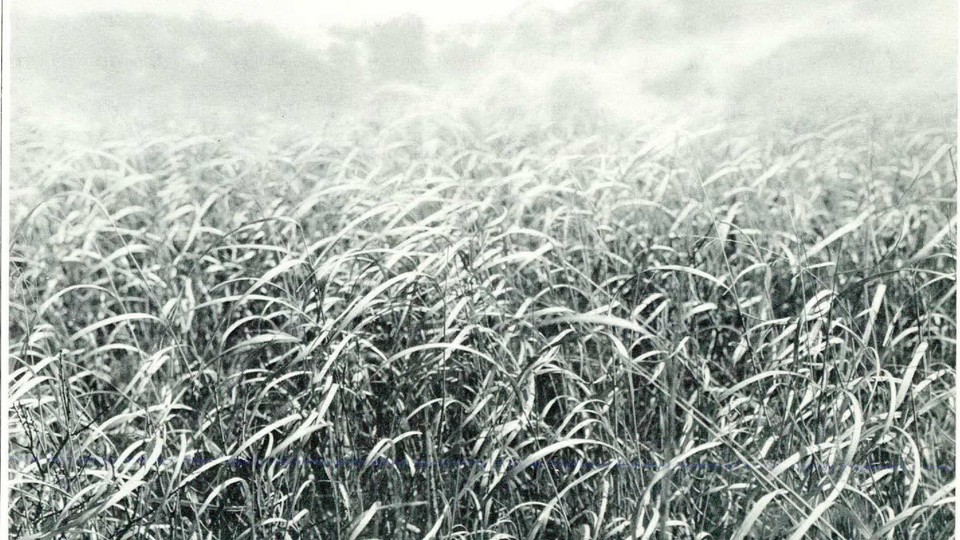
I lived there once and I have seen, from behind the barn, the long roadside pastures heaped with silence. Behind the rooster, suddenly, I saw the silence heaped on the fields like trays. That day the green hayfields supported silence evenly sown; the fields bent just so under the even pressure of silence, bearing it. even, palming it aloft: cleared fields, part of a land, a planet, that did not buckle beneath the heel of silence, nor split up scattered to bits, but instead lay secret, disguised as time and matter as though that were nothing, ordinary—disguised as fields like those which bear the silence only because they are spread, and the silence spreads over them, great in size.
I do not want, I think, ever to see such a sight again. That there is loneliness here I had granted, in the abstract—but not, I thought, inside the light of God’s presence, inside his sanction, and signed by his name.
I lived alone in the farmhouse and rented; the owners, Angus and Lynn, in their twenties, lived in another building just over the yard. I had been reading and restless for two or three days. It was morning. I had just read at breakfast an Updike story, “Packed Dirt, Churchgoing, A Dying Cat, A Traded Car,” which moved me. I heard our own farmyard rooster and two or three roosters across the street screeching. I quit the house, hoping at heart to see Lynn or Angus, but immediately to watch our rooster as he crowed.
It was Saturday morning late in the summer, in early September, clear-aired and still. I climbed the barnyard fence between the poultry and the pastures; I watched the red rooster, and the rooster, reptilian, kept one alert and alien eye on me. He pulled his extravagant neck to its maximum length, hauled himself high on his legs, stretched his beak as if he were gagging, screamed, and blinked. It was a ruckus. The din came from everywhere, and only the most rigorous application of reason could persuade me that it proceeded in its entirety from this lone and maniac bird.
After a pause, the roosters across the street would start, answering the proclamation, or cranking out another round, arrhythmically, interrupting. In the same way there is no pattern nor sense to the massed stridulations of cicadas; their skipped beats, enjambments, and failed alterations jangle your spirits, as though each of those thousand insects, each with identical feelings, were stubbornly deaf to the others, and loudly alone.
I shifted along the fence to see if Lynn or Angus was coming or going. To the rooster I said nothing, but only stared. And he stared at me; we were both careful to keep the wooden fence slat from our line of sight, so that his profiled eye and my two eyes could meet. From time to time I looked beyond the pastures to learn if anyone might be seen on the road.
When I was turned away in this manner, the silence gathered and struck me. It bashed me broadside from nowhere, as if I’d been hit by a plank. It dropped from the heavens above me like yard goods; ten acres of fallen, invisible sky choked the fields. The pastures on either side of the road turned green in a surrealistic fashion, monstrous, impeccable, as if they were holding their breath. The roosters stopped. All the things of the world—the fields and the fencing, the road, a parked orange truck—were stricken and sell-conscious. A world pressed down on their surfaces, a world battered just within their surfaces, and that real world, so near to emerging, had got stuck.
There was only silence. It was the silence of matter caught in the act and embarrassed. There were no cells moving, and yet there were cells, I could see the shape of the land, how it lay holding silence. Its poise and its stillness were unendurable, like the ring of the silence you hear in your skull when you’re little and notice you’re living, the ring which resumes later in life when you’re sick.
There were flies buzzing over the dirt by the henhouse, moving in circles and buzzing, black dreams in chips off the one long dream, the dream of the regular world. But the silent fields were the real world, eternity’s outpost in time, whose look I remembered but never like this, this God-blasted, paralyzed day. I felt myself tall and vertical, in a blue shirt, selfconscious, and wishing to die. I heard the flies again; I looked at the rooster who was frozen looking at me.
Then at last I heard whistling, human whistling far on the air, and I was not able to bear it. I looked around, heartbroken; only at the big yellow Charolais farm far up the road was there motion—a woman, I think, dressed in pink, and pushing a wheelbarrow easily over the grass. It must have been she who was whistling and heaping on top of the silence those hollow notes of song. But the slow sound of the music—the beautiful sound of the music ringing the air like a stone bell—was isolate and detached. The notes spread into the general air and became the weightier part of silence, silence’s last straw. The distant woman and her wheelbarrow were flat and detached, like mechanized and pink-painted properties for a stage. I stood in pieces, afraid I was unable to move. Something had unhinged the world. The houses and roadsides and pastures were buckling under the silence. Then a Labrador, black, loped up the distant driveway, fluid and cartoonlike, toward the pink woman. I had to try to turn away. Holiness is a force, and like the others can be resisted. It was given, but I didn’t want to see it, God or no God. It was as if God had said, “I am here, but not as you have known me. This is the look of silence, and of loneliness unendurable: it too has always been mine, and now will be yours.” I was not ready for a life of sorrow, sorrow deriving from knowledge I could just as well stop at the gate.
Several months later, walking past the farm on the way to a volleyball game, I remarked to a friend, by way of information, “There are angels in those fields.” Angels! That silence so grave and so stricken, that choked and unbearable green! I have rarely been so surprised at something I’ve said. Angels! What arc angels? I had never thought of angels, in any way at all.
From that time I began to think of angels. I considered that sights such as I had seen of the silence must have been shared by the people who said they saw angels. I began to review the thing I had seen that morning. My impression now of those fields is of thousands of spirits—spirits trapped, perhaps, by my refusal to call them more fully, or by the paralysis of my own spirit at that time—thousands of spirits, angels in fact, almost discernible to the eye, and whirling. If pressed I would say they were three or four feet from the ground. Only their motion was clear (clockwise, if you insist); that, and their beauty unspeakable.
There are angels in those fields, and, I presume, in all fields, and everywhere else. I would go to the lions for this conviction, to witness this fact. What all this means about perception, or language, or angels, or my own sanity, I have no idea. □