Tinkering With Sunshine: The Prospects for Solar Energy
Oil grows scarcer and more expensive . . . nuclear power becomes increasingly controversial. But consider the sun. The world basks in an inexhaustible source of power, although the technology for using it hardly exists. At the moment solar energy is a field for visionary inventors and entrepreneurs hoping to build the Model T that will give birth to a new industry.
In October 1976, on the eve of the natural gas shortages, a twenty-nine-year-old physicist named Amory Lovins published in Foreign Affairs a treatise called “Energy Strategy: The Road Not Taken?” Since then, the Lovins article has become something of a focal point for the debate over national energy plans.
Wc can travel into the future on one of two paths, Lovins writes. The one generally favored by U.S. policy has the nation increasing energy production in all possible ways, but mainly through exploitation of fossil fuels and old-fashioned nuclear fission. Later, in “the era beyond oil and gas,” come large-scale, “arcane” energy systems: breeder reactors, nuclear fusion devices yet to be fully imagined, huge space stations gathering electricity from the sun and beaming the juice to earth in the form of microwaves. Lovins calls this “the hard path.” In Lovins’s view, it is a road with dire social consequences: energy wars, repression at home, environmental degradation, and several kinds of catastrophes associated with uranium.
We can follow the other path, “the soft path,” Lovins continues, by engaging in a new and “elegant frugality.” The country maintains its standard of living, but Detroit and Con Edison and the average homeowner learn to conserve truly vast amounts of fossil fuels. In this way, time is bought. We use it to turn, not to new nuclear reactors, but to “benign,” renewable sources of power and heat, and we end up, in about fifty years, living off our “energy income”: chiefly sunshine and solar products like the winds. The technologies employed then arc diverse, easy to understand. safe, relatively clean, and invulnerable to nation-crippling accidents and sabotage because, for the most part, they are deployed at the community level. As a consequence, democracy grows stronger. Our energy suppliers are no longer “alien and remote.” Local autonomy prevails. Nuclear reactors are now antiques and at last there is a chance for peace among nations. Lovins argues that we must choose one path soon, because the country lacks the material and spiritual resources to follow both.
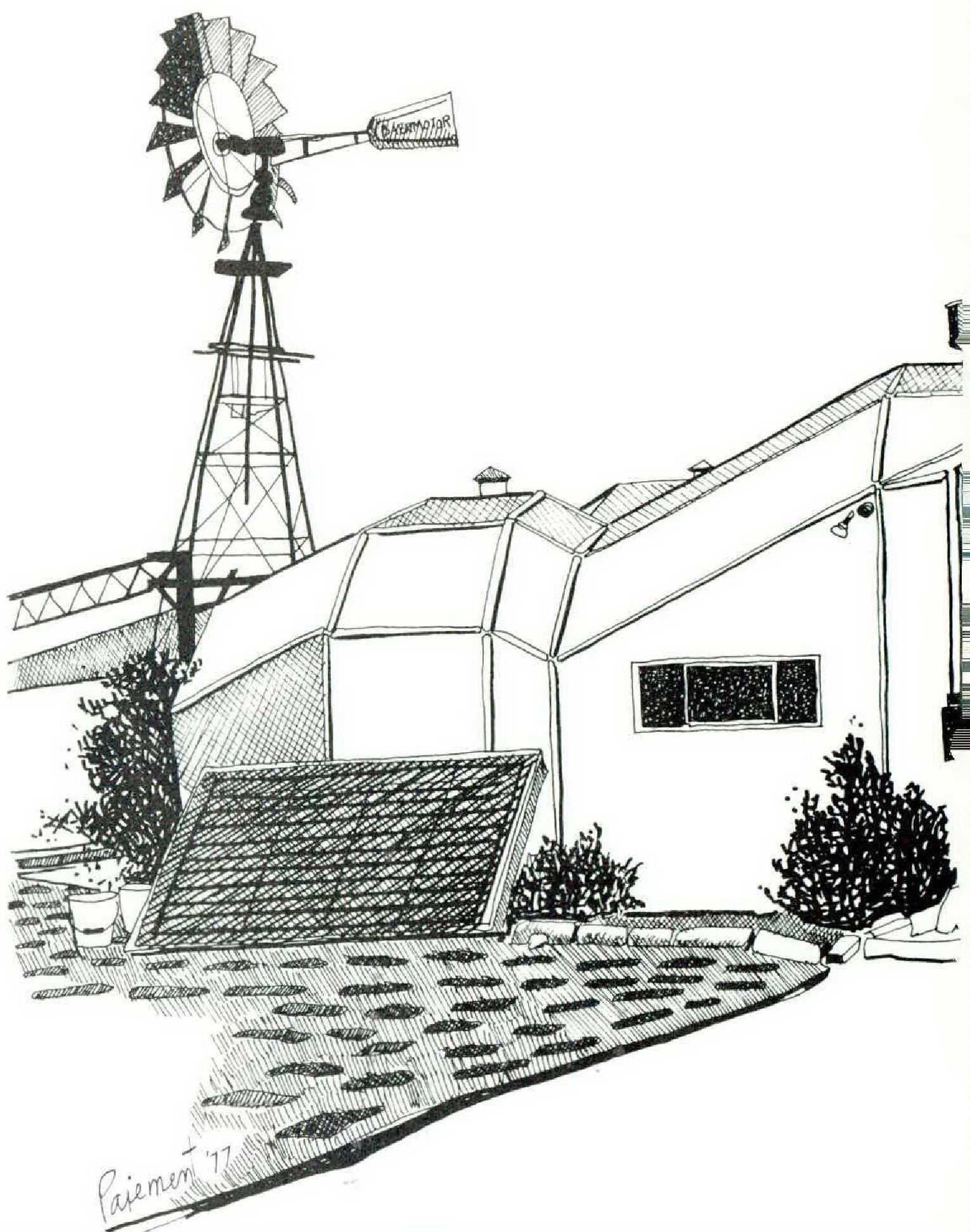
Lovins’s scheme for a “soft” energy future rests largely on an optimistic view of solar technologies. It’s a faith that many share. Surely sunshine is the most enticing of energy sources. It can be “mined” in ways that appear to be harmless, and there’s more than enough to go around. Contemplation of the sun’s power leads even respectable scientists to grandiose hypotheses; one physicist has calculated that if we could convert to mechanical power all of the solar radiation that strikes the United States in just a day, we could lift the entire Republic—and the 1000meter-thick crust it sits on—about three and a half feet into the air. For those who feel that mankind must find a way around plutonium, who wince at news of each new oil spill, the sun is today’s messiah. I pick up small-town newspapers and college alumni bulletins and again and again I read of people who have discovered the guiltless joys of using solar energy in the home. It’s the self-reliant way. It’s the way to harmonize with Mother Earth, while keeping the Arabs out of Fort Knox. But how much energy can we get from the “soft” solar technologies, from such things as windmills, solar ponds, solar space and hot-water heating systems, from rooftop arrays of those marvelous photocells that make electricity from sunshine? And how soon can we get it? What is the real market potential of these technologies?
The Office of Technology Assessment and the Stanford Research Institute, the Energy Research and Development Administration (ERDA), Mitre Corporation, Westinghouse, GE, Thompson Ramo Wooldridge, Inc. (TRW), and the National Science Foundation are some of the organizations that have looked into the future of solar energy. The House and the Senate have held hearings; the collected volumes of testimony on this subject generated by just one Senate committee have a total weight of about twenty-five pounds. A forty-one-year-old solar architect named Gordon Tully holds that solar technologies will have come of age when the thermal energy produced by all the solar collecting devices in the United States is equivalent to the thermal energy that would be produced by burning all the solar studies. Out of this forest of paper come many conflicting predictions.
It isn’t surprising to lind that there is no consensus on what can be done with the sun, because there has been little hard research to go with the studies. In 1952, the Paley Commission prepared a report for President Truman called “Resources for Freedom.” It was a prescient document. It warned of future oil shortages and of a growing dependence on the Middle East, and it recommended “aggressive research” into both the “peaceful atom” and solar technologies. But successive administrations and Congresses took only half that advice. From 1953 to 1973 the U.S. government spent some $5 billion on research and development in nuclear energy, but less than a million on solar technologies.
Government spending on solar research did not begin until 1974, after the Arab oil embargo and in the midst of growing protests against nuclear power. Since then, government financing has come on strong, thanks to a generally enthusiastic Congress and, more recently, to the Carter Administration. In fiscal year 1978 the government will spend a record $368 million on solar research, development, and demonstration, and the subsidy will be still larger if, as now seems certain, Congress goes along with the President’s plan to allow tax credits for people investing in solar-heating equipment. Meanwhile, however, about $3 billion will go to R&D in nuclear technologies, and the lion’s share of that will be spent on the breeder reactor and on fusion, which face futures at least as uncertain as those of most solar technologies.
The usual explanation for this apparent double standard is that solar technologies simply don’t need as much money as nuclear ones. Energy bureaucrats also say that the infant solar industry isn’t large enough to absorb more money than it’s getting. But many disagree. Henry Kelly, a thirty-two-year-old staffer in Congress’s Office of Technology Assessment, has helped to draw up a study of possible approaches to solar energy. The list is huge. Kelly concludes, “Anybody who says more money can’t be spent on solar technologies is just wrong.”
In general, the strongest barriers to larger, useful investments in solar energy appear to lie within the government itself. Soon to be assimilated into the new Department of Energy, ERDA has been a true child of the old Atomic Energy Commission, which it replaced several years ago. The prevalent attitude within ERDA has been that nuclear power is the only possible answer to the country’s future energy needs. Meanwhile, solar technologies have been looked on as small contributors at best, and at worst, as countercultural toys. More than 2000 of ERDA’s employees are involved in nuclear programs, and a mere 100 work in the solar division. ERDA’s hierarchy and the Office of Management and Budget, which control staffing, have kept the solar crew small, and this has made it difficult for the division to spend its money wisely. People in the solar division talk about working twenty-hour days. They admit that they aren’t able to monitor properly even their existing programs.
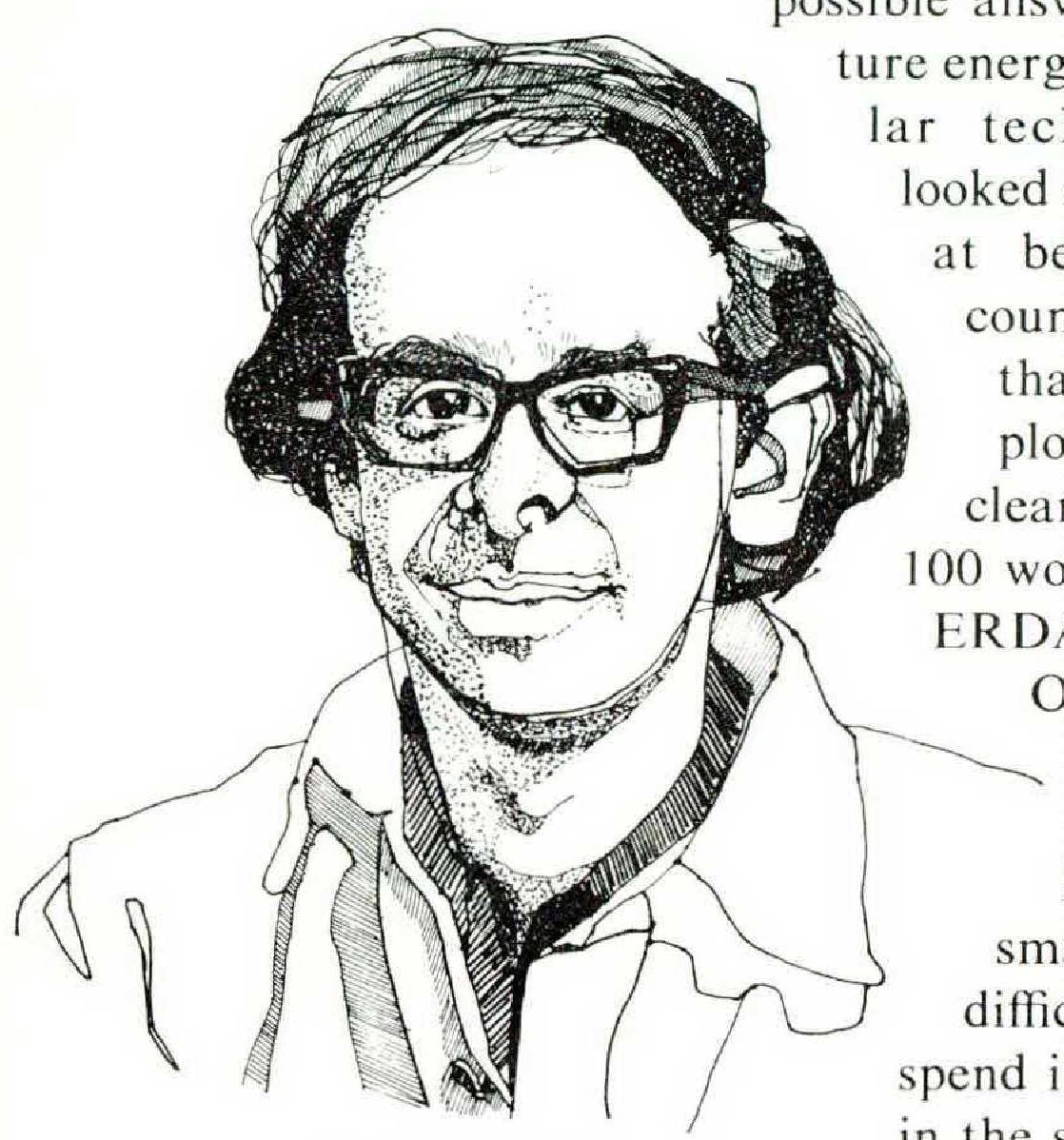
Space and hot-water heating are the most readily practicable of all the solar technologies. Government projects, along with the Arabs and the brutal winter of 1977, have created a boom in the craft. In the early 1970s there were only about 100 solar-heated houses in America. Now there are several thousand and many more on the way, and it is certain that there are even more people working on solar heating than there are solar-heated houses. Professors at more than a dozen universities and something like 550 companies (some large and many small) have entered the competition. It seems the public has been aroused; the governmentsponsored Solar Heating and Cooling Information Center has been receiving about 3000 phone calls a week from interested citizens.
About a quarter of all the energy used in America goes to heating buildings. So solar heating could be significant. But how significant? Is Lovins right when he says that this technology is “now available and economical"? With those questions in mind, I went out in the spring and summer of 1977, into a few regions of solar-heating land, to see what part of the future was there.
Two views from Olympus
An important moment in the history of modern solar-heating technology occurred in 1939, when a team of MIT engineers, led by a young assistant professor named Hoyt Hottel, built a small house outside of Boston and fitted it out with a rooftop “flat-plate” collector. Copper pipes were mounted on a copper surface and the whole thing was covered with three layers of glass. Water was pumped through the pipes on the roof, heated there by the sun, then sent to the basement into a large steel storage tank. The heat was transferred to air and finally circulated through the house by a blower system, as the need arose. This was the prototype for most of the “active” systems on the market and in houses today— systems, that is, in which air or water, moved by mechanical means, carries the heat around. (In a “passive" system, parts of the house itself collect the heat, which is distributed with little or no help from machines.)
The first MIT house was nothing more than a laboratory: Hottel used it to establish the basic engineering principles behind solar collector performance and was so meticulous that his calculations served to correct the Weather Bureau. That first house worked; Hottel was able to Use summer sun to heat the building in the winter. But the storage system was huge, “an economic monstrosity,” according to Hottel. So his team built another house, this time using a south-facing wall of water, a more or less passive system. But they weren’t able to insulate the window well enough after dark to keep heat loss at a satisfactory level. So they went back to active systems and built two more houses, and in 1962, after twenty years of experiments, Hottel and his team “shelved" space heating. “We had gotten the data to know it was uneconomical at the time.”
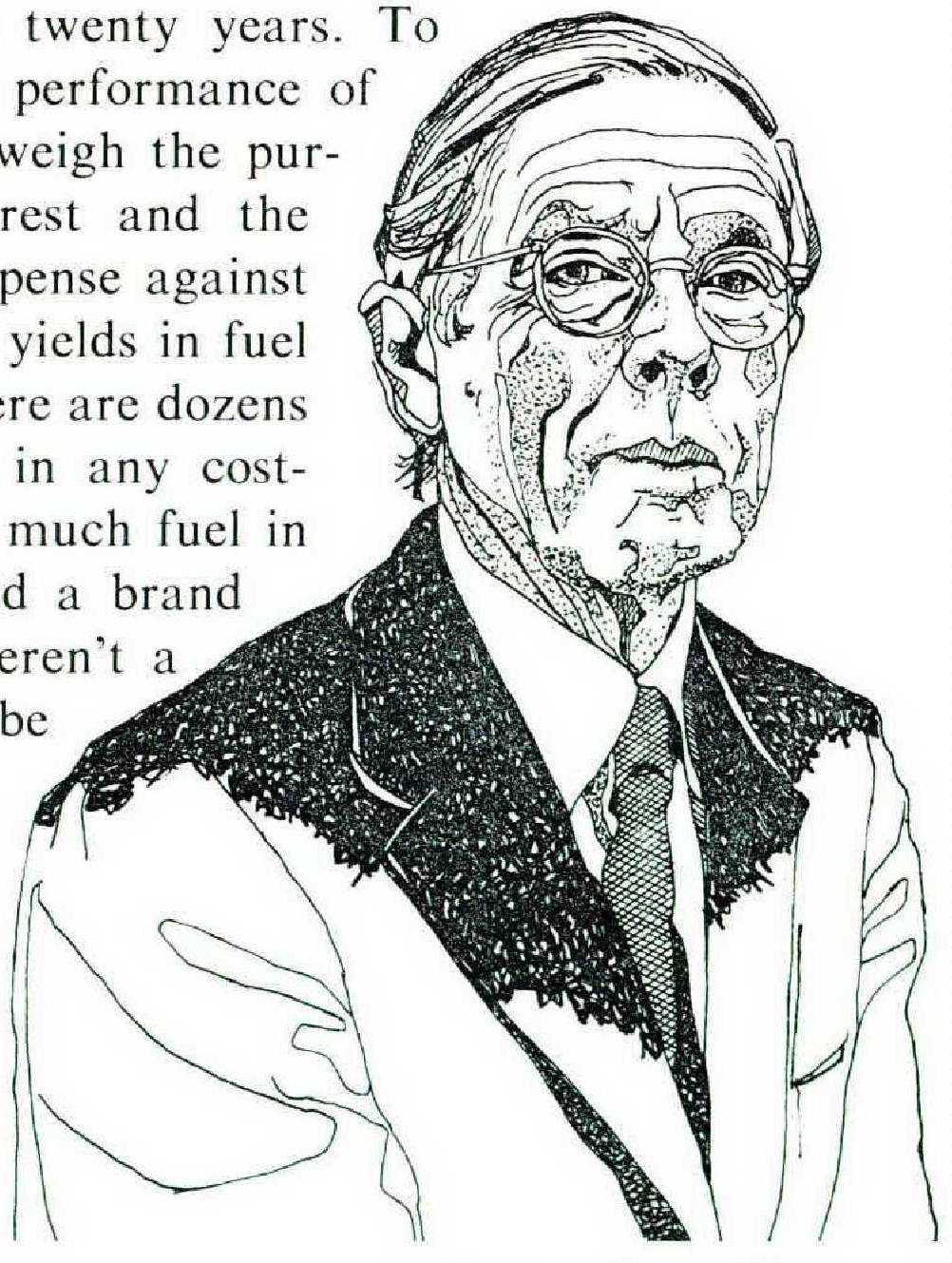
It is May 1977, somewhere near the end of the era of cheap oil and gas, and Hoyt Hottel—MIT professor emeritus, seventy-four and white-haired—sits in his office before a large plate-glass window, looking out on a corner of MIT’s labyrinthine campus. He is justifiably proud of his work, but grows dour when he turns to the object of ail those meticulous experiments. He says that over the years he has watched the costs of solar space heating continually hover above the rising costs of conventional heating, and although he allows that the solar approach may now be almost competitive with expensive, inefficient, electrical-resistance heating, he believes it is still much more costly than heating with oil or gas.
A consultant from Arthur D. Little would tell me later, “Hottel hasn’t heard of the oil embargo.” A prominent inventor of passive systems would say, “Hottel’s a man who bought a ticket on a horse and threw it away before the race was over. Now he can’t bear to think that his horse might come in.” Hottel, for his part, has said that solar-heating enthusiasts base their case on emotion, not on natural law. He describes their reasoning as follows: “Solar energy has to be a good thing. . . . Out of the window with embarrassing negatives; I’ve made up my mind.” Hottel doesn’t say that solar heating won’t become important sometime in the future, but he says that a future which includes it isn’t one to anticipate with relish. “I think you have to say that when solar energy does become important, that will be a measure of the fact that we are not living as affluently as we do today,” he told me. “Because by present standards, it is by no means the cheapest way to get energy.”
There is no disputing Hottel’s central point. No source of energy, whether it’s solar or nuclear or geothermal, will be as cheap and easy to grasp as the stuff we’ve been using these past 100 years. But it’s because of this fact that solar heating now looks more practical than ever before. To some, in fact, this is the beginning of its exciting, even its romantic, age.
On the other side of Cambridge from MIT, near the now-defunct Harvard cyclotron, there is a little office crammed with books and articles on solar heating. In the filing cabinets lie hundreds of letters from well-known and anonymous solar inventors. Everything is in order. The size of the office and the complexity of the subject make order mandatory. William Shurcliff, a sixty-eight-year-old honorary Harvard research fellow, studies other people’s inventions in here. He is the preeminent cataloguer of solar space-heating brainstorms, the author of Solar Heated Homes: A Brief Survey, which he has taken through thirteen editions in the last five and a half years. Shurcliff knows what is out there, if anyone does. Visiting him one day, I remarked that a friend who was building a solar-heated house had hit upon the idea of improving his collector’s performance by dyeing the water inside it black. A novel idea, I had thought. Shurcliff said, “Hmmm. Black water.” From the shelf over his desk he pulled down a thick looseleaf notebook, looked up “Black Water” in the index—“I think books without indexes should be banned, don’t you?”—and proceeded to read off a list of about five companies and “lone wolf" inventors who’d tried it. And then there were several people with hot-air systems who had tried black dust. “So you see there’s been quite a lot on that.”
Shurcliff is tall and thin and he speaks in the accent one often hears on the seacoast north of Boston. He describes himself as “a tired old optics man.” “The electromagnetic spectrum is one of the grandest things in the universe,” he told me. “I’ve spent most of my life working in parts of it, so it was very easy for me to get into this field, and I did it eagerly.” For about thirteen years he worked in optics and radiation at Polaroid. Then he came to Harvard and ran radiation security for the atom-smasher, and when his duties ended there some five and a half years ago, he took up solar heating, thinking at first that he would spend his time inventing. He still keeps his hand in, but he found that in general other people’s ideas were more interesting than his own, and so he became a cataloguer, the first and, until recently, the only cataloguer of space-heating ideas.
At least once before, Shurcliff has devoted himself to a cause. He is generally credited with a large role in the successful campaign against the SST; mainly, he wrote courtly, threatening letters. These days he could be described as a solar advocate. “This world damn well needs solar heating,” he says.
Shurcliff does believe that the solar-heating art can be practical, but he is aware of the problems. “Hurdles,” Shurcliff calls them, disdaining the ordinary word. First among them stand the questions of cost, durability, and performance. In an industry so new, durability is hard to predict, but it is assumed that a good system will last twenty years. To measure the cost and performance of the system, one must weigh the purchase price with interest and the yearly maintenance expense against the savings the system yields in fuel or electric bills. But there are dozens of unknown variables in any costhenefit equation. How much fuel in any given winter would a brand new house use if it weren’t a solar house? What will be the rate of inflation, where will interest rates stand, what will maintenance cost, and, the crucial question, what will be the prices for gas, oil, and electricity? Will there be enough of those commodities to go around, come January 1985? Several studies have attempted to deal with the economic question and several have concluded that solar heating is practical today. But those conclusions are based on a plethora of averages, and there really is no such thing as an average solar-heating system, an average house, or, in many places, an average winter. Shurcliff seems more reliable. He has studied particular systems. He thinks that at least 80, and maybe 97 percent of them aren’t a bargain, not as they are measured beside today’s gas and oil prices.
Hard enough, then, to make a solar-heating system pay when it’s installed on a new house designed with the sun in mind. “How much more difficult it is,” exclaims Shurcliff, “to ‘retrofit’ solar heating to an existing, badly insulated, imperfectly oriented house in a region crowded with tall trees or tall neighboring buildings!” Perhaps householders will be persuaded to undertake retrofits as home improvements or as security against some dark, cold, fuel-less winter. Maybe, as Shurcliff suggests, some will decide that it’s fun, “like owning a yacht.” But economics will weigh heavy, and retrofit will always be an expensive proposition, like any remodeling job.
Although sunshine is free, the nation would have to pay a price for widespread solar heating. Putting the systems in place would require large amounts of labor and natural resources such as copper. A great deal ol energy would be expended; it takes about five years for a well-designed system to gather as much useful energy as it took to build it. A host of small problems must be dealt with, too. For example, experts agree that the most economical systems provide only part— somewhere between 30 and 60 percent—of the heating needs for an average house. So a back-up system is required, and an electrical one is usually the cheapest to install. But thousands of solar houses in a given area, using electricity only on cold, cloudy days, would force the local utility to invest in equipment that would be used just a few times a year. The result would be special high electric rates for solar-heated homes. A possible solution, now being investigated, is to have solar-home owners turn on the power only during the utility’s off-peak hours, and use this electricity to heat up their storage systems.
Shurcliff seems a careful man. He approaches the future cautiously, by asking questions. But five and a half years of studying the designs that now fill his books and filing cabinets seem to have left him in a state of controlled excitement. “We deal, indeed, with a ferment,” he writes. In his little office, it is 1905 and a new industry is stirring. There are hundreds, maybe thousands, of people banging metal in their back yards, trying to build automobiles. Just which of these curious contraptions is the ill-fated Hupmobile and which the Model T is hard to say. But Shurcliff has seen a great many small ideas, and also some complete systems—maybe 3 or 4 percent of the total—that show definite promise. They look cheap and they work, though some seem “crude" today. No single one seems perfect for all climates, but that is no real problem.
“I’m willing to go out on a limb,” Shurcliff told me. “I think that there will be dozens of winning schemes.”
Rhombic dodecahedra and other works of genius
In Corrales, New Mexico, near Albuquerque, there stands an amazing private residence, not a house in any ordinary sense, but a series of metal structures connected to each other, silvery and strange, standing in rugged, treeless terrain. Steve Baer, who created this place, who built it and lives in it, describes the structure as “ten exploded rhombic dodecahedra stretched and fused to form the differentsized rooms.” He also describes his home as “a cluster of zomes.”
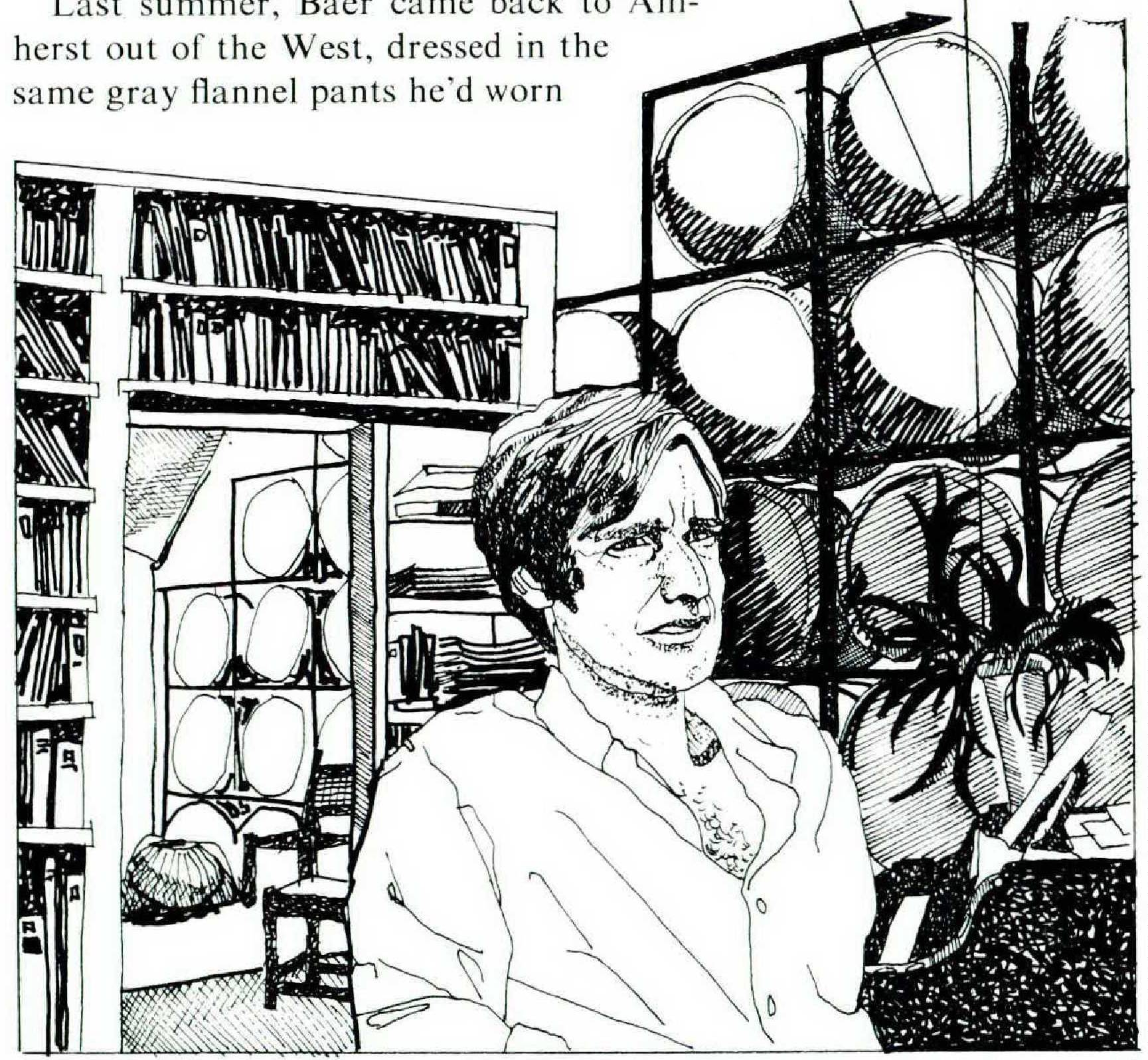
A closer look reveals that arrays of used, fifty-fivegallon oil drums, filled with water and laid horizontally behind single sheets of glass, make up the southern walls. These are the prototypes of the now famous (in solar heating circles) “drum wall.” The walls are equipped with large insulating panels which Baer raises and lowers like drawbridges with a simple rope and pulley device. He drops the panels on winter days to let the sun heat the water drums, and raises them at night to keep the heat in. The walls were cheap to build—about $5 a square foot, which is roughly half the cost of conventional rooftop collectors. They do about 75 percent of the heating in the zomes, allowing, that is, for indoor temperatures that vary from about 55 to about 80 degrees. Baer, who has always been interested in weather, thinks it’s fun to live in a house that reflects what’s going on outside. Some people do not like the temperature fluctuations or the walls, of course. “He’ll sell his stuff by word of mouth,” one conventionally minded solar engineer told me. “Word of mouth is the only way to persuade people to put fifty-five-gallon drums in their living rooms.” But Baer and his company, Zomeworks, have already been employed on some 200 solar-heating projects, and orders for Zomeworks devices come from all over the country these days.
Out of Zomeworks comes the Beadwall—plastic beads are blown into the space within a double-glazed window on cold winter nights and sucked out with a small vacuum-cleaner motor when the sun rises. Baer and his colleagues invented the Skylid, an insulated shutter especially good for skylights: the shutter opens and closes by itself, at the direction of two small thermostats. Baer has been a pioneer in Convective Air Loop Rock Storage (a way of using natural convection rather than the usual mechanical blower to move heated air in and out of a storage system made up of stones), and he thought up something he calls the Double Bubble Wheel Driving Engine. Run by the effect of heat on bubbles in water, it can be solarpowered. There is no end to his inventions. He says he wants to be like Charlie Parker and never play the same tune twice.
Born and raised in California, Baer went to Amherst College and left before graduation. After a stint in the Army, he studied math and physics in Zurich, then came back to the United States. It was the 1960s. Baer wandered around a while, stopping in at some of the communes then flourishing. There he began his
experiments with solor heating. Last summer, Baer came back to Amherst out of the West, dressed in the same gray flannel pants he’d worn the first time he came to college, twenty years before. He is thirty-eight, slim, has sandy hair conventionally cut, piercing blue eyes, and was tanned when I met him. Someone told him that he looked like a representative from NASA, he was so clean-cut. I overheard someone else say that he looked like Gary Cooper.
The occasion for Baer’s return was the University of Massachusetts’s “Toward Tomorrow Fair,” a grand celebration for a dubious future, featuring music from Pete Seeger and speeches from Barry Commoner, Buckminster Fuller, Julian Bond, and Ralph Nader. Out on the fairgrounds, there were hundreds of displays. There were fine-looking wood stoves and pretty windmills, a wind-driven car, many kinds of waterless toilets, chain-saw sculpture, a teepee inside which foot massages were being administered, and lots of booths which bore such names as “Planetary Citizens” and “New England Institute of Appropriate Technology.”Some very satisfactory-looking flatplate collectors were on display as well.
Up from the fairgrounds, outside a U.Mass lecture hall, a huge sign, painted in a shaky hand by a rather hysterical woman, a solar energy buff whom I met later on, said, “WELCOME STEVE BAER!” The line for his lecture was several hundred yards long and many didn’t get in. They missed something.
The first half of Baer’s speech was a stew compounded of ideas familiar to disciples of Abbie Hoffman and to students of the nineteenth-century laissez-faire economists. It was a eulogy for the hippies and the communes of the sixties. It was a lament for something he called “the free economy.” It was an angry diatribe against government involvement in solar heating. At one point Baer began to chastise Exxon for the ads it has been running in magazines and newspapers, cautionary ads about solar energy. The audience showed it was with him. But then Baer seemed to draw back and eye the crowd. Suddenly he was saying that the oil company executives were “just people.” “If we were in their place we’d do the same thing they’re doing.” And a little later on: “Alternate energy! That’s a bunch of junk. It doesn’t have anything to do with good design.” And to what was now a mainly silent house, though I heard some nervous-sounding laughter around me, Baer announced, laughing heartily himself: “I didn’t believe in the alternate-energy future until I saw how dull it was gonna be and how stupid the slogans were gonna be and how much I wasn’t gonna like it. Then I knew it would come.”
Afterward, over drinks at the Student Union, I got Baer onto the subject of Hoyt Hottel. Baer said that after he had built the drum wall, he had read about Hottel’s early experiment with the water-filled wall.
“He decided it didn’t work,” Baer said. “But that was because he didn’t do it the right way. And he didn’t keep on. If he’d been some crackpot, he might have.
“The crackpot is ready to explore new territory without government funding. There’s gotta be room for crackpots in any society.”
Who were some of the crackpots in solar heating? I asked.
“Well, like me,” he said.
Many large companies leaped into solar heating after the oil embargo, picked up government grants, and started out trying to apply very sophisticated, expensive engineering to the problem of heating homes. GE went so far as to assign solar operations to its space division. But a number of companies that began this way have since changed their approach and are now working on conventional designs.
The so-called “high-tech" approach generally involves trying to increase the efficiency of a system by getting the maximum amount of heat out of each square foot of collector. Some gadgets that usually accompany this approach are “selective surfaces” (collector coatings which absorb more sunlight and emit less thermal radiation than ordinary black paints) and “evacuated vacuum tube collectors" (in which tubular absorbers are insulated by vacuums maintained around them). Such high-efficiency devices invariably cost a great deal. The rationale for using them is that high efficiency leads to reduced collector size and thus to reduced materials costs. Maybe someday the approach will yield economical systems, but it hasn’t so far. Moreover, efficiency is a difficult concept to apply to solar heating. For instance, when it is cold outside, many efficient hightemperature collectors lose more heat than inefficient, low-temperature ones, in which case the low-efficiency collector is the more efficient.
One thing many promising solar-heating systems seem to have in common is that their inventors are not connected with big companies. For the most part, they are a gang of small entrepreneurs and lone wolves. They have worked with their own money; only a few have gotten support from ERDA. Perhaps that gave them a head start in the quest for economy.
Traveling around, talking to solar people on the phone, I kept hearing of wonderful systems, so many I could not examine all of them. But here is a sampler of possible Henry Fords and their solar-heating Model T’s:
• Steve Baer and his zomes. Although his audience may be limited today, he is by no means finished with inventing.
• Then there is the man who taught Baer some tricks: sixty-eight-year-old Harold Hay. Fifteen years ago, while working for the State Department as an adviser on building materials to the government of India, Hay hit upon an idea for both heating and cooling residences, a simple design that would employ “a minimum of modern Western technology.”Hay’s flat-roofed SkyTherm house has ponds beneath the roof, a virtual swimming pool contained in large plastic bags. Many little devices make the system work. Powered by a onequarter-horsepower electric motor, the insulated roof panels open on winter days to catch the sun and close on winter nights to keep the heat in. Warmth flows down from the water bags through the metal ceiling of the house. The first home he built in the United States has 1140 square feet of living space. In the winter of 1973-1974 the house was 100 percent solar-heated, and it can get through four cold, sunless January days. Admittedly, it stands in California between San Francisco and Los Angeles, where the winter isn’t harsh. On the other hand, the house is versatile. On summer days the roof stays closed and opens up at night. Thus heat from the house accumulates in the ponds all day and at night it passes out to the sky by convection and radiation. The result, according to the reports of tenants, is marvelous air-conditioning. The system is also cheap—$5000 for a 1000-square-foot house, and less if several are built simultaneously. Hay has also developed a Sky-Therm home for northern climes.
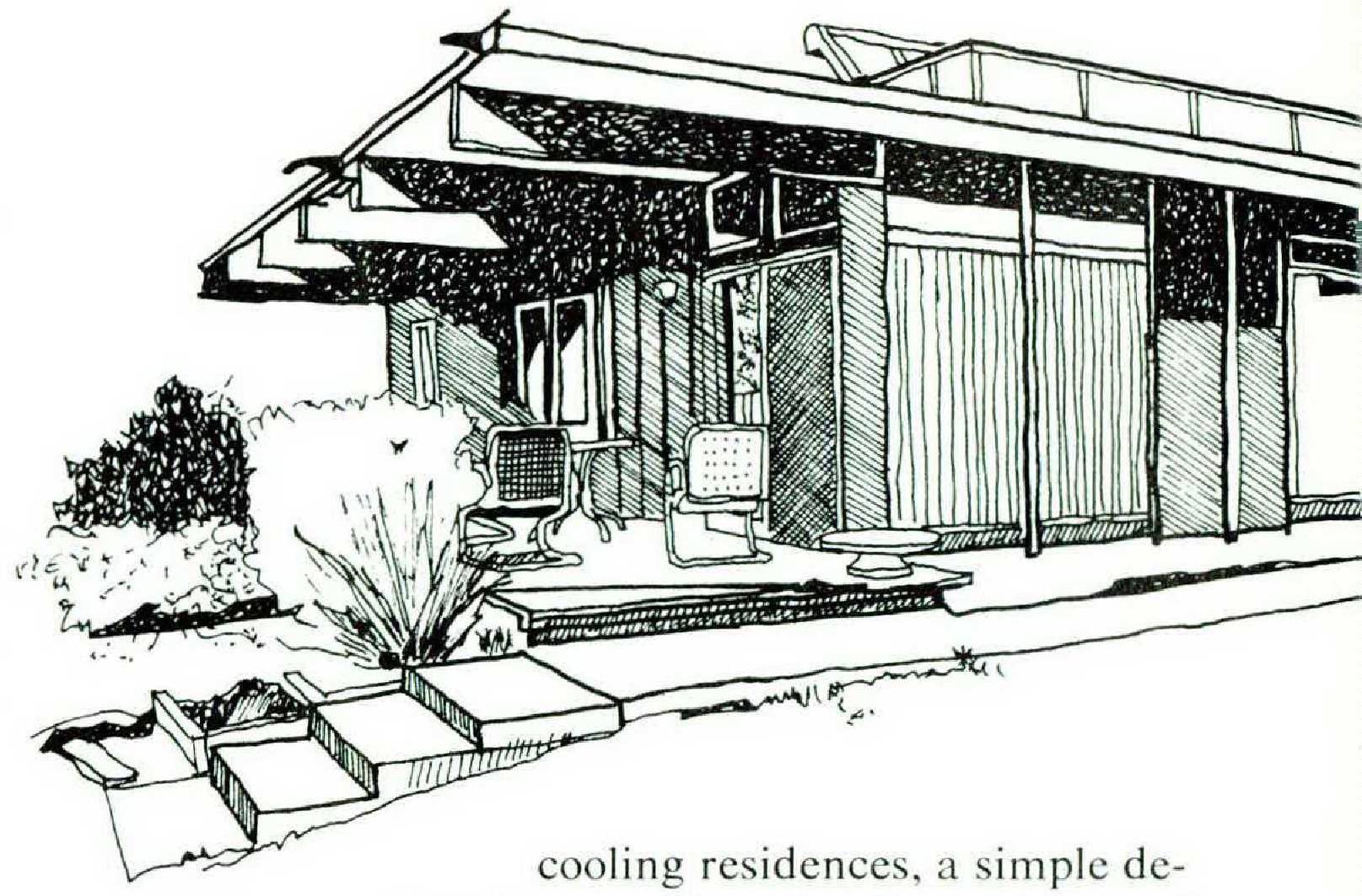
• Felix Trombe of France, another of the “solar pioneers,” has approached space heating with a wall— the Trombe Thermosiphoning Wall. A black-painted concrete wall faces south, behind two layers of glass. There are openings at the top and bottom of the wall. Cold air comes from the house through the bottom opening, is heated in front of the wall, rises as hot air will, then passes through the top opening and back into the house. The system appears to be cheap, like Hay’s, and in one house in France, it has delivered 60 to 70 percent of the necessary heat. The design suffers, though, from the ironic deficiency of too many solar houses. It doesn’t let much sunlight in: there’s a wall where one would like to have windows.
• Many of the hurdles solar heating has to surmount are related in one way or another to storage. Most inventors have opted for water as their heat-storing medium, but it takes a lot of water to get a house through several cloudy days. Water storage is expensive and it can fill up cherished basements. If there were something else that could do the job in a lot less space, the industry might be revolutionized. Maria Telkes, now in her seventies and working at the University of Delaware, has struggled for some thirty-five years with a thing called Glauber’s Salt. In many ways, it’s marvelous stuff, a nonflammable and nontoxic, cheap, and abundant crystal. (It is a by-product of several industrial processes). It also melts at a low temperature—120° F. When it melts, it stores an enormous amount of thermal energy, and when it changes from liquid back to solid form, it gives off eight times as much heat as an equivalent volume of water. Yet Glauber’s Salt has not been a wholly reliable substance. Telkes, who is quite defensive on the subject—“You have probably heard that it doesn’t work,”was the first thing she said on the phone—claims that she has cured the ailments. ERDA is spending over $100 thousand to see if she’s right. But the real question is whether, once you have improved Glauber’s Salt, you have saved any money.
• Back, for the time being anyway, to plain old water storage. Consider the prosaic achievement of thirty-nine-year-old Spencer Dickinson. He is a builder in Jamestown, Rhode Island, and a state representative. Dickinson’s solar houses are conventional, active types, and the one he has built in Jamestown isn’t much to look at. It is small and short on windows. Some people say that it looks like a chicken coop. But it also looks like a lot of tract houses all across the country, so one can’t say that its appearance disqualifies it from the market. What is interesting about this house? More or less by accident, it’s 100 percent solarheated. I say “by accident" because Dickinson outfitted the place with an expensive electrical heat pump, which turns out to be superfluous. Here, the secret is the storage, a shallow, concrete water tank beneath the floor, lined with plastic and covered by a huge concrete slab. The tank is as long and as wide as the little one-story house itself. Heated water from the rooftop collector flows down to the tank and warmth rises up into the house without any outside assistance.
The tank cost about $2000, and it might have cost a great deal more. In fact, it almost wasn’t possible to build it. because the huge slab that goes on top had to have structural supports and there was just no way to provide conventional ones. Then Dickinson thought of stones. He bought about $50 worth of stones and put them in the shallow tank. The stones support the slab.
Of course, there is no basement in the house, but the system could be cheap, since it requires only a collector and a store and the simplest of distribution apparatus. Dickinson says the whole system, now that he’s gotten the hang of it, should go for about $5000 or $6000.
• There are, of course, exceptions to the rule that nothing interesting is coming from big companies or from the government. A few years ago a management group at Raytheon decided to dabble in sunshine. They built an active water system controlled by a fancy microcomputer. It hasn’t functioned well and of course it is expensive. About this time a thirty-twoyear-old Raytheon engineer named Will Hapgood was designing a solar-heating system that would be at least as simple as an oil burner and, as Hapgood puts it, “idiot proof.”
Hapgood may be an anomaly among big company engineers. A rock musician now studying classical flute, he goes to work in sneakers, jeans, and a T-shirt. He does a great deal of w’ork for Raytheon’s Amana subsidiary in Iowa, but he does it near Boston. The last time he was at Amana headquarters he got expelled from the premises, on account of his long hair. Now the Amana people have come to Boston to see what Hapgood’s up to.
Hapgood designed his system for John Bemis, the president of Acorn Structures—a firm that makes high-quality prefabricated houses in the $40,000 to $100,000 range. There is nothing novel about the Bemis-Hapgood system: it’s a fairly ordinary, active water type. It isn’t cheap—$7200 to provide about 55 percent of the heating needs of a three-bedroom house in Massachusetts. Still, it is cheaper than many systems, and more reliable than most. It’s well put together and it actually works.
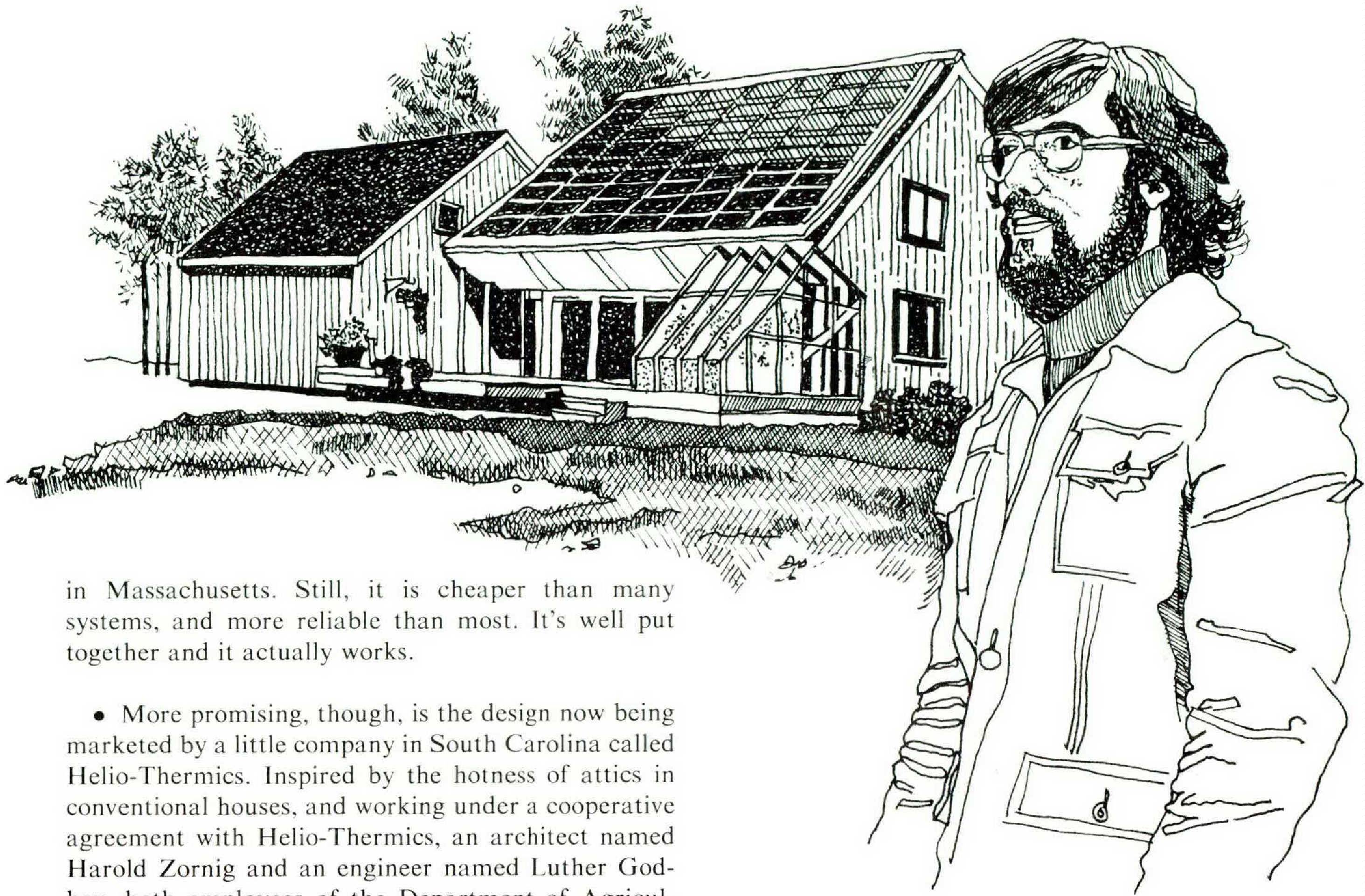
• More promising, though, is the design now being marketed by a little company in South Carolina called Helio-Thermics. Inspired by the hotness of attics in conventional houses, and working under a cooperative agreement with Helio-Thermics, an architect named Harold Zornig and an engineer named Luther Godbey, both employees of the Department of Agriculture’s Rural Housing Research Unit in South Carolina, designed this hot-air system. Mother Earth News has gushed over it. Indeed, it looks like one of the cheapest of all the heating systems available today. Sunshine gets into the Godbey-Zornig house through a double-glazed, translucent, fiber-glass roof, and strikes sheets of black-painted plywood located in the attic, heating up the air. Some heat moves into the living space by itself. There is also a one-half-horsepower blower, hidden in a closet and activated by a device which Helio-Thermics likes to call “a computer” and which Godbey describes as “just a plain old solid-state control device.” The blower drives air through the attic and down into the storage system, a bin containing forty tons of railroad ballast and located directly beneath the house’s main floor. The system has worked well, delivering about 75 percent of the first Helio-Thermics house’s necessary heat during an average 40° F winter in South Carolina. The “incremental” cost of this system in the little prototype house, which has 1000 square feet of floor space, was less than $3000. For a few hundred dollars more, the system can also provide 50 percent of the energy for a home’s hot-water heating. These figures, which come from the USDA, probably make this system economical today. The trick to cutting incremental cost, Luther Godbey told me, is designing the system right into the house, using the solar collector to replace the roof, placing the store right in the foundation. He and Zornig also strove to minimize the use of expensive components such as ductwork.
The system is a testimonial to the low-technology approach. Luther Godbey drawls, “I think the best thing you can say for solar energy right now is simplicity.” Interesting that the idea came from a rural branch of the USDA and was financed by a local builder, not from the public coffers. Interesting that nothing half so economical has come from the National Laboratories, which have received millions in ERDA solar-heating research grants.
• A list of solar-heating wizards and important plodders ought to include at least several dozen more names than the following: Shawn Buckley of MIT, whose “thermic diode” could solve a lot of problems for some active water systems; Malcom Wells in New Jersey, who may be the world’s best designer of solarheated houses located partially underground; George Lof of Solaron in Denver, one of the grand old men of the trade and a pioneer in active hot-air systems; David Wright, who has roamed the Southwest designing dozens of solar houses, including many strange and wonderful-looking passive ones. There is Norman Saunders of Weston, Massachusetts, who stands among the geniuses of the passive approach, eschewing moving parts. His latest design is the Saunders Solar Staircase, which consists of a translucent plastic roof under which hangs a tier of steps, shiny on the tops and transparent on the vertical faces, and precisely sloped and spaced so that summer sun can’t get through but winter sun can. There is also Bruce Anderson, more a synthesizer than a pure inventor. His new Goosebrook House in New Hampshire is quite expensive—it sold for $70,000 four days after it went on the market; the entire solar-heating system cost about $8000. But it’s a spacious home, designed to be a showplace. It weaves several strands together: a greenhouse (for heat as well as growing things), an active water roof collector system, and unobtrusive passive features, such as a set of doors which slide on tracks out of the garage to insulate the southern windows after nightfall. It is the nicest, airiest solar house I’ve seen.
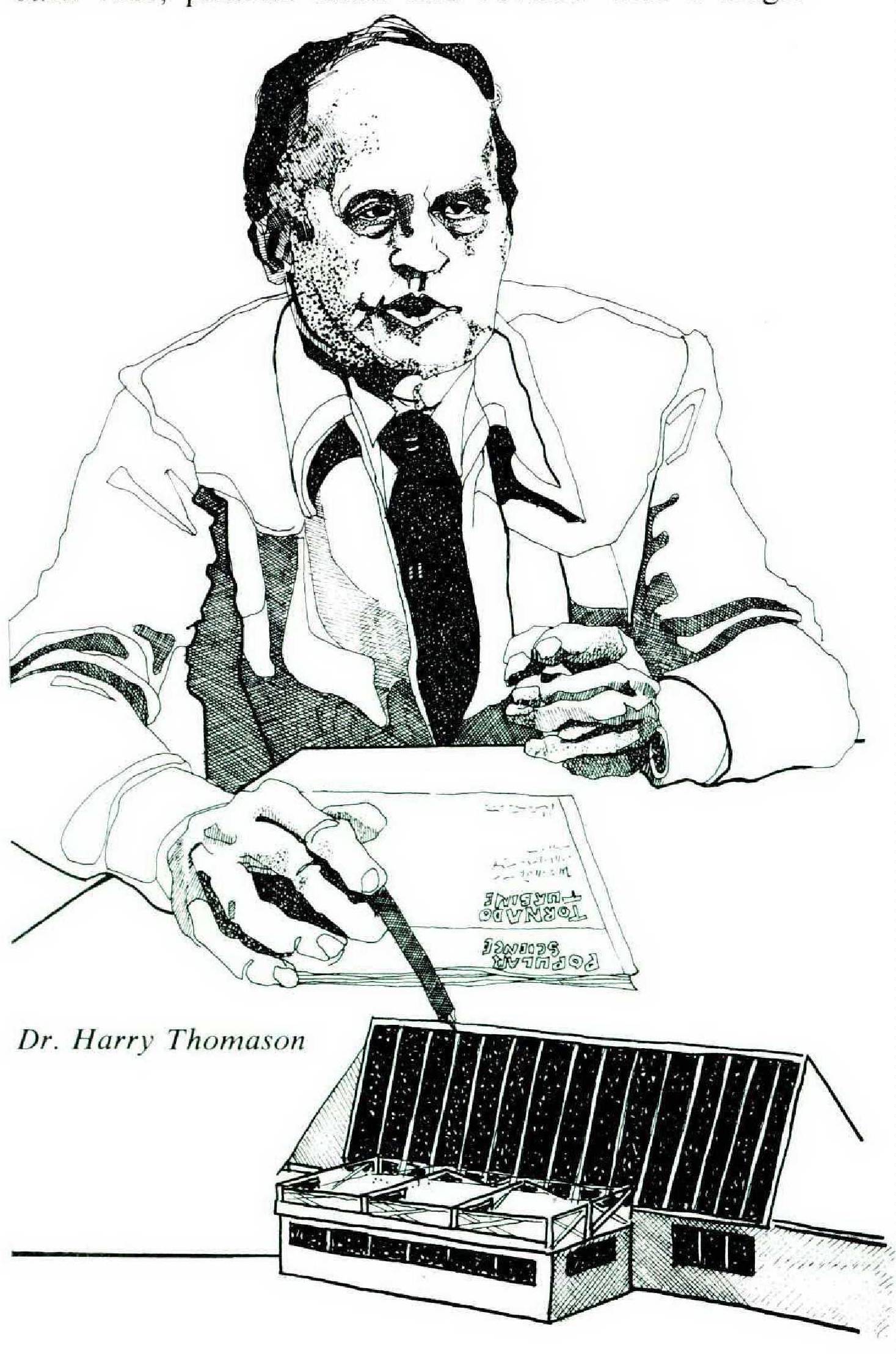
There is also Dr. Harry Thomason. (His doctorate is honorary, from Catawba University, where he got his undergraduate degree in physics and math; he says he learned his engineering in the Coast Guard.) No list can exclude Thomason. Quite literally, the man demands attention. Thomason’s career began serendipitously. “This is a true story,” he told me. “It was in the Reader’s Digest. The New York Times likened me to Sir Isaac Newton.” It was 1956, as Thomason remembers it, back in the middle of North Carolina farm country, a land of sudden summer thunderstorms. “The old barn still stands there,” he recalled. “It had a rusty roof— that made the difference.” A hot day, sun beating down on the barn roof, Thomason out near the barn. Suddenly huge clouds rolled in. “Down came the rain. I ran under the overhang on the barn roof and I thought to myself, ‘Gosh, that’s nice warm water.’ I looked up to see where it was comin’ from. Right off the old barn roof. Instantly—of course, it’s what we call a flash of genius—I realized what was goin’ on. ‘That’s a solar collector there.’ I just dashed under the overhang. Cold water had been fallin’ on my head. Now here came warm water on my head off the barn roof. That was the original inspiration.” Like Norman Mailer and Browning’s Caliban, Thomason often refers to himself in the third person. He writes in his newsletters: “Thomason SPEAKS OUT and writes about EXXON and government agencies who are discouraging solar heat.” Or, “DR. THOMASON WILL CONTINUE HIS ONE-MAN (ONE FAMILY) CRUSADE TO FORCE HUD, FEA, ERDA AND THE BIG OIL COMPANIES TO STOP MISLEADING THE AMERICAN PUBLIC. THEY LEAD YOU TO BELIEVE THAT SOLAR HEATING AND AIR-CONDITIONING APPARATUS, IS EXPENSIVE. THOMASON HAS THE PROOF; THOMASON’S ‘SOLARIS’ IS VERY LOW IN COST.”
“He’s his own worst enemy,” many say. Steve Baer is one of the few people in the business who doesn’t take strong exception to what is known as “Thomason’s style.” Baer feels he understands. Thomason has gotten a lot of good press lately, his disciples now include a number of private builders, and ERDA is spending $194,000 to test a Thomason home. But it wasn’t always so. He has had a long hard time getting people to take him seriously.
Skepticism about Thomason’s system persists, partly because of his style, but also because of the claims that he makes for his brainchild. He says that at a cost of about $3500 his “Solaris" design will provide 95 percent of the heat for a threeor four-bedroom home in a moderately warm climate. In what he calls “bitter cold Massachusetts” or “bitter cold Minnesota,” he says he can get you 75 percent for $4500. This is about half the cost of most good active systems, and the performance he boasts of is 20 or 30 percent better than most.
His collector is essentially a corrugated aluminum barn roof, painted black and covered with a single layer of glass, which is about as simple and cheap as an active solar collector can get. Water flows in a thin stream out of holes in a pipe that runs along the top of the collector. The water travels down the corrugated valleys into a gutter, then down to the basement into a 1600or 2000-gallon water tank surrounded by stones. The water heats the stones, a blower takes the heat from them and sends it into the house. The U.S. Department of Agriculture and Professor J. Taylor Beard of the University of Virginia have tested the Thomason collector. “The results of those tests shocked the nation,” Thomason told me. In fact, what they showed was that Thomason’s collectors are quite efficient, when they’re operated at low temperatures. And that is how they operate; that’s the trick, according to people like Bruce Anderson, who is executive editor of Solar Age, author of the new book, Solar Energy, and a designer, and who installed a Thomason-style collector on the Goosebrook House. What’s more, this collector seems to be virtually indestructible.
I heard allegations that high humidity and mold on northern interior walls afflict some Thomason houses. But a family in Minnesota told me that their Thomason home was fine and cozy. They said they used only $25 worth of gas for their back-up heating from February 25 to March 25, 1977, which was a particularly frigid month up north. The builder said the system cost about $6000, more than a Thomason unit should, according to Thomason. But the house and system are large, and the builder says he was a novice at solar heating and made some costly mistakes.
Rhett Turnipseed, an official in ERDA’s solar division, checked out this Minnesota house. “I keep waiting for the other shoe to drop,” he told me. “Thomason’s system makes real good engineers climb the walls. It’s a Pinto, not a Cadillac. It’s like a Model A, it’ll rattle around some, but the data coming in looks good. He’s a little guy with a widget that works.”
Referring to the now well-known story of the old barn roof, and to the article which likened Thomason to Sir Isaac Newton, Steve Baer said, “Well, it took Newton a whole heavy apple. With Harry, it was just a few raindrops.”
An astonishing gizmo
Most people who are taking part in the refinement of solar heating do not anticipate a new piece of hardware that will at once solve problems of retrofit, cost, performance, and durability. If there is an astonishing gizmo coming, it probably belongs to another solar technology: photovoltaics.
It is impossible to explain the conversion of solar radiation to power without recourse to specialized language, and the specialized language itself is sometimes a disguise for a highly mysterious process. As one science writer has put it, “Photovoltaics is basically an incomprehensible drama.” It is perhaps enough to say that when sunlight strikes the crystalline forms of certain elements—silicon, for instance it frees electrons from their places in the atomic structure and thus generates a small electric current.
The potential applications of photocells appear to be vast, ranging from central power stations to neighborhood photovoltaic plants, perhaps even to individual energy systems for single-family dwellings. Many who dream of local or personal self-sufficiency in energy— a dream which is generally described as “pulling the plug on the utilities”—look toward photocells with interest and anticipation, and so do many solarheating architects and engineers. “Hybrid" systems gathering both electricity and heat for houses are being tested. They work. The problem is that energy systems employing photovoltaic cells always end up costing a great deal more than the houses they’re attached to. So far, the only practical uses for photovoltaics have been on spaceships and buoys located in remote archipelagoes. Though photocells proved themselves to be reliable and durable in those applications, power from a photovoltaic system today would cost twenty, thirty, or maybe even forty times as much as electricity from a conventional nuclear system.
Photo-electric cells produce direct current, and since American homes now run almost exclusively on alternating current, a converter must be used. Storage is a more severe impediment; the absence of a cheap way to store electrical energy alllicts the entire power industry, and a great deal of research is now under way. The space station approach to photovoltaic systems is in essence a plan to get around the storage dilemma by putting the cells in a place where the sun always shines, but that may be the most expensive of all possible solutions. Some researchers throw up their hands over storage and say that photovoltaics can never be more than a supplement to conventional and nuclear central power station energy. Some look to flywheels and to such ideas as storing electric power in underground caverns, in the form of compressed air. Some feel the answer lies with the good old lead-acid battery, or maybe with the sodium-sulphur high-temperature battery, which is being developed for electric cars. Today, the wiring and packaging of cells accounts for about half of their cost. At the one plant I visited, assembly and packaging were being done laboriously, by hand. Cheaper techniques must be applied. Inexpensive ways of installing arrays of cells must also be found, and ultimately backyard inventors such as Thomason and Baer might be enlisted in that effort.
Looming over all other impediments today, however, is the cost of the photo-electric devices themselves, a problem for solid-state physicists, not for solar-heating wizards. The material used most often for the absorber plate, which is the cell’s main component, has been silicon, the second most abundant element on earth, after oxygen. But producing single-crystal silicon hasn’t been cheap. In the past, a high-purity, cylindrical ingot of crystal silicon was drawn from a crucible and then cut like a bologna, in sheets a few thousandths of an inch thick. It was slow work. A lot of hand labor was required. Up to 75 percent of the silicon was lost in the form of expensive sawdust. Then, several years ago, Tyco Labs in Waltham, Massachusetts came across a way of “growing” the silicon crystal in a very thin continuous sheet, which could be scribed and cut with relative ease and little waste. The process is now being refined by Tyco Labs Solar Energy Corporation, 80 percent of which is owned by Mobil Corporation. Mobil-Tyco’s work is considered to be among the most promising approaches in the photovoltaic field, but there are many others. Backed partly by federal money, about fifty organizations have joined the search for a cheap photocell. Investigators include universities, national laboratories, small companies, and large concerns such as Motorola, RCA, Shell, Exxon, Texas Instruments, and Rockwell International.
I talked to representatives from Mobil-Tyco, from ERDA’s solar division, from Solar Power Corporation (an Exxon subsidiary), from Lincoln Laboratory. Optimism was general. The cost of photo-electric cells has already come down from about $50 per watt to about $15, and some researchers claim that they’ll have the price down to $2 a watt within the next two years. ERDA has decreed that the cells will cost fifty cents a watt by the mid-1980s and something like thirty cents in the 1990s. Even at $2 a watt, large new markets should open up. Opinion divides on the question, but some researchers feel that at thirty cents a watt photovoltaic cells could grab a sizable chunk of the residential market.
The economics of the breeder reactor are fully as uncertain as those of the photocell, and compared to nuclear fusion, which has yet to be proven feasible, even in a laboratory, the photo-electric art is far advanced. Nevertheless, in fiscal 1978 the government will spend six times more money on fusion and twelve times more on the breeder than on photocells. And if the $60 million allocated to photovoltaics in 1978 is too little, as some researchers say, ERDA will still have trouble handing out the loot. ERDA has only four people working in photovoltaics. Given the rules of the Washington funding process, four is a pitifully small number to go with $60 million.
A solar philosophy
In a favorite vision, the scientist William von Arx foresees a change in the hardware hanging from the electrical transmission towers that stride in all directions across the United States. These tall backbones of the central-power-station approach to heat and light arc stripped of their high-tension wires. Von Arx imagines windmills attached to them instead.
A senior scientist at the Woods Hole Oceanographic Institute, von Arx has been a professor at MIT and a consultant to a wide variety of scientific agencies such as the National Science Foundation, NASA, and the National Academy of Sciences. Changing the direction of his research every ten years or so, “to avoid going stale,” he has worked “in and between" the fields of astronomy, meteorology, geology, and oceanography. ‘d’ve wanted to understand the physical environment of man,” he explains. This inquiry has led him finally to the all-embracing field of energy. He has approached it, partly, “as a guy with Yankee ingenuity looking for the Model T.”
But he hasn’t found that thing of things yet.
Among other roles, von Arx is a consultant to the “New Alchemists,” a legion of biologists, architects, and lapsed academics turned backyard inventors who are studying ways to tit modern technology into “closedloop” biological systems: systems in which nothing can be discarded or used up with impunity, and which, in that sense, are intended as metaphors for the earth itself. At a cost of about $1000, von Arx has built a solar pond on the field behind New Alchemy East headquarters, near Falmouth on Cape Cod. This shallow concrete pool, which is filled with water, brine, and particles of coal, is about fifteen feet in diameter and produces some four kilowatts of thermal energy by just sitting in the sun—enough heat, von Arx maintains, to warm about a third of a typical Cape Cod house. But the pond idea is old and already well-investigated, principally by Dr. Henry Tabor of Israel, and its possible applications appear to be severely limited. Von Arx has also drawn up plans for a community heating system, suitable for suburbia, which employs underground aquifers to store summer heat for winter use. A group in Texas is working on this, too. It is a promising idea, yet untested. Today, von Arx remains primarily a theorist.
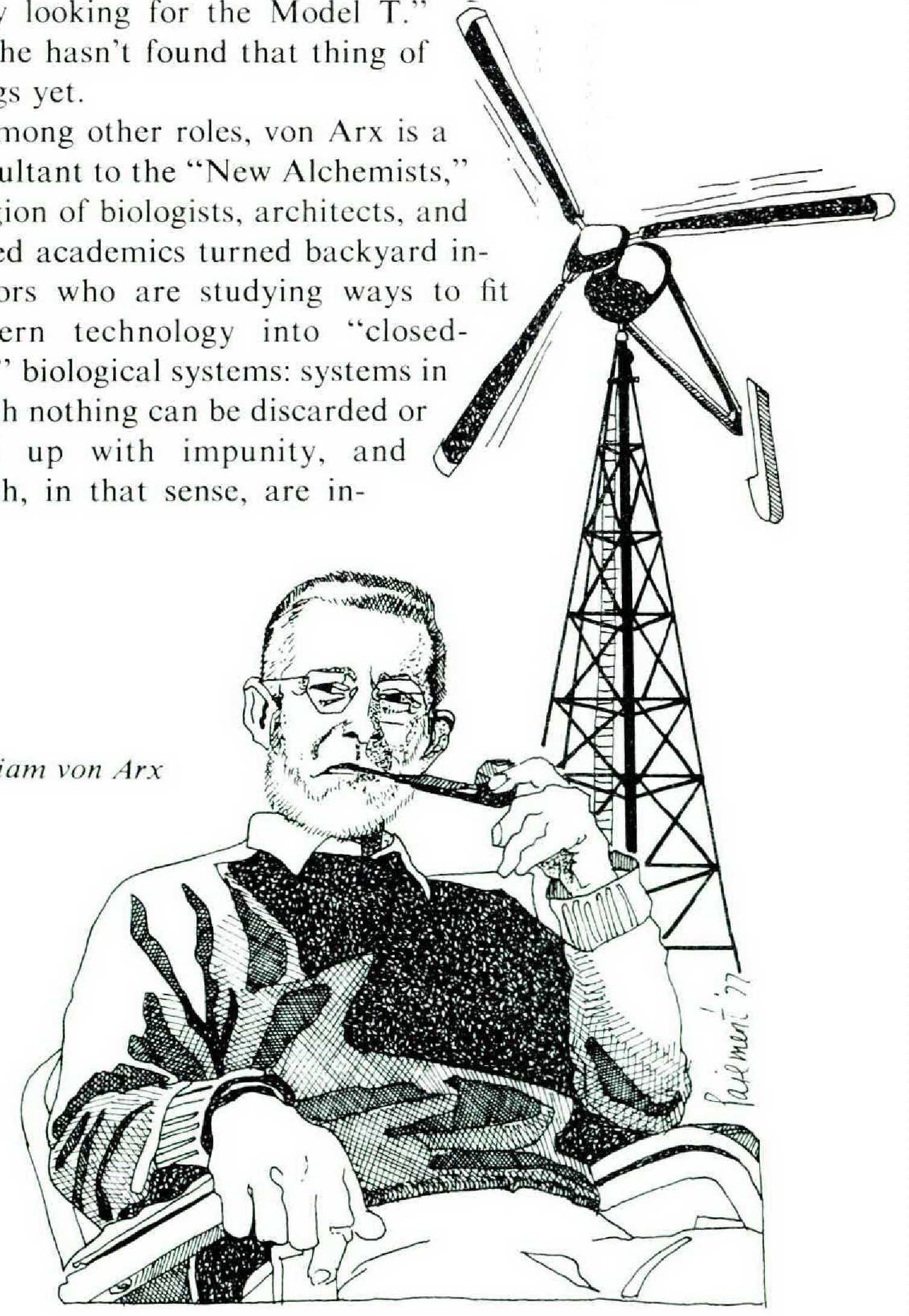
He lives a few miles from his pond, in an airy modern house surrounded by vegetable gardens, on a hilltop overlooking Buzzards Bay. An eleven-inch telescope is set up on the grounds. The morning of the first day of last summer found the windmill near his front door chattering away in a gentle southwester and von Arx inside listening to a public radio broadcast of the Latvian celebration of the summer solstice—an ancient solar rite. He is a man of medium height, vigorous and muscular though a prodigious smoker of Pall Malls. He will not name his age—“Let’s say I’m over sixty.”He was wearing shorts and sandals, a crew cut, and a close-cropped while beard. Von Arx has a way of making his eyes appear to grin. He uses this gesture and other more conventional smiles to qualify statements like these: “I’m worried about the longterm future, if there is to be a long-term future.” Or, “The threat of plutonium is far mightier than the media has led us to believe.” Or, applying the nautical phrase to energy, “It’s time to order a change of course. We got weather ahead.”
Amory Lovins, who has spent many hours on the phone with von Arx, writes of “a substantial social movement” which has begun “a re-examination of the industrial ethic.” In a phrase which his adversaries love to mock, Lovins describes this movement as “camouflaged by its very pervasiveness.”Indeed, it is hard to know just how pervasive such a movement might be. But its existence is obvious, especially at gatherings like the “Toward Tomorrow Fair.” Uninterested in working hard to convince the already convinced, von Arx stays away from such events, but he is one of this amorphous “movement’s” eloquent and credible spokesmen. He says he is looking at energy “from a global point of view.” His sinuous argument reproduces the Lovins and the E. F. Schumacher small-is-beautiful line, but from a naturalist’s and space explorer’s perspective. Ever since the Crusades, von Arx believes, mankind has treated the planet as if it were “an open ecosystem.” To him, nuclear energy is merely another attempt to perpetuate this dangerous violation of “the limits to natural abundance.” We must use less energy absolutely, he feels, and much more of what we use must be of the renewable kind. This would be the ideal: “To live by the natural regimen of the sun.”
Even if the short-term contributions of solar crafts are small, technologies such as solar heating aren’t likely to be insignificant. Bruce Anderson contends, “Out of solar heating comes energy conservation.” The effort to warm living rooms with sunshine does seem to have given solarheating engineers and people who live in solar houses a new awareness of energy, how hard it is to gather and contain, and how precious. “Insulate before you insolate,” has become the first principle of the trade.
Revelations come from solar heating. I have in mind the sort of thing which the sixty-five-year-old entrepreneur John Bemis told me, while we were admiring one of his elegant, expensive, solar-heated Acorn Structures. “It’s fantastic what volumes of energy we’re used to having in a house,” mused Bemis. “You know, having a two-gallon-an-hour oil furnace in your basement is like having a bulldozer down there. And that’s a pretty powerful piece of machinery, a bulldozer.”
But it is difficult to foretell the ultimate practical significance of solar heating and of the other solar arts. Their philosophical importance is easier to see. Many well-informed participants in the energy debate, such as the ardently pro-nuclear Representative Mike McCormack, hold that solar and nuclear technologies are not mutually exclusive. We must look to both in the future, they say, and maybe they are right in practical terms. But to solar theorists, the approaches to nature which these two technologies represent are not compatible.
On August 6, 1945, President Truman stirred the nation with this description of the bomb that had been dropped on Hiroshima: “It is a harnessing of the basic power of the universe. The force from which the sun draws its power has been loosed against those who brought war to the Far East.” That was the beginning of the age of nuclear power. The idea of using this source of destruction for peaceful purposes had been made terribly alluring. Nuclear power would be an atonement, a way of forgetting Hiroshima. But now the solar advocates have redefined the issues. In their rhetoric, solar technologies seek only to collect the energy which nature has provided, while nuclear explorations have sought to penetrate the secrets of the sun and have set about recreating versions of the solar furnace on earth by smashing atoms. To the solar advocates, nuclear energy stands for an arrogant, aggressive attempt to master nature, while the solar approach is a humble, passive effort to make peace with the planet.
Outside Bill von Arx’s front door the little windmill is whirling in the freshening breeze off Buzzards Bay.
Von Arx stands contemplating this piece of machinery, which looks like the skeleton of an airplane with the propeller still intact, mounted on a tripod some ten feet tall. “I think it’s beautiful,”he says. And then he points up toward the morning sun, which supplies the force that drives his windmill, and grinning, he explains, “That’s a safe distance for a nuclear reactor. And it runs unattended, you see.”□